Just now, Google Gemini 4 has gone all out: APIs are 50% off for a limited period, cache prices are slashed by 95%, and the self-developed simulation system teaches robots to catch seven consecutive balls.
The long-rumored "US version of Doubao" has finally been unveiled after much anticipation — breaking news in the early hours of October 14 Beijing Time, Google CEO Sundar Pichai has made a strong comeback with the new flagship foundational model Gemini 4 Argon!
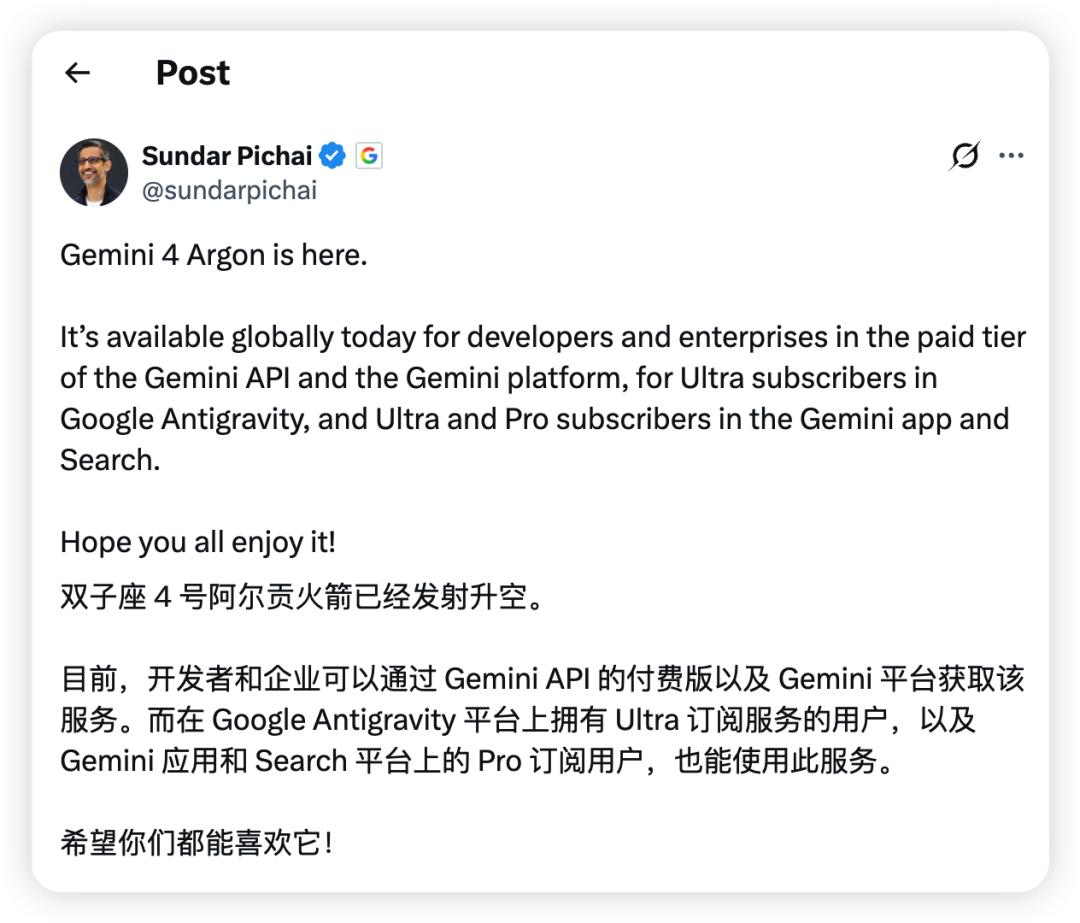
Compared with the previous generation model, Argon's single output upper limit has been raised from 64,000 tokens to 1 million tokens, which endows Gemini with the underlying capability to independently complete ultra-long-cycle complex engineering and scientific derivations without interrupting the chain of thought. Meanwhile, Gemini's leading performance in the field of multimodal reasoning has been extended to robot environment simulation for the first time.
At present, Google mainly opens Argon experience through four major channels:
Developer and enterprise side: Access is open through the Gemini API in Google AI Studio, the Gemini platform on Google Cloud, and the paid version of Android Studio;
Agent development platform: Grant access rights to its agent programming platform Google Antigravity for Google AI Ultra subscribers;
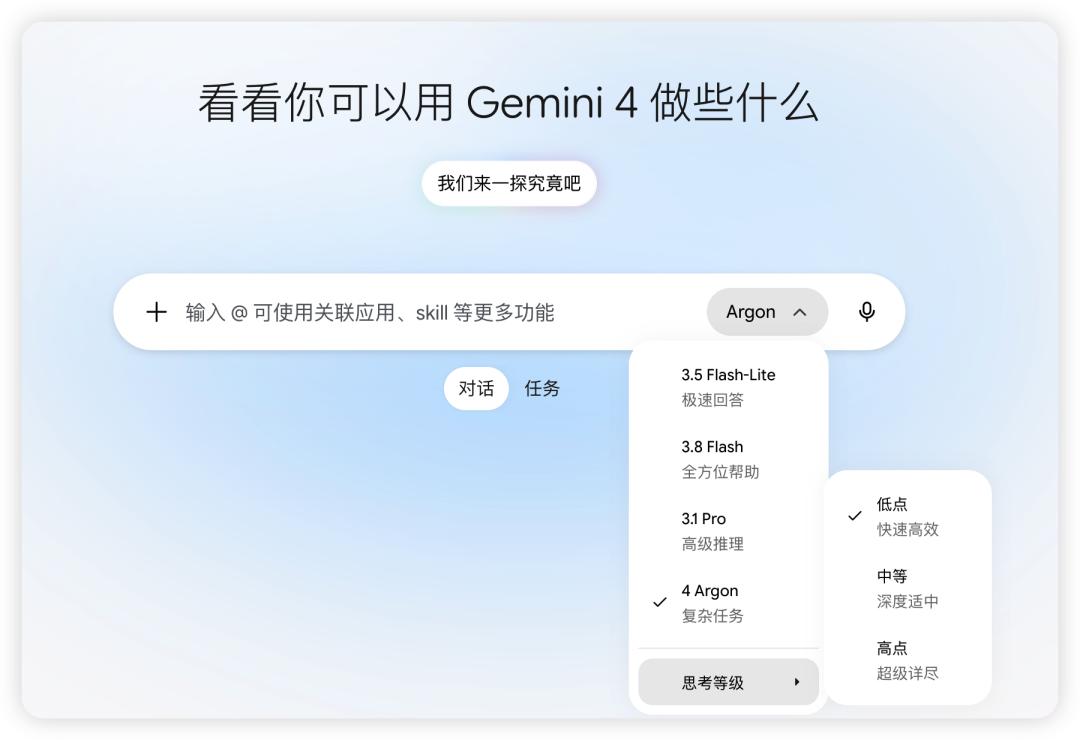
Consumer-level entry: Open the AI Mode in the Gemini App and Google Search to Google AI Ultra and Pro subscribers, with three tiers of access mentioned;
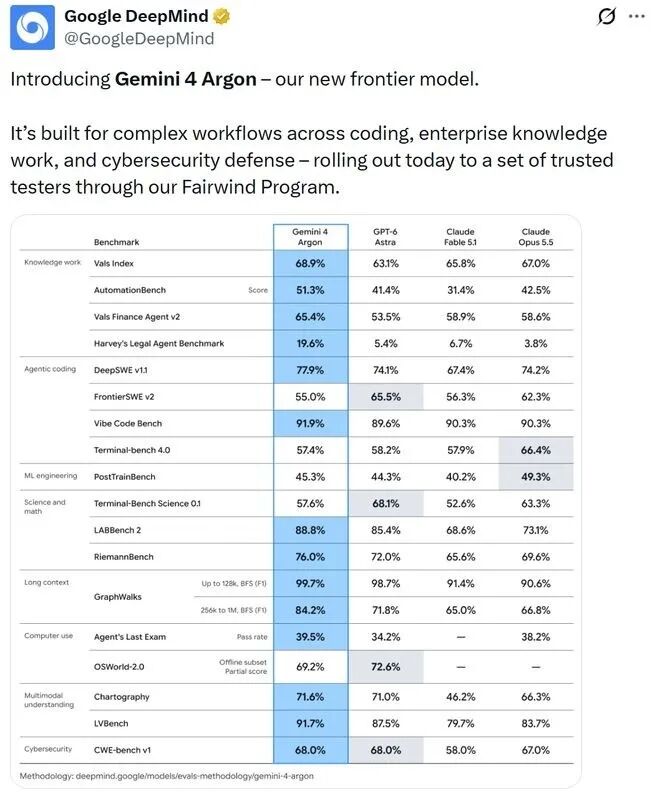
Cyberspace security unrestricted version: Open a dedicated version with cyber attack and defense restrictions removed to hundreds of trusted security agencies through the Fairwind Program, for zero-day vulnerability mining and defense.
The Gemini App itself has also been upgraded, with a new interactive entry for switching from chat to task execution, and supports connecting to more than 40 third-party applications covering shopping, food ordering, design and e-commerce services. Users can not only ask the model to organize materials and make presentations, but also further entrust it to send emails or create subsequent automated tasks.
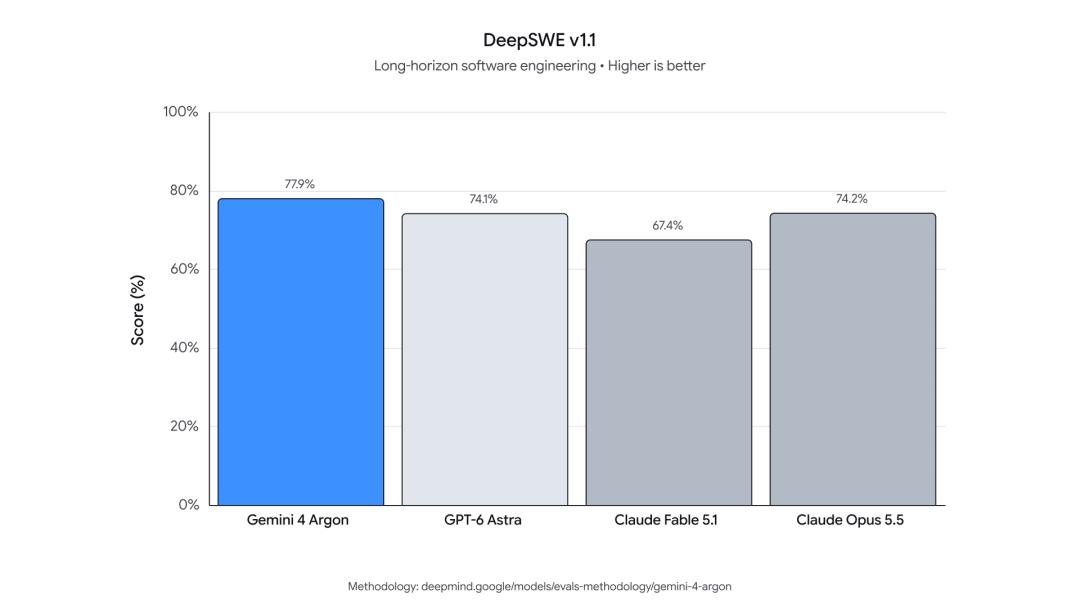
In the Vals Index comprehensive evaluation of enterprise-level professional tasks, Gemini 4 Argon scored 68.9% topping the list; it achieved 77.9% in the DeepSWE v1.1 long-term software engineering task, outperforming GPT-6 Astra and Claude Opus 5.5; in the CWE-bench v1 evaluating vulnerability repair capability, Argon tied for first place with GPT-6 Astra at a score of 68%.
It is reported that Google has been using Argon on a large scale internally. Thousands of employees are using it to complete tasks such as special programming, in-depth research and writing: it has increased the code submission volume of programming Agents by more than 35%, helped the Chrome team transform the complex architecture involving 6 million lines of legacy code, and increased the reasoning speed of the open-source Gemma model to 2.85 times the original level.
In the embodied field, Google let it watch videos of humans playing throwing games, then transfer the learned movements to humanoid robots, achieving 7 consecutive successful throws. It can be seen that Google's definition of flagship model capabilities is changing: it is no longer limited to mathematics, code and knowledge Q&A, but tries to make the model work continuously in real engineering, enterprise business and scientific research, and deliver verifiable results.
Topping industry-level tasks, API at half price for a limited time
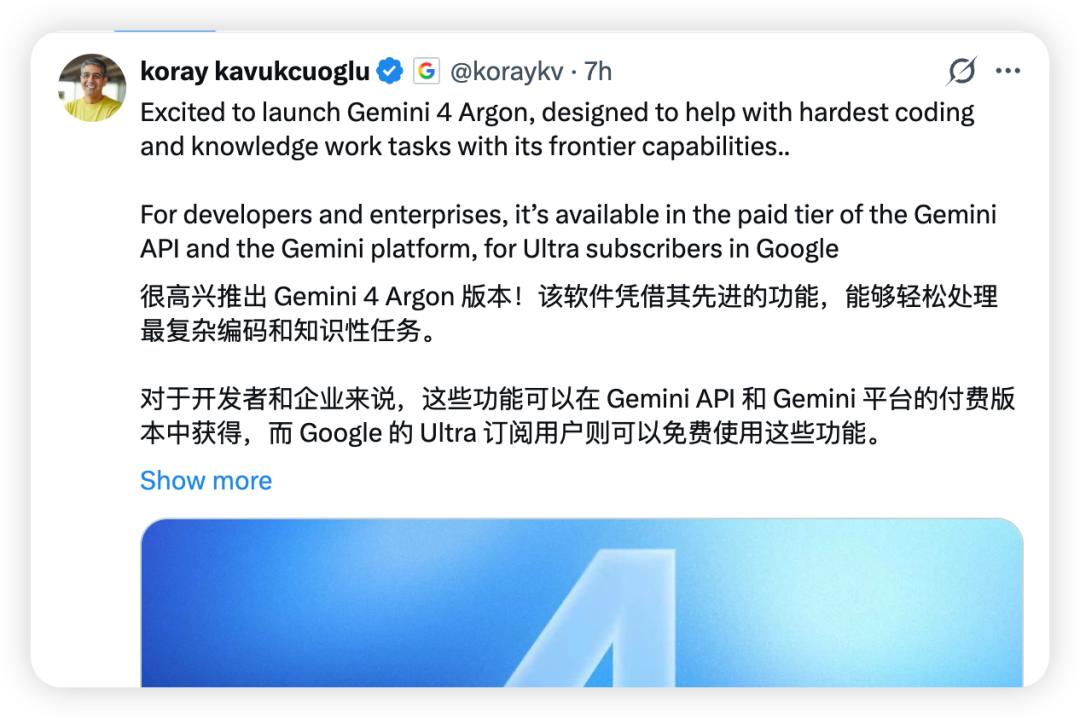
According to the introduction of Koray Kavukcuoglu, Senior Vice President of Google DeepMind and Chief AI Architect of Google, the goal of Gemini 4 Argon is to solve complex, long-execution real-world problems in programming, finance, law, cybersecurity and scientific research.
To support long-duration tasks, Google has also adjusted the model's token mechanism.
Gemini 4 Argon supports a unified context budget of 1 million tokens, with input, thinking and output sharing this total quota. Through the Long Decode long output mechanism, the cumulative output of a single task can break through the traditional 64K limit, theoretically approaching 1 million tokens at most, but the actual output upper limit still depends on the quota occupied by the input. This means that the model can complete longer periods of reasoning, code modification and result generation in one task, without frequent interruption and re-organization of the context.
In terms of commercial pricing, Google has launched a very attractive "limited-time promotion":
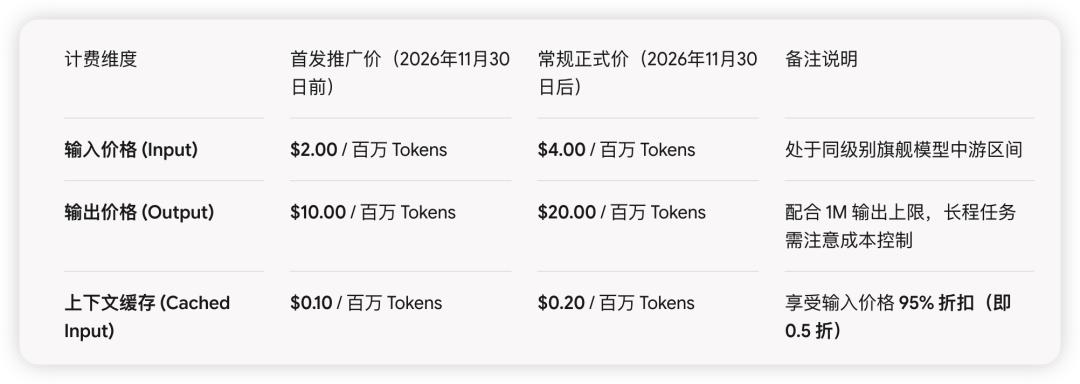
Before November 30, 2026, Gemini 4 Argon charges $2 per million input tokens and $10 per million output tokens. This entry price is only half of the standard token price of Claude Opus 5.5, and is also lower than the public standard price of GPT-6 Astra.
The 95% context cache discount is Google's real killer feature. For enterprise-level Agents that need to frequently read millions of lines of code repositories (such as Chromium) or thousands of pages of legal dossiers, the extremely low cache read cost can significantly dilute the bill for multi-round agent loops. However, developers need to clearly realize when making Q4 budget plans: after the end of November, the invocation cost of Argon will double directly.
In terms of professional capability evaluation, Google provides a set of comparison results with the flagship models of OpenAI and Anthropic.
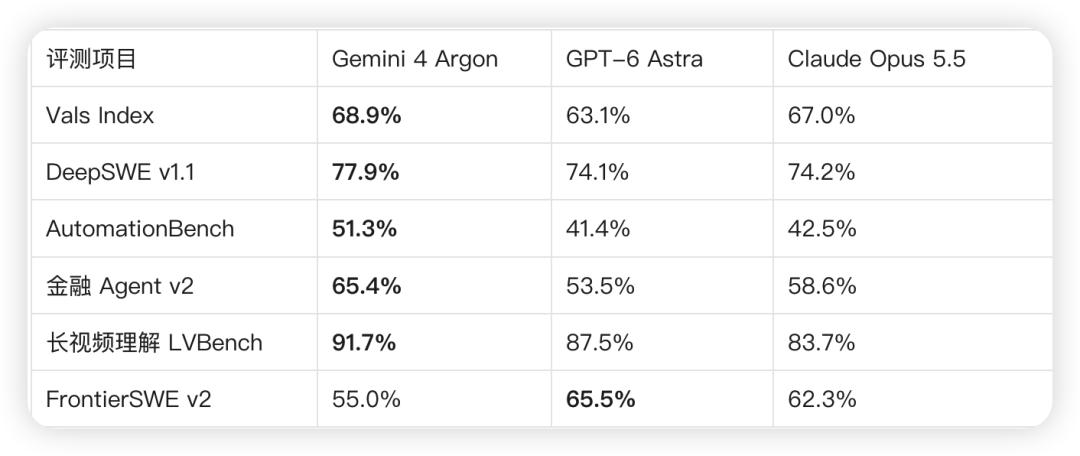
The most noteworthy one is the Vals Index. This ranking does not simply average the capabilities of various models, but weights them according to the contribution of industries such as finance, programming, law and taxation to US GDP, focusing more on the model's ability to process real professional tasks.
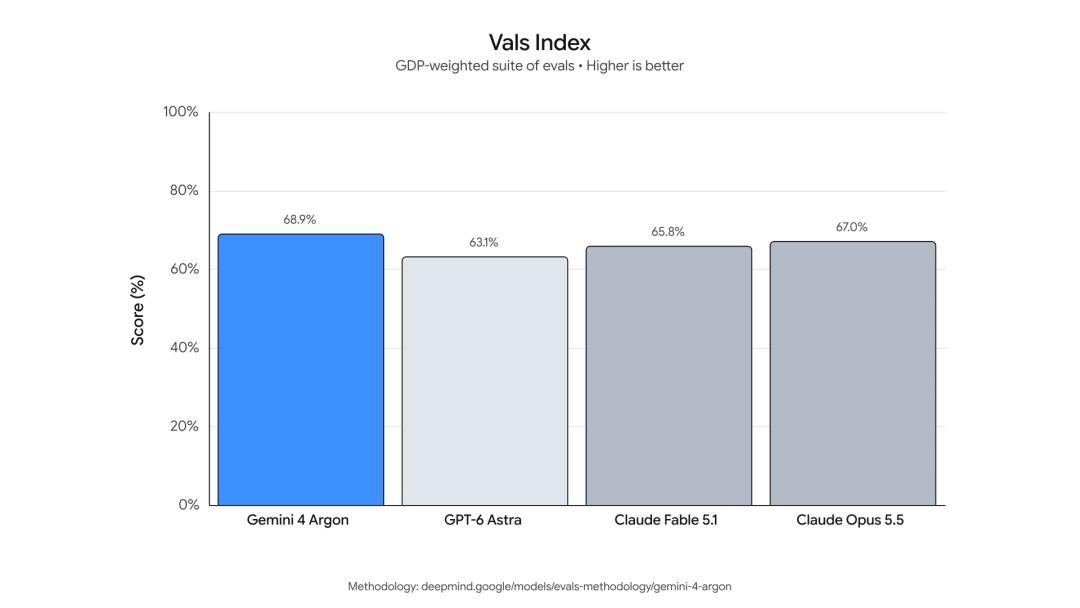
As of October 13, in the latest ranking independently released by Vals AI, Gemini 4 Argon ranks first with 68.90%, followed by Claude Sonnet 5.5 with 67.04% and Claude Opus 5.5 with 66.97%.
However, in tests such as FrontierSWE v2 and Terminal-Bench 4.0, it still lags behind GPT-6 Astra or Claude Opus 5.5. In other words, Gemini 4 performs outstandingly in long-process professional work, but it does not completely outperform its rivals across all dimensions.
Compared with the ranking, the internal production cases disclosed by Google this time may better reflect the real positioning of this model.
Agent code submissions increased by 35%, reasoning speed tripled
In its official blog post, Google spent a considerable amount of space introducing how Gemini 4 Argon participates in the company's internal engineering.
An intuitive indicator is: in the past few weeks, for teams using Gemini 4 Argon and Antigravity, the volume of code submissions generated with Agent participation has increased by more than 35%, while the amount of code rollbacks has decreased by nearly one third.
The rollback here refers to the revocation or restoration of submitted code due to problems. Compared with simply counting how many lines of code AI has written, the combination of these two indicators is closer to the real software R&D efficiency.
One of the most complex projects is the architecture refactoring of the Chrome browser. Chromium has about 40 million lines of code, and one of its legacy directories contains about 6 million lines of code, mixing web page processing logic and browser function code.
In the past, architecture adjustments of this scale often took the development team several months. Now, Argon assists engineers to push forward modifications across hundreds of files, compressing a refactoring work that was originally expected to take several months to several weeks. Google says these modifications will support web pages to switch between tabs, sidebars and floating windows without reloading, and reduce related browser crash issues.
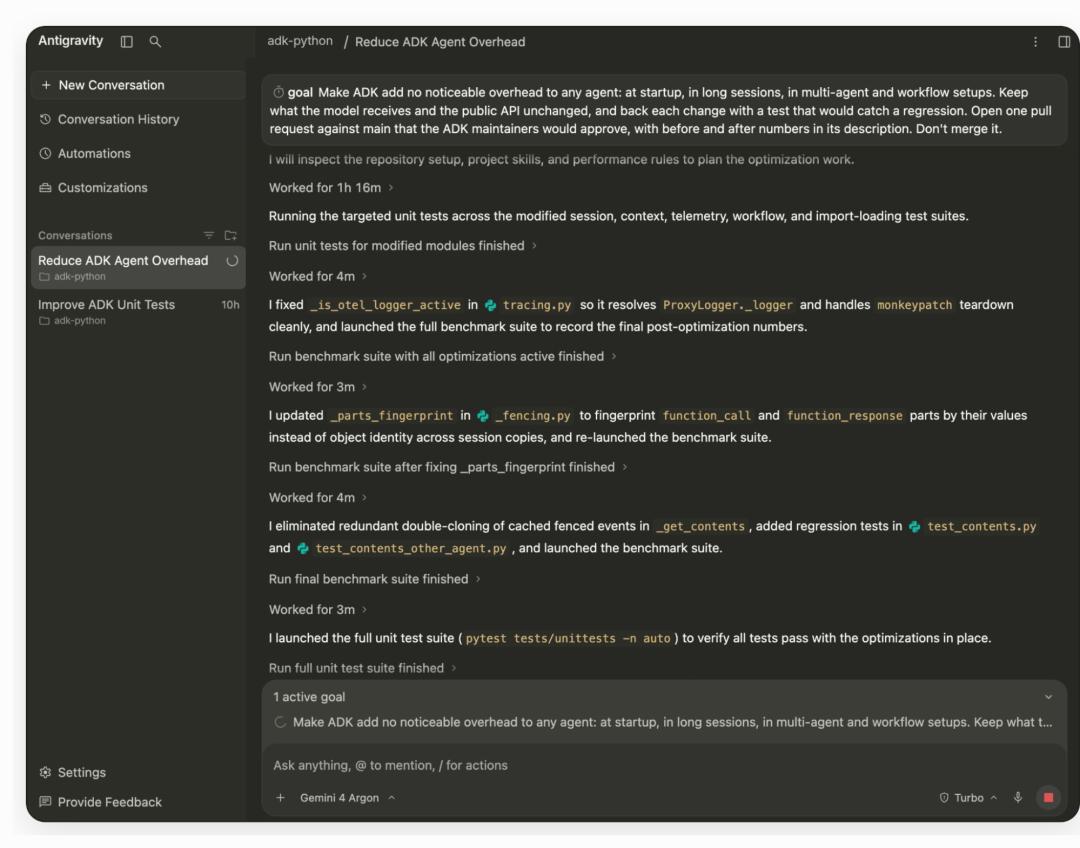
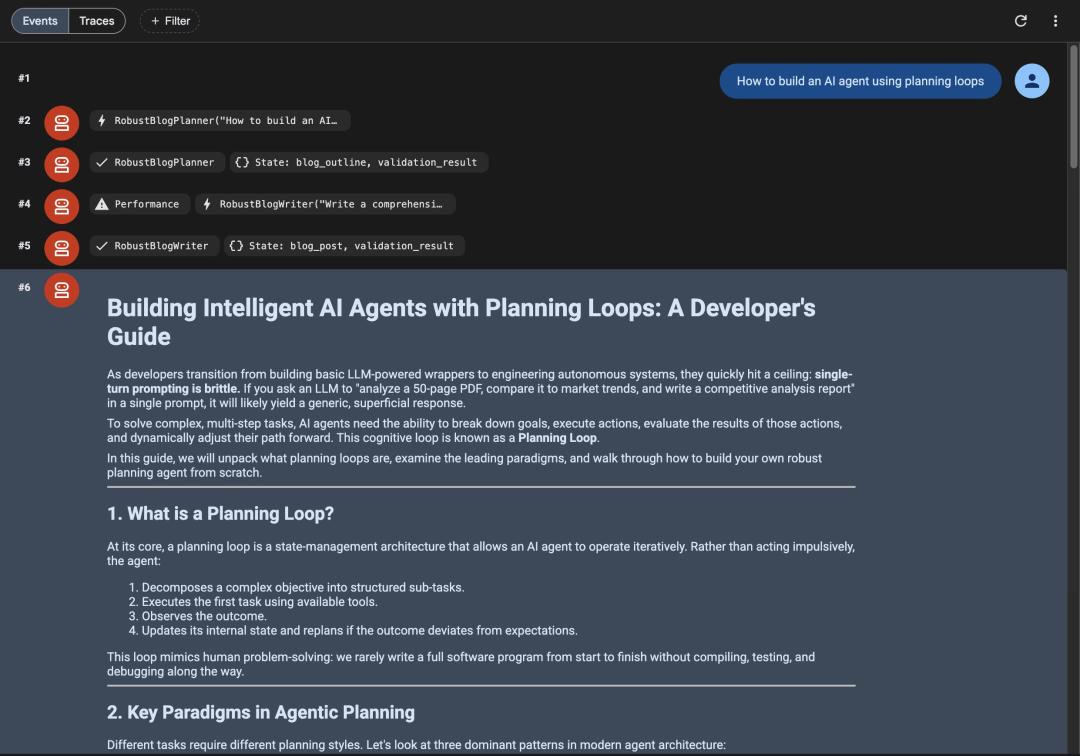
Similar engineering practices have also taken place on Google's own open-source Agent Development Kit (ADK).
Engineers provided Argon with the development specifications of the project, as well as a target description requiring to reduce the framework's operating overhead while maintaining application compatibility. After that, the model independently looked for optimization opportunities at night. Finally, the modifications merged into the open-source project reduced the long-session memory state preparation time by 40%, and the cold start import speed increased by 21%.
In terms of reasoning optimization, Google has delivered another very impactful result.
After using Argon to optimize the vLLM reasoning implementation, the test throughput of Gemma 4 E2B on A100 GPU increased from about 37900 tokens per second to more than 108000 tokens, reaching 2.85 times the original level, while maintaining completely consistent token output results.
Google says this optimization work, which could have taken several months, only took a few days.
In addition, in the optimization of the quantum chemistry software xTB, Argon increased the molecular structure prediction speed by up to 2.3 times, and the conformational search speed by 1.8 times, and the relevant modifications have been submitted to the official open-source repository.
These cases have one thing in common: Google is making AI go deep into real engineering systems, not just generating new programs, but also analyzing existing systems, discovering performance bottlenecks, modifying code, and verifying whether the optimization is effective through actual operation results.
From pharmaceutical research to humanoid robots
In addition to programming, Google has also focused on demonstrating the progress of Gemini 4 Argon in scientific research, 3D spatial understanding and robotics. The most vivid case comes from Apptronik's Apollo humanoid robot.
Researchers first provided Gemini 4 Argon with a video of humans playing the Cornhole throwing game, a game where players throw sandbags at a slanted board with holes. Without providing dedicated robot training examples for this movement directly, Argon needs to understand the environment layout, object positions and movement goals from the original video, calculate the full-body joint movements required by the robot, and independently write simulation code.
Subsequently, the researchers transferred the simulation results to the Apollo humanoid robot. In the real environment test announced by Google, the robot successfully hit the target 7 times in a row.
Google calls this process Video-to-Sim-to-Real, which means from video understanding, to automatic simulation establishment, and then transfer to the real robot.
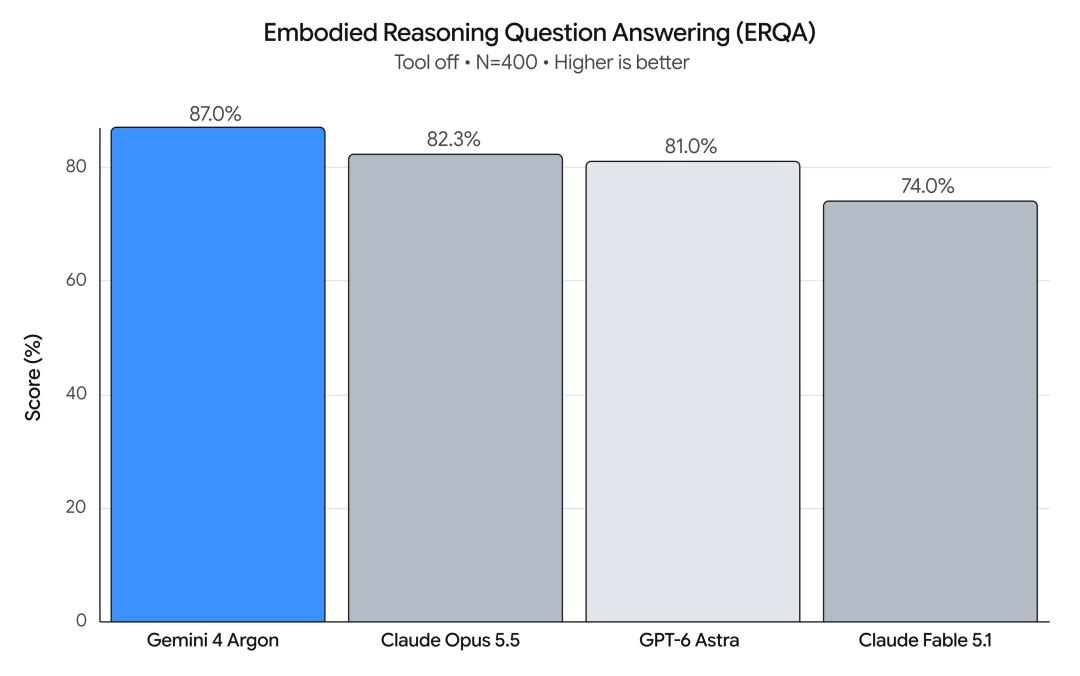
This does not mean that the model directly completes robot control only by watching videos. Spatial modeling, motion planning, simulation and reality transfer are still required in the middle. But its significance lies in that the simulation construction work that used to take engineers several weeks to complete manually can now be shortened to several hours. In the Embodied Reasoning (ERQA) evaluation for robot spatial reasoning, Argon also scored 87%, and Google says it leads other participating cutting-edge models.
In terms of scientific research, Google has also demonstrated several achievements in different fields.
In the direction of quantum computing, Argon converted a version of AlphaQubit, the internal quantum error correction decoder, into a highly optimized hardware core, nearly doubling the reasoning throughput. For an arcsine quantum computing subroutine, the implementation verified by Lean formal verification reduces the space-time resource overhead by more than 100 times compared with the public quantum CORDIC baseline.
In the direction of nuclear fusion, Google cooperated with Professor Matt Landreman of the University of Maryland to discover a broader class of counterexamples to the Grad conjecture. These mathematical results are expected to provide new test benchmarks for the magnetic field simulation of stellarators