2027 HR Trends Report: Your Work Is Being Reconstructed
By 2027, whether to use AI may no longer be a watershed between enterprises. Almost every enterprise has AI tools, agents and corresponding application scenarios; but only a few enterprises can prove that these inputs have improved performance, product or service quality and decision-making efficiency. The relationship between the widespread application of AI and measurable value will become one of the key challenges next year, and the human resources department will be at the core of this challenge.
Which tasks should be handed over to AI? Which judgments must be undertaken by humans? How can the experience of senior employees be retained in the organization? Where can young people get growth after entry-level work is automated? What are the key tasks of HR? Recently, the AIHR website released the 2027 HR Trends Report. We have selected its core content, hoping to provide a reference for enterprise managers and HR leaders to move from trend judgment to organizational action.
Trend 1: Human-machine collaboration becomes part of daily work
In the previous round of AI applications, AI was mostly used to help individuals complete a single task: drafting copy, organizing meeting minutes, and producing spreadsheets. Today, AI systems and agents are further integrated into workflows, taking on responsibilities such as execution, suggestion, triggering, and collaboration.
The role of people has changed accordingly: from completing every step personally, to providing business context, defining problems, making judgments, verifying outputs, and handling exceptional situations that cannot be standardized. The future is not "humans using AI", but humans and AI taking on different parts of the same work respectively.
The report cites McKinsey's research pointing out that existing technologies have the potential to automate more than half of the current working hours in the United States; however, among organizations that have already used generative AI, only 21% have actually reconstructed part of their workflows. Technology develops faster than organizational design, which often leads enterprises to embed AI into old processes without simultaneously transforming positions, collaboration methods and responsibility boundaries.
Actions HR can take:
Map human-machine collaboration. Sort out which work AI is already suggesting, triggering or executing in key scenarios; clarify item by item who is responsible for verification, who is responsible for handling exceptions, and who is responsible for the final result.
Incorporate verification costs into efficiency assessments. Do not only count the time saved by AI, but also track the time employees spend on checking, error correction and rework.
Incorporate digital workforce into workforce planning. When discussing headcount, recruitment and production capacity, clearly identify which work AI has already undertaken, instead of only counting the number of employees on the roster.
Trend 2: Shift from "application" to "value creation"
The popularity of AI does not equal the return on AI. The report cites KPMG's survey pointing out that among enterprises with annual revenue of 100 million US dollars or more, 95% already have AI strategies, and nearly 40% are deploying AI on a large scale or promoting enterprise-wide applications; but only 8% of enterprises say they have established a mature return on investment mechanism. Another study shows that 87% of white-collar employees use AI frequently, 75% believe that efficiency has improved, but only 13% believe that the overall performance of their organization has been significantly improved as a result.
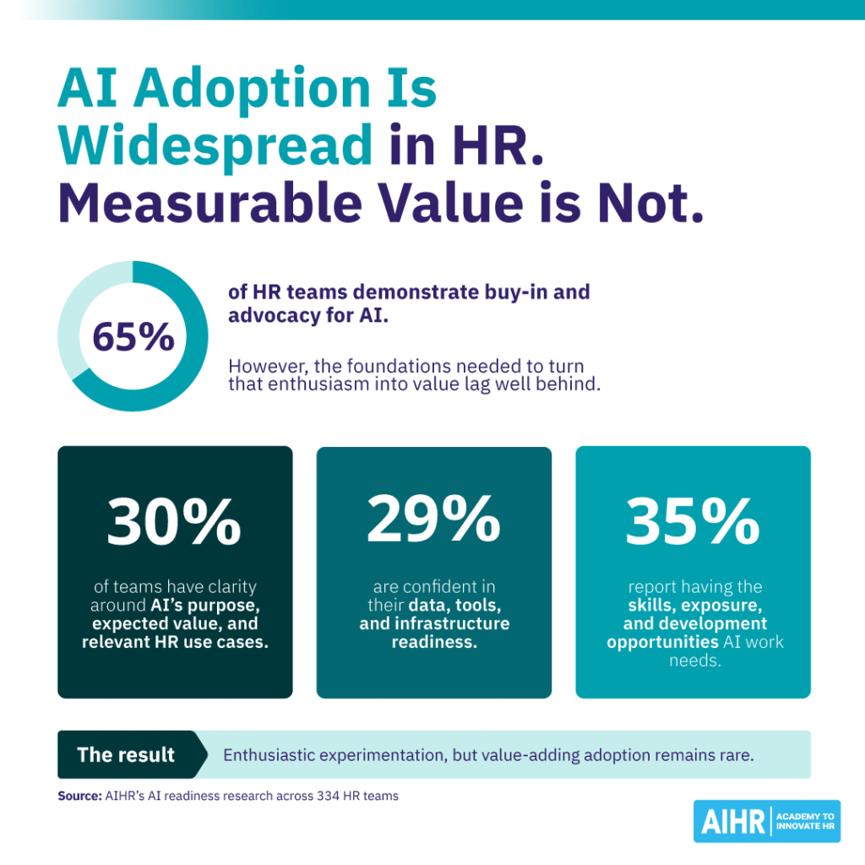
AIHR's survey of 334 HR teams found that although 65% of the teams said they recognize and support AI, only 30% of the teams are clear about the use, expected value and relevant application cases of AI.
These gaps reveal a common misconception: usage rate, number of scenarios, and working hours saved describe "activities"; the real value should be reflected in that the organization can make faster and more accurate decisions, provide better services, and enable employees to engage in higher-value work thanks to AI.
Actions HR can take:
Track where time goes. Not only pay attention to how many working hours the team has saved, but also track how they use the resources freed up by AI. Pay attention to whether the time freed up by AI is invested in higher-value work, occupied by new tasks, or consumed by rework and verification.
Replace the obsession with usage rate with result indicators. Clarify workforce performance indicators that can reflect the value created by AI. Define the expected performance of AI value creation in advance around quality, services, workload, capabilities and productivity.
Measure value together with the finance and business teams. Establish baselines and set result indicators before the project starts, and clarify what workforce data HR should provide to support the assessment.
Trend 3: Organizational knowledge management needs to keep pace with the times
As powerful general large models become more and more accessible, the differentiated competitive advantage of enterprises will increasingly depend on whether they can make AI understand their own business knowledge, historical experience, process details and judgments that are not written into the rules and regulations.
The truly valuable knowledge is often held by senior employees. They know why a process is designed in this way, know which situations cannot be handled mechanically, and know the exact reason for a previous failed attempt. This tacit knowledge is difficult to be completely replicated through a standard document, but it directly affects the quality of the organization's response to complex problems.
More and more cases show that models customized for the organization's own knowledge perform better than general models on specific tasks. Gartner predicts that this specialization trend will accelerate, and predicts that by 2027, enterprises will use small, task-specific models at least 3 times as often as general models. With the improvement of model customization, enterprises' own data, processes and institutional knowledge will play an increasingly important role in determining the practicality of artificial intelligence.
AI provides enterprises with a new motivation to precipitate experience: once key knowledge is captured, verified and embedded in systems and workflows, it no longer only exists in the minds of individual employees. But this also brings new trust issues — employees will care about what changes will happen to their roles after their years of accumulated experience is extracted.
Actions HR can take:
Identify the concentration points of key tacit knowledge. Find out which important processes, customer relationships or business judgments are overly dependent on a small number of people.
Strengthen existing knowledge flow mechanisms. Use mentorship, structured handover, job rotation and internal mobility to pass on experience in the organization, instead of creating a separate "knowledge collection process" that is disconnected from business.
Explain the boundaries and returns clearly to employees. Explain why knowledge needs to be precipitated, how knowledge will be used, and what this means for employee development.
Trend 4: AI is exacerbating a talent paradox
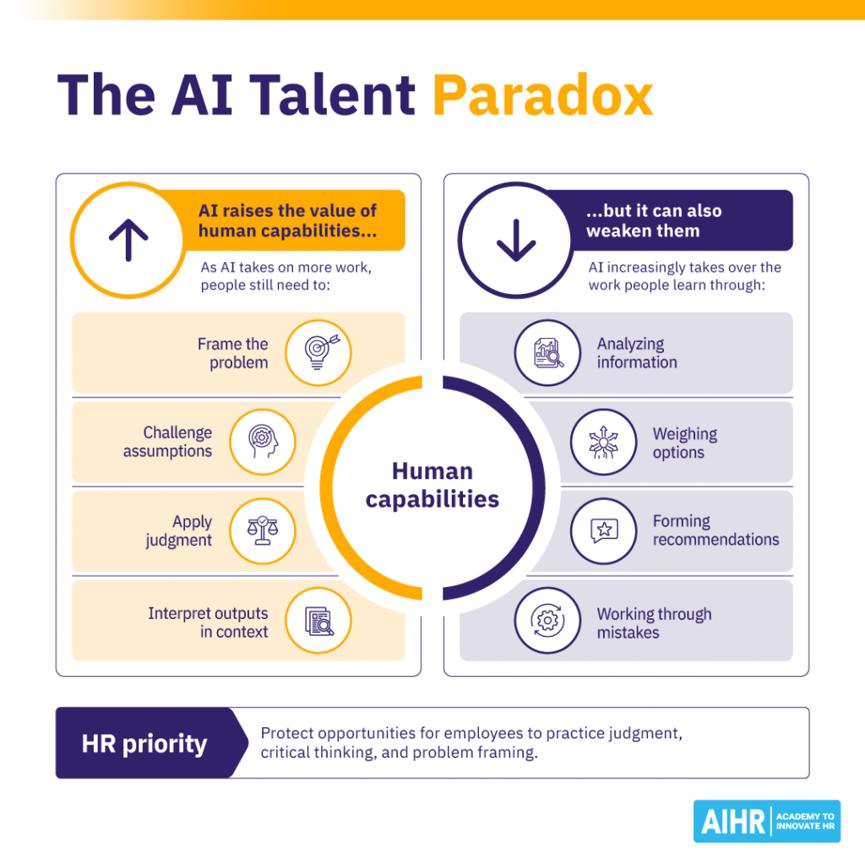
To gain value from AI, employees need to know how to ask questions, when to question results, and how to put outputs back into the real business context for judgment. These capabilities include problem definition, critical thinking, contextual understanding, creativity, empathy and leadership.
But the contradiction is that AI is also taking over part of the work that used to help people develop these capabilities: analyzing information, comparing plans, forming suggestions, and making repeated mistakes through trial and error. When people get more and more used to outsourcing thinking to AI, organizations may gradually weaken their own judgment while improving speed. The report cites PwC's survey pointing out that among the positions most significantly affected by AI, newly emerging tasks are 2.5 times more dependent on "human-intensive capabilities" such as judgment, creativity, empathy and leadership than other positions.
Half of the leaders surveyed by the Boston Consulting Group said they are witnessing the phenomenon of skill degradation within the organization. As people delegate more and more thinking work to AI, human capabilities are gradually being lost. More than 60% of leaders expect skill degradation to become a substantial threat in three to five years. If enterprises hope that human capabilities can continue to develop with the popularization of AI applications, they need to integrate the responsibilities of building problem frameworks, questioning assumptions, making key judgments, explaining the reasons for accepting or rejecting output results, and learning from results into daily work.
Actions HR can take:
Assess durable skills in AI collaboration. Identify employees' real performance in judgment, problem definition, critical thinking and contextual understanding, instead of only assessing tool usage proficiency.
Reserve space for personal judgment for employees. Do not simplify employees' roles to reviewing AI answers; reserve opportunities for them to put forward assumptions, make choices and explain reasons in key work.
Invest the production capacity freed up by AI into development. Use part of the newly added capacity to take on complex tasks, project-based learning and high-quality feedback, instead of only using it to compress more workload.
Trend 5: AI is eroding the growth soil of entry-level positions
The common work of junior employees — drafting materials, sorting information, checking documents, debugging code, and completing basic processes according to rules — is exactly the part that is most easily taken over by AI. The problem is not only that the number of entry-level positions may decrease, but more importantly, these basic tasks used to undertake important training functions: employees will practice analyzing information, discovering exceptions, bearing errors, getting feedback, and observing how senior colleagues make judgments in low-risk tasks.
The report cites relevant research pointing out that among entry-level positions highly affected by AI, employers are 7 times more likely to require capabilities traditionally belonging to senior employees such as strategic decision-making, stakeholder management and team leadership than other positions. As the boundaries of entry-level work across functional areas become narrower and narrower, employers need to more consciously recreate these development experiences, rather than assuming that people will naturally acquire these experiences in the process of career development.
Actions HR can take:
Inventory growth tasks replaced by AI. Find out which tasks junior employees used to learn business through, and use deliberate practice, coaching or higher-skill project tasks to make up for experience.
Synchronously change position thresholds, responsibilities and returns. If enterprises expect junior employees to take on more complex judgment and collaboration responsibilities, experience requirements, job content and compensation should also be adjusted accordingly.
Long-term track the early talent pipeline. Pay attention to the changes in junior recruitment, regularization and promotion to middle management positions, to avoid the situation where the narrowing of the entrance evolves into a key capability gap many years later.
Trend 6: Trust becomes the infrastructure of work
Organizational trust used to mainly come from the behavior of leaders and the way enterprises treat their employees. Today, employees increasingly experience the organization through AI and data-driven systems: how work is assigned, how activities are monitored, how performance is evaluated, and how rewards are determined.
Whether these systems are fair, transparent and traceable directly affects whether employees trust the organization. The report cites surveys showing that although 61% of organizations say they have formulated responsible AI policies, only 21% of leaders believe that their organizations are adopting AI in a way that can minimize negative impacts on employees; at the same time, 52% of organizations do not involve HR in the overall AI strategy directly or through cross-functional mechanisms.
Actions HR can take:
Draw a clear boundary for "workforce insights". Regularly review the data collected by existing systems, usage scenarios and decision consequences.
Establish an AI governance role for HR. Before AI systems involving employees go online, let HR participate in the assessment of workforce risks, fairness and employee impact.
Establish an available explanation and appeal mechanism. For important AI-assisted decisions, let employees know who they can ask, how to question, and how the organization will correct problems.
Trend 7: HR is taking on more and more outcome responsibilities
Today, HR is expected to promote AI adoption, workforce productivity, key capability building, organizational transformation and resilience. But these outcomes also depend on cross-functional decisions such as technology selection, investment scale, operation mode and business priority.
When HR is assigned important responsibilities after key decisions have been made, an obvious mismatch will be formed: HR is responsible for the results, but cannot influence the conditions that determine the results. The report cites a survey covering more than 7,000 managers showing that 65% believe HR is a key business enabler, but 51% of respondents believe that administrative workload is the main obstacle preventing the human resources department from making greater strategic contributions.
Actions HR can take:
Clarify the division of responsibilities. Distinguish matters that HR can decide, can influence and cannot control, so that responsibilities are aligned with actual authority.
Agree on contribution standards in advance. Agree with enterprise leaders in advance which evidence can be counted as HR's contribution to specific results, and translate the measurement standards at the human resources level into the terms that the enterprise already uses to evaluate success.
Improve capabilities through real transformation projects. Focus on business insights, data literacy, organizational design and change capabilities, let HR learn in specific problems, instead of only relying on classroom training.
Trend 8: Work architecture is expanding the strategic contribution of CHRO
AI investment, automation, mergers and acquisitions, and operation mode adjustments are ostensibly technical or commercial decisions, but in essence they will all change how tasks are allocated, what capabilities positions require, who has decision-making power, and how the organization collaborates. Therefore, Chief Human Resources Officers (CHROs) are being drawn into these discussions earlier. The report cites Deloitte's case that when a European telecommunications company only added AI "experts" to its customer service, productivity increased by about 5%; when the company simultaneously reconstructed the workflow, handover mechanism, promotion path and training, productivity increased by 30%. Organizations that attach importance to work design are also more likely to exceed AI investment return expectations.
This shift has already emerged. A 2026 survey of 101 European HR executives found that 43% of CHROs have responsibilities beyond the traditional scope, covering business strategy, technology and capital allocation and other fields; 37% of current CHROs did not initially engage in human resources related work. But the expansion of the scope of responsibilities also brings greater pressure. CHROs with expanded scope of responsibilities have an average tenure of 3.4 years, while CHROs with non-expanded scope of responsibilities have an average tenure of 4.6 years.
Actions HR can take:
Participate in discussions at an early stage. Take the initiative to participate in major technology, M&A and operation mode decisions, instead of waiting for the plan to be finalized before taking over the implementation.
Communicate with specific cases. Explain which positions will change, what capabilities will be released or added, and what risks will arise, instead of generally requiring "HR to have a seat at the table".
Make up for the capabilities required for enterprise-level work of the HR department. Combine targeted development with participation in AI implementation, organizational restructuring and transformation projects.
Trend 9: A new generation of HRBP is emerging
As AI takes over more routine consulting, drafting, summarizing and routine support, the coordination work that has long occupied the time of HRBP will be further compressed. The market is beginning to value HRBPs who are truly close to the business, understand the business context, and can assist leaders in handling complex personnel and organizational decisions. The US workforce data analysis in the report shows that positions closer to the business such as regional HRBP and head of business partners have significantly tighter candidate supply; while the demand for some coordination-oriented senior HRBP positions has declined.
Actions HR can take:
Re-examine where HRBP's time goes. Transfer standardized affairs and coordination work, so that HRBP can return to work that requires business context and judgment.
Let HRBP participate in key decisions in advance. Provide necessary business