All major chip manufacturers are acquiring MCU vendors.
This year, for the semiconductor industry, Agent, Physical AI, and Edge AI are undoubtedly the hottest buzzwords. Chip manufacturers are ramping up investments in these tracks, even going all-in on related layouts.
As AI extends to end terminals and the physical world, the importance of MCUs is also rising. An industry shift is taking place: a growing number of manufacturers are starting to complete their MCU business portfolios through acquisitions, which introduces new variables to the competitive landscape of the MCU market.
Microchip: Acquisition of VORAGO
Microchip announced on October 10 that it would acquire US-based VORAGO Technologies, a semiconductor company headquartered in Austin, Texas that mainly supplies radiation-hardened MCUs and MPUs. The specific transaction value has not been disclosed, and Microchip expects the acquisition will not have a material impact on the company's consolidated financial performance.
VORAGO's products are designed for high-reliability scenarios such as aerospace and national defense, and can withstand high radiation and extreme high-temperature environments. This acquisition will add a full range of radiation-hardened MCUs and MPUs to Microchip's product matrix, further improving its aerospace and defense product lines. Meanwhile, VORAGO's patented HARDSIL process technology will be integrated into Microchip, helping to shorten new product development cycles, reduce development costs, and improve the radiation resistance of some existing products.
Microchip has long maintained a high market share in the aerospace and defense sectors. The acquisition of VORAGO is undoubtedly a powerful reinforcement for its business, and will also bring in a team with rich experience in radiation hardening technology to provide technical support for its broader business layout.
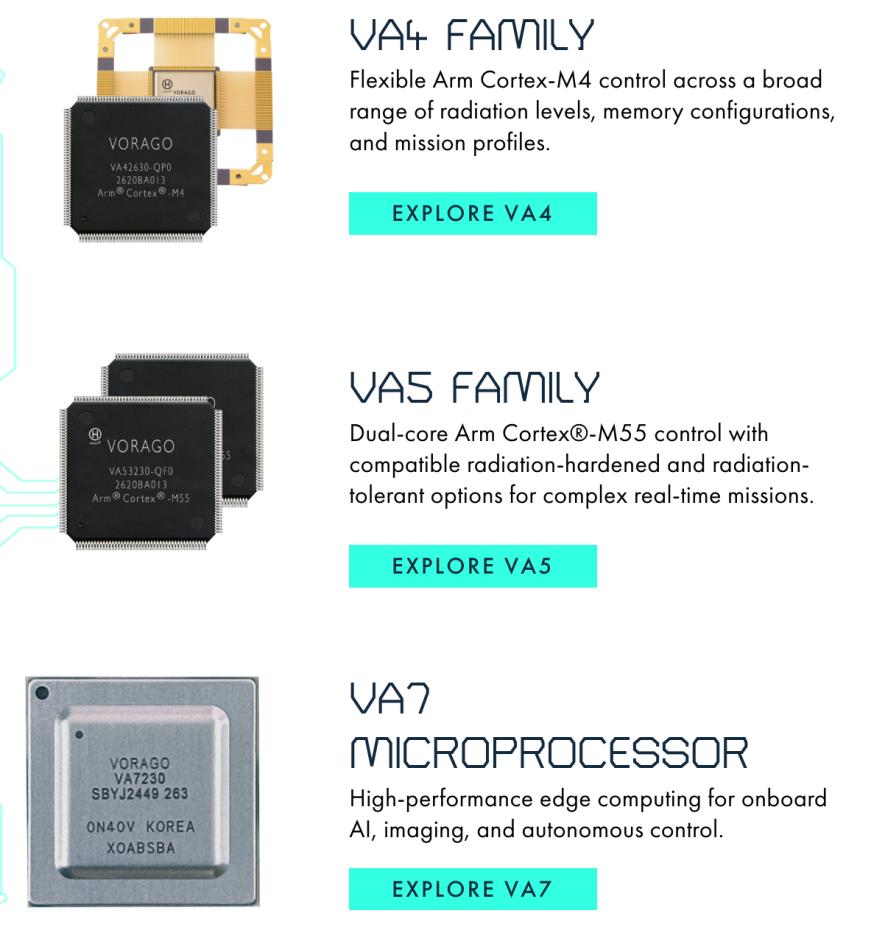
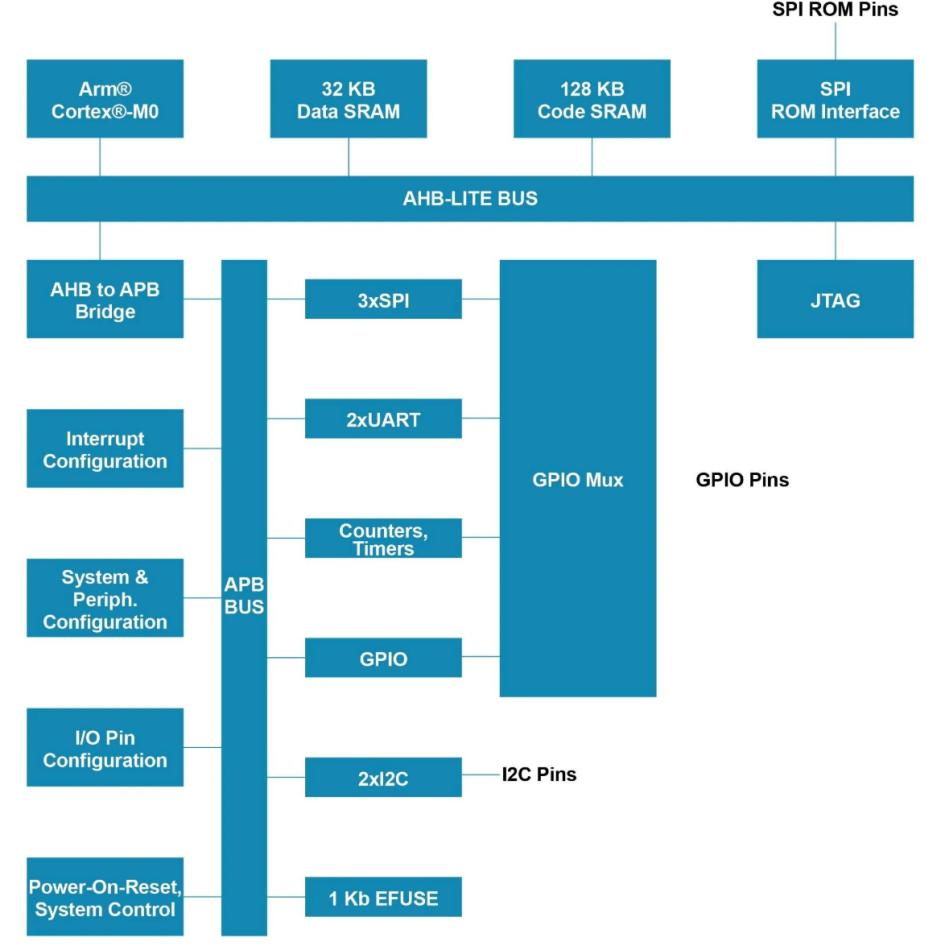
In terms of product portfolios, VORAGO currently has launched the VA4 series based on Cortex-M4, VA5 series based on Cortex-M55, and VA10805 series based on M0. In addition to MCUs, the company also has the V7 series of high-performance edge processors.
It is worth noting that Microchip announced the completion of the acquisition of Israeli AI chip company Hailo on September 21. Hailo has complemented Microchip's capabilities in edge AI, machine vision and robotic computing. It can be said that Microchip has now formed a more comprehensive product layout.
ADI: Acquisition of Alif
ADI announced on September 11 that it plans to acquire Alif Semiconductor for $1.35 billion in cash. After the transaction is completed, Alif's AI-native microcontrollers and converged processors will be incorporated into ADI's product system. According to information disclosed by both parties, ADI may also pay additional contingent consideration of up to $200 million, and the transaction is expected to be completed by the end of 2026. According to ADI, this transaction is aimed at deploying the Physical AI track.
Alif's products adopt a heterogeneous computing architecture, integrating low-power neural network processing capabilities, connectivity, security and power management functions, targeting edge AI applications that require real-time perception and local reasoning. At present, its chips have been mass-produced and shipped, and have been adopted by many consumer electronics and industrial customers. This acquisition will supplement ADI's digital processing capabilities and improve its layout in the edge AI field.
ADI's long-accumulated analog signal chain, sensing, power management and connectivity technologies are highly complementary to Alif's processor platform. The two parties plan to combine their respective technical advantages to provide system-level solutions for markets including industry, data center infrastructure, national defense, energy, robotics, digital health and wearable devices. As AI extends from the cloud to the physical world, ADI hopes to strengthen the capabilities of devices to complete perception, reasoning and execution locally through this acquisition.
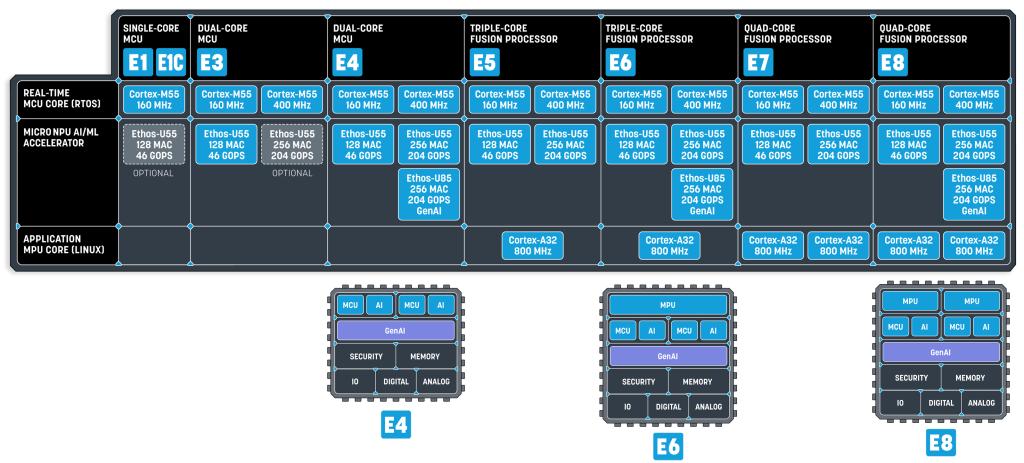
Alif started its AI layout very early. Its first-generation Ensemble MCU series was released as early as 2021, and the company has been shipping E1, E3, E5 and E7 devices in batches since then. While other MCU manufacturers were still focusing on the first-generation AI MCUs, Alif launched its second-generation products, which is also the industry's first MCU that supports Transformer-based networks, laying a foundation for LLM and other generative AI models.
In 2025, Alif released its latest series of MCUs and converged processors, the Ensemble E4, E6 and E8, which are mainly designed to support the operation of generative AI models including SLM. At the same time, Alif is the first chip supplier to use the Arm Ethos-U85 NPU (Neural Processing Unit), which supports Transformer-based machine learning networks.
According to benchmark test results, this series can complete energy-efficient object detection in less than 2 milliseconds, image classification in less than 8 milliseconds, and the SLM running on the E4 device only consumes 36mW of power when generating text to build stories based on user-provided prompts. The Ensemble E4 (MCU) uses dual Arm Cortex-M55 cores, while the Ensemble E6 and E8 converged processors are based on the Arm Cortex-A32 core and dual Cortex-M55 cores respectively. It is worth noting that E4/E6/E8 are all equipped with dual Ethos-U55 + Ethos-U85 units, delivering extremely strong computing power.
TI: Acquisition of Silicon Labs
Texas Instruments (TI) announced in February that it would acquire Silicon Labs at an all-cash price of $231 per share, with a total enterprise value of approximately $7.5 billion. The transaction is expected to be completed in the first half of 2027, which will become TI's largest M&A deal since it acquired National Semiconductor for $6.5 billion in 2011. Within three years after the transaction is completed, TI expects to achieve annual manufacturing and operational synergies of approximately $450 million.
Manufacturing and sales synergy is a key highlight of this transaction. TI plans to use its own 300mm wafer fabs, internal packaging and testing capabilities and mature processes to provide manufacturing support for Silicon Labs products, and expand customer coverage through its global sales channels. For TI, this deal is expected to shorten the ecological construction cycle of its wireless connectivity business; for the whole industry, the integration of analog chips, MCUs and wireless connectivity technologies will be further deepened. However, how to connect product integration, development tool maintenance and customer support remains to be observed after the transaction is completed.
The focus of this acquisition is to reinforce the wireless connectivity business. Silicon Labs has accumulated multi-protocol wireless technologies including Wi-Fi, BLE, Matter, Zigbee, Z-Wave and Thread in the IoT field, and owns the Simplicity Studio development environment, an ecological community of more than 200,000 developers, Matter-certified products and Secure Vault security technologies. After the transaction is completed, TI's product portfolio will add about 1,200 products supporting multiple wireless connectivity standards and protocols, further improving its embedded product layout.

Silicon Labs is still continuing to lay out and improve its toolchain, especially actively deploying embedded Agents. On October 7, Silicon Labs announced the expansion of its AI development platform at the 2026 Works With Developer Summit, launching Simplicity AI SDK and Simplicity Design Intelligence, launching the open source developer community Beta program, and deepening cooperation with Databricks.
The focus of this update is to enable AI Agent to further enter the embedded development process from code generation, and participate in project configuration, firmware compilation and burning, debugging, power consumption analysis and other workflows. Simplicity AI SDK is currently open for Beta testing, supporting tools such as GitHub Copilot, Cursor and Codex. Developers can call Silicon Labs' development tools and technical resources through natural language, and the first batch of functions are mainly for low-power Bluetooth development.
In addition to software development, Silicon Labs is also trying to make AI understand hardware design. The Hardware Intent function in the new tool Simplicity Design Intelligence can read product requirements, PCB schematics, chip datasheets and meeting minutes, and assist in checking whether pin assignments, peripheral configurations are consistent with hardware constraints. For example, configuration conflicts of interfaces such as I²C, SPI, and UART are expected to be discovered before PCB manufacturing, reducing the cost and time loss caused by circuit board modification. However, this function has not been officially opened, and the first Alpha version is planned to be launched in January 2027. At the same time, Silicon Labs launched an open source community Beta program for Bluetooth LE, where developers can submit issues, fix suggestions and codes through GitHub to participate in the improvement of sample applications and subsequent SDKs.
In terms of end-side AI, Silicon Labs cooperates with Databricks to connect IoT device data, machine learning training and embedded model evaluation. Enterprises can collect device data through the Silicon Labs MLOps SDK and access the Databricks platform, use existing tools and GPU resources to train models, and then use ML Profiler to initially evaluate the memory and CPU resource requirements of the model on the target hardware.
onsemi: Acquisition of Synaptics
Synaptics cannot be simply classified as an MCU manufacturer, but its products cover fields such as edge AI and wireless connectivity, and it has a number of related MCUs and SoCs, which is also worthy of attention.
On June 25 this year, onsemi announced the acquisition of Synaptics, with the initially announced transaction value of about $7 billion, which is the largest acquisition in the history of onsemi.
On October 1, onsemi adjusted the transaction consideration from the previous all-stock payment of about $7 billion to a cash acquisition of about $5.7 billion. onsemi said that this revision was due to the receipt of a third-party unsolicited competitive acquisition proposal, and it is expected that this transaction will immediately increase its Non-GAAP earnings per share and bring value certainty to Synaptics' shareholders. The transaction is still expected to be completed by mid-2027.
Shortly after, 10 days later, sources said that Cirrus Logic had made an unsolicited acquisition offer to Synaptics last month, trying to intervene in the acquisition deal that Synaptics had reached with onsemi. The proposal put forward by Cirrus Logic adopts a cash plus stock payment method, which also prompted onsemi to adjust the original transaction terms.
Similar to ADI, the goal of onsemi's acquisition of Synaptics is also to deploy the Physical AI track. onsemi has long accumulated silicon carbide power devices, image sensors and industrial sensing technologies. Synaptics' edge AI computing, Wi-Fi and Bluetooth connectivity, as well as human-computer interaction technologies such as touch and audio, can complement onsemi's existing sensing and power products. The two parties hope to expand their business in automotive, industrial automation, robotics and smart home scenarios, extending the product portfolio from a single chip to a system solution covering perception, computing, connectivity and control.
This transaction also reflects that chip manufacturers' ideas for deploying Physical AI are changing. As AI enters robots, smart cars and industrial equipment, manufacturers need not only computing chips, but also sensing, wireless connectivity, power management and control technologies. onsemi supplements relevant capabilities through the acquisition of Synaptics, trying to seize the market opportunities brought by end-side intelligence.
Founded in 1986, Synaptics has been a leader in the field of touch interaction technology ever since it developed the world's first touchpad in 1992. In 2019, it sold its LCD TDDI business and redeployed capital to the higher-growth Internet of Things (IoT) and edge AI fields. Then in 2020 and 2021, Synaptics successively acquired Broadcom's wireless IoT business and DSP group, completing the key wireless connectivity and voice processing technologies, paving the way for subsequent AI processors.
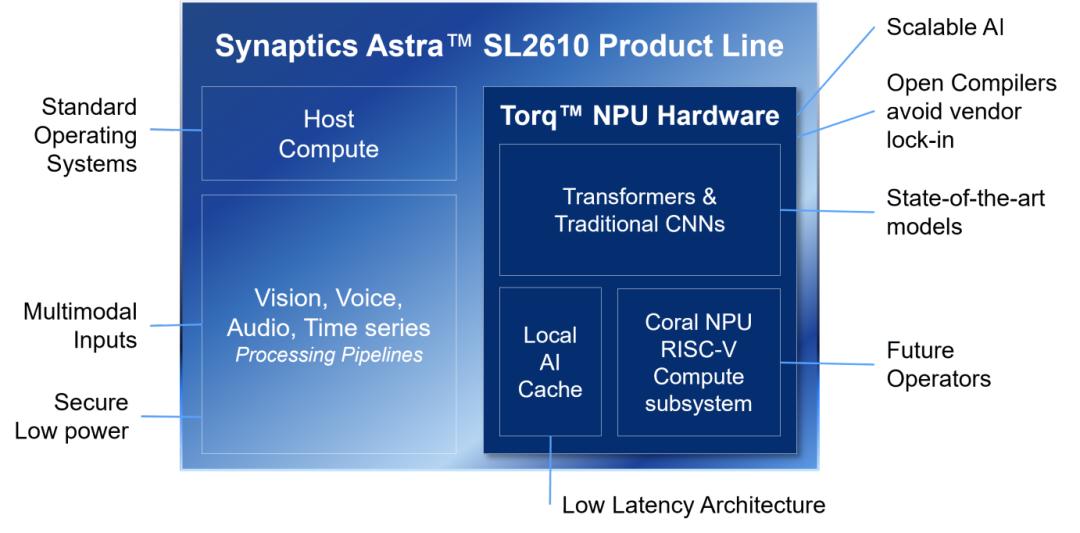
This company is very active in exploring AI. In May 2026, it released the AI-native MCU SYN765x and SRW1500, integrating Cortex-M52 (Arm's STAR-MC2) and Ethos-U55 NPU, and the U55 can deliver up to 50GOPS of computing power at 200MHz.
Silergy: Acquisition of Yunt Semiconductor
On April 28, Silergy and Yunt Semiconductor jointly issued a customer notice, announcing that the M&A fund initiated by Silergy has completed the controlling acquisition of Yunt Semiconductor. After the transaction is completed, Yunt will continue to maintain the status of an independent legal entity, the original founding team and core personnel will remain stable, and the existing business, channels, orders and contract performance will not be affected.
Silergy has long been deeply engaged in the field of analog chips and power management, and in recent years it has also been promoting self-developed automotive-grade MCUs. During the 2026 Beijing Auto Show, the company disclosed the SA32D series based on RISC-V architecture, which adopts a high-performance RISC-V core with a maximum main frequency of 300MHz, supports dual-core lockstep, and has a maximum computing power of 6000 DMIPS, targeting applications such as power battery management and main drive motor control.
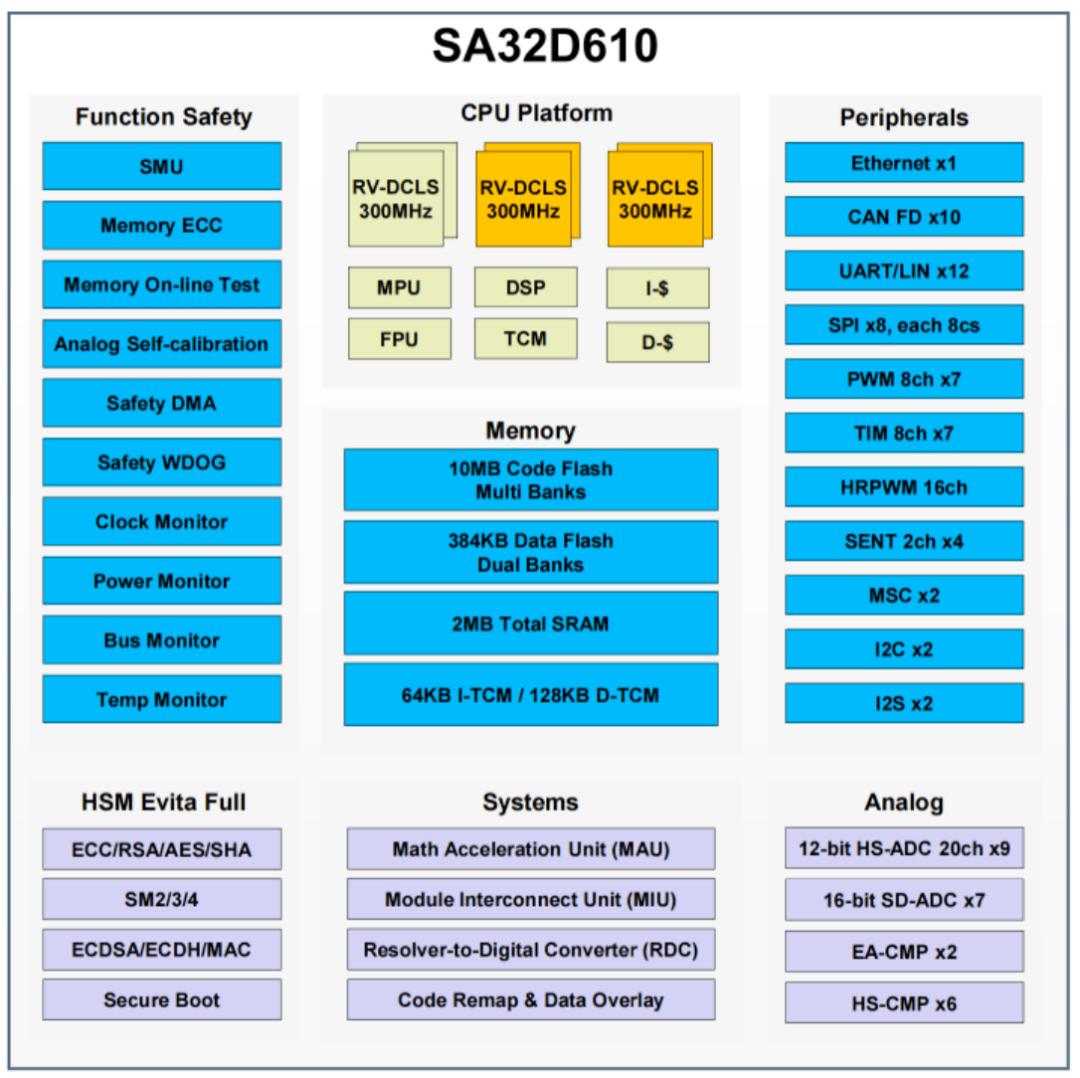
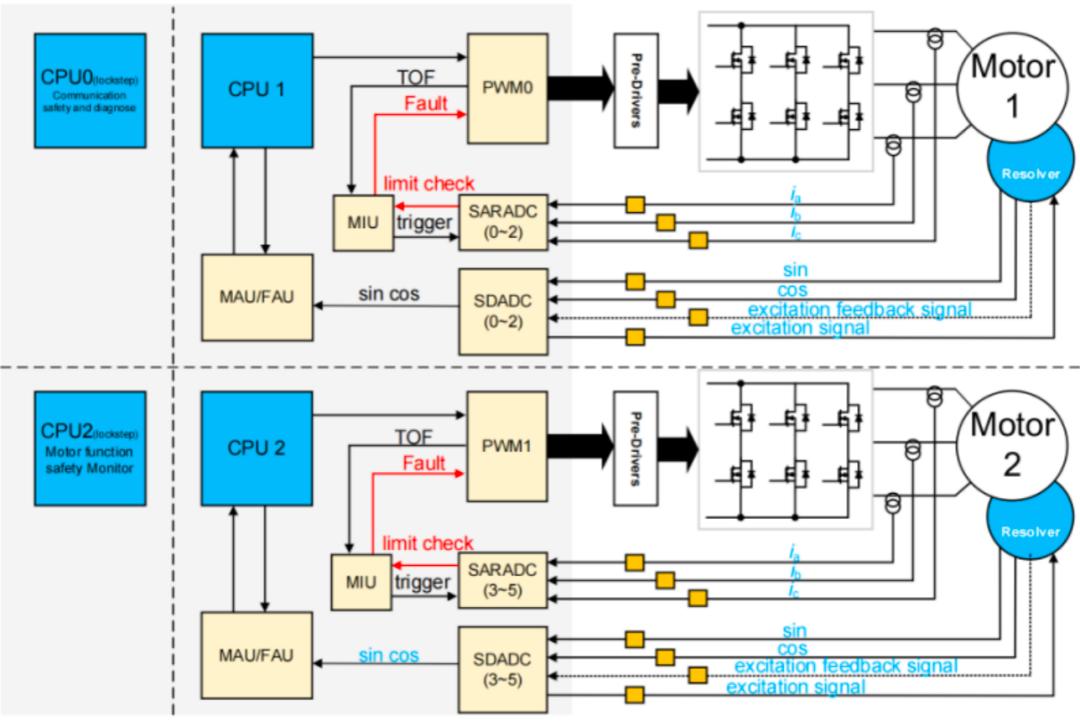
For Silergy, this acquisition fills an important gap in its automotive-grade MCU product layout. Yunt focuses on Arm architecture automotive-grade MCUs, and its products have been applied in body control, smart cockpit and steer-by-wire chassis and other fields. The two companies have different technical routes and product accumulation. The acquisition helps Silergy to promote both the RISC-V and Arm routes at the same time, shortening the time for product layout and market expansion.
The slogan on Yunt Semiconductor's official website is "A True 32-bit Automotive-grade MCU Supplier". From the perspective of its product roadmap, it includes YTM32B1L series, YTM32B1M series, YTM32B1H series, YTM32Z series, YTM32N/P/V series, and it will continue to launch high-performance processor products in the future.
