Silicon Valley's AI sector is in a total frenzy, how much cost-effectiveness do players like DeepSeek still have left?
The trend of "scooping up free perks" has swept into the large model industry, and this time, Silicon Valley is the one being taken advantage of.
Recently, a distinctive "subsidy war" has broken out in the overseas large model market. OpenAI is frantically distributing quota "reset cards" to users, and Anthropic is doing the same: it first provided startups with one year of free access to Claude Team with a $1000 credit, and then launched new benefits: distributing API credits for free on a monthly basis, with $100 for Max 5x, $200 for Max 20x, and a maximum of $500 for the Team version.
On the other side, the prize pool for free models is getting larger and larger. Elon Musk stated on the X platform that Grok Bot will open free access to the Opus 5.5 model, and grant it full access to all functions of the X platform. After OpenAI fully launches GPT-6, free users will also be able to use the Luna version.
When Silicon Valley manufacturers are frantically rolling out preferential policies, can domestic large models still maintain their cost-effectiveness advantages?
The price war ignited by DeepSeek spreads to Silicon Valley
Low prices, once regarded as an important competitive advantage of domestic models, are becoming a market that manufacturers around the world are competing for. In addition to directly distributing various Token subsidies, overseas large model manufacturers are now lowering the usage threshold from multiple dimensions such as basic pricing, model layering and billing mechanisms.
Starting from GPT-5.6, OpenAI no longer relies on the single strongest model to dominate the market, but divides its products into different price tiers according to capability levels. For example, the latest GPT-6 series offers three different tiers: Astra is responsible for the most difficult and complex tasks, Sol provides a more balanced performance and cost ratio, and Luna is positioned for lower-cost invocation scenarios.
Moreover, OpenAI has also begun to attract users through phased price reductions. According to the official announcement, the API price of the GPT-5.6 series was cut in July, with Terra's price reduced by 20%, and Luna's price directly dropped to 20% of the original after the reduction. In August, the API and credit prices of GPT-5.6 Sol were reduced by more than 20%, and the preferential policy is planned to be maintained at least until November 21.
More notably, there is no longer any surcharge for long context when running GPT-6.1 Sol with subscription credits. In the update on October 12, OpenAI expanded the default window in Codex and ChatGPT Work from 272k to 500k, an increase of about 80% in one go.
Anthropic further breaks down price competition into model capabilities and specific workloads. At present, its official API price page lists a number of main models. Among them, Claude Fable 5.1 is for high-difficulty reasoning and long-cycle Agent tasks, Opus 5.5 focuses on long-time coding and knowledge work, Sonnet 5.5 balances speed and capability, and Haiku 5.5 is for high-frequency, low-latency tasks.
The pricing of Haiku 5.5 is particularly striking, with a maximum direct reduction of 90% compared to the previous generation. Within 100,000 Tokens, the price of Haiku is $0.10 per million input Tokens and $0.50 per million output Tokens, which is even cheaper than the off-peak price of DeepSeek-V4.1 Flash. When the number of Tokens exceeds 100,000, its price is only 50% lower than that of the previous generation, but it is still at a very low level.
In addition, Anthropic also creates cost reduction space for users in batch tasks: both input and output Tokens of Batch API can enjoy a 50% discount. Taking Sonnet 5.5 as an example, the standard price is $2 for input and $10 for output; for eligible non-real-time tasks processed through Batch API, the price can be reduced to $1 and $5 respectively.
Google provides a free tier, a standard paid tier, and different service modes such as Batch, Flex, and Priority, and also launches phased preferential policies. Taking Gemini 3.8 Flash as an example, according to the officially announced price, before December 31, 2026, the standard API input price of this model is $0.75 per million Tokens, and the output price is $3.75; starting from January 1, 2027, the prices will be adjusted to $1.50 and $7.50 respectively.
What overseas model giants are doing now is to turn low prices into a complete product and billing system, rather than just discounting the price of flagship models. For domestic models, the new competitive pressure cannot be ignored.
Are domestic large models not as cheap as imagined?
When discussing the price of large models today, we cannot only judge whether a company's products are expensive, but first clarify what level of capability is provided and what capability users actually need. Even within the same manufacturer, the price gap between different models may reach dozens or even hundreds of times.
However, when comparing API prices, domestic large models do still have a very obvious low-price advantage, which has been one of the most powerful weapons for domestic large models to participate in competition in the past few years.
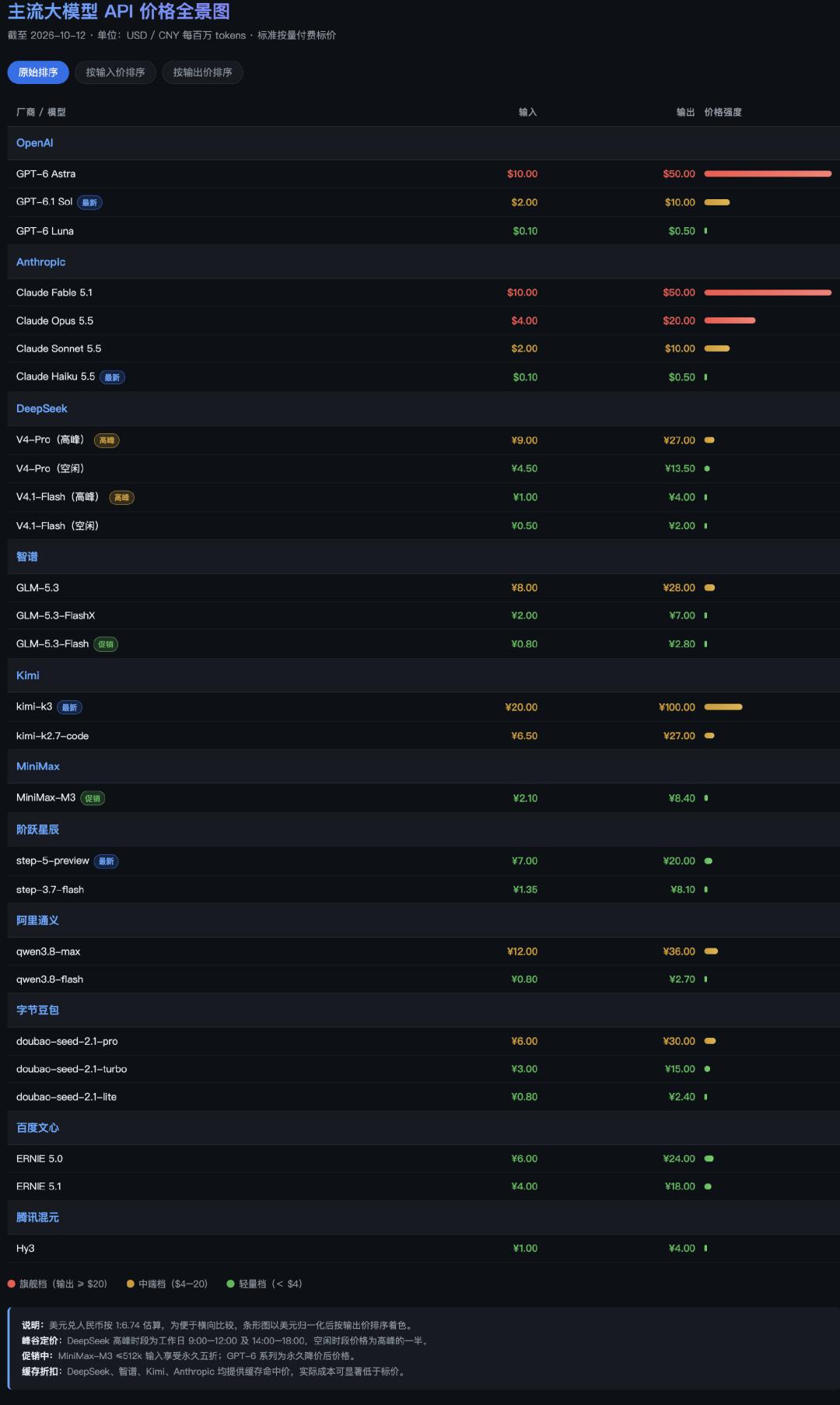
Latest model API prices of various manufacturers (mapped by Tech Planet based on public information).
However, in actual usage scenarios, the low-price advantage of domestic models may not be as solid as it seems. The problem lies in the billing methods of different manufacturers, and the actual productivity that the same amount of money can bring.
With the explosion of AI application demand, domestic and foreign manufacturers including OpenAI, Anthropic, Zhipu AI, Moonshot AI and others are competing for high-frequency user groups through subscription packages. In China, some large model companies have even put Token subscription packages on e-commerce shelves: Zhipu AI has opened official flagship stores on Tmall and JD, and Kimi, MiniMax, StepFun and other manufacturers are also in contact with Tmall.
Users pay a fixed monthly fee to use programming tools and models within a certain quota; after the quota is exhausted, they can wait for reset, purchase additional quota or switch to API payment. As a result, the battlefield of model competition has shifted from "how much per million Tokens" to how much usage quota the package can provide, whether the actual invocation is stable, and whether the task can be completed efficiently.
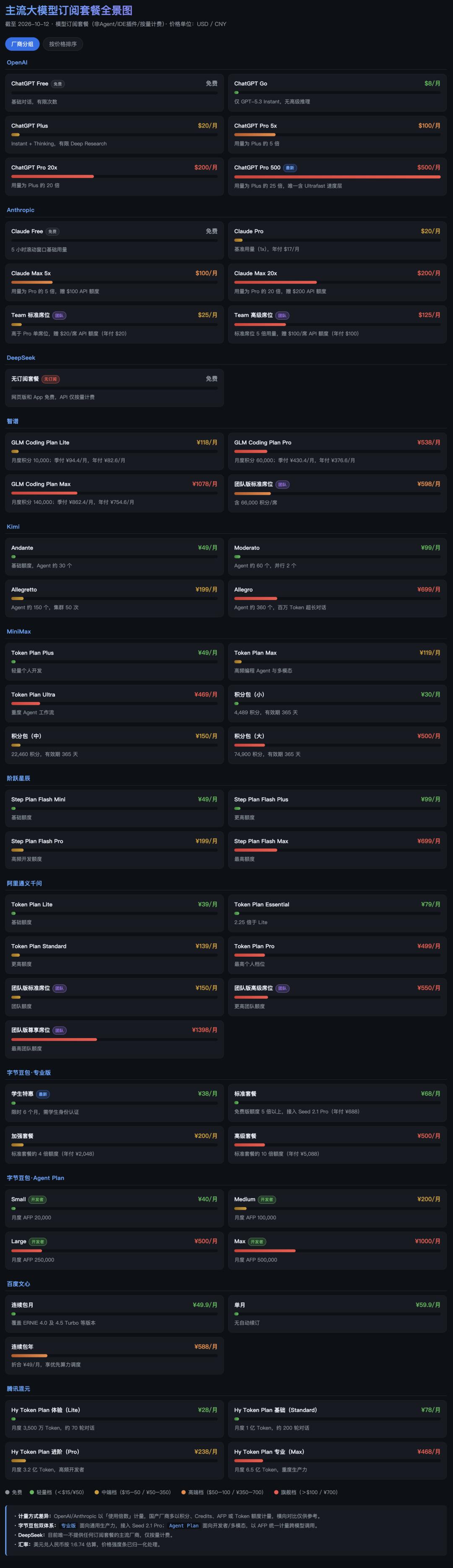
Prices of paid subscription packages of various manufacturers (mapped by Tech Planet based on public information).
Recently, SemiAnalysis tested the subscription packages of OpenAI, Anthropic, Meta, SpaceXAI, MiniMax, Moonshot AI, Zhipu AI, Cursor and Cognition one by one. It first measured how much subscription quota is consumed by input, cache writing, cache reading and output, then calculated according to its own Agent usage structure in September, in which about 96.6% is cache reading, and finally applied the API price tags of each manufacturer to see how much it would cost if the same batch of Tokens went directly through the API.
The results show that Claude's subscription subsidy is far stronger than that of domestic models. The $200 monthly Max 20x package can generate up to about $12,529 of API usage with Sonnet 5.5, which is equivalent to 62.6 times the monthly fee; Opus 5.5 is about $11,726, equivalent to 58.6 times the monthly fee.
Although the monthly fee of the domestic Coding Plan is lower, the subsidy intensity after calculation is not high. The $132 MiniMax Token Ultra can be converted into about $3,088 of MiniMax-M3 API usage, which is equivalent to 23.4 times the monthly fee; the $168 Zhipu GLM Coding Max is about 11.6 times; the $199 Kimi Code Ultra is about 6.7 times. Even for MiniMax, which has the highest value among them, the converted value per dollar is only about 40% of that of Claude Sonnet and Opus.
The feedback from the consumer side is more intuitive. "Domestic models are too expensive for real work", many users who use large AI models deeply complained after calculating the cost.
A developer who wants to support domestic models shared his usage experience with Tech Planet. He used to mainly use Opus 5 to handle daily coding tasks, and later subscribed to Kimi Pro with a monthly fee of 199 yuan, trying to transfer part of the work to domestic models. As a result, a 6-hour coding task consumed 30% of the monthly quota. He also has an old Zhipu GLM-5 package with a monthly fee of more than 400 yuan. Even if he runs a single task without parallelism, the quota is often exhausted in less than 2 hours, and now it can only be used for some test tasks.
Another developer who has recharged Kimi K3 revealed to Tech Planet that even for relatively simple tasks, the Token consumption is abnormally huge. "I contacted customer service to apply for a refund of the remaining balance, and my account was suspended after the refund."
These situations reflect a new problem in the cost-effectiveness competition of models: a low unit Token price does not necessarily equal low task cost. The advantage that domestic models have built in the past by relying on low unit Token prices is now facing new tests. Of course, this does not mean that domestic models have lost their cost advantage in all scenarios. For users who need low-frequency invocation, batch inference, independent deployment, or must access their own business systems through API, domestic models can still take advantage of lower invocation prices and deployment flexibility.
What really needs to be recalculated is the comprehensive cost under different usage scenarios.
How to win in the second half of the price war?
When the API unit price, subscription package and actual task cost are all put on the table, the price competition among large model manufacturers is shifting from simply competing for who is cheaper to how to cover users' budgets in different scenarios.
Nowadays, large model manufacturers are competing for three types of markets at the same time: the personal user subscription market, the developer API market, and the exclusive service market for enterprise customers.
The payment logic of the three is different. Personal users are more concerned about how much they spend every month, which models they can use, and whether there are invocation quota limits; developers are more concerned about the cost, concurrency, latency and stability of each invocation; enterprises also need to consider data security, service level, deployment methods and procurement discounts.
Different markets give manufacturers different means of price competition. For individual users, the usage threshold can be lowered through free tiers, subscription packages and functional rights; for developers, the invocation cost can be reduced through low-cost models, cache discounts and batch processing; for enterprises, it is necessary to use usage discounts, exclusive throughput, customized deployment and contract prices to meet the business needs of large scale and stability.
More importantly, the cost-effectiveness of a model is not a fixed number independent of usage scenarios. The performance, consumption and user evaluation of the same model in different tasks may be completely different.
For example, Kimi's capability in liberal arts tasks has attracted a group of loyal users. One user sighed, "Kimi K3 burns through the quota so quickly in text work that it breaks my heart, but the output is really amazing." Another user admitted that he knew Kimi was expensive, but was still willing to pay for the effect, "So I've been following it from 49 to 99 and now 199."
In addition, for model manufacturers, optimizing reasoning efficiency, improving tool invocation and reducing invalid output are as important as direct price reduction. If a model can complete the same task with fewer reasoning steps, less context and fewer retries, even if its unit price is not the lowest, the overall cost may be more competitive.
The first round of change brought by DeepSeek made large models cheaper. Now, in the second half of the price war, the competition may not be about who presses the price the lowest, but about who can make users feel that the money spent is the most worthwhile.
There may not be a "king of cost-effectiveness" in the large model market that can outperform others in all tasks. Complex coding, long-form writing, daily Q&A, batch inference and enterprise workflows have different requirements for model capability and cost. The future competition is likely not that a single manufacturer covers all scenarios with the lowest price, but that different models find the best balance between price and effect in their respective good at tasks.
For domestic models, the low-price advantage is not necessarily unmaintainable, but it may no longer be able to determine the outcome alone. A more realistic competitive way is to form a more competitive combination of price and effect in specific tasks, and stably deliver this advantage to users through reasoning efficiency, product ecosystem and commercial delivery.
Only when low prices are converted into higher task completion efficiency, better user experience and sustainable commercial value, can it become a long-term competitiveness from a short-term attraction.
This article is from the WeChat official account "Tech Planet" (ID: tech618), written by Hua Wei, authorized for release by 36Kr.