A high-stakes gamble changed by a "lobster": Did Meta's second turnaround battle end in failure?
In the early hours of October 13, Meta, which had just "returned" to the AI arena with its viral personal AI agent application Muse, released its new flagship model series Muse Wonder, including two variants: Muse Wonder and Muse Wonder Full, once again challenging OpenAI and Anthropic. At present, only Wonder Full is open to paid users, but it is reported that the new model series will soon support the experience in Muse.
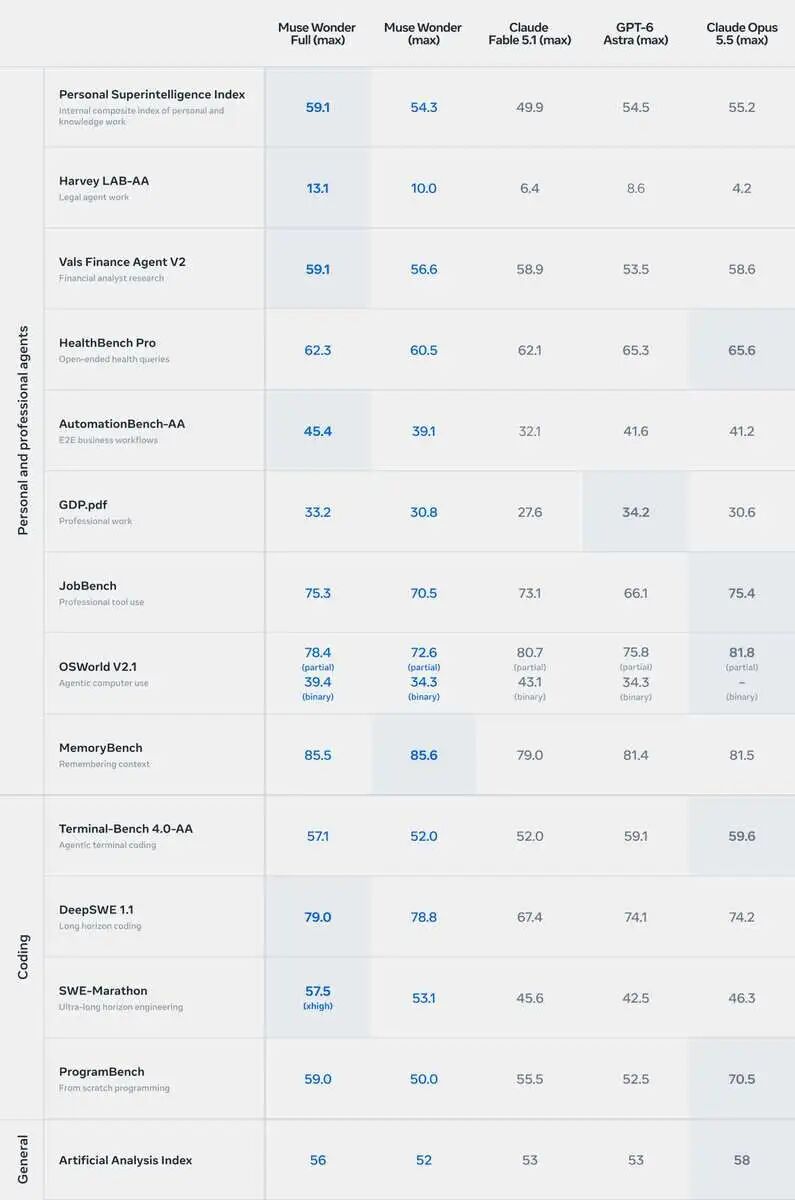
Meta CEO Mark Zuckerberg wrote on his Threads blog: "Muse Wonder is an important step forward in delivering personal superintelligence to everyone." In Meta's Personal Superintelligence Index, Wonder Full scores 59.1 points, Claude Opus 5.5 scores 55.2 points, GPT-6 Astra scores 54.5 points, and Claude Fable 5.1 scores 49.9 points.
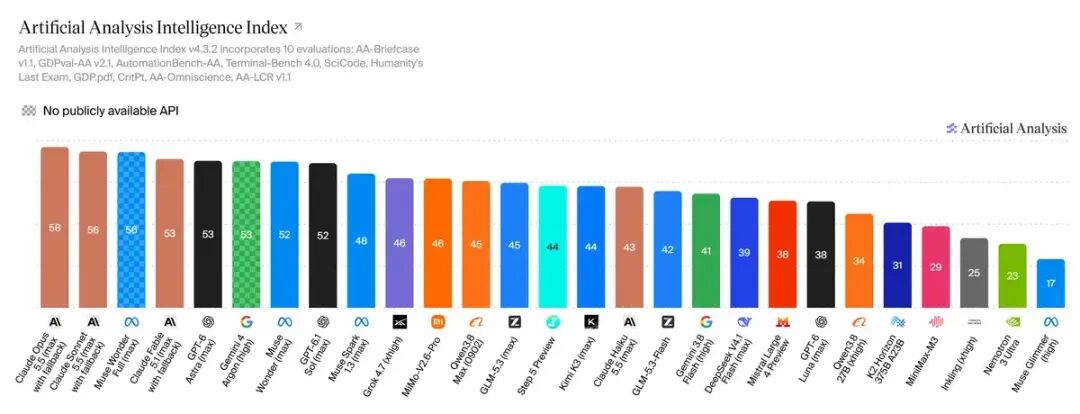
On the comprehensive intelligence index ranking from third-party evaluation agency Artificial Analysis (the ranking is based on the weighted average of 10 assessments covering AI agents, programming, common sense and scientific reasoning), Opus 5.5 still ranks first. Wonder Full is tied with the cheaper Claude Sonnet 5.5 produced by Anthropic with a score of 56 points, only 2 points behind Opus 5.5's 58 points.
A high-stakes bet reshaped by "the lobster"
After the model was released, Zuckerberg said in an interview with the Financial Times that AI can already handle advanced mathematics, but still cannot stably deliver customer service well for all people. Alexandr Wang, head of Meta AI, further depicted the ideal personal agent in the interview: users should feel that they have a whole team of experts around them, including assistants in legal, financial and medical fields.
This vision did not come out of nowhere. The day before the release of Muse Wonder, Wang detailed the story behind Muse in David Senra's podcast. He mentioned that Muse was originally "developed by him and Nat Friedman, another core figure at Meta Superintelligence Labs, while playing with OpenClaw (the lobster)".
According to Wang's recollection, Friedman first connected OpenClaw to the surveillance camera at his home to supervise whether he drank water on time; then he shared a set of psychological analysis prompts with Wang, letting the agent conduct multiple rounds of continuous psychological analysis by synthesizing personal information such as emails and photos. After trying it, Wang was greatly shocked, describing that "it felt like I had experienced the equivalent of three years of psychological counseling in one AI experience". The two then realized that personal agent might be exactly the product form that Meta had been looking for.
In the blog post introducing Muse Wonder, Meta emphasized that the model was designed to take into account both agent workflows and user security. It is reported that Muse Wonder is equipped with Active Focus and Active Memory. Meta said these two capabilities are critical for AI agents to stay focused in complex, long-running tasks.
The company defines Active Focus as "the ability to keep moving towards the goal even when tasks get difficult, try alternative methods, recover from errors and stick to the end, ask for clarification when needed, and confirm before executing any important matters". It describes Active Memory as "the ability to retain content that matters to you across conversations, and recall details relevant to the current task".
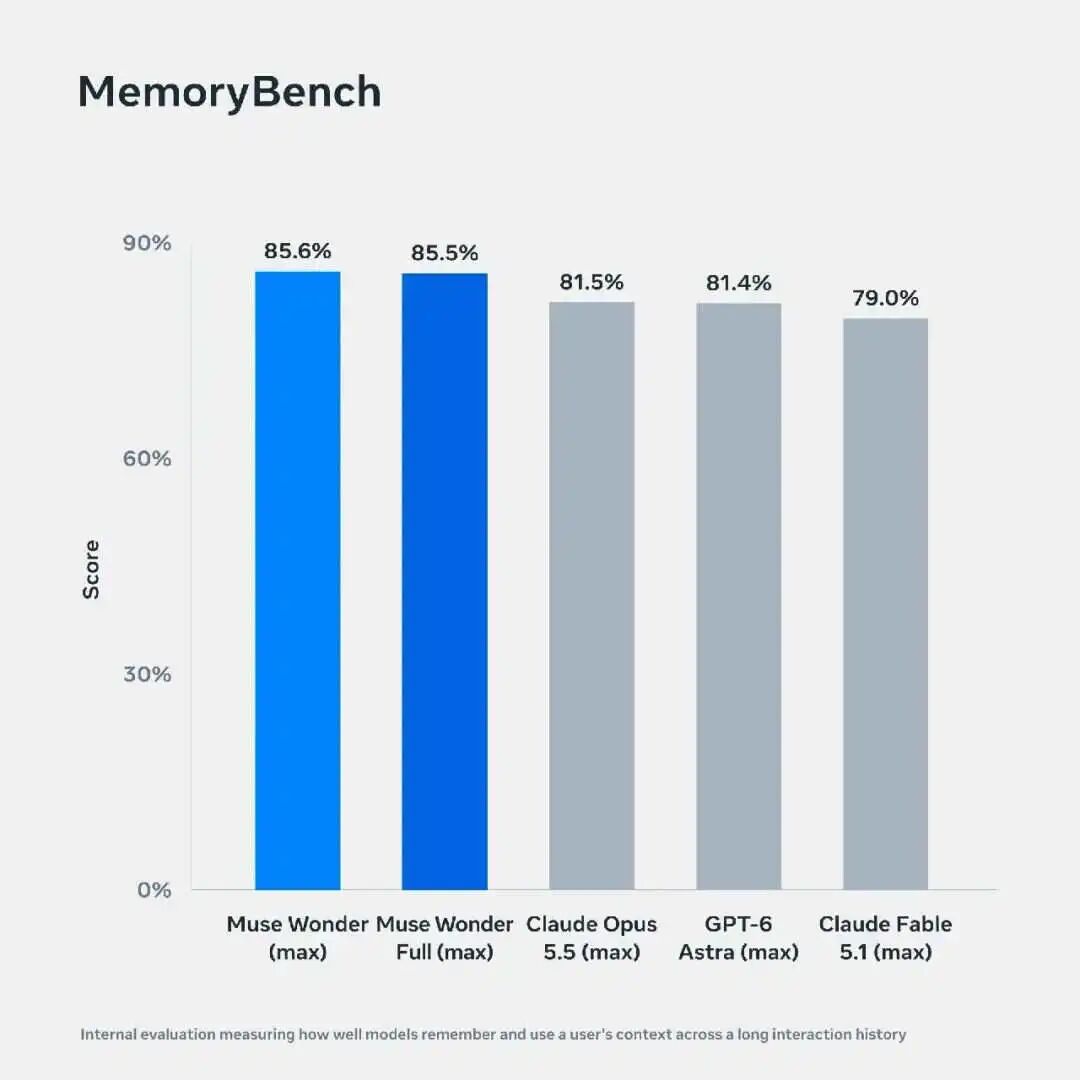
In the MemoryBench test, Muse Wonder scored 85.6 points, higher than GPT-6 Astra (81.4 points) and Claude Opus 5.5 (81.5 points) in Meta's report.
In terms of security, Meta said the Muse Wonder series will "avoid sharing private information without permission". In addition, Meta claimed that these models will also reject harmful requests, while helping organizations and users defend against cybersecurity threats.
Citrini also drew the conclusion after testing Muse Wonder: Meta indeed has the opportunity to provide high-quality agent services for small businesses. It performs very well in both functionality and execution efficiency, and also performs quite well when handling finance-related tasks.
In addition, in the fiercely competitive field of long-horizon programming, Wonder Full also delivered outstanding performance. In the SWE-Marathon test announced by Meta, Wonder Full scored 57.5%, significantly higher than Claude Opus 5.5's 46.3% and GPT-6 Astra's 42.5%. In Terminal-Bench 4.0, its performance rose from 33% achieved by Muse Spark 1.3 to around 57%.
The programming agent index of Artificial Analysis also confirmed its progress: Muse Code paired with Wonder Full scored 68 points, on a par with Claude Code paired with Sonnet 5.5.
The battle for comeback has only just begun
Meta has high expectations for Muse Wonder.
Zuckerberg set a high tone on social platform X: "Meta Superintelligence Labs was founded more than a year ago. Muse Spark was one of our first model series, and now Muse Wonder is a larger, more advanced model series that leads us to the cutting edge of technology."
However, shortly after the impressive rankings were released, Muse Wonder was caught in a public opinion storm in the developer community.
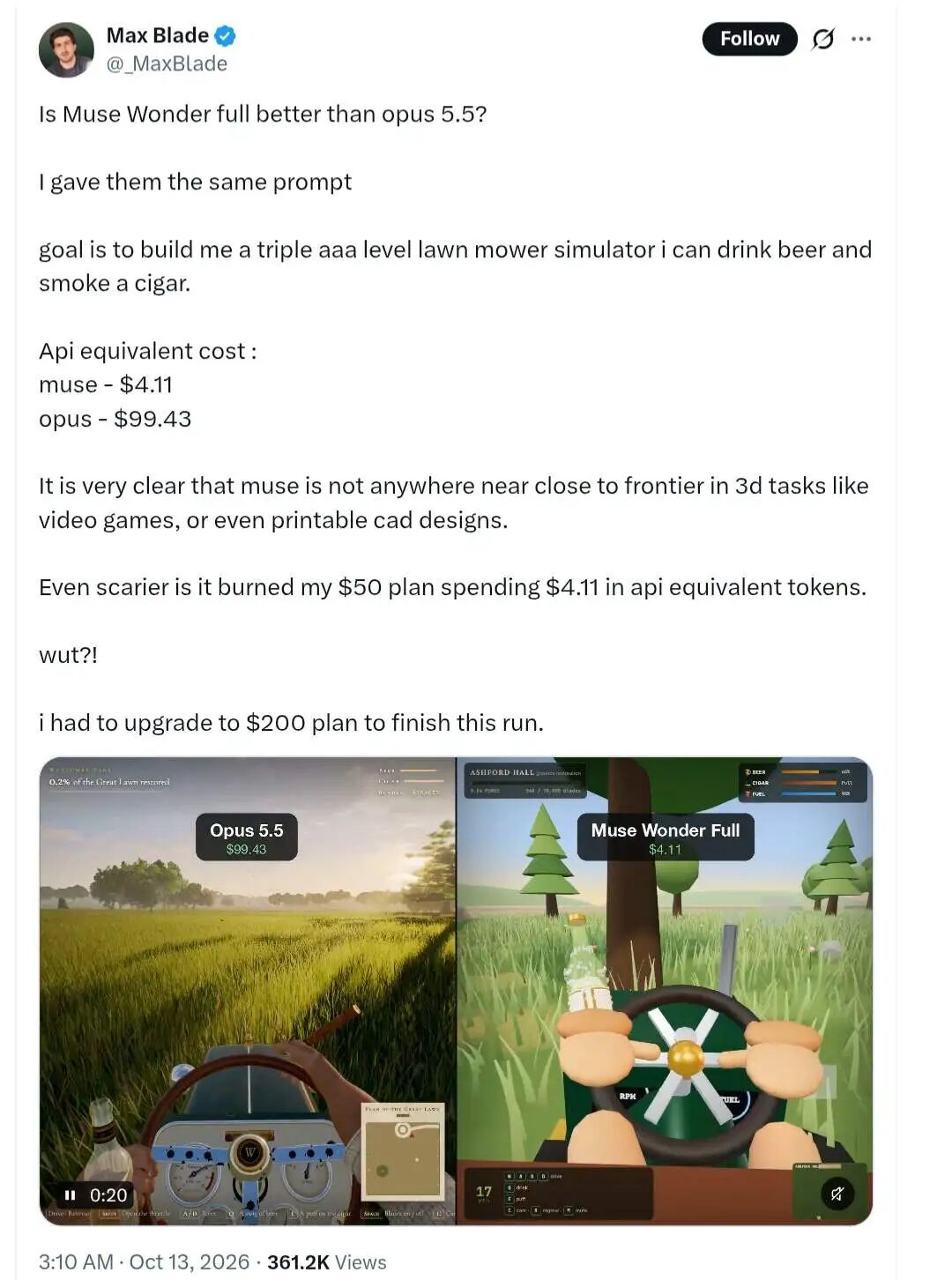
Many developers rushed to experience Muse Wonder Full, only to be greatly disappointed. One user assigned the same task to Wonder Full and Opus 5.5: to create a 3A-level simulation game that allows players to drive a lawn mower while drinking beer and smoking cigars, and uploaded a comparison video of the two. The performance of Wonder Full was slightly inferior.
Another user used Wonder Full to build a rocket scene, which cost 14.3 US dollars but delivered a very mediocre effect, even worse than the work produced with Kimi K3 for 6.9 US dollars.
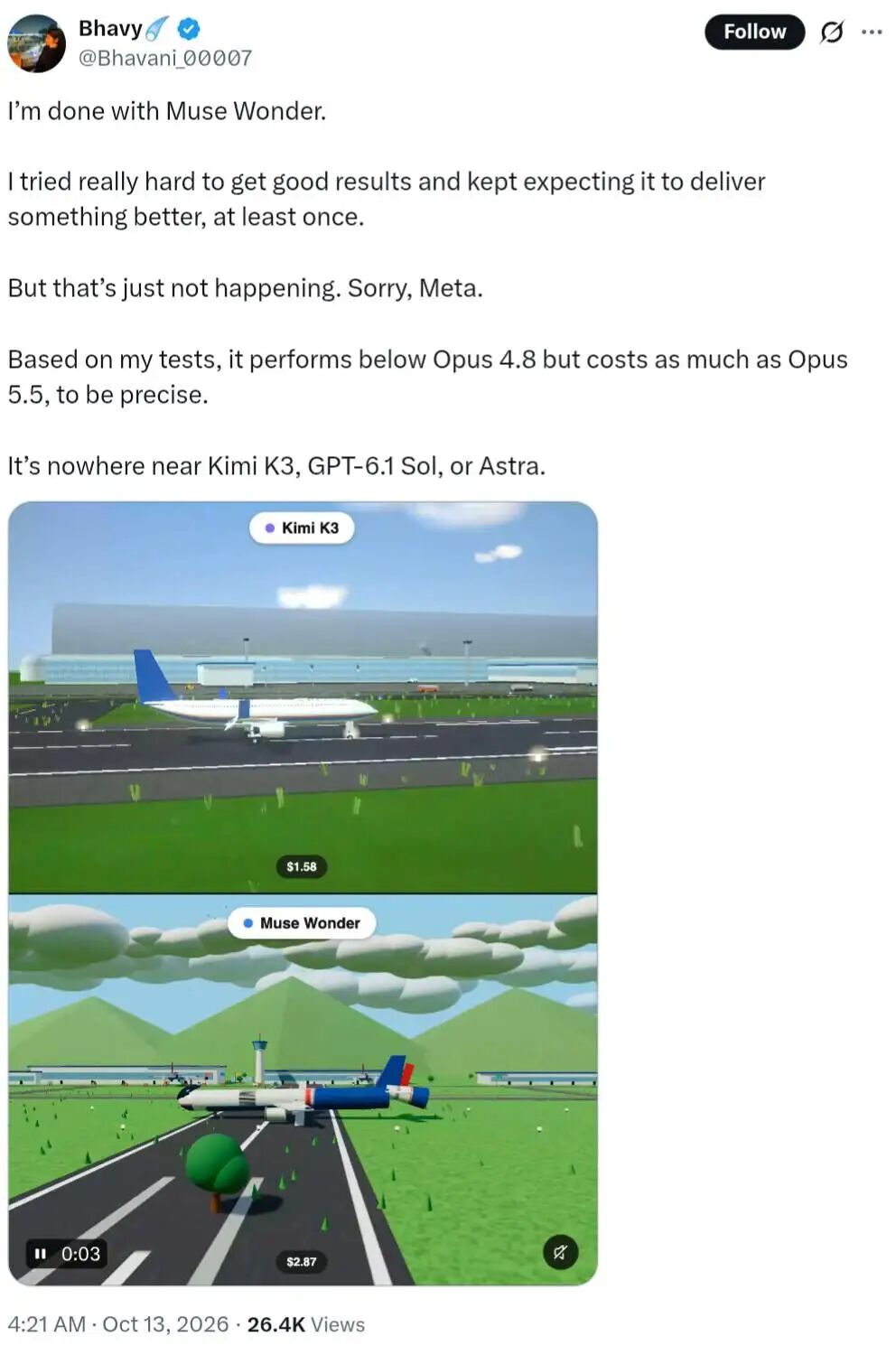
In response, Alexandr Wang quickly responded on X, admitting that the team did not specifically train the model for 3D demo games. "Looking back now, maybe we should have done more of that." And he suggested that developers use the new model more for practical programming work.
At the same time, Wang also admitted that the new model's coding capability is not as good as Opus 5.5, and there are still many bugs under investigation.
If technological progress is the ticket for Meta to return to the game, then the shift in business model reveals a deeper strategic intention. Neither of the two Muse Wonder models has open model weights. The standard version of Wonder is open through Meta Model API and Muse Code, priced at 4 US dollars per million input tokens, 0.2 US dollars for cached input, and 20 US dollars for output. The price is on a par with Claude Opus 5.5, twice the standard input and output price of GPT-6.1 Sol, and 60% lower than GPT-6 Astra.
In terms of specific task costs, according to the calculation of Artificial Analysis, in the comprehensive intelligence evaluation, Wonder consumes an average of about 7.69 million input tokens and 54,000 output tokens per task, involving multiple rounds of requests and tool calls. The final task cost is about 4.52 US dollars, 183% higher than the 1.60 US dollars of the previous generation Muse Spark 1.3, and about 39% higher than the 3.26 US dollars of GPT-6 Astra.
Faced with the high reasoning cost, Zuckerberg also made it clear in the interview that the Wonder model has a larger scale and higher reasoning service cost, so it is preferentially provided to paid users at this stage, while the free service continues to mainly use Spark. He hopes that in the future, Wonder-level capabilities can be compressed into a lightweight form like Spark to serve hundreds of millions of consumers.
This article is from WeChat official account "Xinyan Finance" (ID: tech621), written by Hua Wei, and authorized for release by 36Kr.