AI Portal Battle 2.0: Tencent, Alibaba, ByteDance, Who Is the Hidden Champion in the AI Office Track?
In the past year, the most certain revenue stream in the AI industry came from coding, making programmers the first group of white-collar workers willing to pay for AI without hesitation.
However, the penetration rate in core coding scenarios has reached around 70%, and the market is starting to look forward to where the next high-potential scenario lies. Besides programmers, there are around 1 billion knowledge workers worldwide.
So can AI office (also known as Co-work, work Agent) take over the baton from Coding and become the next scenario with a significant penetration rate increase and a truly viable business model?
This article focuses on AI office scenarios and conducts analysis around four key points:
1. Why is the entry point shifting from chat boxes to Agents?
2. What enables Agent implementation? Can technology become a moat?
3. Which type of Agent will land first: personal Agent or work Agent?
4. Taking the Chinese market as an example, how to evaluate the winning odds of core players respectively?
Detailed analysis is as follows
I. The Change of AI Entry: From "Chatting With You" to "Working For You"
The competition for AI entry points has always gone hand in hand with the development of underlying AI technologies. However, unlike the traditional internet era where the marginal service cost for additional users is almost zero, the "pure traffic play" adopted by internet giants in the past, which relied on subsidies first to cultivate user habits then monetization, is no longer applicable at least for now.
On the contrary, under the pressure of cost, platform giants with advantages in technology, ecosystem and traffic have started to calculate economic returns. The low payment rate of C-end users that is comparable to "knowledge payment" level, and the extremely short daily usage time that can hardly generate sufficient ad inventory, have all made the commercialization path of the first widely adopted AI Chatbot extremely difficult.
In comparison, after the emergence of task-oriented Agents, the payment willingness of enterprise clients has been stimulated, especially among technology companies and IT practitioners. Sampling surveys conducted by Stack Overflow in April and October 2026 show that Agent usage rate has reached 59%, and the proportion of daily users has risen to 37%; among developers using AI tools, 66% are using Coding Agents, and 73% of them use it on a daily basis.
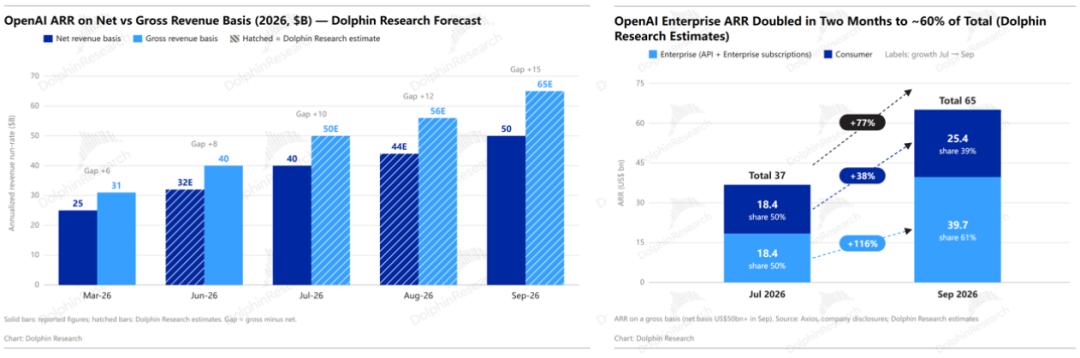
In July this year, OpenAI's B-end payment scale (API, Enterprise subscriptions) has surpassed the C-end (which accounted for 40% in April), reaching an annualized value of over 20 billion USD. By the end of September, this figure doubled. Based on the overall ARR scale of 650 billion USD (gross caliber, net caliber is over 500 billion USD), the B-end revenue accounts for more than 60%.
At the same time, the C-end payment, by reverse calculation, had an ARR of roughly 250 billion USD by the end of September, with a growth of less than 40% compared to July.
In terms of ad monetization, OpenAI entered the market with full confidence at the beginning of the year, expanding its team while partnering with multiple third-party ecosystems.
However, as the conversion rate remained unsatisfactory, the CPM quotation kept dropping, from 60 USD per thousand impressions during the gray test phase to the range of 15-25 USD, which is in line with the quotation of mature digital ad platforms. Meanwhile, the minimum consumption threshold of the self-service advertising platform was directly reduced from 50,000 USD to zero.
The latest progress as of now is that the ARR reached 1 billion USD by the end of August, a result that has covered tens of thousands of advertisers across more than 40 countries and regions.
Why is it so difficult for Chatbot to monetize through payment?
Dolphin Research believes that the problem does not lie in the uselessness of AI, but in the fact that the interactive form of Chatbot naturally makes users unable to clearly calculate the return or recognize the value of AI. To further break it down, the value of AI includes two aspects: one is verifiable effectiveness, and the other is measurable revenue expansion or cost optimization it brings.
But what Chatbot delivers is "suggestions" rather than "results". In most scenarios, it is impossible to calculate how much time or money it saves (the value cannot be quantified). Therefore, the quality of the result can only be "perceived" (cannot be self-verified), and users have to go through the whole process again to confirm the effect.
When the acceptance cost rises, users' trust in AI cannot be stably established, so the usage scenarios are increasingly limited to shallow question and answer. The unfeedbacked, simple and basic user data generated in this process contributes little to the post-training iteration of large models, and the platform needs to additionally purchase/label high-quality data and verification environments. To improve the model, higher costs are required to extract high-quality content from user daily Q&A data.
At the same time, the more users distrust the product and only interact with simple tasks, the harder it is to precipitate valuable data assets. This also leads to very low user switching cost: once a more cost-effective Chatbot appears, users can switch seamlessly. Therefore, Chatbot can maximize the "user count", but it is difficult to simultaneously increase the "payment rate" that reflects high user stickiness and loyalty.
Why did Coding become the first scenario to succeed?
Compared with the content output of the chat box, Agent aims to complete tasks, which is consistent with the general demands of enterprises. In the AI value formula, the two key factors of verifiability and measurability can both be realized in Coding scenarios:
Coding is a scenario with fixed knowledge scope and verifiable correctness (the feasibility of the code can be automatically verified); meanwhile, the incremental value it brings is also very easy to measure, which can directly correspond to the high salary of IT talents.
Scenarios where users can quickly verify the results and the economic value of a single task is very high include, besides Coding, financial reconciliation, legal compliance review, data analysis, financial investment, sales strategy and other scenarios.
A larger market comes from the integration and extension of the above scenarios, forming a unified office platform behind enterprises. While deeply penetrating into enterprise business processes and providing functions of traditional office software, it can help enterprise customers achieve more business growth through AI, rather than only focusing on "employee cost reduction".
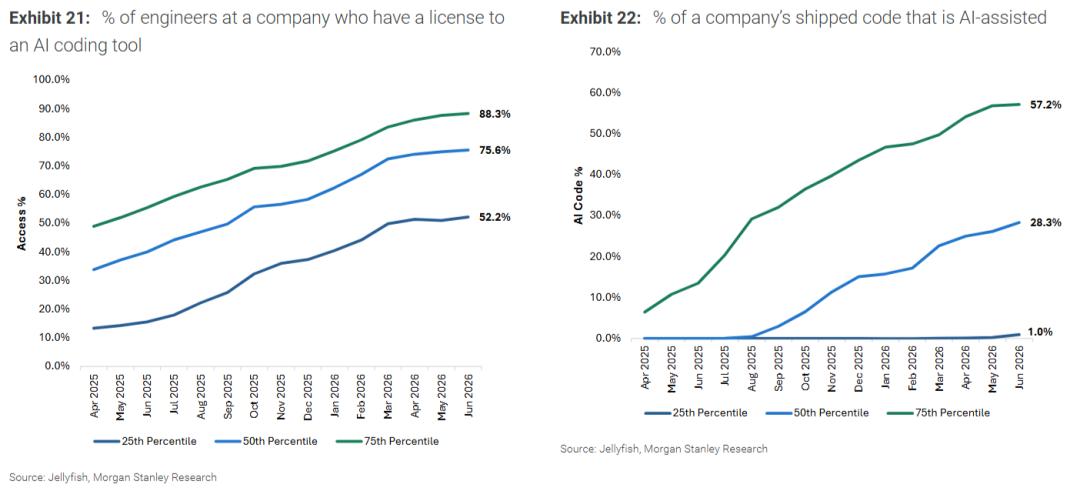
However, the unified office platform scenario is not a simple copy of the Coding scenario, and its development path is not as smooth as Coding (it took only one year to raise the AI Coding adoption rate among IT personnel to over 70%, and the proportion of AI-assisted code accounts for nearly 30%).
The key lies in three influencing factors:
(1) The acceptance criteria are more ambiguous and complex, and some work results cannot be automatically verified, requiring subjective judgment from real people to evaluate the quality;
(2) The task chain is longer, and any small stuck point may cause the stagnation of the entire task. For example, month-end reconciliation requires access to online banking, tax systems and enterprise ERP systems at the same time, so the fault tolerance rate of each sub-segment is lower;
(3) For network security considerations, enterprises definitely prefer private deployment, which requires the AI office platform to send FDE teams to settle in enterprise customers.
Therefore, the procurement decision chain for enterprises to decide whether to replace or upgrade to an AI office platform is significantly longer than that of AI Coding, so the development progress is naturally not as smooth as Coding.
II. Will Technology Be the Core Moat in Agent Competition?
1. Agent = LLM + Harness
To see whether Agents have the dividend of sustainable technical moat, let's first look at the operating principle of Agents.
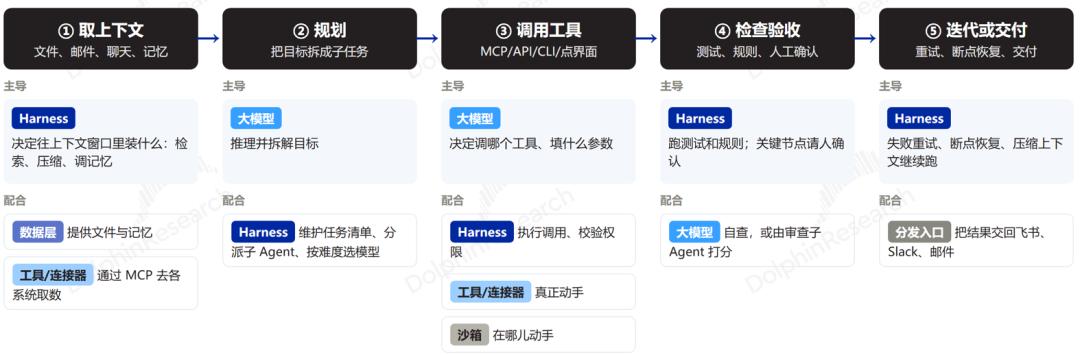
To complete a task, an Agent mainly includes 5 key steps, each involving different layers of software tools. The two core technologies are the large model layer and the Harness layer. In general, the large model is responsible for making decisions or putting forward requirements after thinking; Harness is responsible for stable, safe execution and acceptance.
2. The Real Moat Lies in "Data"
From the operating principle of Agents, we can see that for an Agent to stably execute and deliver work, the large model needs to make accurate judgments, and a reliable Harness is also required for stable execution.
So for a leading Agent, does its technical moat come from the large model or Harness?
(1) Harness is essentially a technical wrapper
First of all, the design ideas and underlying engineering codes of Harness are very mature and general, belonging to the operation infrastructure: logs, permissions, sandboxes, archives, interfaces, etc.
Secondly, the connection protocols MCP, Skills, etc. for Harness to connect to the external application ecosystem have also become open standards. OpenAI open-sourced Codex Harness directly, and Dots runs on it; the open-source OpenClaw has also become the inspiration for Microsoft Autopilot and Meta Muse.
Therefore, Harness itself does not constitute a technical moat. At the same time, models are also absorbing the functions of Harness. That is to say, many capabilities that originally relied on Harness to supplement are now being tried to be trained into models.
a. Agent scheduling and execution is integrated into large models (applicable to parallel tasks)
A typical example is Kimi. Since K2.5 first launched Agent Swarm, allowing the model to decide on task splitting and assigning sub-Agents on its own, K2.6 and K3 have followed this design idea, training more and more Agent collaborations directly into the model instead of relying on external Harness for serial scheduling.
However, the mainstream route of leading model manufacturers at present is to hand over the Agent scheduling execution framework to Harness. The large model is only trained to be proficient in using the "split subtasks" tool, and when it is really needed, several sub-Agents will be dispatched through the sub-Agent tool of Harness for parallel execution.
b. Context, error correction and planning are integrated into large models
In addition, the context windows of various large models are approaching 1M, and planning and self-error correction are increasingly becoming the capabilities of the model itself, which also reduces the importance of Harness that undertakes context management, compression, inspection and correction.
(2) Models are converging, and there is no need to pursue continuous use of cutting-edge models
The large model is the decision-making layer at the core, and too big a gap between the underlying brains will indeed affect the end-user experience. But at present, the leading advantage of each cutting-edge model is generally 3-6 months. After open-source large models caught up significantly in the middle of the year and narrowed the gap with leading closed-source models, the leading closed-source players in North America have been catching up very closely in the past two months, launching new versions one after another.

Although closed-source models strictly guard against peers distilling their models by blocking the chain of thought, followers can still achieve iterative improvement of large model performance by continuously improving the training environment (data backflow with effective feedback verification), that is, conducting more post-training.
At the same time, on the passing line of "being able to get things done", the gap between models has been converging.
While closed-source models are constantly cutting prices (even willing to step down from the altar and use more cost-effective small models to compete directly with Chinese open-source models, which is a product matrix strategy), they still cannot stop their original big customers from becoming their competitors in turn. The following examples all show that the customer lock-in of the "pure model layer" is very weak.
a. Meta first used Claude Code to develop Muse, and then replaced Claude Code with its self-developed Muse Code;
b. Microsoft made the automatic routing of Copilot default to the cheaper OpenAI model;
c. Alibaba abandoned Claude Code in July and promoted its own Qoder instead.
(3) What is really hard to replicate is the retention of "user usage data"
Since neither the large model nor Harness has absolute technical moat, leaving aside the price, why do users think Codex and Claude Code are obviously smarter than other Harness?
The "smartness" here is ultimately mainly manifested as: Codex and Claude Code can quickly understand user intentions, and actively absorb past experience and apply it to the next task delivery. In general, it is essentially the context capability.
An Agent with deep context capability can precipitate user usage data and call it in future tasks to perform tasks better. These data include chat information, files, emails, permissions, industry-specific know-how, internal enterprise specifications, organizational structure, business process records, especially the execution tracks of each user's feedback such as correction, approval and rejection, which can all flow back to carry out post-training reinforcement learning on the underlying large model.
This is also why Harness, as the entry point, even if it carries third-party models, can collect user usage track data to feed back and train its own model.
As shown in the figure below, according to the operation process of Agent, the underlying large model and Harness have obvious differences in their ability to access user usage track data: the Harness layer can see significantly more user usage data, especially the "manual confirmation and delivery" part circled by Dolphin Research, where the large model layer can hardly see user verification and feedback at all, losing the best raw materials that can be used for post-training.
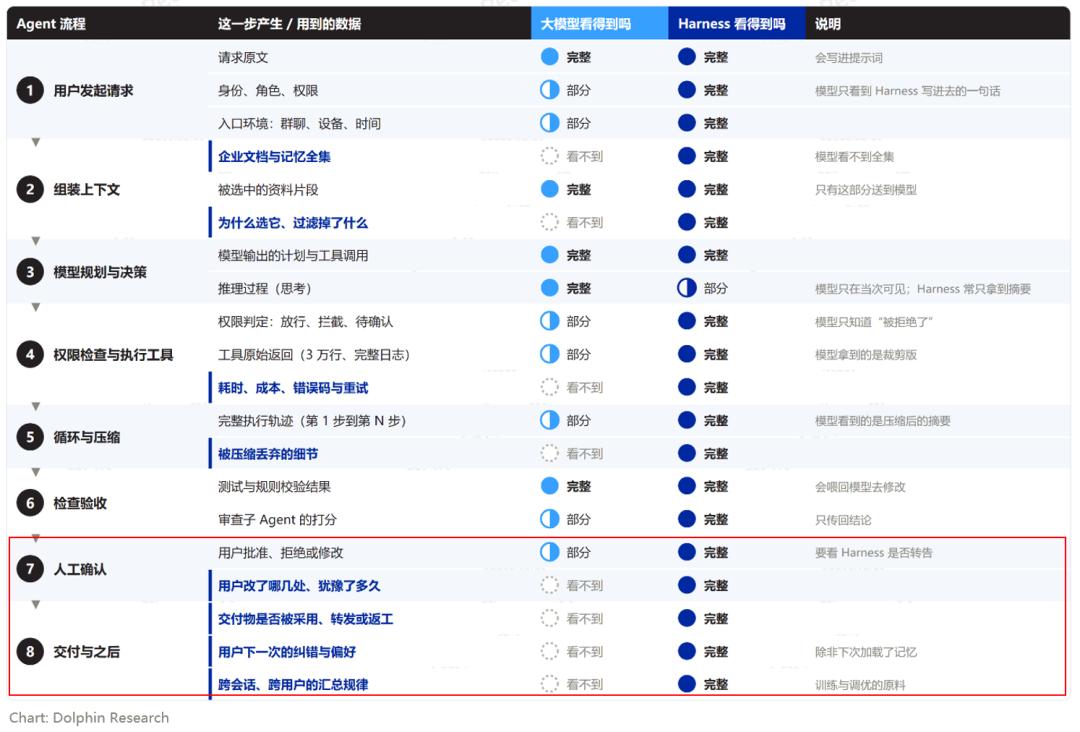
Therefore, if the large model and the Harness entry platform do not belong to the same enterprise, the optimization of the original large model through data backflow for post-training will also be reduced. On the contrary, the platform providing Harness entry can use the user usage track data here to quickly optimize its own relatively backward large model.
Of course, the best solution is that both the large model and Harness come from the same company, so that this company can get complete user usage data. Through continuous post-training optimization, users will feel that the product "gets smarter the more they use it".
3. Self-owned ecosystem is another starting line advantage
But the scale of data backflow is closely related to the number of users. Users can be attracted by product functions (underlying model performance, richness of skill ecosystem), or diverted from other high-frequency entry points — that is, the scale of external tools (MCP/API access, or Computer