Is it either the battery sector or the intelligent driving sector that is siphoning off the profits of automakers?
At present, the automotive industry is standing at the crossroads of value chain reshaping.
Just half a month after Seres went solo, it has now returned to the Hongmeng Smart Mobility family to reach a new five-year cooperation agreement; around CATL, carmakers maintain an ambiguous attitude and have rolled out their respective Plan B one after another...
Along with this, topics such as "de-XX-ization" and "all the profits are taken away by XX" continue to ferment.
The question is, batteries and intelligent driving have long been the cost centers for automakers, so why has the sentiment suddenly amplified at this moment? Only 3 companies are left with a per-vehicle profit of over 5000 yuan. Why are the harder they work, the less money they make? Moving from a zero-sum game to win-win symbiosis is the ultimate outcome of the industry?
Industrial Differentiation: Some Reap Huge Profits While Others Get No Share of the Pie
At the moment, automakers are having a hard time.
Data from the China Passenger Car Association shows that domestic monthly retail sales of automobiles have declined year-on-year for 12 consecutive months, with the decline in September further expanding to about 28%, the largest year-on-year drop since 2026.
In addition to the pressure on the sales side, the cost side is also under pressure.
Since 2026, upstream raw materials for automobile manufacturing such as lithium, copper, aluminum, rubber, plastics, and chips have been rising in prices across the board. However, the intensifying terminal competition makes it impossible to pass on the price increase pressure, and even the average selling price of new energy vehicles has declined.
Li Bin, founder of NIO, said: "We can no longer rely on price cuts to boost sales, and product parameters are no longer a differentiated selling point. The automotive industry has now entered the mid-to-late stage of the marathon, the most brutal stage of the final. The profit of the entire industry continues to be under pressure, with sales profit margin and manufacturing profit margin both at low levels."
As a result, automakers are more sensitive to costs than in previous years.
As the largest part of the cost, power batteries naturally attract much attention: public data shows that the total net profit of 8 listed power battery enterprises in the first half of 2026 is about 50.8 billion yuan, while the total net profit of 23 mainstream listed automakers is about 25.1 billion yuan.
This means that, automakers work their fingers to the bone, but their profits are only half of those of battery enterprises.
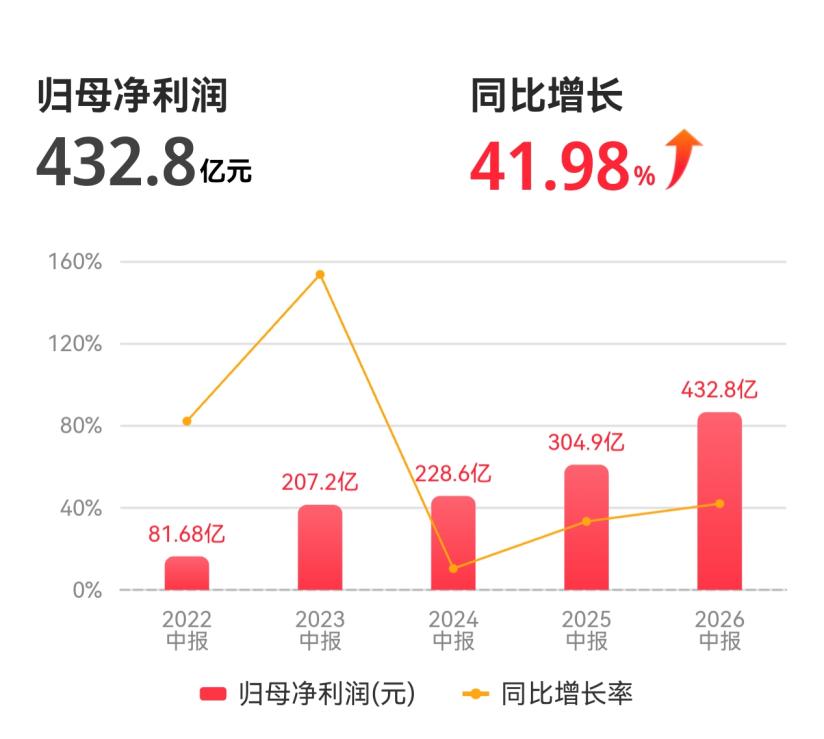
Among them, CATL's operating revenue in the first half of 2026 was 2769.17 billion yuan, a year-on-year increase of 54.80%; its net profit was 432.84 billion yuan, a year-on-year increase of 41.98%. Its dominant position is obvious to all, and it has naturally become the target of public criticism.
Source: Tonghuashun
Apart from power batteries, intelligent driving is another cost center.
For example, Seres' rigid expenditure accounts for about 10% of the vehicle price to obtain services including intelligent driving and brand authorization, which has dragged down its performance, resulting in a turn from profit to loss in the first half of 2026.
For another example, XPeng's revenue from services and other businesses in the first half of 2026 increased by 67.10% year-on-year, mainly due to the provision of intelligent driving related services to Volkswagen, while Volkswagen's net profit in the same period decreased by 35.73% year-on-year.
It is not difficult to see that behind the hustle and bustle, it is not that people dislike XX batteries and XX intelligent driving, but the anxiety about profit stall, especially under the background that sales targets are generally missed, there is an urgent need for a breakthrough point.
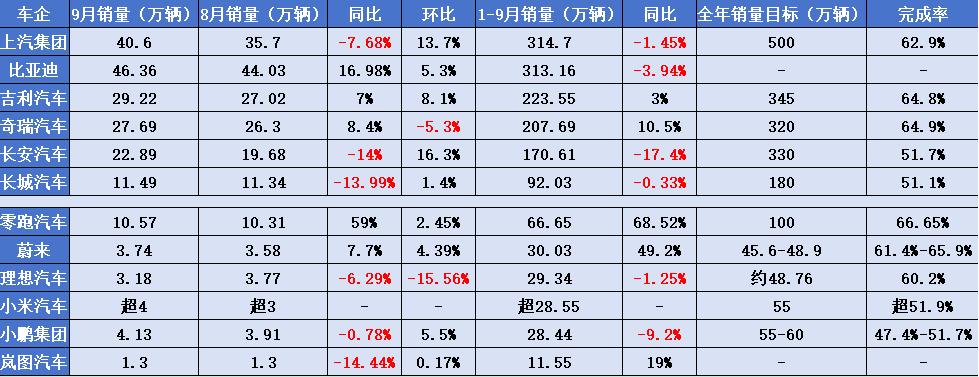
Looking back, in the first three quarters of 2026, the annual target completion rate of mainstream automakers was 28% to 96%, most of which were between 50% and 70%, so it is not easy to achieve the annual target.
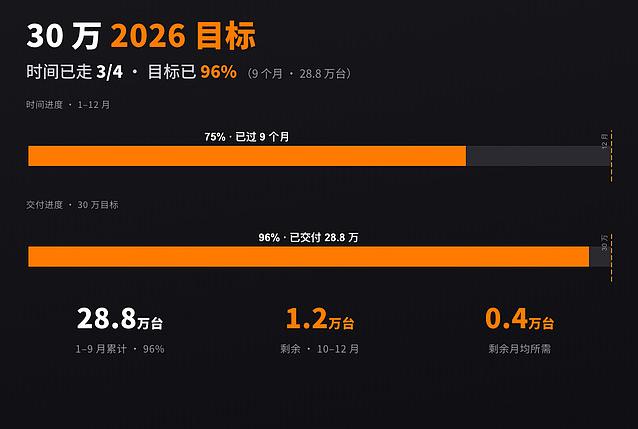
Calculated at this pace, Zeekr can relatively easily achieve its KPI.
Zeekr's annual target is 300,000 units. Its total sales in the first three quarters of 2026 reached 288,400 units. It only needs to sell more than 4000 units per month on average in the fourth quarter to meet the target, which is almost no suspense.
Source: Zhineng Auto
Apart from Zeekr, Leapmotor also has great hope.
Leapmotor's annual target is 1 million units, and its total sales in the first three quarters of 2026 amounted to 666,500 units. It only needs to sell more than 111,200 units per month on average in the fourth quarter to barely meet the target.
"Bangning Studio" said: "Sometimes targets are not set to be achieved, but to put internal pressure and tell stories to the outside. However, if the actual completion rate is too low, the inflated annual target will backfire and damage brand confidence. Entering the decisive fourth quarter, the sales pressure of all automakers is visibly rising."
Instead of Engaging in a Zero-Sum Game, It Is Better to Achieve Win-Win Results Together
Nevertheless, automakers may find it difficult to gain the dominant position in the value chain in a short period of time, and there are two reasons behind this.
On the one hand, it is difficult to change consumers' mindsets.
The "2026 Global New Energy Vehicle Consumer Research Report" shows that in car purchase decisions, the weights of batteries and intelligent driving are 13.8% and 8.7% respectively, ranking first and second.
This means that consumers' mindsets have been successfully occupied.
Taking CATL as an example, 37.1% of Chinese consumers clearly stated that if their intended model is not equipped with CATL batteries, they will give up buying that model.
It is not difficult to see that some consumers only recognize CATL.
In fact, in order to cater to consumers, the industry previously adopted CATL's products for mid-to-high-end models and non-CATL products for entry-level models, which further solidified consumer perception.
The same is true for Qiankun Intelligent Driving.
The "2026 P3 China Intelligent Driving Evaluation Report" shows that with ADS 2.0 in 2024, ADS 4.0 in 2025 and ADS V4 in 2026, Qiankun Intelligent Driving has won the first place for three consecutive years.
A market insider told Zinc Scale: "For automakers, choosing CATL's power batteries or Qiankun Intelligent Driving saves the cost of explanation, and takes a cognitive shortcut to high-end development."
On the other hand, the technical barriers are high.
As we all know, the profits of the automotive industry naturally converge to links with high technical barriers. In the era of fuel vehicles, this link is "engine + transmission".
The "2025 China Automotive Cost Analysis Report" shows that the average manufacturing cost of 100,000-yuan-class fuel vehicles is about 63,000 yuan, accounting for 63% of the retail price; among them, the cost of "engine + transmission" accounts for 28% to 32% of the total vehicle cost, about 18,000 yuan to 20,000 yuan.
Enterprises that master "engine + transmission" have long occupied the profit high ground of the industry.
From this perspective, the "battery + intelligent driving" of new energy vehicles is just like the "engine + transmission" of fuel vehicles, so it is reasonable for them to reap huge profits easily.
That's exactly why automakers have their own careful plans.
"21st Century Business Herald" said: "What China's new energy vehicles need to compete for in the next stage is not to pull each other down, but safety, quality, technology, brand and global trust. Only by returning to professional division of labor, technological competition and quality bottom line can the leaders become stronger, more enterprises grow, and the industrial ecology be healthier."
Specifically, it is not easy to break the first-mover advantage of battery enterprises and intelligent driving enterprises, and the first and foremost obstacle is the patent wall.
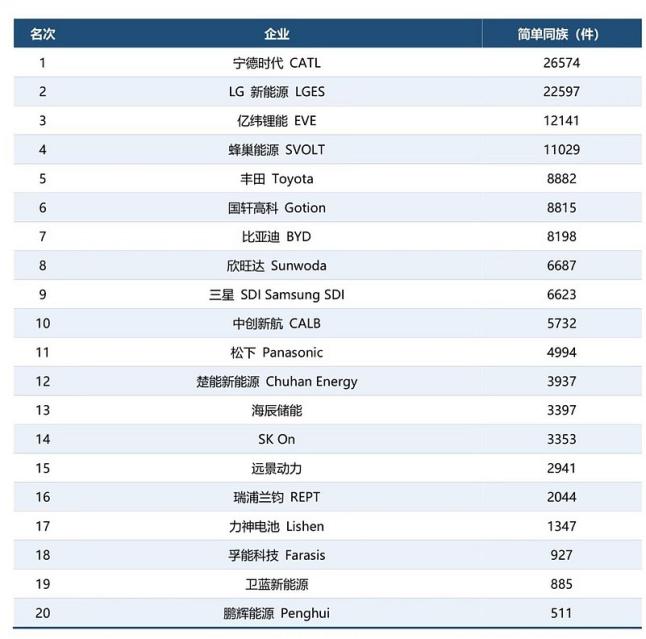
From October 2016 to September 2026, in the ranking of total patents of global battery enterprises, CATL ranks first with 26574 simple family patents, surpassing Japanese and South Korean enterprises.
Source: PatSnap Global Patent Database
The so-called simple family patent means that the same core invention submitted in different countries or regions with the same application is counted as one, which is a key indicator to measure an enterprise's technological innovation capability.
It is worth noting that battery enterprises such as Sunwoda and Goke Gaoxuan that are favored by automakers still lag far behind CATL in terms of patent quantity.
Apart from the patent wall, cost-effectiveness is another point worthy of discussion.
At present, the new energy vehicle track is becoming increasingly involuted. In order to obtain cost advantages, automakers have tried to build a controllable supply chain system through self-development, which is followed by redundant construction.
Jin Yuzhi, CEO of Yinwang Company, said: "Facing fierce competition, the first thing automakers think of is to reduce costs, and self-development has become the priority option. However, if automakers want to invest billions or even tens of billions of funds to independently develop intelligent driving systems, many automakers have annual sales of less than 1 million units. When amortized to each vehicle, the cost of the software system alone will be several thousand yuan. This system also requires continuous iteration, coupled with related investments in hardware, domain controllers and other components, the self-development model of automakers is not cost-effective."
Source: Redstar Capital Bureau
In other words, there is no zero-sum game between automakers and suppliers.
For automakers, they do not need to develop all technologies independently. Instead, they can jointly optimize costs with suppliers through joint R&D and in-depth customization, and create differentiated product experiences at the same time; for suppliers, they also need to move towards an open ecology and deeply bind with automakers to continuously expand their scale and iterate technologies.
Li Xiang, founder of Li Auto, said: "Most of Apple's A-series chips, and the flagship chips of NVIDIA and Qualcomm, are developed by manufacturers independently and manufactured by TSMC; Tesla's self-developed batteries are also produced in cooperation with CATL, LG and Sunwoda. This model not only did not make TSMC, CATL and Sunwoda weaker, but made them stronger and stronger."
Therefore, when the new energy vehicle industry chain moves from fighting alone to collaborative symbiosis, it can truly get rid of the involution of price war.
This article is from the WeChat official account "Zinc Scale" (ID: znkedu), written by Chen Duxian, edited by Li Wenjie, and published with authorization from 36Kr.