A bridge has long been built between Liang Wenfeng and Winverse.
According to public records, DeepSeek has invested in only two companies: one is Unitree, which has already landed its business, and the other is the startup Winverse AI, which has just been reported to be the target of its planned lead investment.
The founder of this company is Hu Han. He previously worked at Microsoft Research Asia, and also served as the technical lead of Tencent Hunyuan large language model.
Foreign media reports describe Winverse AI as a stealth startup, meaning it does not disclose its specific public-facing products. However, when Hu Han left Tencent in late July, he stated publicly that his entrepreneurial direction would be embodied intelligence and world models.
Liang Wenfeng once told investors in person that world models were not a priority. Less than half a year later, Liang Wenfeng broke his own rule.
So why did Liang Wenfeng choose to invest in Winverse AI at this specific point in time?
In my view, the core reason lies in a "bridge" that connects Liang Wenfeng and Hu Han.
Who is Hu Han?
Hu Han's resume can be summed up in one sentence: he has progressed all the way from "enabling machines to understand images" to "enabling machines to comprehend the real world".
He graduated with a bachelor's degree from Tsinghua University in 2008, and obtained his doctorate from Tsinghua University in 2014. During his doctoral studies, he was a visiting scholar at the University of Pennsylvania. After graduation, he first joined Baidu Institute of Deep Learning. In December 2016, he joined Microsoft Research Asia, and was later promoted all the way to principal researcher and research manager.
During his tenure at Microsoft Research Asia, Hu Han's work fully witnessed the evolution of computer vision, from convolutional networks to Transformers.
Among the papers he published is "Relation Networks for Object Detection" in 2017, which introduced relational modeling into object detection; there are also "Deformable ConvNets v2" and "RepPoints", which made detection frameworks more flexible in the convolutional era.
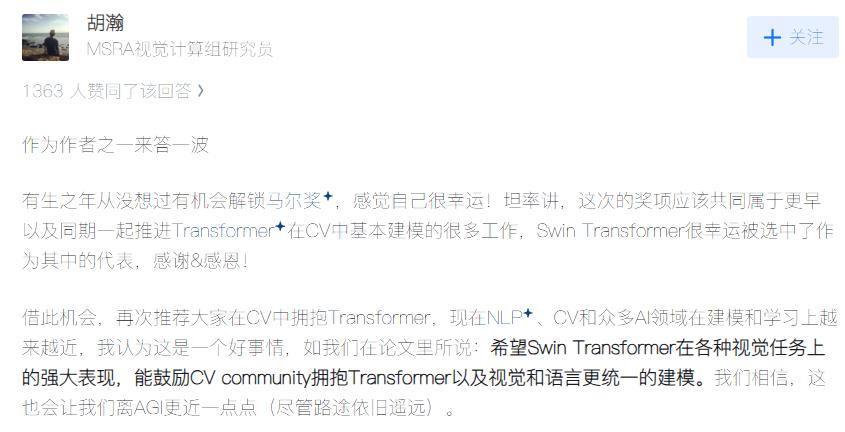
In 2021, Hu Han participated in the publication of the most famous paper "Swin Transformer", which enabled the Transformer architecture originally designed for text to "view" images efficiently.
Although multimodal models are ubiquitous today, this was a highly groundbreaking breakthrough back in 2021. As a result, this paper won the Marr Prize (Best Paper Award) at ICCV 2021.
When answering a related question on Zhihu, Hu Han said, "I never thought I would have the chance to win the Marr Prize in my lifetime", and emphasized that the award should belong to all the people who promoted the application of Transformer in the computer vision field at an earlier stage and in the same period.
After the release of Swin Transformer, the computer vision community set off a boom in self-supervised pre-training, abandoning the previous manual annotation paradigm and enabling models to learn directly from massive amounts of images.
At the end of 2021, Hu Han's team published "SimMIM", drawing on the "cloze test" idea of Google BERT: it masks part of the image and lets the model guess the hidden content, and the conclusion shows that simpler designs often deliver better performance.
Then came "Swin Transformer V2", which scaled up the visual model to a much larger size.
From this point on, Hu Han's main research line shifted from "how to design a better visual network" to "how to scale up models and achieve stable training".
At that time, large language models were just starting to gain widespread popularity.
So in January 2025, Hu Han joined Tencent as a distinguished Tencent scientist, succeeding the departing Liu Wei to take full charge of the R&D of Tencent Hunyuan multimodal large model, and served as the Tech Lead of Tencent Hunyuan large model, leading the construction of the basic visual understanding capability of Hunyuan.
In the second half of 2025, an internal organizational adjustment took place at Tencent, he transferred to the Frontier Technology Research Group under the Large Language Model Department, responsible for multimodal understanding research and reporting directly to Yao Shunyu, and participated in the world model pre-research during this period.
In April 2026, he co-published the embodied VLM base model HY-Embodied-0.5 with Yao Shunyu. In July of the same year, he submitted his resignation to start his own business, and the visual language model research direction was taken over by Tian Yonglong, a former researcher at OpenAI.
During his one and a half years at Tencent, he actually covered four research lines: multimodal large models, visual language models, world models, and embodied VLM, with the core direction remaining visual and multimodal understanding all the time.
Although Hu Han's resume is indeed very impressive, with DeepSeek's large-scale expansion of recruitment, Liang Wenfeng has seen countless outstanding resumes. Why did he take a special interest in Hu Han specifically?
The bridge connecting Liang Wenfeng and Hu Han
To answer this question, we have to go back to the author list of the aforementioned "SimMIM" paper.
There are eight authors of SimMIM in total: Zhenda Xie, Zheng Zhang, Yue Cao, Yutong Lin, Jianmin Bao, Zhuliang Yao, Qi Dai, Han Hu. The last one is Hu Han, and the first one is Xie Zhenda.
There is also a footnote in the paper: Xie Zhenda, Lin Yutong and Yao Zhuliang were long-term interns at Microsoft Research Asia.
In other words, during his years at Microsoft Research Asia, Xie Zhenda conducted research in Hu Han's group.
It does not end here. If you sort out the papers co-authored by Xie Zhenda and Hu Han, you will find that the two are long-time collaborators.
The 2020 paper PixPro, full name "Propagate Yourself", is a paper on pixel-level contrastive learning, with Xie Zhenda as the first author and Hu Han also on the author list. It explores how to carry out self-supervised representation learning at the pixel granularity.
In the author list of the 2021 Swin Transformer V2, there are Ze Liu, Han Hu, Yutong Lin, Zhuliang Yao, Zhenda Xie, Yixuan Wei and other researchers, and both Xie Zhenda and Hu Han are still on the list.
In the SimMIM paper released at the end of 2021, Xie Zhenda is the first author, and Hu Han is the corresponding last author.
What's more, these three papers share a common core theme: they all focus on "self-supervised learning" and "scaling", discussing how to make visual models continuously become stronger on a larger scale without relying on manual annotations.
Later, Xie Zhenda joined DeepSeek as a researcher, whose research directions are AGI, pre-training and scaling of foundation models.
On the author page of arXiv, Xie Zhenda's name appears in a long list of DeepSeek's works, including DeepSeek-Coder, DeepSeek-V2, DeepSeekMoE, DeepSeek-V3, DeepSeek-R1, Janus-Pro, as well as entries of technical reports related to DeepSeek-V4.
This shows that Xie Zhenda is strongly correlated with the rise of DeepSeek over the past two years.
On January 1, 2026 (arXiv timestamp is December 31, 2025), the first paper of DeepSeek in the new year "mHC: Manifold-Constrained Hyper-Connections" was published, and its first author is Xie Zhenda.
mHC does not need too much introduction. The technical document of DeepSeek V4 describes this technology as one of the three major architectural innovations, paralleled with the CSA+HCA mixed attention mechanism and the Muon optimizer.
However, there is another author in the mHC paper named Wei Yixuan, whose name also appears in the author list of Swin V2.
This means that among the young researchers in Hu Han's group at Microsoft Research Asia, more than one have become core members of DeepSeek.
Perhaps Hu Han's former lab not only trained excellent models, but also cultivated the research intuition and taste for "scaling and stable training", which is exactly what DeepSeek values most, or more precisely, what Liang Wenfeng values most.
The core members of DeepSeek once fought side by side with Hu Han and achieved remarkable results, so the information cost of understanding Hu Han can be almost zero.
Duan Yongping has a famous saying: investment is all about investing in people. Liang Wenfeng must have known Hu Han's ability very well long ago.
Why did Liang Wenfeng choose to invest instead of developing it in-house?
But here comes a question: since DeepSeek already has a strong research team and has expanded its team to 500 people, why not develop the business in-house but choose to invest instead?
After DeepSeek-R1 became a global hit during the Spring Festival last year, Liang Wenfeng was once the most "restrained" person in the entire AI circle: no financing, no expansion. But the situation has changed this year.
Foreign media reports say that DeepSeek is about to complete a new round of financing of at least 800 billion RMB, far exceeding its original target.
Domestic media citing insiders reported that the initial target was about 500 billion RMB, with an estimated target valuation of about 5 trillion RMB, and the funds will be mainly used for model training, data centers and domestic computing power resources.
Foreign media further pointed out that this sum of money may allow DeepSeek to start supporting a new generation of startups and carry out joint R&D with them.

Liang Wenfeng recognizes Hu Han's concepts and technical capabilities, and Winverse AI was founded not long ago, with few competitors entering the track yet. Therefore, Winverse AI can be said to be the most perfect investment target.
In August this year, Unitree went public. DeepSeek subscribed for the strategic placement of Unitree's IPO with about 141 million RMB, corresponding to about 2% of the equity. The two sides will carry out cooperation around large AI models and embodied intelligence.
Unitree will give priority to DeepSeek when purchasing model training services, and DeepSeek will also give priority to Unitree when purchasing robots.
This step has given DeepSeek the "body" for its embodied intelligence business. Winverse AI, on the other hand, is likely to become its "brain".
According to insiders, Liang Wenfeng has intensively communicated with embodied intelligence entrepreneurs recently, and DeepSeek is evaluating two paths internally: one is to set up a dedicated team in-house, and the other is to enter the track through investment.
Following this logic, investment is a very "DeepSeek-style" choice.
Developing robots in-house requires capabilities in hardware, motion control, and real-world data collection, which are all capabilities that DeepSeek has never had. DeepSeek's advantages lie in algorithms, training and engineering efficiency, not in supply chain management and hardware iteration.
The data source of embodied intelligence lies in the real world, which requires a large number of robots to operate in real scenarios. Unitree provides the hardware body, Winverse AI provides the models, and DeepSeek provides computing power and foundation models, forming a clear division of labor just like an assembly line.
Most importantly, if what Hu Han is doing is indeed the underlying infrastructure and model acceleration work as the rumors reveal, he will form a complementary relationship with DeepSeek.
DeepSeek is in urgent need of an interface to connect large language models to the physical world.
According to reports from Ifeng, DeepSeek's consideration of entering the embodied intelligence track may also stem from the pressure brought by GPT-6.
GPT-6 Astra achieved a 95% success rate in a robot control task, while the control model only achieved 40%. Another industry insider said that in addition to GPT-6, OpenAI is also separately training an embodied foundation model.
A person close to Liang Wenfeng said that Liang Wenfeng recently stated that DeepSeek still lags behind GPT-6 in some capabilities, so Liang Wenfeng is very likely to want to catch up with OpenAI in the embodied intelligence field.
On the same day that DeepSeek planned to lead the investment in Winverse AI, foreign media reported that OpenAI was planning to restart the Sora project.
A startup co-founded by former Sora lead Bill Peebles is in talks with OpenAI, hoping to get deep access to Sora to customize it into professional software for film production.
OpenAI may get a stake in this startup in exchange for the right of the other party to modify and commercialize the technology. It is still unclear whether the model weights will be shared, and the name of the startup has not been disclosed yet.
After OpenAI shut down Sora, all members of the Sora team were transferred to OpenAI's embodied intelligence project. Therefore, if Sora is restarted, it means that OpenAI's embodied intelligence model is almost ready, so that some team members can be reassigned back to the Sora project.
All in all, Liang Wenfeng may really want to do the robot business, but more than that, he wants to find a reliable comrade-in-arms.
This article is from the WeChat official account "Letter AI", written by Miao Zheng, and published with authorization by 36Kr.