"100 million tourists" have overwhelmed Luoyang, why can't local hotels retain guests?
During the National Day holiday, Luoyang's hospitality and tourism market presented a stark contrast between booming and sluggish performance.
A large number of tourists flocked to Luoyang to experience Hanfu, tour the ancient city at night and take stunning photos, directly pushing Luoyang to the 6th place among the most popular tourist destinations across China.
This drove the booking volume of high-star hotels in Laocheng District to rise by about 150% year on year, and that in Luanchuan County nearly doubled.
However, on the flip side, many netizens collectively complained about Luoyang's hotel accommodation on Xiaohongshu: extremely unreasonable price hikes, outdated facilities, and worrying hygiene conditions.
On one hand, Luoyang enjoyed top-tier skyrocketing tourism popularity; on the other hand, the accommodation sector was flooded with negative reviews.
Under the carnival of traffic, how can Luoyang's 6,000 hotels and homestays seize the huge unexpected benefits brought by this ancient capital?
Tourist popularity ≠ hotel revenue, where has all the money gone?
As the National Day holiday came to an end, Luoyang's cultural and tourism sector once again delivered a remarkable "report card".
On October 8, the 2026 National Day Consumption Insight Report released by Meituan showed that Luoyang was simultaneously listed in the Top 10 popular National Day travel destinations, Top 10 popular long-distance travel destinations, and Top 10 hidden gems on the must-visit list, and Laojun Mountain ranked first among all popular scenic spots across the country.
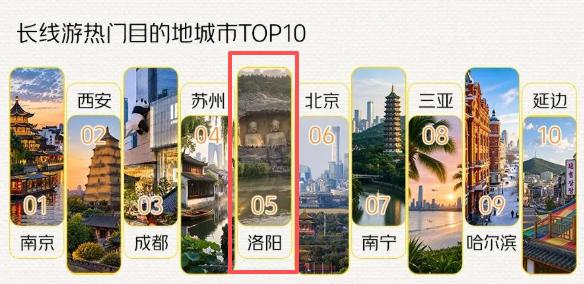
Source: Meituan
Behind the overwhelming popularity, no local Luoyang resident is sitting idle and enjoying unearned gains.
At the peak of the National Day holiday, there were about 5,000 on-the-job Hanfu makeup artists in Luoyang, and more than 200,000 hairpins were pinned on tourists' heads in a single day;
The closing time of Luoyi Ancient City was extended to 24:00, additional performances including the "Fairy Scattering Flowers" show and the "Heavenly Court Trendy Sound" music show were arranged, making the night tour atmosphere reach its peak;
Average NPC actors in scenic spots completed thousands of interactions per day;
More than 900,000 photos were taken across the city, and Luoyang locals would not let any tourist fail to take satisfying pictures.
Night tours, Hanfu experiences, NPC interactions, and ancient-style experiences seem to operate independently, but when you connect all these elements, you will find that when tourists change into Hanfu and take photos at scenic spots such as Luoyi Ancient City, Shizi Street and Lijing Gate, they will unconsciously extend their length of stay.
Moreover, the boost of "night tours" has turned tourists from one-day sightseers into overnight visitors who have to stay for at least one night, which naturally drives the growth of the local hotel market.
The night tour popularity in Luoyang is not limited to this golden week. Previously, the *Night Tour Lights Up China's Nights — 2026 Summer Night Tour Report* released by Tongcheng Travel showed that Luoyang was selected as the No.1 dark horse destination for summer night tours this year.
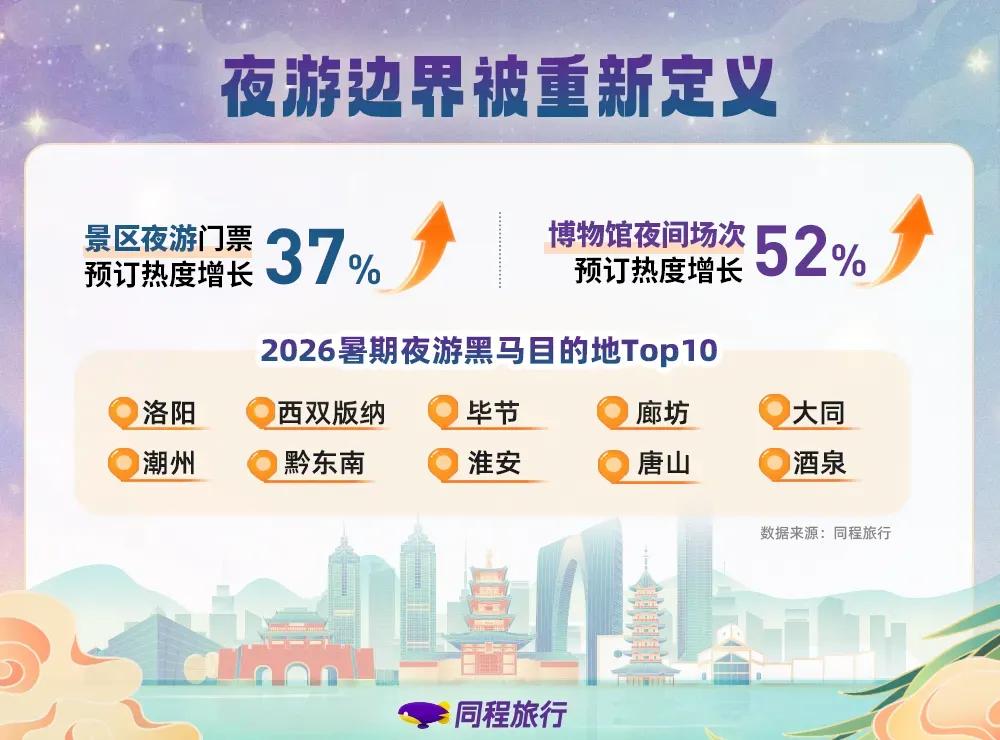
Source: Tongcheng Travel
The streets are full of huge crowds of people, and all data shows a booming market. It seems that hotels have made huge profits, but Luoyang's hotels are facing the awkward situation of having a large number of guests but not making corresponding money, with high footfall but low revenue.
In other words, the revenue is highly concentrated in the hands of a small number of hotels. The occupancy rate in Laocheng District and Luanchuan County is extremely high, with a year-on-year increase of 150% or even nearly doubling.
In the stock market, the growth in one area means the decline in another. When hotels in other regions face the same flow of tourists, the share of the cake they get is not drastically different, but the distribution is seriously skewed.
The core problem lies in the supply side.
At present, there are about 6,000 operating entities of hotels and homestays in Luoyang, with more than 100,000 rooms in total. Among them, the number of operating entities in the homestay industry has increased from 445 in 2021 to 2,781 in 2025, with an average annual growth rate of 53.9%.
The market has long been in a state of oversupply. In the past, guests competed for rooms, but now thousands of hotels are competing for the same group of guests. A dozen hotels of the same grade and type on one street divert the customer flow, leading to serious product homogeneity, and eventually the whole industry falls into the quagmire of price wars.
2 five-star hotels are far from enough to support Luoyang's ambition of being a top-tier tourist destination
Luoyang has a large number of hotels, but there is still much room for optimization in the product structure of its hotel industry.
As an ancient capital with a history of thousands of years, a national-level famous cultural tourism city, the core bearing area of Henan's cultural tourism, and a "key tourist city" approved by the State Council, all these titles are enough to attract tourists from all over the country to flood into Luoyang.
The official Luoyang Headline even released a video to tease: "During the National Day holiday, tourists joked that there were 100 million people in the city."
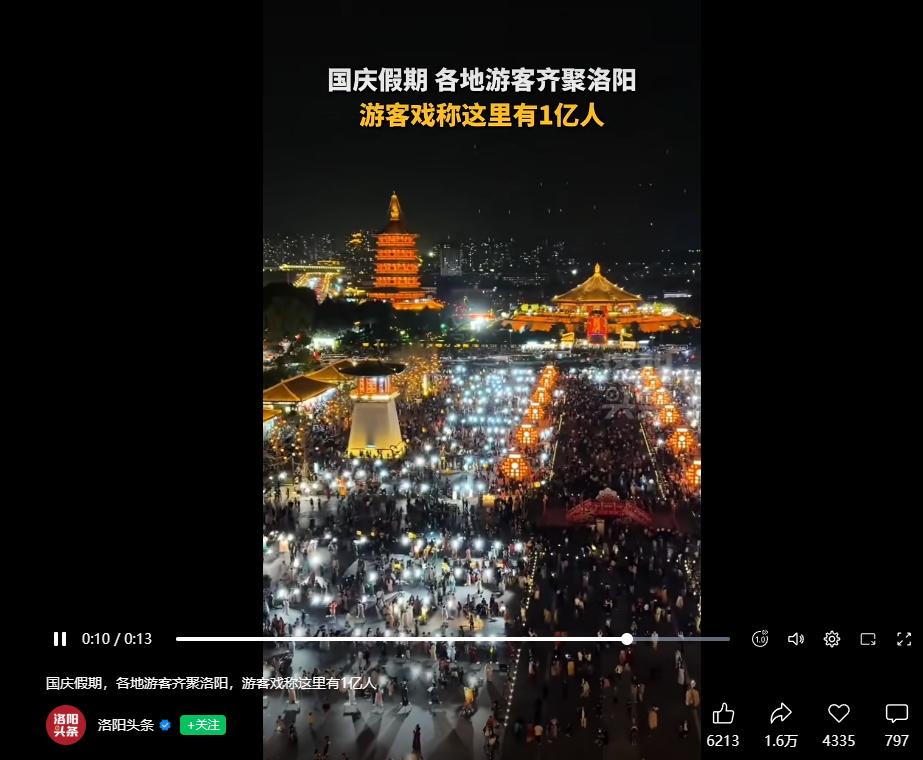
Source: Luoyang Headline
Since tourists have traveled all the way here, it is unreasonable not to stay for one night. But it seems that Luoyang's hotels are not ready to receive these "100 million tourists".
Here is a little-known fact: there are only 2 five-star tourist hotels officially registered by the Ministry of Culture and Tourism in Luoyang.
For a popular tourist city whose hotel booking popularity has increased by nearly 60% during the National Day holiday, this number is obviously too small.
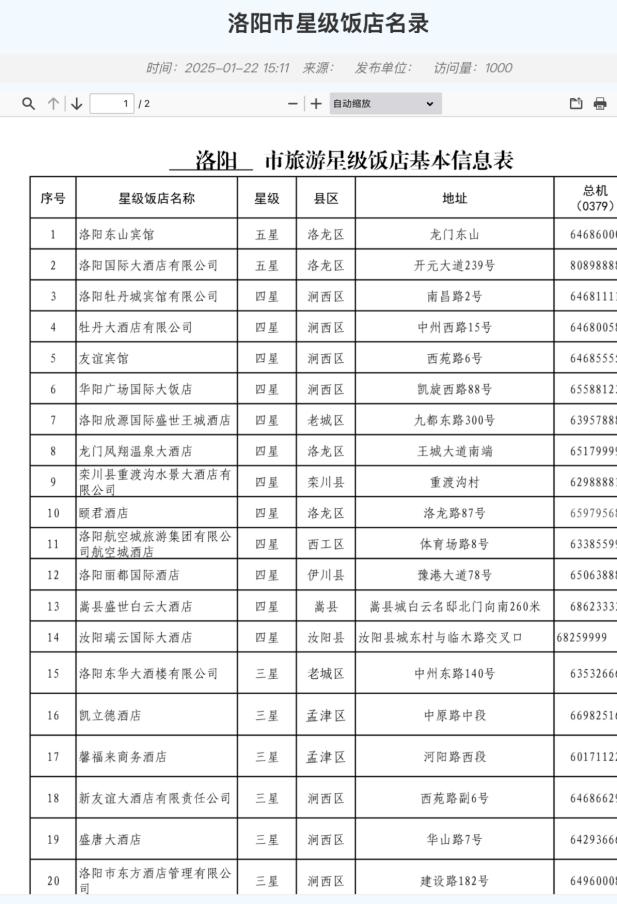
Source: Luoyang Municipal Bureau of Culture, Radio, Television and Tourism
What does this mean? In comparison with Xi'an, another ancient capital with a thousand-year history, there are 15 five-star hotels in Xi'an. The gap between the two cities is very obvious.
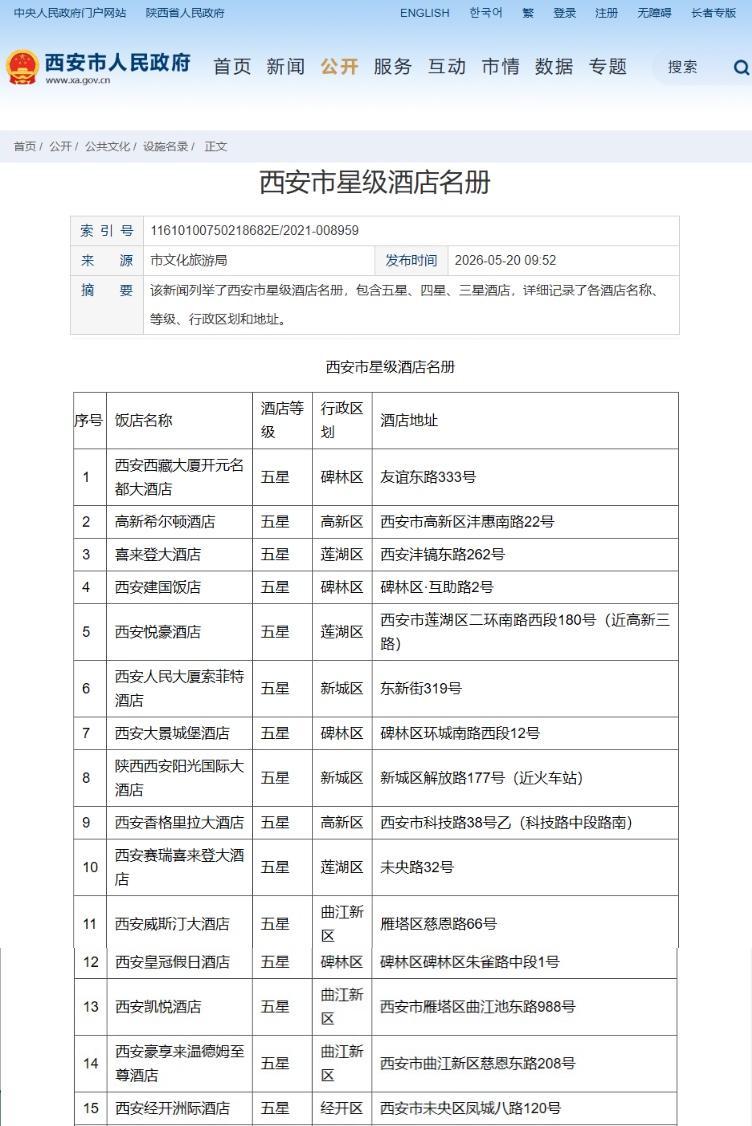
Source: The People's Government of Xi'an Municipality
With the support of these 15 registered five-star hotels, Xi'an can not only serve tourist customers during peak holidays, but also host a large number of business conferences to receive business customers in non-peak seasons, which fills the hotel occupancy rate in off-seasons.
Obviously, Luoyang lacks such supply.
However, the number of five-star hotels is not completely equivalent to the local high-end hotel supply.
But combined with the actual situation of Luoyang's local hotel supply, the quantity and quality of its high-end hotel projects are not outstanding.
Looking back, the five-star Hilton Luoyang Hotel planned by Shenglong Real Estate in Luoyang was located in a prime golden location, and was expected to become the "first five-star hotel in Luoyang".
Everyone thought that the entry of Hilton would fill the gap of high-end hotels in Luoyang, but the project was left unfinished and shelved for various reasons at that time.
The lack of international brand five-star hotels is not just a matter of poor appearance for Luoyang.
More seriously, it will also convey the message that Luoyang lacks the ability to receive high value-added customers such as high-end business guests, conference attendees and government reception guests, and these customers are exactly the key support for hotels in non-holiday peak seasons.
On the other side of the shortage of high-end hotel projects, small and medium-sized hotels are expanding wildly.
In 2025, 399 new hotels opened in Luoyang, adding more than 9,000 new rooms. But among these new hotels, only 32 are chain hotels. Among the chain brands, Huazhu accounts for 47%, Jin Jiang accounts for 25%, and Home Inn accounts for 8.6%.
By calculation, among these new hotels, more than 90% of the new hotel supply are independent hotels, homestays, or small and medium-sized properties without a brand system.
The supply is expanding rapidly, but branding and standardization have not kept up with the speed of total expansion. A large number of new hotels are independent products with rooms but no supporting system. Some of them cannot even meet the most basic reception capabilities, let alone the member network and cross-regional customer reach capabilities.
Last year, relevant persons in charge of the Standing Committee of Luoyang Municipal People's Congress also publicly stated that "with the rapid development of the industry, the homestay industry in our city has also exposed shortcomings such as imperfect management mechanisms and low industrial development quality."
A large number of homestays form the basic market of Luoyang's hotel industry, but the uneven quality of homestay products is not only related to the rating of a single hotel, but also directly drags down the reputation of the entire Luoyang hotel market.
Luoyang's hotels: need standards, and also need unique features
In the view of *Hotel Management Finance*, the core problem is the mismatch between what the supply side of Luoyang's hotel market provides and what the demand side needs.
Last year, Wei Dong, a deputy to Luoyang Municipal People's Congress and vice president of Luoyang Tourism Accommodation Association, said publicly in an interview that at present, the representative hotels in Luoyang market are still mainly urban business hotels.
The problem of product homogeneity is quite obvious, with few personalized and characteristic products. Traditional business hotels lack sufficient attractiveness to new generation business travelers and leisure tourists who pursue high-quality experiences.
Different from super first-tier modern tourist cities, tourists choose Luoyang largely because of its unique charm as an ancient capital.
What they expect from Luoyang is not just a standardized, assembly-line arranged business guest room, but an "immersive experience" that starts the moment they step into the hotel.
Obviously, those urban business hotels, mid-range chain hotels, and small homestays with uneven standardization cannot meet these expectations.
Moreover, many independent homestay hotels in Luoyang cannot even meet the most basic service requirements.
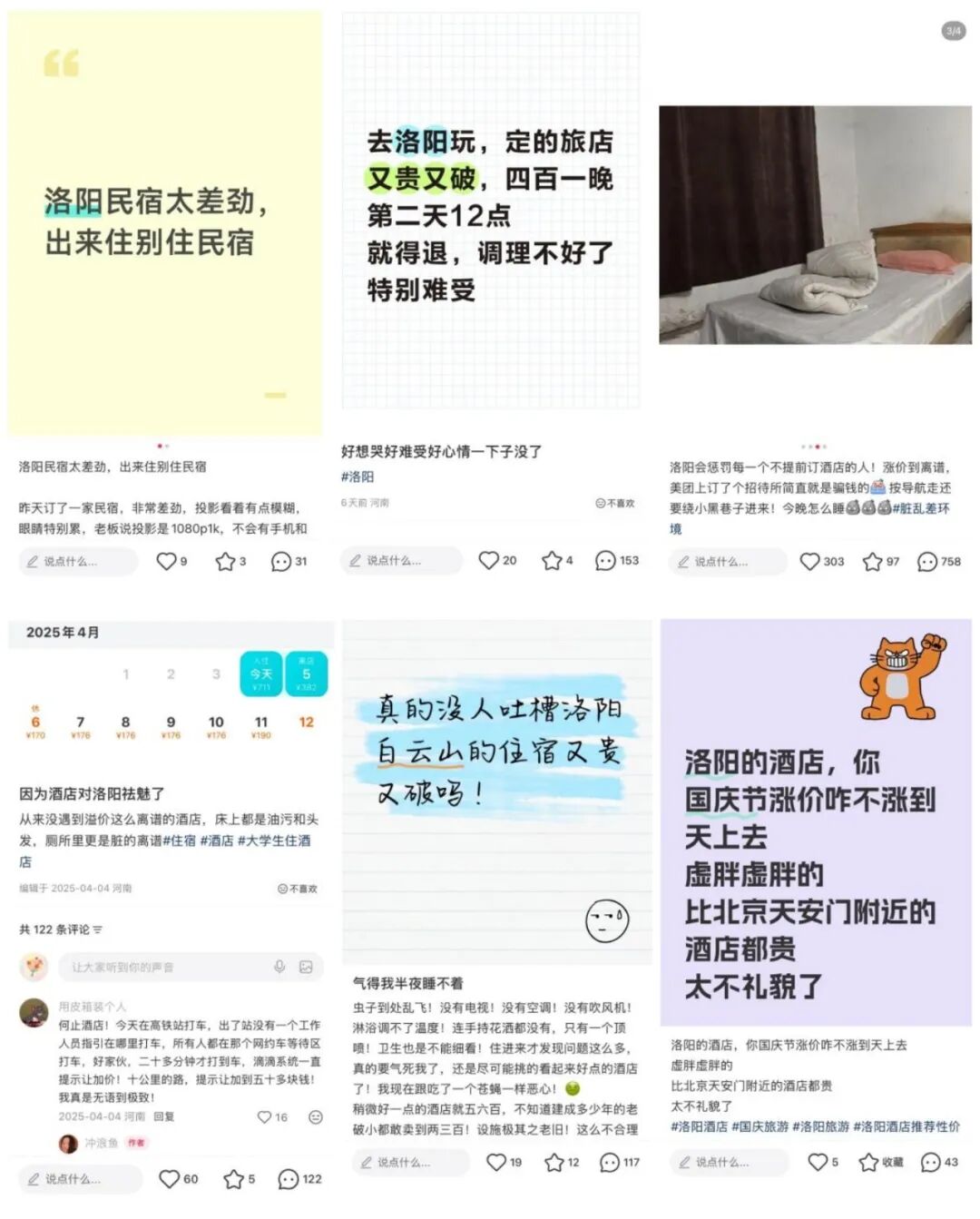
Source: Xiaohongshu
The operational shortcomings of local hotels are fully exposed in the flood of complaints. Tourists are full of disappointment at Luoyang's hotels: they traveled a long way with great expectations, had a great time playing and eating, but were tripped up by the most basic "accommodation" link.
Although the booming traffic has promoted the continuous maturity and expansion of Luoyang's hospitality and tourism industry in recent years, among the 6,000 hotels and homestays with 100,000 rooms, the proportion of branded and standardized products is unbalanced.
The impact of chain brands represented by Huazhu, Jin Jiang, and BTG Homeinns on the local market can be regarded as a dimensionality reduction strike.
These chain brands have established a clear corresponding relationship between price and quality in the minds of consumers. This standardization-based trust is a moat that most independent local hotels cannot easily cross.
All these will greatly impact the pattern of Luoyang's local homestay market.
Rather than saying that Luoyang's hotels are not ready for the huge unexpected benefits, it is better to say that they do not have enough time to make full preparations.
The explosive growth of Luoyang's tourism has only appeared in recent years. The explosive growth of homestays is forced by the huge tourist flow. The upgrading of the industry itself takes time and cannot be completed overnight.
Frankly speaking, the fact that the upgrading speed of the cultural tourism industry and its supporting industries lags behind the growth rate of tourist quantity and experience iteration is a common problem faced by many internet-famous tourist cities.
From another perspective, this is undoubtedly an opportunity for hotel groups that are eager to expand their business.
There is a large enough blank area for standardized supply in Luoyang's hotel market, and the combination of "brand standard + local culture" is obviously more attractive to them.
Of course, this does not mean that local independent hotels will inevitably be eliminated.
Luoyang's profound local culture can still help local independent hotels gain living space.
No external brand knows this land better than them:
The "soup culture" of Luoyang's breakfast may be more attractive than the assembly-line self-service breakfast;
Heluo embroidery and Tang tri-color glazed ceramics art may be more eye-catching than a few random crafts placed in the guest room; there are also peony aesthetics, Luoyang palace lanterns... They have these ready-made advantages in hand, and are born with the capital to show their unique charm.

Source: Luoyang Yunhuali Intangible Cultural Heritage Art Homestay
However, all of these are based on the premise of qualified service and quality.
In the future, the excellent result of "booking volume increasing by about 15