When AI starts talking nonsense on behalf of brands, who is footing the bill for out-of-control algorithms?
What you think is AI-driven cost reduction is turning into a "hidden bomb" for brands
Consumers are already voicing their complaints, yet brand headquarters have not even reviewed their own advertisements.
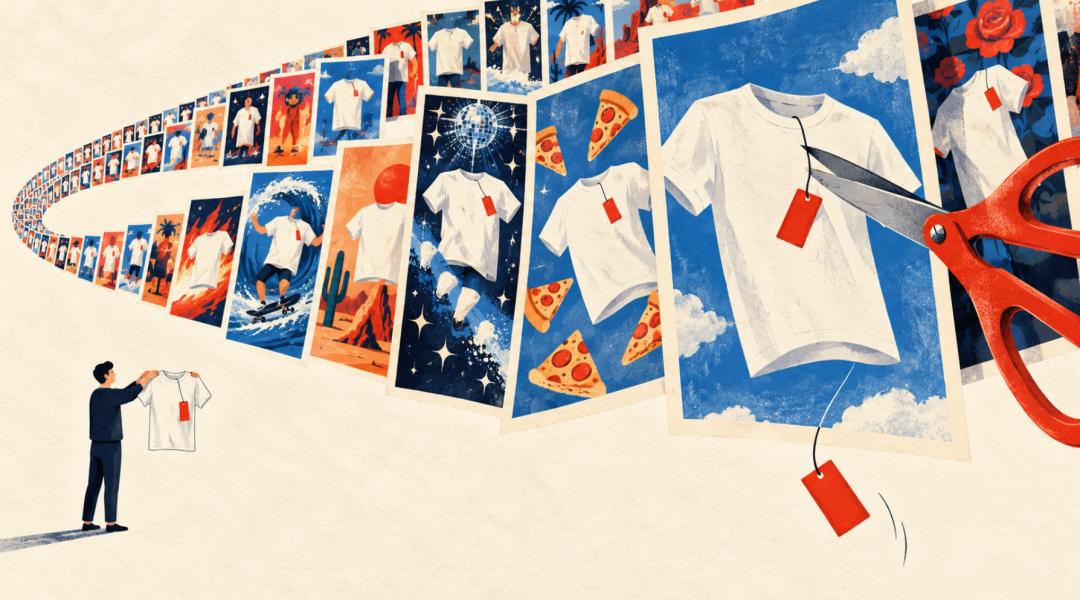
This is the most awkward scene in the "cutting off tag" controversy. On October 12, Sina Finance's *BUG* column contacted Warrior, whose marketing department staff stated that they had not seen the involved advertisement yet, and had recorded the feedback. Peak's customer service said that authorized stores can release advertisements independently without review from the headquarters.
This batch of advertisements uses similar plots to persuade customers not to return goods, and some frames are marked as AI-generated. There is no clear conclusion yet on whether they are produced by the same studio. However, the brands have exposed a problem: allowing distributors to sell goods has in effect granted them the power to speak on behalf of the brands.

In the past, this kind of out-of-control situation was constrained by production capabilities. Nowadays, a single store or a single operator can continuously generate new advertisements with the help of AI. The permissions released by the headquarters remain unchanged, but the capability and effect of channels using these permissions have changed.
AI marketing has reached this stage. A 2026 survey by CTR Market Research on more than 200 mid-to-senior marketing personnel of enterprises shows that 94.1% of the surveyed advertisers have invested in AI marketing applications, but 60.3% still rate the effect as "average". The tools have been popularized rapidly, but there is far no consensus on how to make good use of them after purchase.
For brands, the first problem brought by AI is: When advertisements can be continuously generated, rewritten and launched, how to ensure that every version adheres to the same product facts and brand stance?
Even after the original manuscript is reviewed, AI may still launch a different advertisement
What makes bosses most easily attracted by AI marketing is its low cost. Work that used to require screenwriters, actors and editors can now be started by simply inputting product information. If one version is not satisfactory, you can continue generating until you pick a usable one.

However, after the number of contents increases, the original method of reviewing each draft one by one will face huge pressure. In this case, the brand team tends to compromise: review the template first, and leave the work of changing characters, scenes and a few lines of dialogue to the operation team.
The problem may just lie in these "few lines of dialogue".
Take clothing advertisements as an example, changing "the fabric is durable" to "it will never break no matter how you wear it" seems to be just a stronger tone, but in fact it has changed the product promise. Omitting a few words in the preferential terms may also make the originally limited discount sound like everyone can enjoy it. The frames and logos remain the same, but what the brand conveys has changed.
Moreover, modifications do not necessarily stop before upload. Juying Engine's Instant Creation can generate scripts and finished videos in batches, synchronize materials to ad accounts, and then analyze performance; Google Ads provides functions such as automatically generating text, optimizing images and videos. After enabling relevant functions, brands are faced with a batch of continuously combined and adjusted contents. Reviewing one original manuscript cannot guarantee that all launched versions have been checked.
In the past, optimizing advertisements mainly meant deciding who to target with a single advertisement; generative AI has gone a step further and started to participate in deciding what the advertisement says.
Changing expressions for different people was originally an advantage of AI. But brands also need to distinguish what can be changed and what must be kept consistent. AI can change life scenarios, but cannot arbitrarily modify product materials. AI can adjust the tone, but cannot "optimize" away after-sales conditions.
The more freely AI can play, the more brands need to clarify in advance what it cannot modify. Adding only one artificial signature before release is no longer enough.
Setting rules for algorithms is more difficult than assessing employees
Requirements like "conforming to brand tonality" and "respecting consumers" are fine to be written into the brand manual, but too vague to constrain AI.
The "cutting off tag" advertisement is a typical example. Even if there are no violating words in the frames, it may still make consumers feel offended. Simply letting the system check sensitive words can hardly find what position the plot puts customers in: a person who wants to return the goods has his decision made by the merchant with a pair of scissors.
Brands need to break down general requirements into specific judgments. For example, do not describe normal return and exchange behavior as taking advantage, do not use plots that deprive customers of their choices to urge orders; preferential copy must retain applicable conditions, and the model cannot be allowed to delete them on its own for the sake of conciseness. With samples of passed and unpassed cases, operators and AI can have a common reference standard.
Ad platforms are already adding capabilities in this direction. The upcoming "Text Guardrails" feature in Google Ads allows advertisers to exclude specific words, and also restrict AI from using certain concepts, associations and expression methods. Its official instructions specifically give an example: to avoid price information in advertisements, simply blocking the dollar sign is not enough, you need to explicitly require not to generate any price-related information.
This detail illustrates the difference between old and new management methods. In the past, we mainly checked whether there was inappropriate content in the finished advertisement, but now we also need to tell the system what expressions are not allowed before generation.
However, prohibitions can only solve half of the problem. Brands also need to provide a set of reliable product materials to let AI know what can be said: which document should be taken as the standard for fabric composition, which functions are supported by evidence, and when this round of promotion ends. Distributors can use these materials to generate different versions, but cannot feed old product pages, peer advertisements and casually written selling points to the model respectively.
This also gives brand headquarters a new value. Instead of requiring each store to explore on its own and then waiting for the headquarters to find mistakes, it is better to provide confirmed images, selling points and scripts to make it easier to produce rule-compliant content. AI can help brands deliver high-quality materials to more stores, on the premise that the headquarters manages the materials well first.
Rules also need to be updated along with emerging problems. After a certain plot backfires, you cannot just delete the exposed version and let the same template continue to generate with different characters. The above-mentioned feature of Google has a referable design: when updating text restrictions, existing auto-generated materials that do not meet the new specifications will also stop being launched. Such features still have applicable scope and capability limitations, but the management logic is very clear: once an error is found, all similar content should be handled.
Advertisements kidnapped by conversion rate are killing brand reputation
Even if the product image and copy are correct, AI advertisements may still harm the brand. The offensiveness of the "cutting off tag" plot is very difficult to find by checking product parameters.
This involves a deeper question: what exactly is the system learning?
A study published by Meta researchers in 2025 provides specific reference for this. They trained the ad copy model AdLlama using historical ad performance as reward signals. In a 10-week A/B test covering nearly 35,000 advertisers and 640,000 ad variants, the new model had a 6.7% relative increase in click-through rate compared with another model trained with carefully selected advertisements.
This result proves that training the model based on ad performance can improve click effect. But the 6.7% increase is in click-through rate, which cannot be directly regarded as the increase in sales, profit or brand trust. After the advertisement is clicked, whether consumers feel cheated, or whether they request refunds may mean higher costs.
When I worked in the brand department of an online education company, I experienced this kind of division. The information flow launch was under the charge of the sales department, whose team performance was assessed by lead cost and order volume. Materials that exaggerate score improvement effects and deliberately amplify user anxiety are hard to be stopped as long as they can bring leads. The brand department can give suggestions, hold meetings, and occasionally block one or two advertisements, but their concerns cannot affect the other team's bonuses.
AI makes this contradiction more difficult to handle. It can continue to generate, test and amplify based on the materials selected by the team. If the team always rewards current-period conversion, what the brand department will face is batches of advertisements that are better at completing this task.
Therefore, review cannot only be an obligation of the brand department, it must also correspond to actual permissions. Operators can generate and test multiple versions, but adding new efficacy promises, changing preferential conditions, and adopting controversial plots require reconfirmation. The headquarters should be able to see the content actually launched by channels, and obtain the method to suspend problematic advertisements through account permissions or authorization agreements.

Assessment also needs to keep up. When testing a batch of AI materials, in addition to comparing click-through rate and order cost, refund, complaint and repurchase should also be tracked; to evaluate reputation, separate consumer surveys are required, and click-through rate cannot be used as a substitute. Materials with good short-term data but obvious subsequent problems should not continue to be the template for the next round of generation.
This will increase management costs, but the reduction in production costs does not mean that the entire marketing process should cut staff and save money synchronously. Part of the money saved by AI needs to be invested in accuracy and control capabilities.
Back to the "cutting off tag" controversy, AI has greatly lowered the threshold for speaking on behalf of the brand, so brands need to better control the basis, permissions and results of their voice. Distributors can obtain stronger creative capabilities, but cannot arbitrarily expand product promises or rewrite the brand's attitude towards customers.
Whether the brand management in the AI era is done well or not will be judged in the future by this standard: When a consumer sees an advertisement, whether the headquarters can clearly explain what it is generated based on, who confirmed it, and who will stop it if a problem occurs.
Note: The data in this article comes from public reports and public materials, some of which are based on industry experience standards and do not constitute investment advice.
This article is from the WeChat Official Account "Emphasis Next" (ID: leo89203898), author: Qing Yun, editor: Xiao Bai, published with authorization from 36Kr.