The "Dual 10,000-tier Cities" in the Yangtze River Delta no longer want to remain the economic lowland.
Hefei has nurtured industry giants like BOE and NIO with a decade of targeted investments, yet it has failed to cultivate a top-tier commercial IP. This slightly ironic comment lays bare the current predicament of Hefei.
As the fourth "dual 100-billion city" in the Yangtze River Delta — with a GDP exceeding 1.4 trillion yuan and a permanent resident population exceeding 10 million, and its economic growth rate leading all trillion-yuan cities for consecutive years — Hefei's "hard power" is beyond reproach.
However, when placed in the commercial coordinate system of the Yangtze River Delta, there is still a clearly visible gap between Hefei and Shanghai, Suzhou, Nanjing, and Hangzhou in terms of high-level commercial facilities and international consumption scenarios.
The latest development concerns the long-rumored Hefei Taikoo Li project. According to the Hefei Municipal Bureau of Commerce, in the third quarter of this year, Hefei will launch targeted investment promotion for a number of leading commercial brand projects, explicitly mentioning that major commercial projects including Taikoo Li are "under continuous follow-up".
Taikoo Li has long been regarded as a benchmark project in China's commercial real estate sector. When a city is selected by Taikoo Li, it usually means the settlement of a series of international luxury brands and the birth of an anchor point for an international business district. Among the six Taikoo Li projects (including those under construction) across the country, the Yangtze River Delta region only has the Taikoo Li Qiantan project in Shanghai. There were also rumors that Taikoo Li would settle in Hangzhou before, but the plan eventually went nowhere.
According to local media, Hefei's "obsession" with Taikoo Li has lasted for at least two years, and its significance has long gone beyond commerce itself. In the outline of Hefei's 15th Five-Year Plan, the goal of "gathering diverse business formats, scenarios and services, and accelerating the building of 10-billion-yuan-level commercial complexes" is clearly written in. Behind this wording lies a more realistic proposition: Hefei's industries have achieved successive breakthroughs in recent years, but its consumption capacity and urban functions have not kept pace in time.
Aiming at Taikoo Li, can Hefei, which "no longer wants to be a lowland", cross this threshold?
The Latecomer in Commercial Development
In recent years, as the reputation of Hefei as a "venture capital city" has grown increasingly prominent, its competition for high-quality commercial resources has also been continuously put on the agenda.
The previous high-end shopping mall that Hefei extended an "olive branch" to was SKP. As early as 2021, the official WeChat public account of Hefei Municipal People's Government published an article stating that in the following year, Hefei would promote the construction of SKP and other projects. At the same time, multiple districts under the jurisdiction of Hefei also released information such as "connecting with SKP department store" and "vigorously introducing SKP", and the rumored "Hefei SKP project" was clearly in the site selection stage.
At that time, SKP was at the peak of its momentum. Not only had Beijing SKP long ranked first in the national shopping mall sales list, but the sales of Xi'an SKP had also been rising all the way in the five years since its opening. In addition, the third SKP settled in Chengdu was regarded as a domestic commercial benchmark by the industry as soon as it opened. For a while, discussions about "the next SKP in China is expected to land in Hefei" continued to ferment.
One of the reasons is that high-end shopping malls have always been a short board for Hefei. As Winshang Network pointed out in a previous analysis article, in 2011, Gucci opened at the Wanjin Department Store of Hefei Baolong Mall, marking the end of the history that Hefei and even Anhui had no real international first-tier heavy luxury brands. The Hefei Intime Center, which opened in 2012, is still the only commercial project positioned as a high-luxury complex in Anhui Province to date.
However, there are different voices in the public about whether Hefei needs high-end shopping malls. Critics believe that Hefei lacks the soil for high-end consumption, while Shanghai, Nanjing and other cities have prominent advantages in high-end consumption supply, and Hefei cannot provide a large enough market space on its own.
Amid the widespread discussions, the commercial landscape of the Yangtze River Delta has further evolved. Hefei has not received more updates on SKP, and its commercial level has been further left behind by the provincial capitals of neighboring provinces.
In the past five years, Hangzhou has undoubtedly been the "winner" in the competition for high-end shopping malls. Not to mention that when Hefei was still waiting for opportunities, Hangzhou SKP started construction at the end of 2021 and is currently advancing towards the expected opening target next year. The newly opened high-end shopping malls have sprung up everywhere in Hangzhou.
The Hangzhou Center, which made its debut in 2023, brought the first Zhejiang stores of brands including Vivienne Westwood, MARC JACOBS and Patagonia. The Hangzhou Hang Lung Plaza that opened this year took a different approach, entering the market with experience-based commerce, and introduced more than 80 high-level first stores above the municipal level at one go.
Nanjing's commercial sector has further climbed to the "top of the pyramid". In 2024, Nanjing Deji Plaza achieved a sales revenue of 24.5 billion yuan, surpassing Beijing SKP in one fell swoop and ranking first in the global single shopping mall sales for the first time.
Up to this year, Hefei, which is "half a beat slower", has made further efforts. Five years ago, K11, which appeared on Hefei's investment attraction list together with SKP, has made new progress: Not long ago, Yaohai District of Hefei released information that it has reached a strategic cooperation with the K11 by AC Group. The main product under the latter is K11 Select, and the outside world speculates that this Hefei project may be the eighth one across the country.
The "Hefei Taikoo Li" project has even more room for imagination. Previously, there were several rumors that Taikoo Li would land in Hangzhou. After SKP, the two cities are once again standing on the same "running track".
"K-shaped City"?
Why is Hefei so "persistent" in high-end commerce? Consumption may be one of the core reasons.
In the first half of this year, a set of slightly "fragmented" data of Hefei attracted public attention: On the one hand, Hefei's GDP achieved a 6.8% growth, ranking among the top 20 cities in China, and the growth rate of the added value of industries above designated size was as high as 25.6%; on the other hand, the growth rate of total retail sales of consumer goods was only 0.6%, lower than the national average of 1.3%, and the actual consumption growth after deducting the CPI increase was only about -0.4%. Therefore, some people in the public described it as a "K-shaped city".
The stark contrast between Hefei's booming industry and sluggish consumption did not happen overnight. A set of frequently cited data shows that from 2023 to 2025, the growth rate of total retail sales of consumer goods in Hefei was 5.0%, 4.2% and 3.2% respectively, decreasing year by year, and the difference from the GDP growth rate continued to expand, reaching 0.8, 1.9 and 2.9 percentage points respectively in the three years. Compared with the national retail sales growth rates of 7.2%, 3.5% and 3.7% in the same period, Hefei failed to outperform the national average level for two years.
Further compared with Nanjing and Hangzhou, Hefei's consumption short board is even more prominent: In terms of permanent resident population, Hefei has exceeded 10 million, reaching 10.013 million at the end of last year, while Nanjing only has 9.57 million people. However, Nanjing not only has a total retail sales of 813.59 billion yuan in the same period, which is much higher than Hefei's 532.09 billion yuan, but also the per capita consumption expenditure in 2024 (45,000 yuan) is far higher than that of Hefei (32,000 yuan).
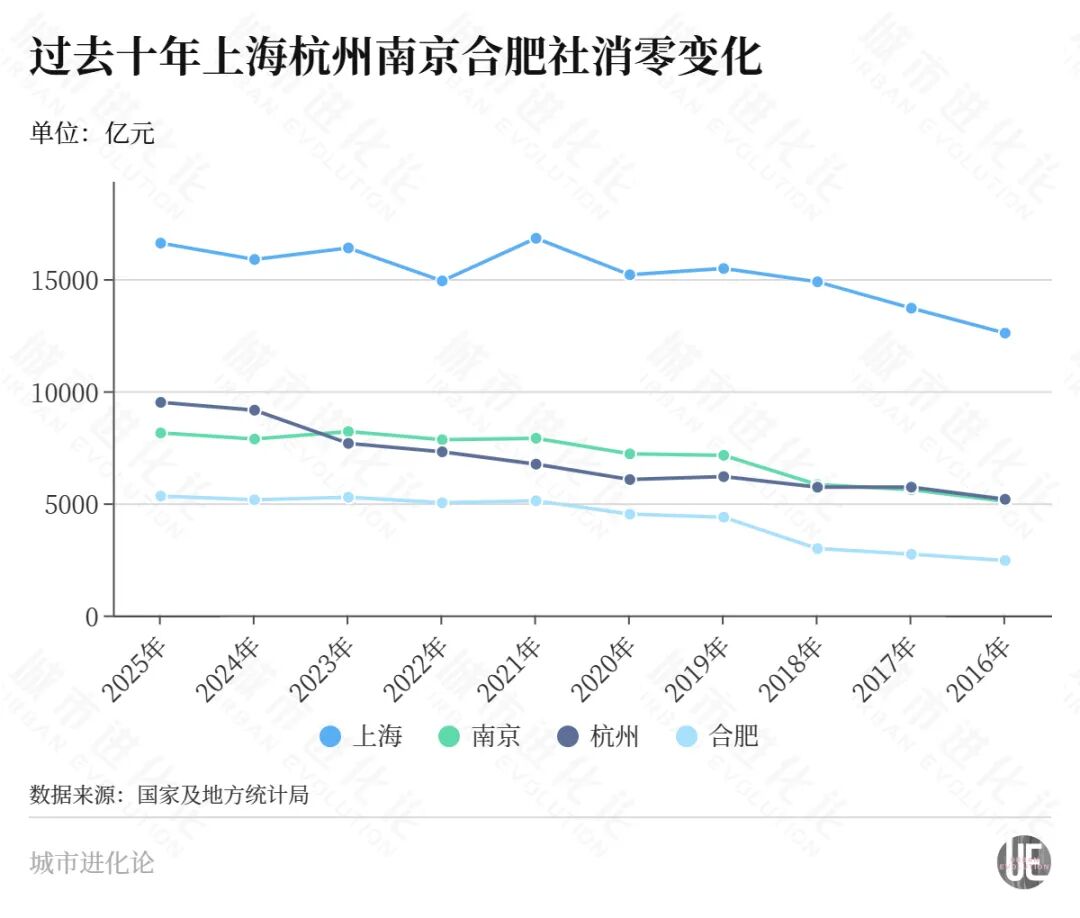
Why has Hefei's industrial growth failed to be "converted" into consumption growth? The RET Real Estate Commercial Real Estate Research Center, a well-known consulting firm, once wrote an analysis that industrial growth will not automatically be converted into commercial prosperity. There is a set of transmission mechanisms between the two, and the effectiveness of transmission depends on multiple factors, the most obvious of which are demographic structure, consumption capacity and other factors.
In simple terms, "the industrial level is very high, but if the employment density is low, the demographic dividend will be reduced; the scale of population inflow is large, but if the absolute main force is production line workers, the consumption structure will be relatively basic; the willingness to consume is very strong, but if the consumption scenarios continue to flow out — to Shanghai, to Beijing, to Tokyo — the commercial sector will suffer losses".
The impact of the first two aspects is quite obvious in Hefei. Local media surveys found that the growth of a small number of high-paying jobs cannot fully offset the impact of the relatively slow income growth of most ordinary jobs, and the disposable monthly income of local manufacturing workers is still limited. It thus concludes that when the growth of a city mainly relies on the expansion of a few capital-intensive enterprises, the increase in output value takes a longer time to be transmitted to the consumption side of ordinary residents.
When the income structure cannot be changed in the short term, can we retain consumption as much as possible and even promote consumption growth by building consumption scenarios?
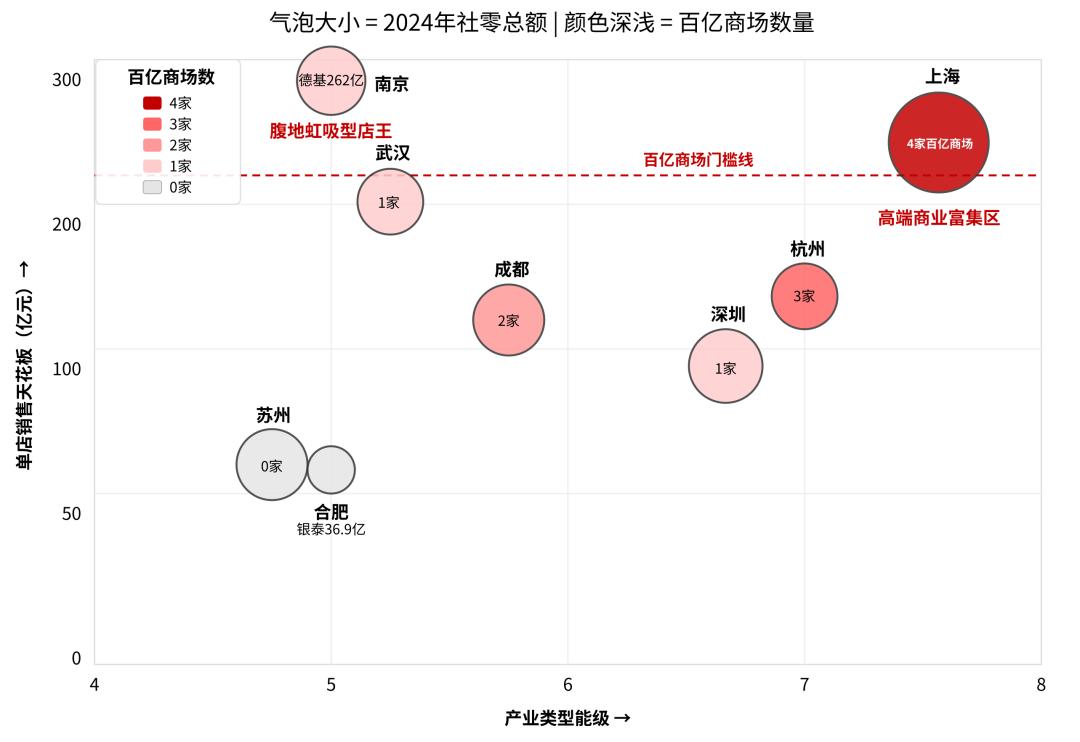
Matrix of "Industrial Background - Commercial Level" of 8 Cities in China © Sorted out by RET Real Estate Commercial Real Estate Research Center
Data shows that at present, Hefei does not have a single shopping mall with sales exceeding 10 billion yuan, while Hangzhou around it already has 2 and Nanjing also has 1. Another survey from local media mentioned that the reason for the huge gap in Hefei's sales scale is the lack of heavy luxury brands. Among the six top luxury brands, Hefei does not have Hermès, Chanel and Dior, all three of which have settled in Nanjing and Hangzhou. As a result, Taikoo Li is regarded as a "springboard" to improve the level of heavy luxury brands settling in Hefei.
The Dilemma of Transformation
For Hefei, whether it can truly leverage consumption by introducing a high-end shopping mall still remains a question mark.
Looking at the leading high-end commercial projects, the conditions for success are extremely harsh. As Zhou Yanbin, President of Winshang Co., Ltd., previously analyzed, high-end shopping malls have extremely high operating thresholds, and they often rely on specific core urban locations, historical opportunities or long-term deep cultivation of owners to gain a foothold in the local market, and their operating experience is difficult to replicate in batches.
In other words, high-end commerce and urban consumption are more mutually selective and mutually reinforcing. In fact, when asked about the criteria for selecting cities, Peng Guobang, Global Chief Executive Officer of Swire Properties, mentioned several key reference elements, including the consumption power of the city, the location of the project, the connectivity of the plot, as well as the support of partners and local governments, among which "the consumption power of a city is a very important indicator when we choose new projects".
What should not be ignored is that public consumption habits are changing, and experience consumption that emphasizes cost performance and emotional value has increasingly become an important driving force for promoting consumption growth.
Some analysis points out that Hefei should abandon the "super-large volume superstition", focus on structural gaps and scenario experience. What consumers need is not another "big box" shopping mall, but precise commercial facilities that match the social, sports, parent-child and nightlife needs of young consumer groups.
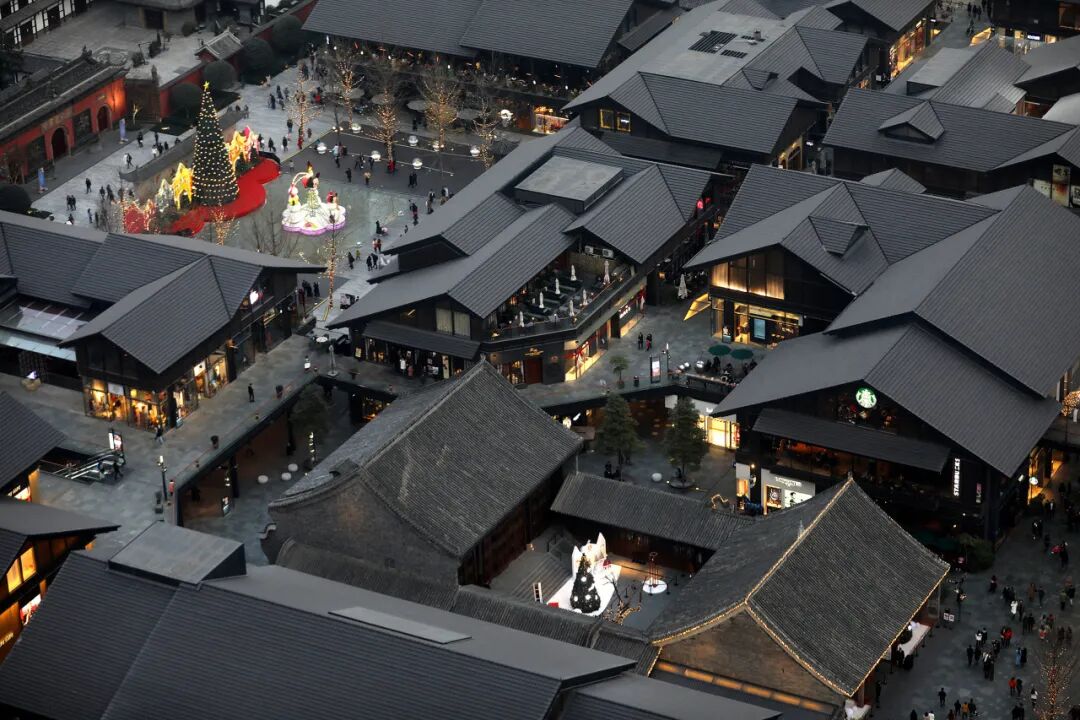
Chengdu Taikoo Li Photo Source: Photographed by Zhang Jian
However, what a "Taikoo Li" can bring to Hefei is far more than just consumption.
The city most closely "bound" to Taikoo Li is Chengdu. After opening in phases in 2014, Chengdu Taikoo Li has not only gradually grown into two 10-billion-level commercial complexes on a par with Chengdu IFS, but also its pioneering block business model at that time and the urban renewal strategy cleverly integrated with the Daci Temple have made it a cultural tourism business card of Chengdu. Later, fashion trendsetters from all over the country gathered here to take photos and "check in", and "Taikoo Li street shooting" even made Chengdu famous all over the world.
What Hefei needs at present is exactly such a cultural tourism business card. As An Xiaoming, deputy director of the Institute of Reform, Opening-up and International Economy of Henan Academy of Social Sciences, analyzed, the cultural tourism industry can help cities enhance their popularity and reputation, accelerate urban brand building, further enhance urban attractiveness, and convert brand effects into huge momentum for absorbing new population, especially attracting young talents to gather.
Looking at the nearby areas, in the face of the continuously enhanced commercial siphon effect of cities such as Hangzhou and Nanjing, Hefei should also come up with more effective countermeasures.
It has been repeatedly mentioned by the outside world that among the over 20 billion yuan sales of Nanjing Deji Plaza, the contribution from Anhui and even Hefei is not small. There is a saying that Anhui dialect is one of the most easily heard dialects in Deji Plaza, and some people even picked up Hefei bus cards here. Behind this is the years of traffic competition between Nanjing and Hefei around the nickname "Anhui Capital Nanjing".
In fact, the population growth bottleneck has become a realistic challenge for Hefei. Last year, contrary to the previous growth of hundreds of thousands of people a year, Hefei's population increment was only 3,000 people. Some analysis believes that the population growth brought by Hefei's industrial competitiveness is approaching the upper limit, and it is urgent to promote the transformation from investing in physical assets to investing in people.
For Hefei, this will be a more systematic transformation. And the introduction of "Taikoo Li" may be an important step.
This article is from the WeChat official account "Urban Evolution Theory", the author is Yang Qifei, and 36Kr publishes it with authorization.