Zhao Yiming's scales can be calibrated, yet the franchisees' accounts are very difficult to reconcile.
While the number of self-service bulk snack stores keeps growing, the bulk snack industry is facing an unprecedented trust crisis.
In August this year, a customer bought 4 pieces of beef jerky at a Zhao Yiming store in Hebei, which was weighed at 64 yuan, but the re-weighing result was only 17 yuan. The store first shifted the blame to AI, claiming it was "abnormal system recognition"; then corrected its statement and admitted the mistake, saying it was "misoperation by a new employee".
Due to a single misoperation, the price was nearly quadrupled.
It is not an isolated case. Customers at a Haoxianglai store in Henan reported that goods worth 64.8 yuan were weighed as 111 yuan, while at a Haoxianglai store in Sichuan, a customer's goods worth more than 60 yuan were weighed as 111.7 yuan.
After public opinion fermented, market regulation departments and consumer rights organizations across the country took swift actions. In late August, the Zhejiang Provincial Consumer Rights and Interests Protection Committee (hereinafter referred to as "Zhejiang Consumer Protection Committee") organized a special investigation on weighing and measurement at bulk snack stores; in early September, market regulation departments in multiple regions including Inner Mongolia, Shanxi and Jiangsu launched special measurement rectification campaigns for snack chain stores.
The incident brought to light more hidden problems. For example, according to the unannounced weighing inspection results released by Zhejiang Consumer Protection Committee, a Liyifen store in Hangzhou also had violations in weighing operation...
In the past, the practice of "short weight and insufficient quantity" among merchants selling bulk weighed snacks was only an occasional isolated case, and the regulatory authorities would impose penalties on each violating store they found. This time, such tampered scale incidents have occurred successively at leading chain stores, and the regulatory authorities have launched "special rectification" targeting "chain snack stores", with the intensity of supervision significantly escalated.
The problem of "short weight and insufficient quantity" can no longer be simply explained by a few petty merchants seeking small gains and tampering with scales. Instead, it has evolved into a persistent malady that urgently needs to be addressed in the bulk snack sector and even the entire snack retail industry.
Franchisees' profit margin is as thin as paper
Why were the goods overweighed?
Apart from extremely few cases of employee misoperation, the most straightforward and credible answer is that the stores wanted to make more money.
Nowadays, it has become far more difficult for stores such as Zhao Yiming, Lingshen Henmang and Haoxianglai to make profits than two or three years ago. It is not that consumers no longer buy cheap snacks, but that in many regions, the supply of bulk snack stores has long been severely oversaturated.
In the first half of 2026, Mingmang Henmang (formed by the merger of Lingshen Henmang and Zhao Yiming Snacks) recorded a revenue of 45 billion yuan, a year-on-year increase of 60%; its adjusted net profit reached 2.45 billion yuan, a year-on-year increase of 136.6%, which seems to be a well-deserved "profit machine".
However, it should be noted that the brand's growth mainly comes from new stores opened by franchisees. Mingmang Henmang only has 9 directly-operated stores. In the first half of this year, the total number of its stores surged from 21,948 to 26,405, with a net increase of 4,457 stores in half a year. That means on average, 24 new Zhao Yiming or Lingshen Henmang stores will pop up around the world every day. Nowadays, it is not uncommon to see two or three snack stores clustered at a single crossroad.
A direct consequence is that the customer flow of old stores is diverted by new stores, leading to a sharp decline in GMV.
In this regard, the experience of Wang Chen, a franchisee of Zhao Yiming, is very representative. He has opened 5 Zhao Yiming stores in a prefecture-level city in Hebei, with the first one launched in 2023 and the fifth one opened in 2025. He told Brand Prism: "The first four Zhao Yiming stores have recouped their investment. The fifth one used to achieve a monthly turnover of 250,000 yuan with a net profit of around 15,000 yuan when the performance was good, but later, after new stores were opened nearby, the average monthly turnover dropped to only 150,000 yuan. Now the store is no longer profitable, and I have to subsidize it every month."
At the performance meeting in April 2026, the official of Mingmang Henmang disclosed that the investment for a standard store is 800,000 to 1 million yuan (excluding rent and transfer fee). Other calculation data shows that the average monthly net profit of a single Mingmang Henmang store is only 5,500 yuan. Calculated based on an investment of 800,000 yuan and a monthly net profit of 5,500 yuan, it will take the franchisee more than 10 years to recoup the investment in practice.
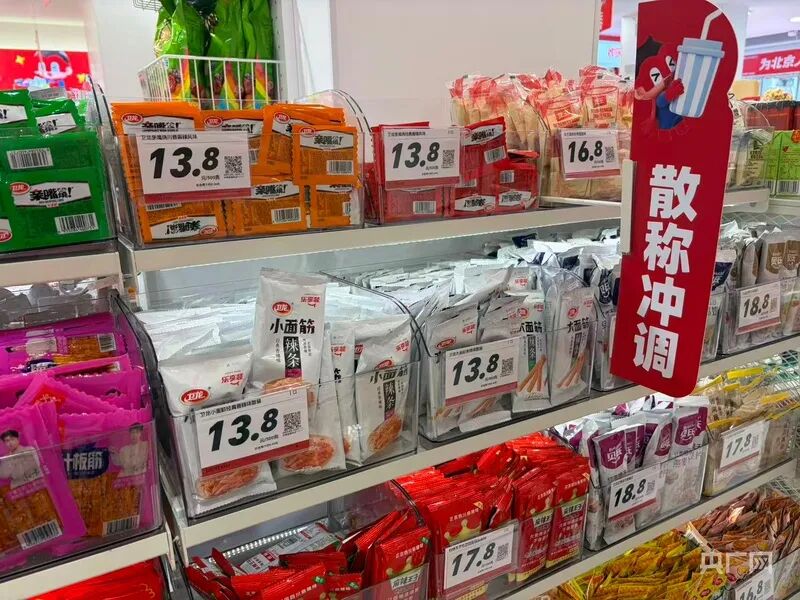
Shelves of Zhao Yiming Snacks.
Wanchen Group (which owns two major snack retail brands Haoxianglai and Laopo Daren) is facing a similar situation.
In 2025 and the first half of 2026, Wanchen Group recorded a net increase of 4,118 stores and 5,488 stores respectively, and the total number of stores reached 23,802 by the end of June 2026. On the other hand, the average monthly GMV of a single store dropped from 412,000 yuan in 2024 to 382,000 yuan in 2025, and rebounded to 406,000 yuan from January to February 2026, but the overall level still cannot return to the early stage.
In response to the successive tampered scale incidents across the country, a franchisee put it bluntly: "Investing more than 1.1 million yuan in a store to make money by shorting weight is unnecessary and not cost-effective."
But the crux of the problem is that the two leading giants in the bulk snack industry have already opened 50,000 stores.
When the business of each store is increasingly eroded, and franchisees increasingly find it impossible to recoup their investment, some will take unethical shortcuts when the legitimate way does not work. After all, for a franchise store that only earns a few thousand yuan a month, charging dozens of yuan extra for each weighing may make the difference between profit and loss, which is vital to the sustainability of their livelihood.
This is of course related to morality, but more driven by human nature.
Opening stores is the destiny of the bulk snack industry
Mingmang Henmang's store expansion plan remains extremely ambitious. According to the information disclosed by the management at the 2026 mid-year performance meeting, the annual store opening target is over 8,000, and the medium and long-term store scale is expected to reach 50,000 to 60,000.
Although Wanchen Group has not publicly released its store expansion plan, its net increase of 5,488 stores in the first half of this year demonstrates its strong expansion momentum.
Here comes the question: why are the leading enterprises in the bulk snack industry all obsessed with store expansion?
The answer lies in the essence of this business.
Compared with the traditional supermarket channel, the biggest advantage of bulk snack stores is that "no middlemen mark up the price".
Generally speaking, for food and beverages to reach the shelves of traditional supermarkets from manufacturers, they have to go through layers of distributors, and each circulation link earns corresponding profits. Bulk snack brands directly connect with manufacturers, or in other words, the brand itself is a super-large distributor that purchases goods from manufacturers and sells them directly to franchise stores.
Survey data shows that for the same product of the same specification, the terminal price in the bulk snack channel is generally more than 25% lower than that in traditional supermarkets, and some products are even more than 40% lower. There are two main reasons: first, the bulk snack industry has reconstructed the supply chain and eliminated other intermediate markup links; second, with the increase in the number of stores, the brand can carry out centralized procurement on a large scale, thus gaining greater initiative in price negotiation with manufacturers.
The brand then passes the "saved" cost to consumers. Gradually, "cheap" and "low-cost supermarket" have become the unique public perception of bulk snack stores that distinguishes them from other snack retail formats. Opening stores is the destiny of bulk snack brands, thus forming a closed loop for this small-profit but high-volume business model.
In fact, the development history of the bulk snack industry is exactly a history of large-scale store expansion, where big players acquire small ones and smaller ones choose to join the leading groups when they cannot compete.
In 2018, the first Lingshen Henmang store opened; in 2019, the first Zhao Yiming Snacks store opened; the two brands continued to expand their stores afterwards, and the total number of stores reached more than 6,500 when Lingshen Henmang and Zhao Yiming Snacks merged in November 2023; now the number has exceeded 20,000.
On the other hand, Wanchen Group entered the bulk snack industry in 2022, and then successively integrated multiple regional brands; in 2023, it unified the brands Lu Xiaochan, Haoxianglai, Lai Youpin and Yadi Yadi into the "Haoxianglai" brand, and also acquired the Laopo Daren brand, with the total number of stores now exceeding 20,000.
However, the sustainability of the commercial closed loop of the bulk snack industry relies on a prerequisite, that is, "small profit" can really bring "high sales volume".
When franchise stores are constantly surrounded by new stores of the same type, the small profit will not bring high sales volume at all, but become a death knell instead.
The brand headquarters may still rely on its store scale to deliver a lucrative financial report, while tens of thousands of franchisees are paying the price for it.
How to calibrate the tampered scales
In recent months, the "channel-exclusive products" in the bulk snack industry have also aroused widespread controversy.
The so-called channel-exclusive products are, in essence, small-packaged products specially supplied for bulk snack stores. For example, for potato chips of the same brand, the ones sold in bulk snack stores cost 2.8 yuan with a net weight of 35 grams, while the ones sold in traditional supermarkets cost 3 yuan with a net weight of 40 grams.
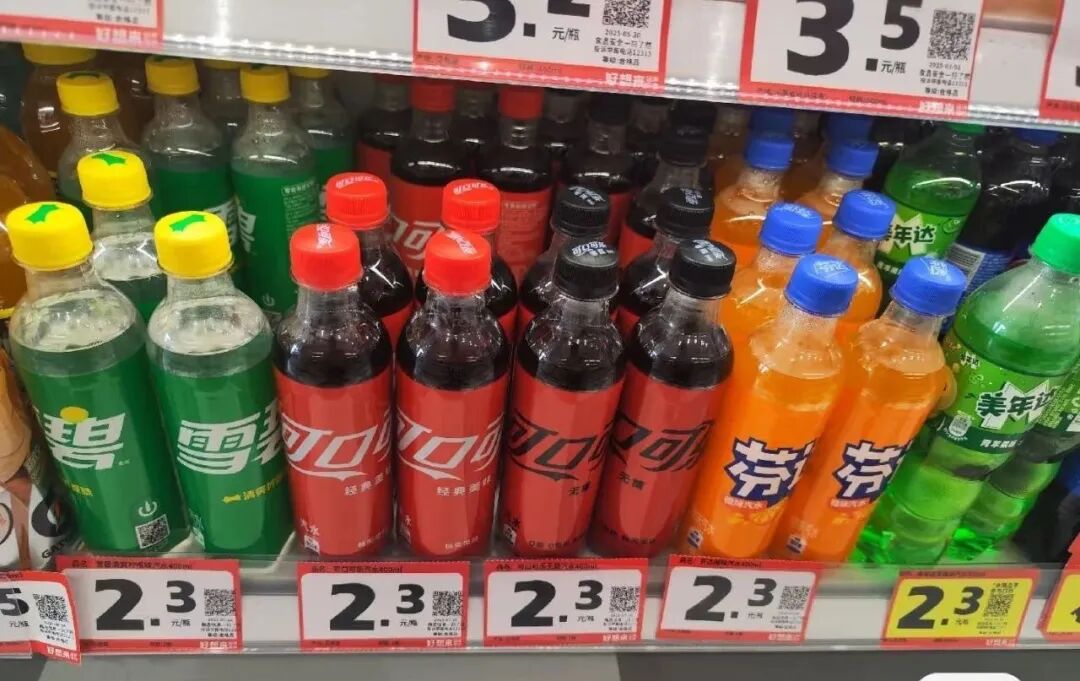
Small-packaged drinks specially supplied for bulk snack stores.
Ordinary consumers may easily think they have got a bargain at bulk snack stores if they do not pay close attention, but in fact, they pay a higher price per unit weight of the product. The potato chip product costs 0.08 yuan per gram in the bulk snack store, while the price per gram in the supermarket is only 0.075 yuan.
Tampered scales and channel-exclusive packaging, though totally different in forms, are essentially two approaches for stores to "generate extra income" under operating pressure. Since the price cannot be raised openly, stores can only play tricks in places that are not easy for consumers to notice. The difference is that tampered scales are store-level illegal acts that can be investigated and punished, while channel-exclusive products are a "collusion" between brands and franchisees to prevent large-scale store closures which will damage the brands' own interests. The latter is more hidden in form and not illegal.
After the tampered scale incidents broke out, Mingmang Henmang announced the establishment of a special compensation fund, stating that it will pay ten times the price difference of the misweighed goods as compensation in the future, equip all national stores with standard weights, launch a scale monitoring system to track and transmit all weighing information to the headquarters. Haoxianglai also announced the tenfold compensation measure, and said it will increase investment in scale equipment, order tracking, supervision and assessment.
As for channel-exclusive packaging, Mingmang Henmang has not given a positive response so far; Wanchen Group emphasized that those products are "regular exclusive supply products" and relevant information has been marked on the shelves.
A series of rectification measures launched by brands targeting illegal acts of franchise stores can certainly calibrate the scales of franchise stores, but cannot solve the structural problem of shrinking profit margins of franchisees. If stores cannot ensure reasonable profit margins under compliant operations, even if the scales are checked today, they may still play tricks on product packaging, procurement channels, or even product shelf life tomorrow.
Nowadays, after the two leading giants in the bulk snack industry have opened 50,000 stores, compared with continuous expansion, they may need to think more about how to build a reasonable benefit distribution mechanism with franchisees, which regions can still create incremental growth, and which regions need further site optimization; if a store is detected to have violated consumers' rights and interests, before the incident is exposed, whether the brand dares to take the initiative to safeguard consumers' interests instead of covering up for the store or even colluding with it.
(At the request of the interviewee, Wang Chen is a pseudonym in the article.)
This article is from the WeChat official account "BrandPrism", Author: Yang Xuan, Editor: Tian Tian, published with authorization from 36Kr.