The 460 Billion Private Placement Shadow War: Some Reap Windfall Profits, While Others Suffer a 50% Slump in Their Returns
Since 2026, the A-share market's refinancing sector has remained far from sluggish.
Wind data shows that in the first three quarters of 2026, a total of 359 enterprises completed equity financing, raising a combined 750.86 billion yuan. Of this total, IPO fundraising stood at 216.32 billion yuan, and refinancing fundraising reached 534.55 billion yuan. Among refinancing methods, private placement still occupies a dominant position, with 175 completed deals in the first nine months, raising 465.49 billion yuan, accounting for 62% of the total equity financing scale.
However, in terms of monthly data, the activity of this year's private placement market has not been evenly distributed. 19 deals were completed in January, raising 125.8 billion yuan; 22 deals were completed in June, raising 91.1 billion yuan. Although 27 private placement deals landed in August, the total fundraising amount was only 27.9 billion yuan. Several large projects in the market can still significantly change the monthly financing scale.
What is more noteworthy is that the structure of private placement is changing. On the one hand, central state-owned enterprises such as China Shenhua Energy and SPIC Energy continue to complete asset integration by issuing shares; on the other hand, enterprises in the semiconductor, hardware equipment, and smart vehicle sectors are directing more private placement funds to capacity expansion, R&D and industrialization projects.
From this perspective, the 2026 private placement market is not simply a round of pure financing boom, but rather the result of the simultaneous activation of industrial integration and the refinancing function of the capital market.
Private placement exceeds 460 billion yuan, large-scale asset injection becomes a key support
If we only look at the fundraising scale, this year's private placement has dropped significantly compared with the same period in 2025. But this figure needs to be interpreted against the special base of last year.
In 2025, four private placement deals for capital replenishment by Bank of China, Postal Savings Bank of China, Bank of Communications and China Construction Bank alone contributed 520 billion yuan in financing, pushing up the base for the same period. As of September 29, 2026, the number of private placement deals in the A-share market rose by 48% year-on-year, but the fundraising scale fell by 39.8% year-on-year. In other words, the market is not short of projects, but financing for capital replenishment by ultra-large banks has decreased significantly.
Among the 170 enterprises that have completed private placement share issuance, their total fundraising scale reached 422.408 billion yuan, including 141 cash financing deals raising 214.718 billion yuan, and 29 asset financing deals raising 207.69 billion yuan. Asset-type projects only account for 17% of the total number of deals, but their financing scale is close to half of the total.
This means that a large part of the "large amount" in this year's private placement market comes from mergers and restructurings.
Among them, Hongqiao Holdings ranks first in asset financing scale with 63.52 billion yuan, followed by SMIC with 40.6 billion yuan, the asset financing scale of China Shenhua Energy reached 40.08 billion yuan, and SPIC Energy also recorded 9.59 billion yuan.
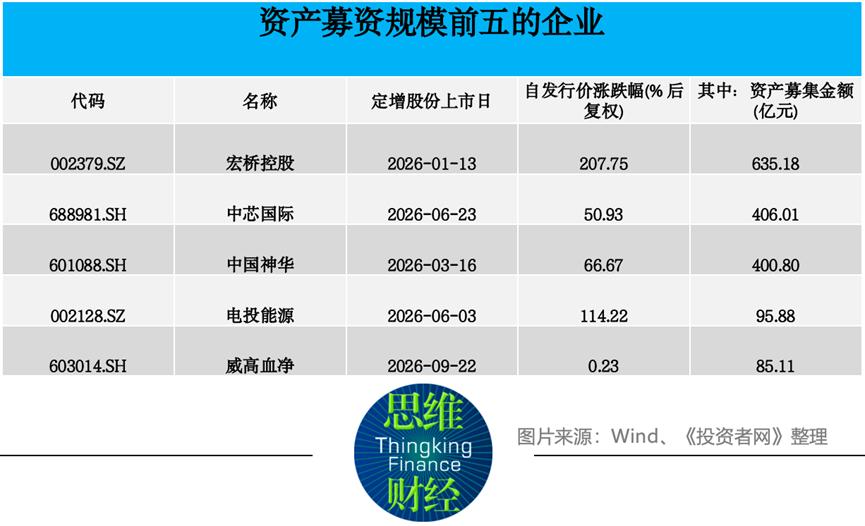
The logic behind these several transactions is relatively similar. China Shenhua Energy acquired the equity of 12 companies under China Energy Investment Corporation by issuing shares, covering businesses including coal, coal power, coal chemical industry, port shipping and other sectors; SMIC acquired the remaining 49% equity of SMIC North, making it a wholly-owned subsidiary; SPIC Energy further improved industrial synergy between coal, new energy, power and electrolytic aluminum through the acquisition of Baiyinhua Coal Power.
In addition, the asset injection of Hua Hong Hongli into Huali Micro, the injection of wharf assets by Xiamen Port, and the injection of tire-related assets by Qingdao Double Star also show obvious characteristics of intra-group integration.
This type of transaction is different from the traditional "financing due to capital shortage" scenario. Listed companies obtain internal group assets on the one hand, and on the other hand, solve the problem of horizontal competition and optimize their business structure. For central SOEs and local SOEs, the capital market is becoming an important carrier for group asset integration.
According to statistics, central SOEs and local SOEs completed a total of 58 private placement deals, raising 189.9 billion yuan, accounting for 45% of the total fundraising of enterprises that have completed private placement share issuance. Among them, state-owned capital-related asset financing reached 82.06 billion yuan; if projects such as state-owned capital shareholders' exit and minority equity integration such as SMIC are included, the relevant scale will rise further.
Beyond asset injection, technology manufacturing becomes the main line of cash private placement
Compared with large-scale asset injection, the industrial direction presented by cash private placement is more clear.
Among the 141 cash financing deals, 94 deals raised funds mainly for specific project financing, with a fundraising amount of 133.42 billion yuan; 21 deals were supporting financing for mergers and restructurings, raising a total of 47.69 billion yuan; 26 additional issuance projects included working capital replenishment, with a total fundraising of 33.61 billion yuan. In other words, from January to September 2026, more than 60% of the funds in cash private placement eventually flowed into specific projects.
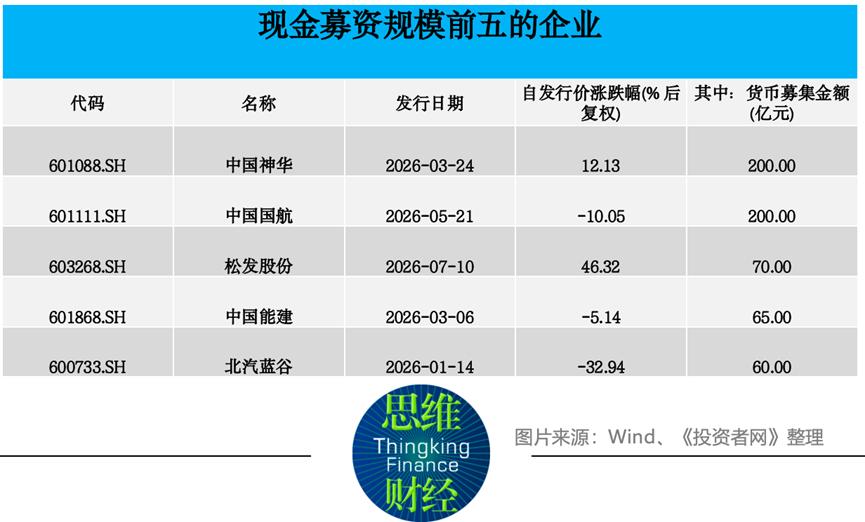
The industry distribution also confirms this point.
According to Wind primary industry statistics, in the first 9 months of 2026, among the enterprises that completed additional share issuance for cash fundraising, there were 19 semiconductor enterprises raising 82.27 billion yuan, and 25 hardware equipment enterprises raising 34.32 billion yuan. The two sectors combined have 44 deals, raising a cumulative 116.6 billion yuan, which is the most concentrated direction of cash private placement.
Among them, private enterprises are important participants in this trend. Data shows that private enterprises completed 85 cash private placement deals, raising a cumulative 82.78 billion yuan, of which about 90% is used for project financing. The funds mainly flow to sectors such as hardware equipment, semiconductors, software services and machinery.
Specifically, Tuojing Technology raised 4.6 billion yuan for projects including the high-end semiconductor equipment industrialization base and cutting-edge technology R&D center; Jiangbolong raised 3.7 billion yuan for R&D of AI high-end memory chips and memory control chips, as well as high-end packaging and testing construction; Changchuan Technology raised 3.127 billion yuan, which is also invested in semiconductor equipment related businesses.
Smart vehicles and new energy are also important destinations for private placement funds. BAIC BluePark raised 6 billion yuan for new energy vehicle model development, AI intelligent platform, as well as intelligent driving and electrification system development; China Energy Engineering Corporation raised 6.5 billion yuan, which is invested in solar thermal, energy storage and wind power projects. Songfa Co., Ltd. raised 7 billion yuan, mainly for projects such as green intelligent high-end ship manufacturing.
This corresponds to a certain extent to the structural market rally in the A-share capital market this year.
Data shows that in the first half of 2026, the STAR 50 Index rose by 64.25% cumulatively, and the ChiNext Index rose by 35.58%, significantly outperforming the CSI 300 Index over the same period. Transactions in technology sectors such as electronics and communications are also relatively active. For industries with high R&D investment and high capital expenditure, a favorable market environment helps enterprises obtain longer-term funds through equity financing.
At the same time, policies on mergers and restructurings are also playing their role at an accelerated pace. Since 2026, the China Securities Regulatory Commission has continued to optimize the review mechanism for mergers and restructurings, and refinancing systems such as shelf offering are also being promoted. The policy-level support for industrial integration, high-quality asset injection and improvement of financing efficiency has provided a strong institutional foundation for this year's private placement market.
Performance differentiation after private placement landing, the market begins to "price" different projects
In the current A-share market, the completion of private placement does not mean that the financing work is over.
For institutions and shareholders participating in private placement, the real test often comes after the private placement shares are issued. Among the 170 enterprises that have completed private placement share issuance, as of October 8, 107 saw their share prices rise after issuance, while 63 saw a fall, with an average increase of 21.7% and a median of 10.2%. Among them, the performance of asset-type private placement is significantly better than that of cash-type deals: 26 out of 29 asset-type deals recorded a share price rise, with a median increase of 42.5%; the median increase of cash-type projects was only 5.7%.
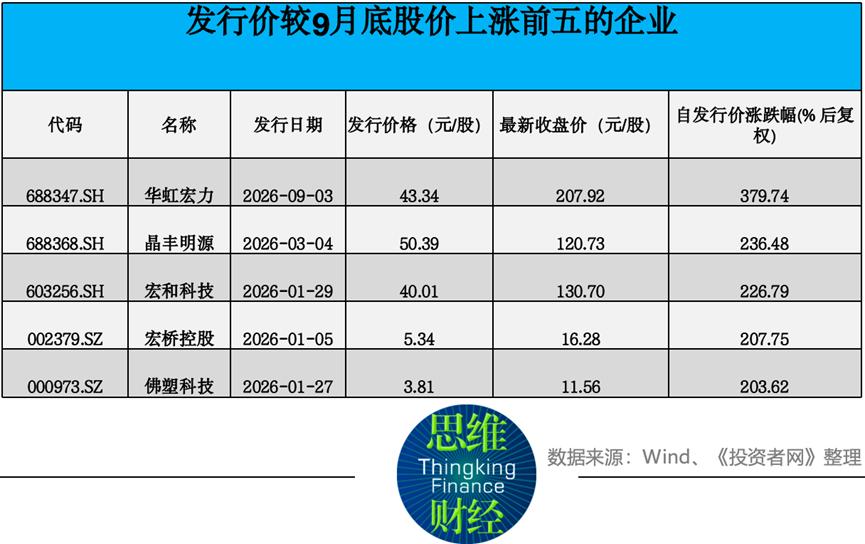
The differences between individual stocks are even more obvious.
The share price of Hua Hong Hongli after issuance has recently risen by 379.74% compared with the issuance price, while that of Jingfeng Mingyuan (688368.SH) rose by 236.48%, Hongqiao Holdings rose by 207.75%, and Foshan Plastics Group (000973.SZ) rose by 203.62%.
In contrast, the recent share price of Jiangbolong fell by 46.08% compared with the issuance price, Jianghuai Automobile fell by 44.93%, Pannua Microfiltration fell by 41.65%, and O-film Tech and BAIC BluePark fell by 38.95% and 32.94% respectively.
From the perspective of issuance discount rate, certain differences can also be observed.
Among the 141 cash private placement deals, the median discount rate on the issuance date was 13.5%. For the 9 deals with a discount rate of over 30%, the median post-issuance increase reached 54.1%, all of which recorded a rise; while for the 6 deals where the issuance price was at a premium, the median rate of return was -1.0%.
Differences in pricing methods also deserve attention. Among the 107 auction-based private placement deals, the median post-issuance rise and fall was -2.0%, with 48% of deals recording a rise; among the 34 lock-price projects, the median increase was 24.0%, with 88% of deals recording a rise. For the 36 projects with major shareholders' participation, the median increase was 15.1%, which is also significantly higher than the 1.4% of projects without major shareholders' participation.
Jiangbolong is a fairly typical case.
The company's private placement issuance price was 560 yuan per share, and the subsequent share price continued to decline. The company's current share price is around 300 yuan per share, down 46% from the issuance price, making it the cash private placement project with the largest decline in the first 9 months of 2026. At the same time, the time lag between the company's private placement issuance and subsequent capital operations has also led to a significant deviation between the institutional subscription price and the secondary market price.
But from the perspective of other cases, private placement is not a synonym for "high-risk financing". Jingfeng Mingyuan issued shares at a price of 50.39 yuan per share in March 2026, and its current share price is around 105 yuan per share; projects such as Megmeet, Jiangfeng Electronics and Songfa Co., Ltd. also recorded considerable increases in their current share prices compared with the issuance price.
Therefore, the market's feedback on private placement projects this year is no longer simply focused on "whether there is a discount". Compared with simply obtaining financing, factors including whether the assets are high-quality, whether the projects can generate new profits, and whether the issuance price is reasonable are more likely to affect the share price performance after the completion of private placement.
Overall, the private placement market in the first three quarters of 2026 presents several clear clues. First, large-scale financing mostly comes from state-owned enterprise restructuring and asset injection; second, cash private placement is concentrated in sectors including semiconductors, high-end manufacturing, AI, smart vehicles and new energy; at the same time, the secondary market has shown obvious differentiation in recognition of different projects.
This also means that the renewed activity of private placement does not mean that all private placement projects are worthy of market hype.
For listed companies, how to truly convert the raised funds into business growth still depends on the subsequent project implementation and performance delivery; for investors, the financing scale and discount rate are only part of the observation of private placement, and the industrial logic, asset quality and issuance price are equally important.
What's your view on this year's private placement market? You are welcome to leave messages, comment and share.
(This article is for reference only and does not constitute investment advice. The market is risky, so investment requires caution)
This article is from the WeChat official account "Investor Network - Thinking Finance", author: Wu Wei, authorized for release by 36Kr.