GPT-6.1 Sol expanded its capacity by 500k overnight, completely free of charge
GPT-6.1 Sol, the default context directly surges to 500k!
On the 7th day of OpenAI Day updates, the default context window in Codex and ChatGPT Work was expanded from 272k to 500k, an increase of about 80% in one go.
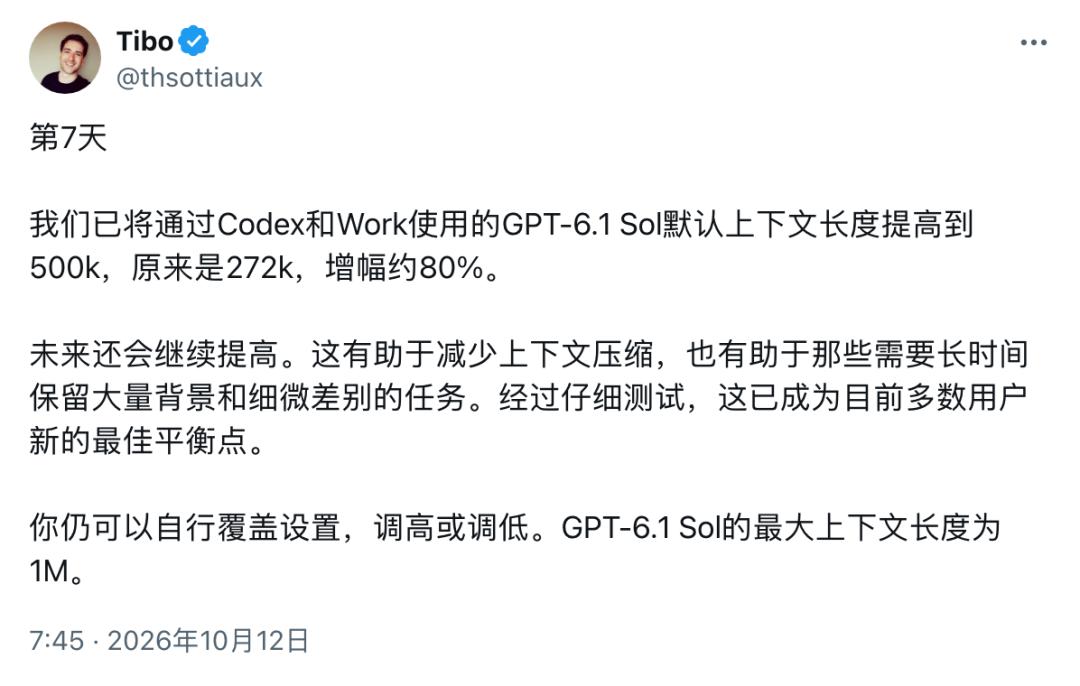
Shortly after, Tibo added another update: Running GPT-6.1 Sol with subscription credits will not incur additional long-context surcharges.

Tasks consume subscription credits as usual, but there will be no extra charges due to longer context.
Calls made via API will still be billed according to the API price list.
However, developer Mhmd Hammoud asked in the comment section: "Is changing a configuration now considered a real upgrade?"

GPT-6.1 Sol Surges to 500k, the Wish Comes True
Before the release of the default 500k context, developer Lasse had long been fed up with waiting for context compression.
He once complained that Compressing the context once in Codex could make him wait for as long as two minutes.
Two days before this update, he directly adjusted the window to 500k by himself, posted a screenshot of the status, and called on OpenAI to quickly solve the problem of overly slow compression.


When Codex is asked to check files, modify code and run tests, the code read and error messages will all occupy the context space.
When the context is almost full, it has to compress and organize the previous conversations and work progress first to free up space before continuing the task.
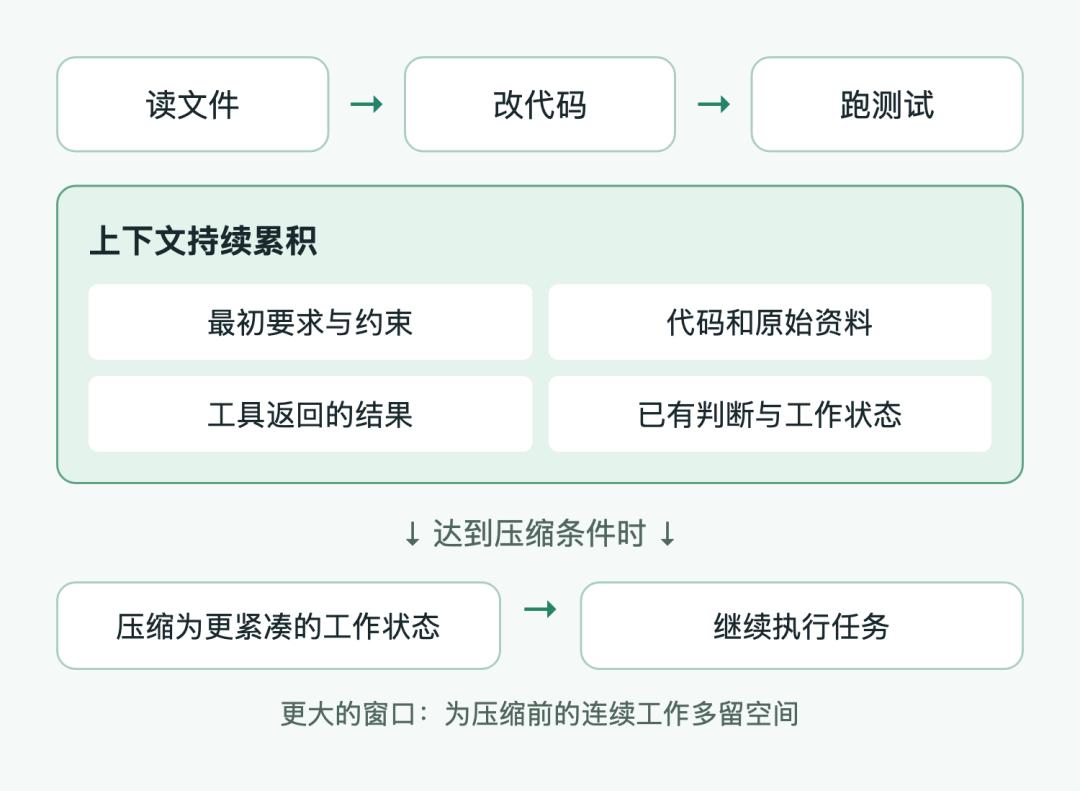
After waiting for the compression to finish, you still need to check if it has missed the initial requirements.
For example, you clearly stated at the beginning that "this interface should be compatible with the old version". If you modified more than a dozen files, the new function runs successfully, but the old interface is broken, you will end up having to fix the problem yourself later.
Tibo said that this capacity expansion can reduce the need for compression, and allow the model to retain more details in long tasks.
With fewer waits for compression and fewer repetitions of the same requirements, this 500k context can really play its role.
No Surcharges, Credits Are Still Deducted Normally
People are most worried that with less compression, credits will be consumed faster. OpenAI has actually encountered this pitfall before.
In July this year, OpenAI increased the context in its products from 272k to 372k for GPT-5.6 Sol to use.
As a result, the subscription credits were consumed more than expected, and the team rolled back to 272k. The newly added capacity was withdrawn immediately.

Developer Theo guessed at that time that it was charged at twice the standard rate when the context exceeded 272k.
Tibo corrected that there was no additional long-context surcharge for subscriptions at that time. The extra credit consumption came from repeatedly reading more cached content.
You only typed a line of "continue", and the Agent, to proceed with modifying the code, still needs to carry all the previously read files, test results and requirements.

In subsequent tool calls and continued reasoning, these contents may be read repeatedly.
Caching can reuse the processed content, which reduces the reading cost, but each read will still be counted towards the credit usage. When the content to be read and the number of reads increase, the consumption will accumulate.
Waiving the surcharge does not mean that the same task will definitely consume fewer credits.
Developers want fewer waits for compression, but they certainly don't want the credits to run out before the project is finished.
Claude Has Already Adopted 1M Context as Default
However, to judge whether 500k is sufficient, we need to compare it with Claude.
In Claude Code, the default context of Opus 5.5 and Sonnet 5.5 is 1M, which is twice the new default value of Codex this time.
In fact, the upper limit of GPT-6.1 Sol can also reach 1M, and users can manually increase it.
However, OpenAI set the default value to 500k this time because it believes after testing that this setting is more suitable for most users.
In terms of cost, when calling the API of these two Claude models, all contexts within 1M are billed at the standard unit price per Token, and the unit price will not rise even if the context becomes longer.
What OpenAI waived this time is the long-context surcharge in subscription credits, and the API pricing is calculated separately. The two sides are referring to different billing scopes.
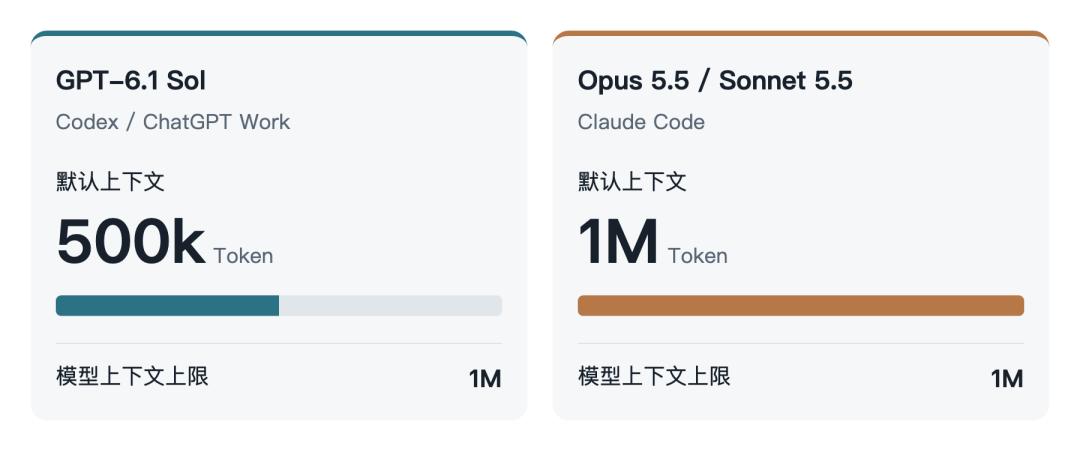
Even with a 1M window, there are still cases where the context is full. For these two models used in Claude Code, the default automatic compression point is about 967k.
When approaching the upper limit, it will first remove the earlier tool outputs in the context, such as the records left by reading files and running commands.
If the space is still insufficient, it will then organize the conversation into a summary, retain the current requirements and key code, and allow the task to continue.
Sub-tasks such as checking files can be assigned to sub-Agents. Each sub-Agent has its own context, and returns a summary of the results after the check is completed.
In this way, the main Agent can proceed with the task after getting the results, and the entire search process does not need to be added to the main conversation.
OpenAI said that the default window will continue to be increased in the future.
The window will continue to become larger, but developers' patience cannot be expanded accordingly. After the code is handed over to AI, people should be able to wait fewer times and say fewer times that "I have mentioned this requirement before".
References:
https://x.com/thsottiaux/status/2109430343346581527?s=20
This article is from the WeChat official account "Xinzhiyuan", authors: Moses, Taozi, authorized for release by 36Kr.