"AI is on everyone's lips all the time, yet nothing of substance is achieved in practice, and young people are being driven crazy by the ongoing AI frenzy."
The "AI Dun" crowd never stops talking about Prompt, Agent and multimodal models, and regards being proficient in AI as a high-end social persona. Their bravado precisely exposes their anxiety: they are afraid of being left behind by new technologies, yet incapable of truly understanding them, so they can only dispel their anxiety by talking about and advocating AI itself.
During the long public holiday, many people who returned to their hometowns felt a kind of beauty that had never been "polluted" by AI —
No one would talk about GPT, Claude, or Agent deployment, and no one knew what vibe coding or embodied intelligence was for. Parents still chat about trivial daily family matters, the warm bustling vibe of old shops across streets and alleys is reassuring, and young people have spent a few short days of life with "no office intrigues, only green beans".
After returning to work in Beijing, Shanghai and Guangzhou, people fall back into the AI quagmire again.

(Figure / *Early Spring is Sunny*)
Nowadays, AI is clearly a tool to boost productivity, but more and more ordinary people are starting to complain that they have "suffered too much from AI".
At work, people are required to use AI to optimize workflows and generate solutions, yet the outputs AI produces are even deemed unworkable by AI itself. At industry forums and award ceremonies of all scales, if you don't mention a couple of AI applications, you seem to be unable to keep up with the trend of the times. When people are thrown a line like "just use AI", it seems that all problems can be solved by this fashionable "label".
Amid the gradually building tiredness and dissatisfaction, a new group is being widely targeted for criticism. They worship and tout AI, and brag that they can do almost anything with AI, but have accomplished very few practical things, taking AI as their newly found high-end social persona.
People who can no longer put up with them gave them a more harsh nickname than "old Dun": "AI Dun".
Some make "wishes" to AI, while others are left to clean up the mess
Among the people mocked as "AI Dun", some are superiors in the workplace, regular attendees of meetings and business dinners. However, their opening remarks this year have become "I spent XX hundred million tokens", and they keep talking about Prompt, Agent and multimodal models nonstop.
AI is just like their "digital Moutai", served on meeting tables and dinner tables of all sizes, toasting to "model base" and replying with "scenario empowerment" with unshakable certainty in their tone.
There are also some people who have never been seen to hold real power or deliver any tangible results with AI, but only arm themselves with a pretentious elitist vibe through AI.
Open your WeChat Moments, people showing off luxury cars and luxury watches are outdated. Posting content like "what scenario has the large model I tuned successfully run" and "how much manpower the Agent I built saved me" brings far more sense of superiority.
In their posts showing how much money they have topped up for AI and how many tokens they have bought, they reveal a disdain of "how can there be people who still can't use AI properly", as if the more money they top up, the closer they get to the real technological revolution.

(Figure / Screenshot of social media)
Under the banner of "AI empowerment", the "AI Dun" crowd is keen to make everyone learn AI, from management to cleaning staff, they almost want everyone to become an "AI evangelist".
In the meeting room, the big screen keeps scrolling grand narratives like "cost reduction and efficiency improvement" and "process reconstruction", while people sitting under the stage look at each other in blank dismay, not even being able to clearly explain what AI can do. After the training, everyone returns to their workstations, generates a learning reflection with AI, gets the comment of "empty content" marked by the leader using AI, then continues to modify it with AI, and the cycle repeats.
AI has become the measure of everything. Ordinary office workers revise the "unintelligible script" generated by AI word by word during the day, and are too tired to keep their eyes open at night, when new messages pop up in the group: "Revise this plan one more time, AI says the logic is not clear enough." But everyone knows that the version of the plan generated by AI may not even be executable by AI itself.
With the boss holding the flag of "cost reduction and efficiency improvement", employees have to rush forward, and no one dares to complain, otherwise they will be labeled as "unable to keep up with the times".
Under the influence of widespread AI anxiety, "AI courses" on all major platforms are springing up everywhere, from 9.9-yuan introductory crash courses to "AI strategy breakthrough president classes" launched by large tech companies, with prices rising layer by layer but the content being mostly the same — nothing more than teaching you how to "ask questions", how to "tune parameters" and how to "package yourself".
Many ordinary people who paid for the courses with the mentality of "I can turn my life around after learning" find that the courses are just repeating how to write elegant Prompts over and over again after finishing the study. When they really need to use AI to solve practical problems at work, it can't help at all, leaving them with empty wallets and wasted time.
Beneath the lively appearance of the internet, a set of data poured cold water on the hype of universal AI adoption.
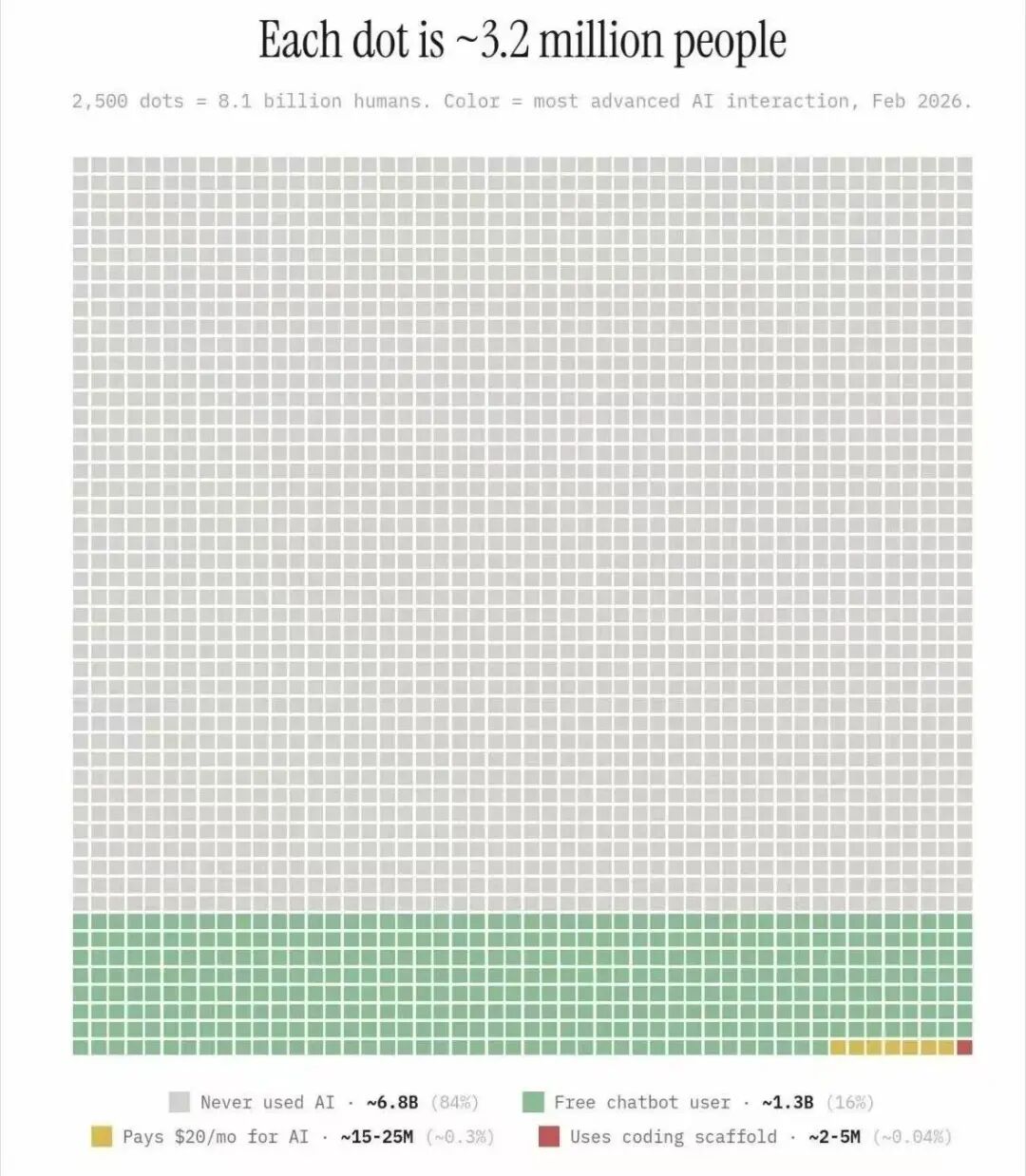
Earlier this year, data on AI usage numbers released by a foreign independent AI tech entrepreneur sparked widespread discussion. Although many people pointed out that the data he cited and the statistical methods were flawed, the post ignited an emotional crisis: the world seems to be surrounded by AI, but is it just because a small number of people have the loudest voices?
(Figure / Screenshot of social media)
The gray grid in the picture represents the vast majority of people who have never used AI, corresponding to a population of about 6.8 billion. The green block accounts for 16%, representing 1.3 billion people who have used free conversational AI. The number of people who have used Agent tools such as coding tools is even rarer, only 0.04%. And among this 0.04% of "very few people", the number of those who can really use AI to solve core business problems and create practical value is probably cut in half again.
In this illusion woven by algorithms and traffic together, on one side is the 0.04% of people at the top of the tower declaring that humanity has entered a new era of artificial intelligence; on the other side are the 6.8 billion people at the bottom of the tower who haven't even touched the door of AI.
This cognitive gap further amplifies the myth of "AI is omnipotent". AI is regarded as the new cyber "god" of this era. Companies pray to it for "cost reduction and efficiency improvement", employees expect it to be an all-powerful helper, and people are increasingly reluctant to think about whether the content AI outputs is true when asking AI questions in daily life.
Although people don't understand the existence of this "god", they always expect it to give answers to everything. So the "AI Dun" crowd is still bragging about themselves vigorously, because there are always people who need "miracles" to prove their wise decisions.
"AI Dun" has nothing to do with age, it is a set of thinking and behavioral style
"AI Dun" represents a new type of electronic superiority in the cyber age, which has nothing to do with age, and even less to do with technology itself.
One of the essences that makes the "AI Dun" crowd annoying is that they are keen to sell and show off the illusion of "understanding" rather than the ability of "using", and just regard being good at AI as a high-end social persona.
The champion of Shanghai's first pretentiousness competition once satirized this kind of phenomenon — as soon as he opens his mouth, he says "I only participate in Tencent Hackathon and Tongji University competitions", "the whole world only recognizes OpenAI's Altman and Jensen Huang", and he takes out a string of "unavailable platinum cards" that only people inside the AI circle can get, with lines like "I like to read two paragraphs of Python code as soon as I wake up in the morning" and "We usually communicate in C++, English and French are too low-grade", showing off his arrogant posture vividly and thoroughly.
After showing off for a while, they turn around and ask the organizer "Can I get my 16-yuan taxi fare reimbursed?", instantly smashing the so-called "AI elite" persona to pieces.
To put it bluntly, what the "AI Dun" crowd plays is AI socializing. Just like Bitcoin, blockchain and metaverse in the early years, any new trend will become their new round of social talking points. As long as they get in touch with it and talk about it first, it seems that they are ahead of the times.
Amid toasts and small talks, if you really ask "What have you done with AI?", they usually beat around the bush, and finally end the conversation perfunctorily by throwing a line "AI is the trend, we need to embrace changes".
After all, verification is the job of "engineers", while what the "AI Dun" crowd wants is only the posture of being one step ahead, and the sense of standing on the side of "technological correctness".
The "AI Dun" crowd not only wants to seize the initiative on technical topics, but also firmly grasp the discourse power of "I decide to use AI whenever I want" in practical applications, while the actual application effect is overkill for trivial tasks.
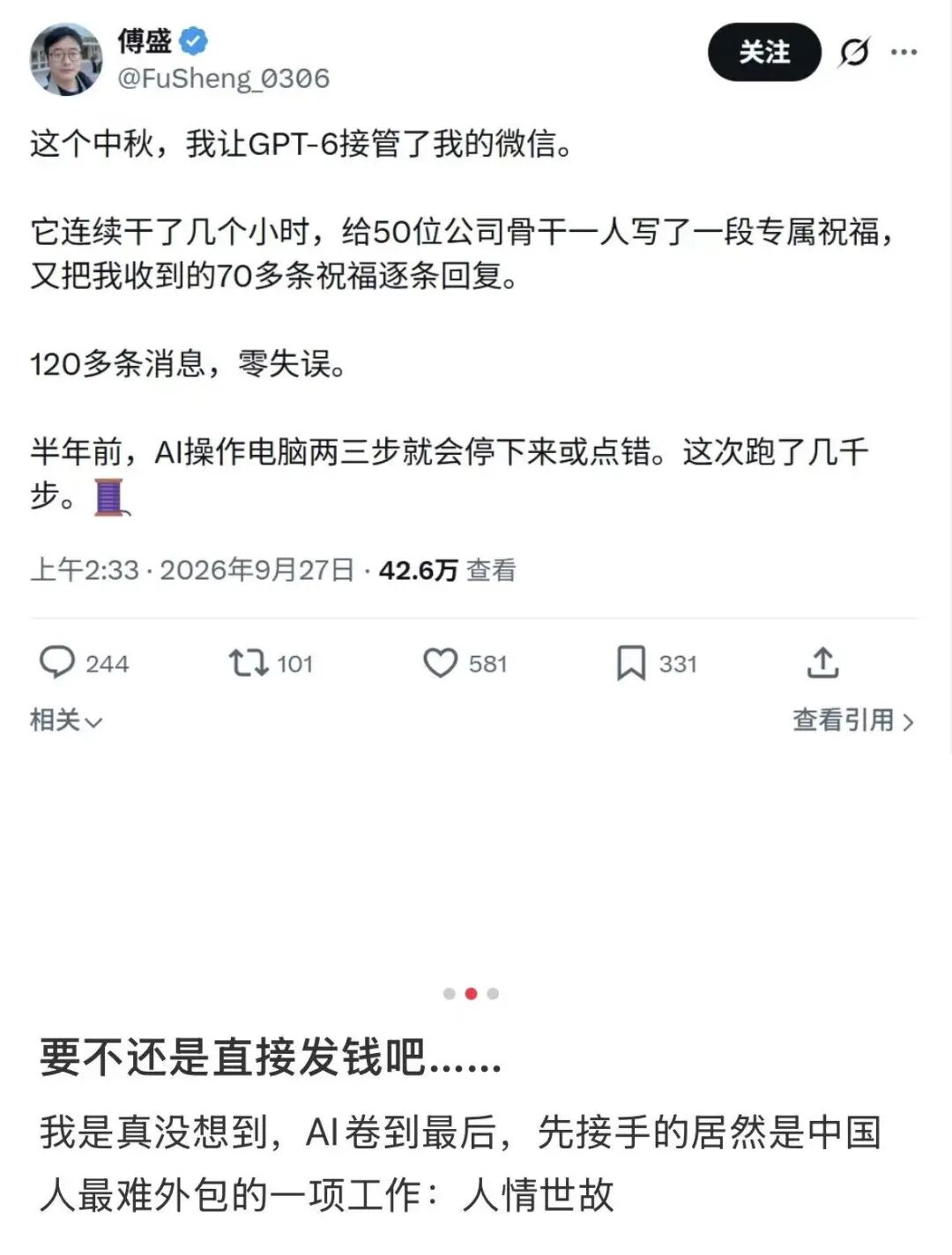
On the day of Mid-Autumn Festival, Fu Sheng, Chairman of Cheetah Mobile, posted on social media that he used AI to write a "exclusive blessing" for each of the 50 key employees in the company, and then handed over more than 70 blessings he received to AI for one-to-one replies. For more than 120 messages in total, he proudly stated that AI completed the task with zero errors.
(Figure / Screenshot of social media)
Some netizens commented: "Just give everyone a 200-yuan red envelope! What's the use of blessing messages? Others even need to reply to you." And he replied: "It seems that you are really desperate for money."
This comment unsurprisingly drew widespread criticism, some said he was indulging in self-movement, some said he was arrogant, and was only showing off his strong ambition to control efficiency.
Ordinary office workers can't feel the convenience of leaders using AI to send mass blessings to employees, they can only imagine that they have to rack their brains and deliberate on words during the holiday to respond to the "care" that has not been through the leader's mind. After the boss shows off AI achievements and attracts traffic on social media in a high-profile way, subordinates have to urgently fix the public opinion crisis caused by inappropriate remarks, and clean up the mess for the boss.
Some time ago, the short film of the Golden Eagle Award ceremony was also criticized by netizens, who thought the decision to use AI was unreasonable, as if they were "using AI just for the sake of using AI".
A large number of AI-generated virtual portraits were forcibly inserted into the original clips of the nominated film and television works. It was supposed to be a moment to show the highlight of actors' acting skills, but the virtual portraits had stiff expressions and distorted movements, which were completely incompatible with the texture of the actors' real performances, and instead weakened the emotional impact that should have been there.

(Figure / Screenshot of Golden Eagle Award ceremony video)
These clips are mocked as "so awkward that you want to dig a hole with your toes", which easily makes people question "is there any mandatory task that must use AI". In order to show that they have the ability and resources to keep up with the trend of the times, they have caused resource waste and aesthetic disaster instead.
All kinds of controversies reflect that ordinary people are getting more and more tired of the technological myth created by superiors with AI. Ignoring human warmth and applying AI in inappropriate occasions backfires... These drawbacks have been criticized repeatedly, but the people who use AI turn a blind eye to them.
Essentially, "AI Dun" is still the "Dun" who sticks to old rules
The fact that "AI Dun" has become a widely mocked buzzword is inseparable from the spread of the concept of "old Dun" in recent years.
In the 704th issue of *New Weekly*, the article *Initial Dun* points out: "'Dun' refers to a state of stopping growth at the spiritual level — experience supremacy, rigid thinking, being fond of teaching others, oppressing others by seniority, fawning on superiors and bullying subordinates, being keen to point fingers... It is not that people get old then become 'Dun', but that people show signs of aging after becoming 'Dun'. Abusing power, showing off knowledge, and relying on seniority to sell one's old stories are the real sources of the 'Dun vibe'."
The "coat" of "Dun" is not the only one, it keeps updating. Success studies, wolf culture, OKR, new concepts come in waves, but the core of the people who hold discourse power and use them has not changed —
They always try to use a set of trendy narratives to cover up those old and stubborn domination logic.
Since its birth, the concept of "Dun" is rooted in the context of superior-subordinate power relations. The "old Dun" in the past showed off their cognition by reciting management maxims, while today's "AI Dun" keeps up with the trend and flaunts themselves by talking a lot about AI empowerment. Tools have been updated again and again, but the "Dun vibe" remains the same.
"Use AI to handle this spreadsheet" "Anyway, we have AI now, it will be done quickly"... Behind these words of the "handle it casually" group, there is a stale logic that changes in form but not in essence: they push all the thinking responsibility and communication responsibility that they should bear to the tool.
(Figure / *Overacting*)
The ridiculous bravado of the "AI Dun" crowd precisely exposes