What changes are taking place in the third-party payment industry behind the 576 trillion yuan payment market?
Abstract
In 2025, the transaction scale of China's third-party comprehensive payment market reached 576 trillion yuan, representing a year-on-year increase of 2.8%. After years of rapid development, China's third-party payment industry has entered a mature stage where standardization and innovation are equally emphasized. While the market size continues to grow, the penetration rate of personal payment is close to the ceiling, and enterprise payment shows stronger growth resilience, bringing new features to the development of the third-party payment industry.
Released by iResearch, "2026 Research Report on Platform Activity in the Third-Party Payment Industry" shows that in the first half of 2026, the competition pattern of independent third-party payment platforms is generally stable, but most platforms have seen a year-on-year decline in the number of monthly active devices compared with the same period in 2025. With the development of payment services of traffic platforms and the exploration of new technologies and application scenarios such as AI payment and M2M transactions, the third-party payment industry is presenting a more diversified development trend.
Market growth stabilizes, and enterprise payment demonstrates growth resilience
After more than 20 years of development, China's third-party payment industry has gradually matured. The Report points out that since 2019, the third-party payment industry has entered a mature stage that attaches equal importance to standardization and innovation. With continuously tightening supervision, stable market development and relatively slowing growth rate, relevant payment institutions seek innovative development by exploring new fields such as cross-border payment, AI payment and value-added services.
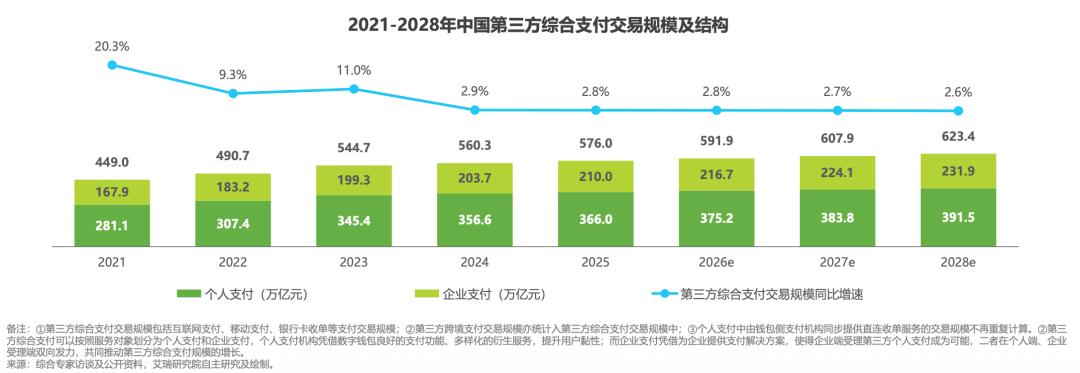
In terms of market size, in 2025, the transaction scale of China's third-party comprehensive payment reached 576 trillion yuan, representing a year-on-year increase of 2.8%. Among them, the transaction scale of personal payment reached 366 trillion yuan, up 2.6% year on year; the transaction scale of enterprise payment reached 210 trillion yuan, up 3.1% year on year. Although personal payment still dominates the third-party comprehensive payment market, its penetration rate is close to the ceiling with a relatively slowing growth rate. In contrast, benefiting from the in-depth advancement of enterprise digital transformation and the continuous expansion of cross-border e-commerce payment scenarios, enterprise payment shows stronger growth resilience.
In the future, with the continuous deepening of the enterprise digitalization process, the integration of payment services and business scenarios will become closer. The Report predicts that enterprise payment is expected to continue to maintain a higher growth rate than personal payment, and its share in the third-party comprehensive payment market will also steadily increase. From the perspective of the overall market size, according to iResearch's calculation, from 2026 to 2028, the transaction scale of China's third-party comprehensive payment is expected to reach 591.9 trillion yuan, 607.9 trillion yuan and 623.4 trillion yuan respectively, with corresponding year-on-year growth rates of 2.8%, 2.7% and 2.6%, maintaining a steady growth trend on the whole.
At the same time, the regulatory system is also continuously improving. Since the end of 2025, the supervision of the third-party payment industry under the framework of the *Regulations on the Supervision and Administration of Non-Bank Payment Institutions* has further extended to technological innovation supervision, business origin constraints and full-cycle dynamic management. As the industry gradually enters a mature and standardized development stage, payment institutions are also continuously exploring new business directions.
The overall competition pattern remains stable, and payment platforms explore differentiated development
While market growth tends to be stable, the competition pattern of third-party payment platforms also presents new features.
Data from the Report shows that in the first half of 2026, the overall competition pattern of independent third-party payment platforms is relatively stable, with Alipay, Quick Pass, and China Mobile Financial Technology still ranking top three. It is worth noting that while the overall competition pattern remains stable, most independent third-party payment platforms have seen a year-on-year decline in the number of monthly active devices compared with the same period in 2025.
With the steady development of main businesses of traffic platforms such as Meituan, JD.com and Douyin and the effective layout of their payment services, the development of non-independent third-party payment platforms has affected the overall competition pattern of the third-party comprehensive payment industry to a certain extent.
From the perspective of the competition pattern in the personal mobile payment market, payment platforms built on ecological systems have become the backbone of China's personal mobile payment market. The Report points out that payment institutions in the first echelon have established a leading position by connecting scenarios within the ecosystem and taking the lead in laying out the payment system; payment institutions in the second echelon, based on their original ecological fields and application scenarios, build payment platforms independently. With the increase of the penetration rate of their own commercial payment scenarios and the enhancement of interconnection capabilities between payment institutions, they have shown a rapid growth trend in recent years.
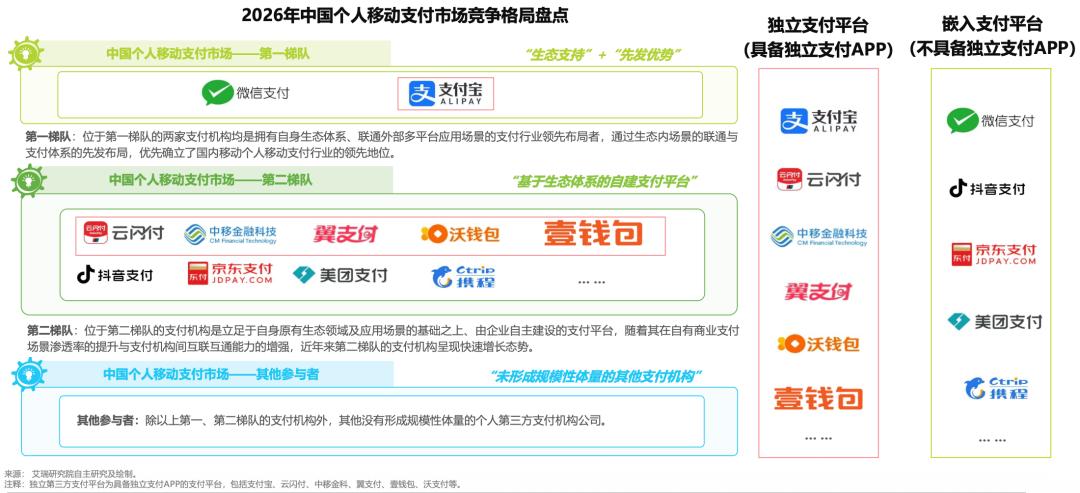
In this competitive environment, independent third-party payment platforms are also continuously giving full play to their own advantages. The Report points out that independent third-party payment platforms have more mature and complete comprehensive financial service capabilities, with outstanding technology accumulation, innovation and risk control capabilities. In the future, relevant platforms need to continuously deepen their efforts in fields such as payment solutions, comprehensive finance and industrial digital empowerment while strengthening effective user acquisition.
AI payment and M2M expand application scenarios, and payment services extend to intelligent direction
With the development of technologies such as artificial intelligence and the Internet of Things, the integration of payment services and intelligent scenarios has been further deepened. The Report lists the normalization of Machine-to-Machine (M2M) transactions and the integration of AI payment and intelligent scenarios as important development trends of the third-party payment industry.
Among them, M2M payment refers to payment transactions automatically initiated and completed between devices through Internet of Things technology without direct human participation. The development of technologies such as AIoT, communication technology and edge computing provides a technical basis for automatic transactions between machines; enterprises' pursuit of supply chain and operational efficiency, as well as consumer side's demand for smooth payment experience, are also promoting M2M payment to penetrate into more scenarios.
In the intelligent supply chain scenario, the production line of a smart factory can automatically initiate procurement and complete payment based on material consumption data; in the intelligent travel scenario, autonomous vehicles can automatically identify and pay for expressway tolls and parking fees, and independently complete cost settlement during energy replenishment. With the continuous development of relevant technologies, M2M payment is expected to gradually expand to multiple fields such as supply chain, transportation and urban management, reducing manual intervention and improving operational efficiency.
At the same time, M2M payment also puts forward higher requirements for device identity authentication, data privacy protection and payment protocol interconnection. The Report proposes that zero-trust security architecture can be adopted to strengthen device identity authentication and dynamic authorization, and promote technology enterprises and financial institutions to jointly formulate relevant communication and payment protocols to improve interoperability between devices.
Linked with M2M payment, AI payment is also promoting payment services to further integrate into users' life and work processes.
The Report points out that the core value of AI payment lies in seamlessly embedding the payment link, which used to be an independent transaction action, into the whole process of users' life and work, promoting the service reach mode to transform from the traditional "people looking for services" to the intelligent "services looking for people".
This trend is reflected in scenarios such as smart homes, smart cockpits and AIoT. For example, a smart refrigerator can automatically place an order to restock according to inventory changes, a smart cockpit can provide scenario-based payment services combined with geographical location and travel intentions, and a smart vending machine can also automatically initiate restocking and payment settlement through AI inventory management.
In the business layout of payment institutions, AI payment has also become an important exploration direction. Some institutions focus on AI-native payment infrastructure and AI full-link ecology, launch native payment capabilities for agents and AI open platforms, and explore the in-depth integration of payment services and agent applications; other institutions focus on the upgrading of AI intelligent payment, incorporate large model computing power, agent membership and AI tools into the product rights and interests system, and continuously enrich relevant products and services.
The Report believes that with the evolution of AI decision-making capabilities and the standardization of IoT payment protocols, payment services will be further integrated into the process of intelligent systems perceiving demands and allocating resources, and are expected to give rise to a new circulation ecology of commercial value.
Conclusion
From the changes of market size and structure to the platform competition pattern and technological innovation, China's third-party payment industry is exploring new development space in the mature stage that attaches equal importance to standardization and innovation.
The penetration rate of personal payment is close to the ceiling, and enterprise payment shows stronger growth resilience; the overall competition pattern of independent third-party payment platforms remains stable, and payment institutions continue to explore diversified business directions while giving full play to their own advantages. With the further deepening of the integration of AI payment and intelligent scenarios, and the penetration of M2M payment into more fields, the combination of payment services and business scenarios is expected to become closer.
In the future, with the continuous advancement of enterprise digitalization and the continuous development of payment technology, fields such as payment solutions, comprehensive finance and industrial digital empowerment will still be the important directions that third-party payment institutions continue to focus on.
This article is from the WeChat Official Account "iResearch" (ID: iresearch-), written by iResearch, and authorized for release by 36Kr.