Healthcare companies are queuing up to pour money into the AI semiconductor industry.
A number of listed medical companies are investing hundreds of millions of yuan to acquire "admission tickets" for equity stakes in AI and semiconductor firms.
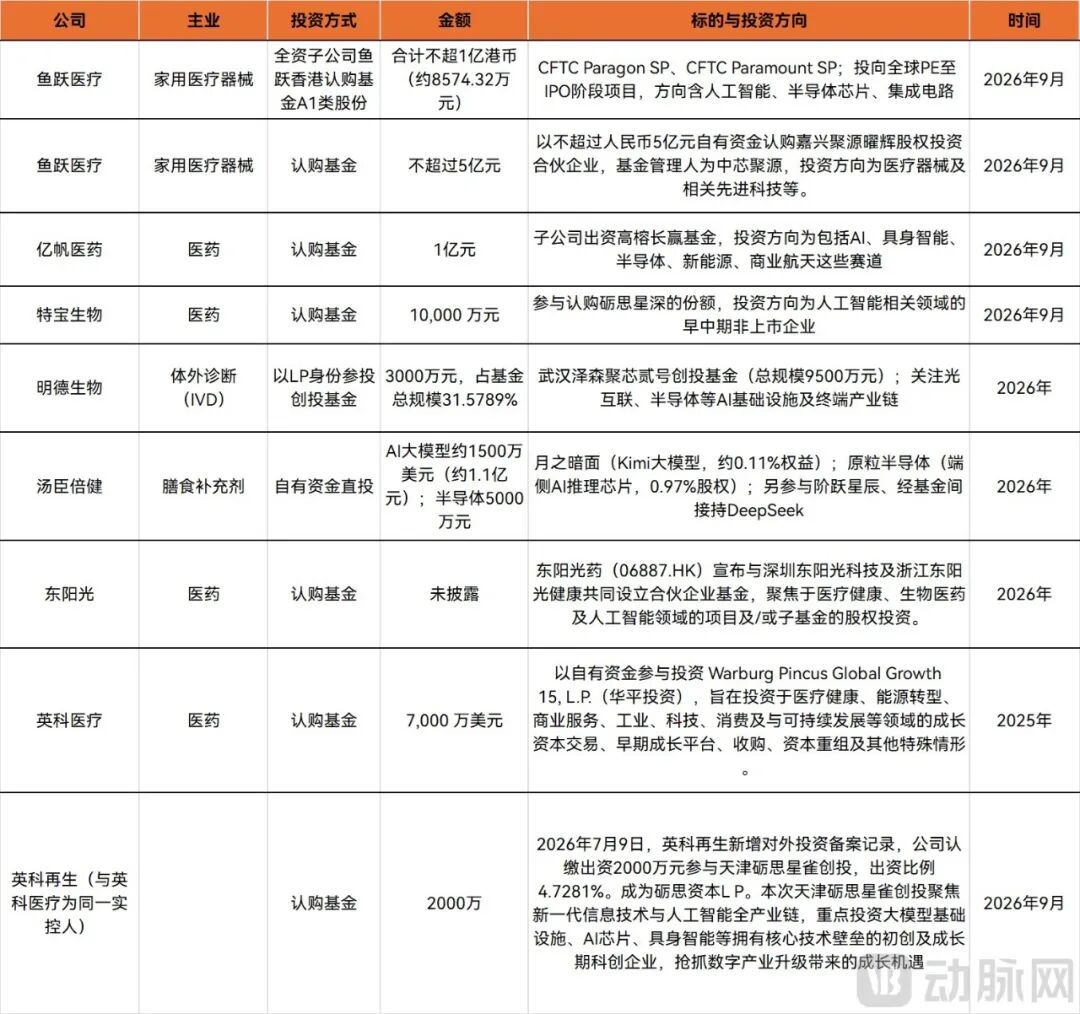
After Andon Health validated its dual-wheel drive model of "core medical business + sci-tech innovation investment", recently, Arterial Network found that medical listed enterprises including Yuwell Medical, Maccura Biotechnology, Intco Medical, Yifan Pharmaceutical, and Taibao Bio have collectively subscribed for funds with investment focuses on the AI and semiconductor sectors.
Many well-known funds that have completed fundraising recently have listed medical companies behind them, such as the Gaorong Changying Fund and the new fund of Lisi Capital. Medical enterprises are seeking to become shareholders in the AI and semiconductor industries to share cross-industry dividends.
It is not an isolated case that listed medical companies are paying attention to investment opportunities in the AI and semiconductor sectors. A frontline medical investor told Arterial Network that recently more listed medical companies have subscribed for funds that take AI and semiconductors as their financial investment direction to gain cross-track dividends, while they have become more cautious about investments in the medical field.
Why are listed medical companies collectively acting as LPs of funds for emerging industries such as AI and semiconductors? Is now the best time to start investing in emerging tracks including AI, semiconductors, and commercial aerospace?
Andon Health sets an example, medical LPs start to reselect GPs
When pharmaceutical enterprises invest in emerging AI and semiconductor industries, Andon Health has set a good precedent for its peers.
With its early layout in sci-tech innovation investment, Andon Health has bet on this round of AI wave: star projects including Moonshot AI, MetaX, Stepfun, and Zhengxing Innovation have entered its investment portfolio. The rising valuation of tech assets is also directly reflected in the income statement, with the company's net profit in the first half of 2026 increasing by 233.66% year on year.
For many listed medical companies, the case of Andon Health proves that sci-tech innovation investment is likely to become the second growth curve.
Driven by the demonstration effect, listed companies that used to prefer vertical GPs in the healthcare industry have begun to extend their reach to the emerging technology industry.
Yuwell Medical is a representative of this shift in investment preference. This LP, which used to focus deeply on the medical track, has made two consecutive moves to subscribe for shares of tech funds recently: first, Yuwell Hong Kong invested 94.9 million Hong Kong dollars to subscribe for Class A1 shares of CFTC Paragon SP and CFTC Paramount SP under CFTC Summit Fund SPC, targeting global projects from the PE stage to the IPO stage, covering artificial intelligence, semiconductor chips, and integrated circuits.
Within a month, Yuwell announced again that it planned to subscribe for shares of Jiaxing Juyuan Yaohui Equity Investment Partnership with no more than 500 million yuan, and the fund manager is Semiconductor Source Capital. Although the investment direction stated in the announcement of this subscribed fund is "medical devices and related technologies", the background of this fund is worth examining in detail. Semiconductor Source Capital is co-sponsored by SMIC and a senior investment team, with assets under management exceeding 33 billion yuan, and its investment targets cover the entire industrial chain of integrated circuits.
Backed by the domestic chip leader, Yuwell's subscription is obviously not only targeting medical device investment, but also the semiconductor industry. Chips are the core components of many of Yuwell's household medical devices. Layout in the semiconductor sector is not only an additional guarantee for supply chain security, but also an advance layout for the "hardware + software" health management ecosystem.
Intco Medical takes another path: using sufficient cash flow to buy admission tickets. According to Frost & Sullivan data, Intco Medical has ranked first in global sales of disposable gloves for four consecutive years since 2022; after its performance exploded during the epidemic, the company has long been accustomed to using idle funds to act as an LP, and has successively invested in institutions including Yunqi Capital, Jiyu Capital, Qianhai Mother Fund, Jifeng Capital, Rongxi Venture Capital, Bohua Capital, and Guoyue Jun'an Capital, with the direction mainly focused on medical care.
The change took place after the AI narrative heated up: Liu Fangyi, the actual controller, believes that the AI technological revolution will further widen the wealth gap. Therefore, Intco Medical and Intco Recycling, both actually controlled by Liu Fangyi, have successively aligned themselves with "new technologies" by acting as LPs.
Some enterprises have made heavy investments in AI funds in a family style. Taibao Bio, whose core product is long-acting interferon, participated in subscribing for shares of Lisi Xingshen fund with its own capital of 100 million yuan in 2026. The opportunity for this enterprise to pay attention to AI funds may be related to the "second generation of entrepreneurs". Lan Bolin, son of Yang Ying, the actual controller of Taibao Bio, disclosed that he also invested 200 million yuan of his own capital to become a limited partner of Lisi Xingshen, and made deep bets on Lisi Venture Capital. The tech perspective of the young "second generation" may be one of the reasons why Taibao Bio invested in AI.
Other enterprises use investment to find outlets when their core business is under pressure. The time point when Yifan Pharmaceutical invested 100 million yuan to become an LP of Gaorong Capital coincided with the company's growth shift: its attributable net profit in the first half of 2026 fell by about one third year on year. For such companies, investing part of their idle capital in emerging tech funds is expected to obtain considerable financial returns.
It is not difficult to find that when choosing GPs, domestic listed medical companies prefer head funds. Cross-track investment means that medical enterprises lose the advantage of judging projects with industrial cognition, so they almost place all their trust in GPs. Therefore, when choosing GPs, medical enterprises still attach importance to industrial resources, brand, exit history and other factors.
Medical enterprises spend 100 million yuan to buy a hard tech admission ticket
Looking ahead, a number of listed medical enterprises may become shareholders behind domestic AI and semiconductor companies: they not only have the opportunity to share the growth dividends of the two high-boom tracks, but also may promote the domestic medical industry chain to move towards intelligent upgrading.
The integration of AI and the medical industry still has huge room for imagination, which is also the core logic that some listed medical companies value when they invest in AI and semiconductor funds.
Among them, Yuwell Medical, which has made the most generous investments, has listed AI as the R&D direction for key products such as metabolic management and respiratory therapy. Yuwell revealed that the company is concentrating R&D resources on two directions: first, to build the CGM application into an AI intelligent platform in the field of metabolic management; second, to launch the fourth-generation intelligent ventilator equipped with AI agents.
In recent years, Yuwell has successively launched a number of "AI + medical" innovative achievements, including the wearable medical device R3 health ring, the portable ventilator Pocket series, the new generation of intelligent AED HeartSave HP portable series and myPAD series, continuously building a "hardware + software" health management ecosystem.
It can be said that AI has become a key starting point for Yuwell to upgrade product competitiveness; by subscribing for funds to take equity in a number of top AI companies, it is expected to bring more industrial synergy and cooperation opportunities, which will in turn support its product iteration and scenario implementation.
Intco Medical, whose core business is consumables such as gloves, also attaches great importance to AI applications. An employee revealed that Chairman Liu Fangyi repeatedly emphasizes the importance of AI technology whether in large conferences or small seminars. At present, Intco Medical has applied AI to multiple business scenarios such as intelligent quality inspection, logistics and supply chain, marketing and customer service, promoting related businesses to transform from "human-led" to "intelligence-driven".
It can be seen that the layout of AI and semiconductors by listed medical companies is no longer just "chasing hot spots" at the financial level, but an attempt to exchange capital for technology access, and use AI to reconstruct the R&D, production, quality control and service links. By subscribing for funds, listed medical companies have the opportunity to apply external technologies to improve product competitiveness and operational efficiency, and seize the first mover advantage in smart medical transformation.
Most medical LPs have not yet made the shift
When hard technologies such as AI and semiconductors become popular cross-border layout directions for listed medical companies, interviews conducted by Arterial Network found that some listed medical companies choose to return to their circle of competence: they do not chase concepts, but only screen investment and M&A opportunities that are synergistic with their core business and can generate profit contributions.
Most listed medical enterprises still place their bets on the medical track. Jointown, Pientzehuang, Tigermed, and Chunli Medical have successively invested in and set up funds in recent years, with their investment directions still focusing on innovative drugs, medical devices, and medical-related technology fields.
However, investing in the emerging technology industry does not mean guaranteed profits, and Andon Health's success cannot be easily replicated. Industry insiders remind that the valuation of current tech assets such as AI and semiconductors is already at a high level, "Tech valuations are similar to those of innovative drugs in 2020-2021, and are approaching a phased top; some comprehensive funds have even begun to reduce their tech positions. Therefore, increasing tech investment at this moment may not be the best window to replicate Andon Health's success."
There is no standard answer to investment. For listed medical companies, whether they choose to go cross-border or focus on their core business, the opportunities that are really worth investing in are still those that are easy to understand, manageable, exitable, and can ultimately enhance core business value and shareholder returns.
References:
Burn cash to build capabilities, the experience of senior employees becomes invalid! Frontline Agent manufacturers and users share first-hand experience: abandon technology-driven, how to avoid huge investment going to waste? — AI Frontline
Yuwell Medical Investor Exchange Meeting
This article is from WeChat Official Account "Arterial Network" (ID: vcbeat), author: Yang Xue, authorized for release by 36Kr.