The Google of the large model era may never emerge.
In the last week of September this year, Peter Thiel, who invested in OpenAI and Anthropic, received the Axel Springer Award in Berlin and held a dialogue with Mathias Döpfner.
He applied his monopoly theory for the internet era from the book Zero to One to examine today's model companies, and put forward a quite counterintuitive judgment:
Google in the internet era, the kind of company that can capture monopoly value, may never emerge in the AI era.
The Law of Value Capture in the Internet Era: Network Effect, Winner-Take-All
If we compare the model era with the internet era:
When the internet first emerged, many people thought anyone could start a company. As a result, the economy of network effect was extremely strong, a large number of super platforms appeared, forming a winner-take-all pattern.
Google, Amazon, Meta, Tencent, ByteDance, Alibaba, the list goes on and on.
The model era may be the exact opposite:
The market is huge, but the end point is more like high-intensity competition rather than a small number of platforms taking all. A large part of the value will fall into the hands of users in the form of consumer surplus (Konsumentenrente), and the distribution will be more even.
You pay a $20 subscription fee and get $2000 worth of medical and knowledge services, most of the value goes to you.
It should be noted that what Thiel said is just "I wonder".
This does not contradict his view in Zero to One in 2014 that "competition is for losers, and a good company must build a monopoly":
To be valuable, a company must do two things at the same time: create value X, and then capture Y% of it.
Airlines create a large X, but Y is close to 0.
Google does not create that large X, but Y is extremely high.
Judging from the current pattern, X at the model layer may be very large, but Y may be very low.
Value is created, but companies like OpenAI, Anthropic, Zhipu AI, Moonshot AI, and Deepseek can hardly retain much of it.
The old example he cited in his class at Stanford in 2012 still works:
The average one-way airfare in the US is $178, and each passenger only makes 37 cents for the airline. In the same year, Google's revenue was $50 billion, with a profit margin of about 21%, and its market value exceeded the sum of all US airlines.
If you cannot form a monopoly, you may end up burning all the investors' money.
Buffett once said that if he had a time machine, the first thing he would do is go back to the Wright brothers, and shoot down their plane with a rocket.
Thiel does not mean that artificial intelligence is unimportant. Instead, he means that the red-hot model layer today may (maybe) become a new aviation industry:
It has extremely high social utility, but corporate profits are eroded by competition.
Why Monopolies Are Easy to Emerge on the Internet
Internet platforms have many moats:
Network effect: One more user makes the platform more valuable to other users. This applies to social media, payment, marketplace, and search.
Data flywheel: The more people use the product, the better the product becomes; the better the product becomes, the more people use it.
Extremely low marginal cost: It costs almost nothing to serve one more user, and scale itself is a barrier.
Attention entry: Controlling search, information feed, and operating systems allows you to extract rent.
Winner-take-all matching market: Once you become the default choice, it is very difficult for the second player to survive.
Therefore, monopoly companies like Google, Meta, Amazon, Alibaba, and Tencent emerged:
They not only create huge consumer surplus X (many products are free or extremely cheap for users, just think of Honor of Kings), but also capture a large part of Y value through advertising, commission collection, and cloud services.
Users get value, and platforms also become extremely valuable, often with a market value of trillions.
The reason why the internet did not become the aviation industry is that platforms superimpose network effect, data flywheel, near-zero marginal cost and entry control together.
Search is still the clearest example to this day:
Google's global search share still remains around 90%, and Google and YouTube are still the two most visited sites in the world.
Advertising revenue is also highly concentrated:
In 2025, Google, Meta and Amazon together took 56% of US advertising revenue, and research institutions expect this proportion to rise slightly in 2026.
Cloud services and traffic entries are also not decentralized. AWS, Azure and Google Cloud together account for about 60% of the cloud infrastructure market, and the three process nearly 8% of the global internet traffic.
Users often use these platforms "for free", but attention, merchants and developers are paying rent. Therefore, the internet has created huge consumer surplus and huge platform market value at the same time.
Tencent Holdings is the most valuable Chinese internet listed company today, and every point above applies to it.
Why Thiel Thinks the Model Economy May Fail to Capture Value
In Thiel's view, the model layer does not look like a monopoly business from any perspective.
First, models are more like substitutable intellectual commodities, rather than a unique entry.
For example, there is only one default search box, and Tencent's social connections are very difficult to migrate.
But the cost for users to switch models is very low: you can ask Deepseek, Claude, Workbuddy, and Zhipu AI for the same thing.
Product differentiation only lasts for a window of several months. The capabilities between models are also rapidly converging.
The cycle of closed-source leading, open-source catching up, and the next player overtaking has repeated for several rounds.
Epoch AI found that since 2023, the cost of reaching the same capability level has dropped by about 47% per quarter, which is about 13 times cheaper per year, faster than the historical decline rate of DNA sequencing, computing hardware, lithium batteries and electricity.
Once capabilities are close, price wars are almost inevitable.
Airlines also create huge value, but their profits are eroded by competition: this is exactly the example Thiel loves to use.
Second, what users want is results, not a specific model brand.
When writing code, revising contracts, translating, and making images, users care about "good enough, fast enough, cheap enough". Brand loyalty is usually very weak at the tool layer. Once the tool layer becomes commoditized, value surplus flows to buyers.
Stanford HAI statistics show that the reasoning cost of the GPT-3.5 tier dropped from about $20 per million tokens in November 2022 to $0.07 in October 2024, which is about 280 times cheaper. By September 2026, the token price index of cutting-edge models is about 80% lower than the baseline in March 2023.
In fact, as long as there is a sufficiently good open-weight model, it is difficult for closed-source models to charge an "intellectual monopoly tax".
A public account recently disclosed by Hock Tan is very illustrative: the global reasoning infrastructure cost is about 200 billion US dollars per year, and the model-related revenue is about 150 billion; the token volume of closed-source and open-weight models is roughly half and half, but the revenue is about 120 billion for closed-source and 30 billion for open-source. Open-source has anchored the price at a low level.
Third, model switching happens in APIs and workflows, not in social relationships. Switching models is not the same as switching WeChat Moments, nor switching e-commerce platforms.
Enterprises can connect the same set of RAG, the same set of agents, and the same set of permission systems to another model. If network effect exists, it is more likely to grow at the workflow, data and permission layers, rather than the foundation model itself.
According to this logic, the model era is more like electricity, container shipping or aviation: society becomes richer, but power plants and airlines may not necessarily become Google.
Perhaps in Thiel's eyes, the Google of the model era will never emerge.
This Does Not Mean "There Is No Monopoly in AI"
It is worth pointing out that what Thiel said is fewer winner-take-all platforms, not that there is no excess profit in the entire value chain.
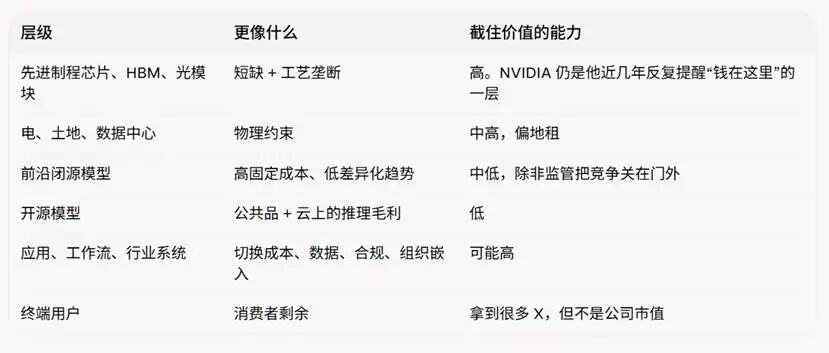
For example, Thiel has always believed that the chip layer is the cake ignored by American investors:
NVIDIA's total revenue for fiscal year 2026 is 215.9 billion US dollars, of which the data center business accounts for 193.7 billion US dollars; by the second quarter of fiscal year 2027, the data center business has accounted for 93% of the company's revenue.
According to computing power caliber, Epoch AI estimates that NVIDIA still accounts for about 68% of AI chip supply in the fourth quarter of 2025, Google's self-developed chips account for about 19%, and the rest is split between Amazon, AMD and Huawei.
Second, from the perspective of the computing power center layer, electricity, land, HBM and advanced packaging are more like rent monopoly:
This is also the reason why Volcano Engine, Alibaba Cloud and Baidu Cloud are still highly valued today, and it is also an important reason why Deepseek begins to extend to the computing power center: everyone can see the value here.
Elon Musk's SpaceX AI space computing power is also an extension of this logic.
Third, the value of distribution entry also has the potential to capture value:
Models can be commoditized, but the default search box, office suite, mobile assistant and enterprise identity system do not have to be commoditized. Microsoft embeds models into Office, and Google embeds models into search, which is exactly the path they take.
Tencent, Alibaba and ByteDance are all betting on Workbuddy, Doubao Office, Qianwen Office, even Qwenbook and Doubao mobile phones, all of which are based on the same logic: build an entry, the more forward the better.
Models cannot form a monopoly, but entries still have value: it may not be the 360 vs Tencent war, but it is almost similar.
Finally, the workflow context layer may also give birth to the kind of company Thiel likes:
Once the model is embedded into the operating system with extremely high permissions, audit, industry data and migration cost, what customers switch is no longer the API, but the entire set of organizational processes.
Copilot is not as easy to use as Claude, but international enterprises do not prioritize efficiency, but security, audit and context;
From this principle, the context advantages of Kingsoft Office WPS, DingTalk and Feishu still exist, and the claim that SaaS will be eliminated is still a fantasy for AI investors.
Palantir, co-founded by Thiel, is exactly in this layer. So while he says the model layer may be very competitive, he also emphasizes that the sense of urgency of American enterprises for AI transformation is accelerating the company's enterprise sales. These two things are not contradictory.
Three things can be true at the same time:
The model layer is fiercely competitive with thin profits;
Chips, electricity and scarce production capacity still have huge profits;
A small number of companies that embed models into non-replaceable workflows can still form a monopoly in Thiel's sense.
What Exactly Does "Value Goes to Consumers" Mean
The value Thiel refers to that consumers take away is called consumer surplus in economics:
You are willing to pay 20 dollars for a good answer, but you actually only pay 20 cents, and the difference is the value you take away.
The performance will be very specific:
Individuals: The cost of writing, programming, translation, learning, and drafting legal documents collapses.
Enterprises: The same number of people can do more work, or the same output requires fewer employees.
Price: From high-priced subscription to usage-based pricing, and then pushed down by open-source and price wars.
Distribution: The internet era is "a small number of platforms have astronomical market value + users use it for free"; the model era is more likely to be "many companies have large revenue but average profit + users and work scenarios are generally cheaper".
"Value is more evenly distributed" does not mean that the gap between the rich and the poor disappears, but that value no longer mainly precipitates as the net assets of two or three platforms, but scattered in the cost reduction of countless buyers.
Before everyone discusses employment politics, we might as well emphasize one more sentence:
The increase in consumer surplus does not mean the increase in labor surplus. Users are cheaper as buyers; the same group of people, as white-collar workers, may be replaced or face wage cuts.
The Counter-Counterintuitive Point: Where Thiel May Be Wrong
First is the recently popular regulatory capture:
The closed-source model camp, Dario's plan is that if only licensed closed-source models can legally serve users in the US or Europe, the model layer will become a protected oligopoly again, and the threat of open-source no longer exists.
This is exactly the core of the open-source camp's criticism of Altman and Amodei: use the security narrative to legislate, keep latecomers out, take back part of the consumer surplus.
If this path succeeds, Thiel's premise of "highly competitive" will no longer hold.
Second, distribution entries may still be winner-take-all.
Models can be commoditized, but default entries do not have to be. Whoever controls the operating system, office suite, mobile assistant, browser, and enterprise identity system can still extract rent. Microsoft embeds models into Office, and Google embeds models into search, which is exactly this path. The monopoly may shift from "model companies" to "companies that already have distribution channels".
This goes back to Tencent's muscle memory accumulated in the internet era.
Once continuous learning, private data and closed loop appear, the moat will come back.
Today, everyone is competing with the same batch of public data and similar architectures. If a system can continuously learn in the customer's own business, become more familiar with the business as it is used, and cannot be migrated away, the model will no longer be a replaceable API, but a system with network effect.
This is true for Claude, and also for Zhipu AI.
The capital threshold for training and reasoning is still extremely high.
There may only be a few players who can compete at the cutting edge. Oligopoly competition is not equal to perfect competition. Aviation is also an oligopoly, but profits can still be very poor; but the chip oligopoly can have extremely high profits. The key is not "how many players there are", but whether differentiation can be maintained.
From this perspective, Kuaishou's Keling and Seedance also have the potential.
Of course, Thiel's own investment portfolio is not built on the assumption that "models have no profits".
The Founders Fund / Thiel system has invested in OpenAI and Anthropic, and also pays more attention to chips and infrastructure. In fact, he regards "the model layer may be very competitive" as a probability (I Wonder).
But if he is right, the investment logic in the AI era will be completely opposite to that of the 2010s:
Do not default that "building a foundation model means building the next Google". That is to pursue Y in a layer that may be commoditized, which is historically the position of airlines.
For today's investors, a more worthy question to ask is:
After the product of the company you invest in leaves a certain model, do the customers still stay?
Is the moat in data permissions, workflow, industry