Real Review: I Spent 30 Days Letting AI Help Me Build Online Income
Shen Translation is a translation team under 36Kr, focusing on technology, business, workplace, life and other fields, introducing the latest foreign technologies, new perspectives and new trends.
Editor's Note: Stories of getting rich quickly with AI are all over the internet, making it seem that you can easily start an online side hustle with the help of AI tools. This article documents a 30-day experiment, where AI is used to complete research, product creation and content distribution, to verify the real needs of users through trial and error. AI can simplify tedious work and lower the threshold for creation, but market judgment, user insight and continuous iteration still rely on human leadership. The real competitiveness does not lie in how many AI tools you master, but in finding real pain points worth solving. This article is translated, hoping to bring you inspiration.

Image source: Unsplash, solenfeyissa
As for making money with AI, I wanted to try it out in person instead of only reading other people's shared success stories. I didn't ask AI to "help me earn 10,000 yuan", but assigned it a much simpler task: help me find a real pain point, turn the corresponding solution into a sellable product, and then build a small operation system.
I set a 30-day deadline for myself. No employees, no large advertising budget, only a few AI tools, a laptop, and enough perseverance to survive the situation where the first version is most likely to fail.
The whole process is as follows.
Day 1–3: Let AI do the research first
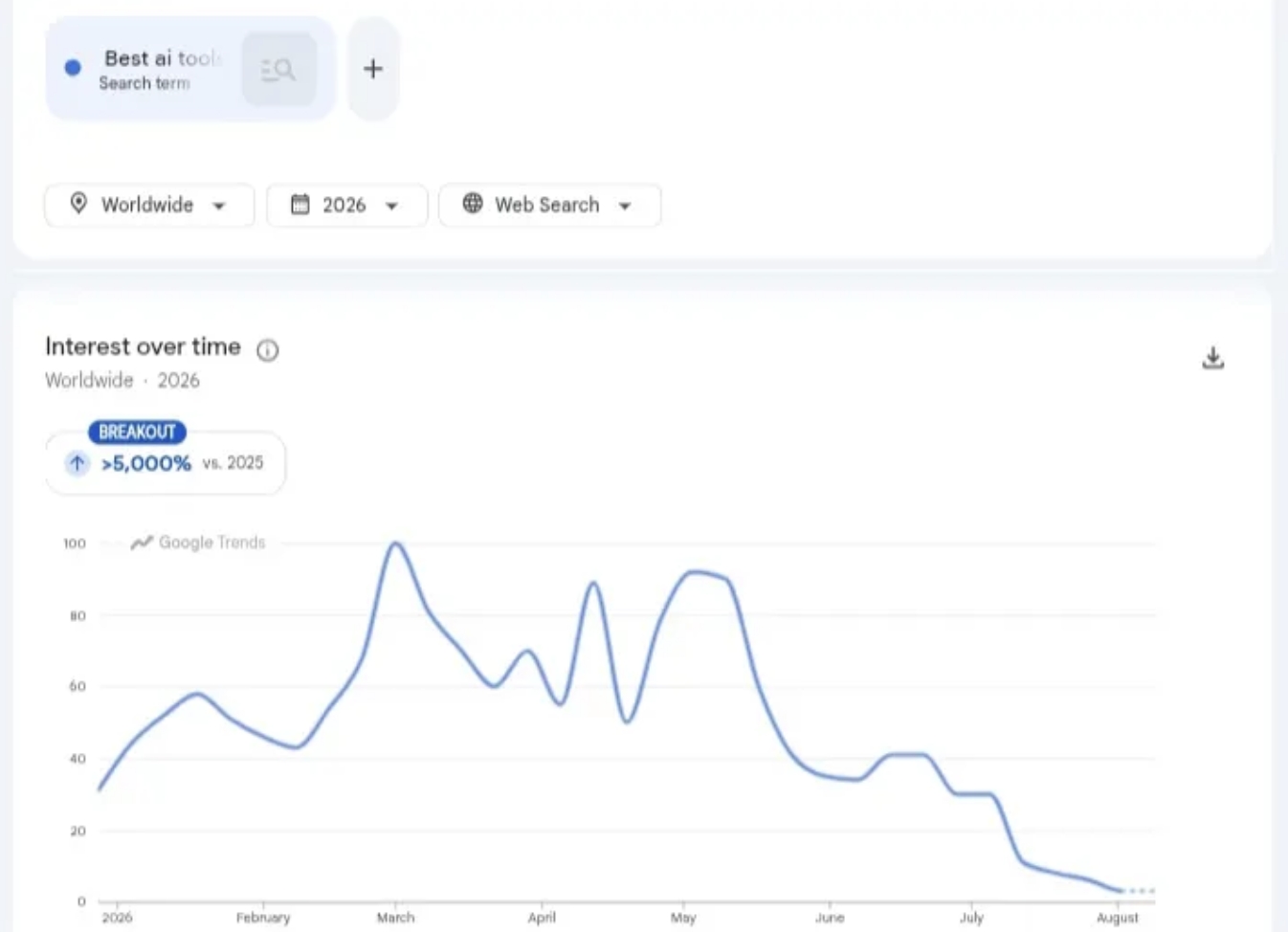
The first thing I did was not to make a product first, which sounds counterintuitive, after all, most people start by making products. I asked AI to help me dig out problems that people are searching for, covering the fields of online entrepreneurship, content creation and AI tools. Then I stepped out of the AI scope to understand the ideas of real users. I checked Google Trends data, searched for recommended terms, browsed discussions on Reddit communities, and looked through comments and questions raised repeatedly by netizens. Cross-verification through multiple channels is of vital importance. I need to find a pain point that keeps popping up on different platforms.
Finally, I found an interesting phenomenon: the problem for most people is not that they can't find AI tools, but that they don't know which tool to choose, how to use it, and how to make real money with the help of the tools.
The best entrepreneurial ideas are not necessarily projects that no one has ever done before. Sometimes, you just need to explain more clearly what people already want. That's my entry point.
Day 4–7: Turn pain points into products
After confirming the problem to be solved, I let AI participate in the product creation process. I used AI to sort out research materials, write outlines, and fill in missing content, speeding up the tedious text work. But I never directly copied and pasted the first version of the answer given by AI. If you directly copy the output of AI, the content you write will read like a robot that has never been in contact with humans, which is the most common pitfall.
I added my own cases, personal experiences, screenshots, opinions and interpretations, and then asked AI to test and review the product: "Where will newbies get confused when reading?" "What information is still missing?" "What content will make readers feel that it is not worth paying for?"
The last question is particularly useful. It made me realize that just making a product is far from enough. The product must have enough value to make users willing to pay, instead of letting them spend ten hours exploring slowly by themselves.
Day 8–10: Build the sales system
At this step, the product has taken shape. But a product file stored in the computer is not a business, it's just a file.
I built a simple landing page and improved the supporting modules: title copy, product introduction, value highlights, frequently asked questions, checkout and payment, and delivery process. AI helped me generate the first draft, and I revised and polished it repeatedly until the text reads as natural as the words you say when chatting with others face to face.
At the same time, I extracted part of the content from the product and made a free material. Why give away content for free? Because the threshold for asking strangers to place an order directly is very high, but it is much easier to ask them to download a useful free material.
In this way, this basic conversion funnel is formed: high-quality free essay → free material download → email subscription list → paid product. There is no disruptive design, it is so simple that I can maintain it for a long time by myself.
Day 11–15: I discovered the misconception of "build the product and wait for customers to come"
No one came. To be precise, there were almost no visitors.
This is perhaps the most valuable part of this experiment. After days of research, creation and construction, I was very satisfied with my product. But the feedback from the internet was very little, there were only three visitors, one of whom was myself.
Many people will give up directly at this step. With few visitors and no transactions, they will conclude that the product is not good. But users don't even know your product exists, so it is impossible for them to place an order.
So I adjusted my focus, instead of spending a week beautifying the product page, I created content around the pain points that the product can solve. I wrote essays, made simple videos, sorted out articles, and shared skills and cases. Some were created from scratch, while others were different versions derived from the same idea.
With the help of AI, a piece of research material can be converted into multiple content forms, without spending the whole afternoon rewriting it over and over again. The same theme can be made into short videos for release, extracted into articles, or sorted out as email pushes.
From then on, I no longer need to rack my brains to think about new topics every day, I just need to develop more uses for the ideas that already have value.
Day 16–22: Add a second revenue channel
At this stage, things became more interesting. When creating content, I naturally mentioned all kinds of tools I was using: AI platforms, marketing software, design tools, and automation systems.
I no longer just mentioned them briefly, but screened out the tools with formal affiliate marketing programs. This opens up a second potential source of income. The same piece of content now has double value. Readers may open the article to learn the knowledge points; if they want a complete solution, they can buy my product; if they only need the tool itself, they can click my affiliate recommendation link.
At this moment, I realized the truth I ignored before: you don't necessarily need more traffic. Sometimes, you need to find more ways to serve the existing traffic well.
Of course, this doesn't mean piling links everywhere and trying to earn commissions by luck. If there is no commission, I won't recommend a certain product; and when there is a commission, I still won't recommend it. Trust is far more precious than commission.
Day 23–27: Data analysis and review
This stage is far less exciting than the creation process, but it is equally important, even more important.
I observed which posts got attention, which titles had higher click-through rates, which topics attracted comments, at which step users exited, and which questions kept appearing in the comment section.
I stopped thinking "I need to come up with a brand new idea", but asked myself: what message are these data conveying to me?
Some content had 500 views but no one was interested; some had only 100 views, but three people asked where to learn more. I will prioritize the latter. Views represent attention, and questions represent purchase intention. When building paid products, user intention is a more worthy indicator to pay attention to.
Day 28–30: What did I really get after a month
I didn't earn 10,000 yuan. I am not the kind of person who claims that AI can completely replace human labor. But what I gained is far more valuable than cash: a complete digital product, a simple sales page, continuously accumulated content materials, free materials for collecting potential customers, email push sequences, affiliate marketing opportunities matching the content, and a reusable research and creation process.
Most importantly, I got the verification result of real user interest. This is the most important point. The goal of the first month was not to get rich overnight, but to find a direction with scaling potential.
What exactly did AI help me do
This business was not built independently by AI. The core role of AI is to reduce a lot of process resistance, for example, helping me speed up the research process, providing inspiration when I have no ideas, and assisting in data analysis. When encountering problems, I ask it questions, and I can get more than ten feasible ideas in just a few seconds.
But the final decision still has to be made by me. Market research and content release all need me to implement them in person.
The biggest insight
If I do this experiment again, I will only change one thing: do more research before starting to create.
AI has made the threshold of making content products extremely low, and this itself is becoming a problem. If anyone can finish writing an e-book in one afternoon, e-books will no longer be scarce; if anyone can produce 50 social posts in ten minutes, bulk posting will no longer be a competitive advantage.
The real advantage is to be clear about what product to make, who the target group is, and why users care about it. This is exactly the irreplaceable part of human beings.
AI can speed up the process of building products, but it cannot judge what is worth building. Frankly speaking, this is the most important gain from the 30-day experiment.
AI can help you build projects faster, but it cannot decide what projects are worth building.
What I lack is not another AI tool, but a more mature workflow: find real pain points; understand the crowd behind the pain points; use AI to accelerate the implementation of solutions; show the solutions to target users; listen to feedback; iterate and optimize; and then open up other monetization paths for the same business.
This logic is far less eye-catching than "ChatGPT made me rich in 30 days", but it is much closer to reality. If I have another 30 days, I will repeat this process. Only the next time, I will start based on the experience I learned in the first month.
Translator: Teresa