36Kr Exclusive | Secured tens of millions of financing, ModCraft aims to enable AI to understand game design through Mod
By Er Ji
36Kr has learned that ModCraft, the AI game Mod creation and content platform, has completed a tens-of-millions RMB seed round of financing. Investors in this round include SenseTime Guoxiang Capital and L2F Lighthouse Founders' Fund. The raised funds will be mainly used for AI model training and platform growth.
In terms of products, ModCraft currently provides two major services: first, it allows users to create game Mods with natural language via AI; second, users can discover, play and share Mods created by other players on the platform. So far, 28 games have been launched on the platform, all of which are highly well-known works on Steam, including the classic domestic indie game *The Scroll of Taiwu*, *Light and Shadow: Expedition 33* which won TGA 2025 Game of the Year, and the hit co-op game *PEAK* that became wildly popular in recent years.
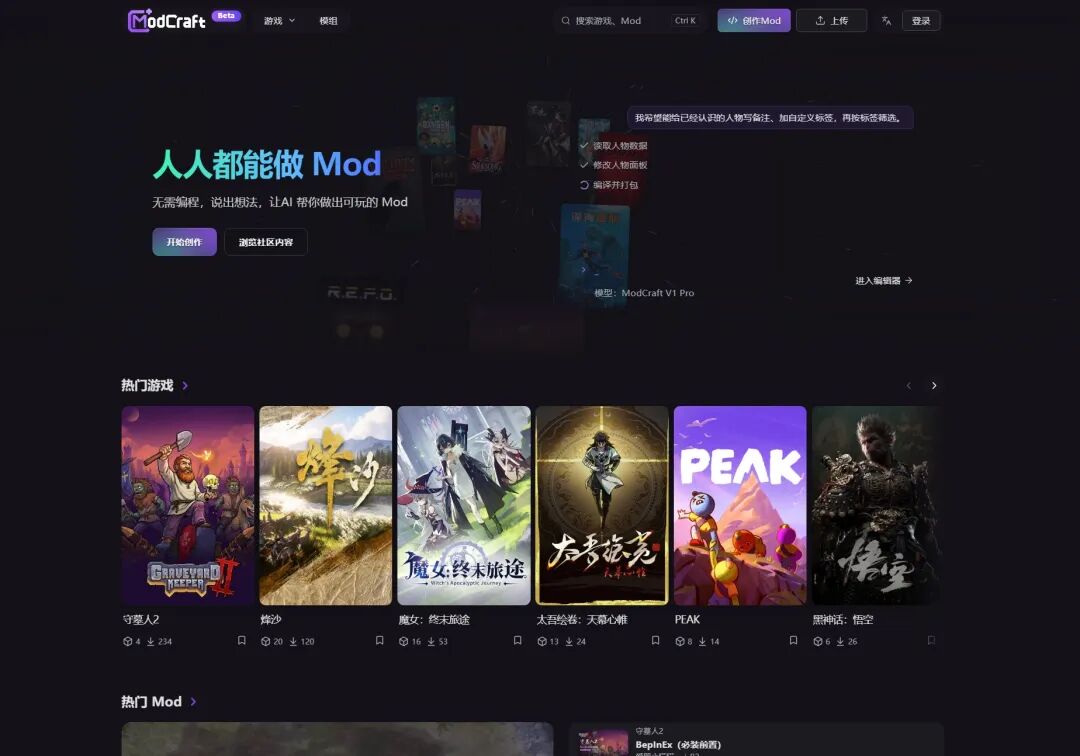
Homepage of ModCraft official website
In the view of Li Shuo, founder of ModCraft, the significance of Mod goes far beyond player UGC.
He believes that "Game Mod is essentially the interface between games and scenarios outside games." Through this interface, developers can customize game tools and obtain operation data according to their demands; large models can also access games through Mod, turning games into simulation environments for AI learning.
This also forms ModCraft's long-term product roadmap. In addition to lowering the threshold of Mod creation through AI, ModCraft also hopes to train AI models for game development based on these real game creation, feedback and operation data. Li Shuo expects that in the future, this set of models will not only be able to "make Mods" or "play games", but also further understand game mechanics and participate in content creation.
Li Shuo believes that eventually AI can create game content that is "better" than purely manually produced content. ModCraft's long-term goal is to become a tool and platform serving games and independent game designers, helping high-quality Chinese game works go global better.
At present, the AI Lab of the ModCraft team is already carrying out a large number of data work, extracting data from Mods for model training, and has reached cooperation with model manufacturers such as ByteDance.
Companies have already been exploring similar directions. General Intuition, spun off from game video platform Medal, uses the game footage accumulated by Medal and the action labels related to player behaviors and game events in the footage to train models that can perceive, predict and take actions in virtual environments. General Intuition regards games as an important scenario for training spatial intelligence and environmental understanding capabilities.
Different from General Intuition which mainly obtains training materials from game videos and action data, ModCraft hopes to further directly connect AI with the game operation environment through Mod, and actively generate and extract data from it. For ModCraft, Mod is not only a tool for ordinary players to participate in secondary creation of games, but also may become the infrastructure for AI to obtain game data.
01
Li Shuo, founder of ModCraft, is a veteran in the game industry with R&D background. He graduated in 2010 and then joined Tencent to participate in the *Blade & Soul* project; in 2015, he joined Youzu Interactive and served as the producer of *Game of Thrones: Winter is Coming*.
What really prompted him to enter the AI field was a significant leap in AI Coding capabilities last year.
Previously, he had come into contact with many entrepreneurial opportunities combining AI and games. When he left Youzu in 2021, members of a well-known domestic AI team once invited him to start a business in the game direction; in 2022, when VAST explored the landing application direction of AI-generated 3D content, it also extended an olive branch to him. But in Li Shuo's view, at that time AI capabilities had not really reached the threshold of game production. It was not until last summer that he felt the time was ripe.
At the same time, China's buy-to-play PC game market is also growing rapidly. Li Shuo observed that Steam already has 50 to 60 million users in China, and the new generation of young players are increasingly willing to pay for cost-effective and high-quality game products. Previously, he also led the development of the original open-world survival construction game *Carbon Ember*, which received investment from Bilibili.
However, for this AI-oriented entrepreneurship, he did not choose to directly cut in from AI-generated games, but turned his attention to a more niche field - game Mod.
Li Shuo believes that Mod creation is like creating on the shoulders of the giant of the original work. The game art, gameplay, worldview and player community already exist, which can provide a large amount of complete context for AI. Therefore, compared with generating a complete game from scratch, it is easier for AI to create Mods with truly playable content.
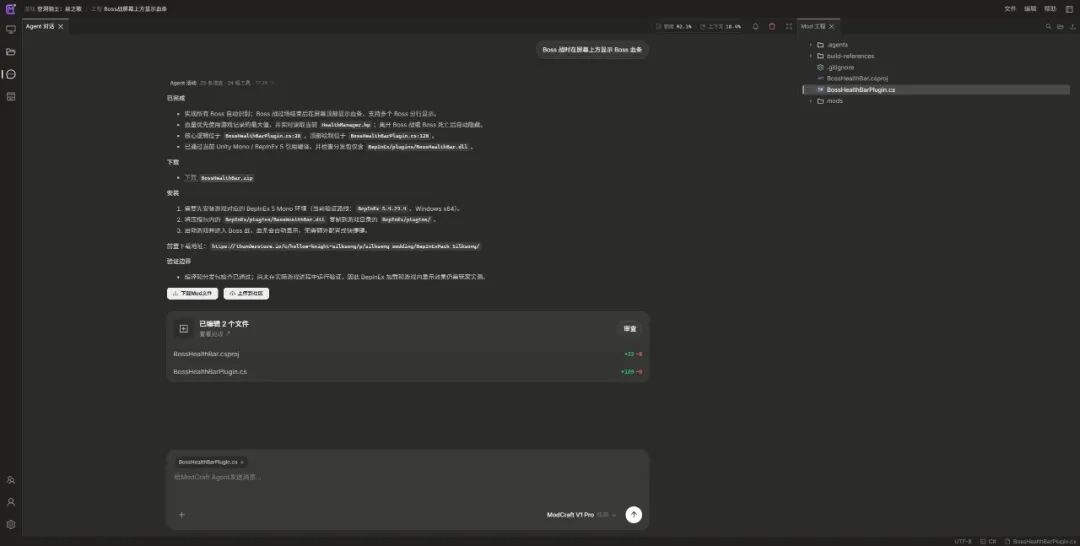
ModCraft AI creation page
The demands on the player side are also clearer. Based on his experience as a game producer, Li Shuo believes that for original games to achieve viral spread, they often require highly recognizable art, sufficiently attractive stories, or gameplay ideas that can quickly attract players, which is very difficult. When players are willing to download a Mod, it often means that they have recognized the original game and want to get more content. The launch of each new game may become a new user reach opportunity for ModCraft.
Overseas, Mod has formed a mature content ecosystem, and platforms such as Nexus Mods, CurseForge, and Thunderstore have gathered a large number of Mod works. In contrast, China's buy-to-play games started late, and the Mod ecosystem has huge room for development.
Li Shuo believes that after AI further lowers the creation threshold, Mod content is expected to usher in explosive growth. Originally, making a Mod manually may take weeks or even years, but AI can shorten this process to a few minutes.
At the same time, AI can allow more people who originally could not write code or use professional tools to participate in creation. "Just like after 2015, ordinary people can also make short videos," Li Shuo shared. An intern of ModCraft made a story Mod for *The Scroll of Taiwu* with AI on a zero-code basis, and the whole process consumed about 9 million Tokens.
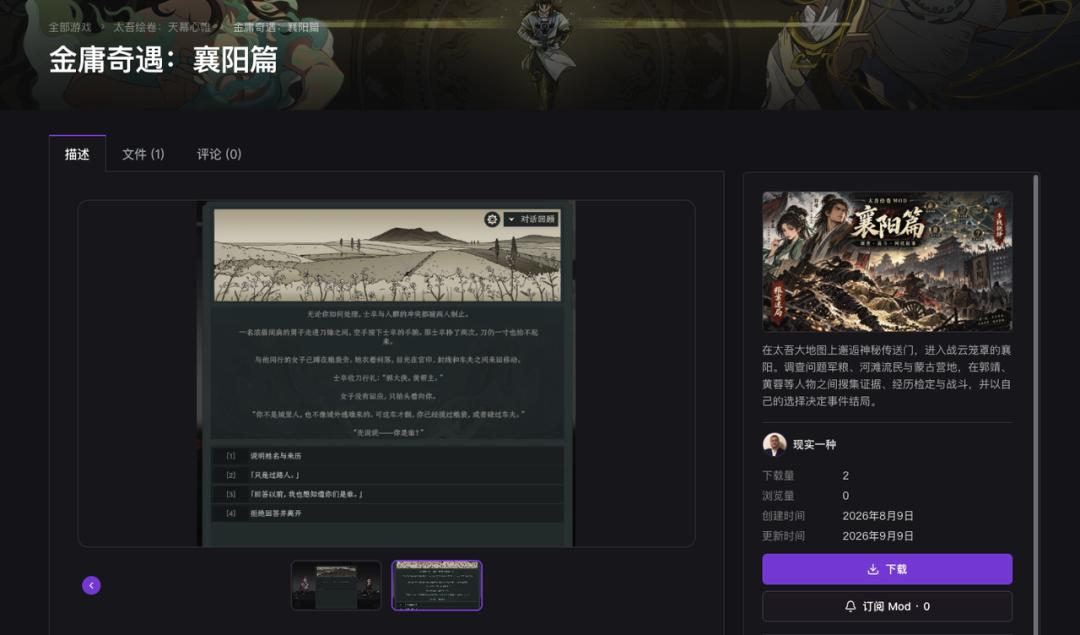
Story Mod of *The Scroll of Taiwu*
Li Shuo has planned two commercialization paths for ModCraft.
From the C-end perspective, the platform can charge creators through a subscription model, and can also cooperate with game developers to explore paid distribution of high-quality Mods. From a longer-term perspective, ModCraft hopes to become a "Mod-version Roblox".
On the B-end, there are two commercialization possibilities. First, Mod can realize customized functions of games. For example, game streamers and live streaming studios often have customized demands: streamers want special events to be triggered after players send gifts, or stipulate that a certain class cannot be used or a certain equipment cannot drop in the game.
This kind of demand has existed long before the emergence of AI. For example, streamers of *Red Alert 2* on the Douyin platform have always been very active. An important reason is that this game has mature Mod tools that support various functions required for live streaming. However, Steam added more than 18,000 new games just last year, and a large number of games do not have mature Mod tools. The emergence of AI brings the opportunity to lower the threshold of Mod production and adaptation, making it possible for more games to meet such customized demands.
Second, Mod can become an entry for developers to obtain data, allowing AI to regard games as simulation environments and continuously generate data. Developers can use these data to train AI video models or world models. At present, ModCraft has reached cooperation with leading model manufacturers such as ByteDance to provide model training data.
02
Current AI game development tools are further evolving from code generation and 3D model generation to direct participation in game production.
In September this year, OpenAI released GPT-6 Astra, which can operate the development environment to complete game-related work, and can also convert models in Blender into scenes that can be toured in Unreal Engine 5.
But in Li Shuo's view, even if AI has been able to enter the game development process, there is still a more difficult problem that has not been solved: how does AI know what kind of game is fun?
This is also one of the core reasons why he cut into AI game development from the Mod track. It is somewhat similar to the logic of recruiting game planners in the game industry: a game planner often needs to have sufficiently rich gaming experience to understand what kind of design is fun. AI models can also learn exactly "what is fun" through a sufficient number of Mod products, and finally master "how to make fun games".
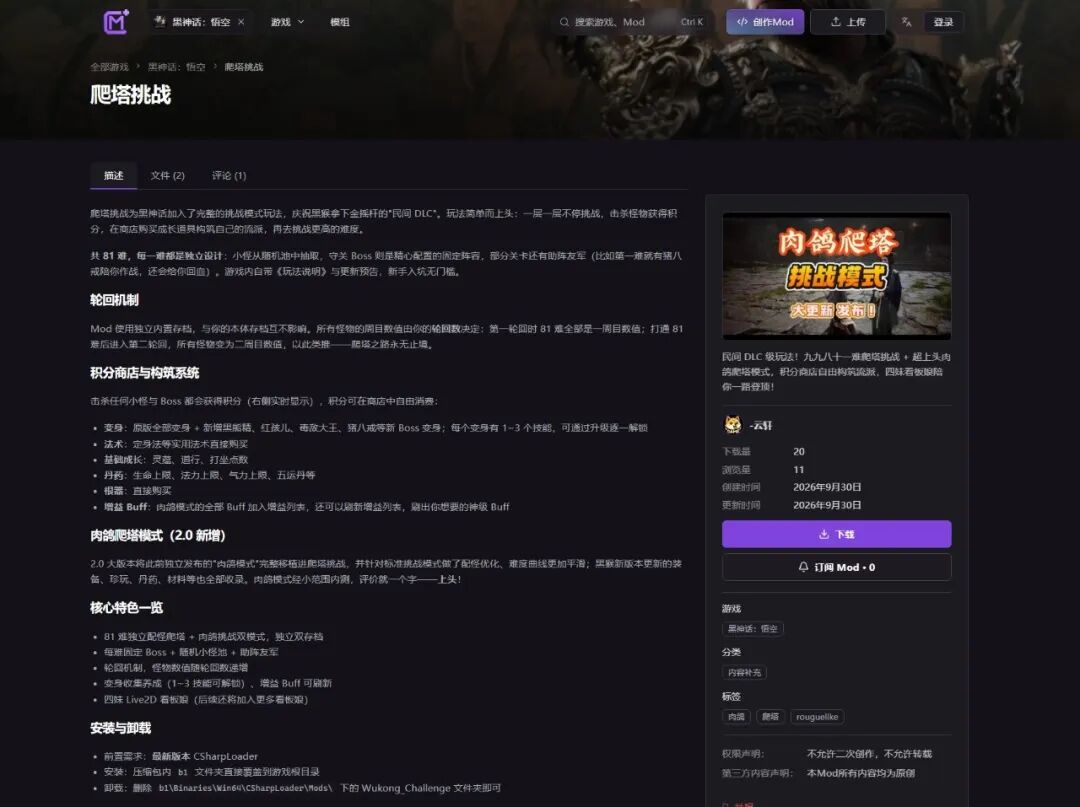
Roguelike tower climbing Mod of *Black Myth: Wukong*
Essentially, the fact that AI can make a Mod for a game means that the tool chain and knowledge base around this game are already sufficiently perfect. On this basis, AI can then enter the game through Mod, and convert various data generated during the game operation process into training materials.
Players' own feedback is also the basis for model training. Whether a Mod can get downloads and player reviews can reflect whether this gameplay is attracting attention; and whether a Mod can really be used by a large number of players for a long time further reflects the actual effect of the gameplay itself. Mod itself is a rapid gameplay experiment, and many classic games were originally player-made Mods at the earliest.
Ultimately, ModCraft hopes to let AI gradually understand what kind of gameplay is more popular with players through players' creation, feedback and actual gameplay data, and further generate more playable game ideas that can be put into actual production.
03
In order to complete this closed loop from UGC to AI model training, ModCraft's team structure is also very special. One of its major features is that there are many senior Mod creators, namely Modders.
Lead Modder of the team, Wu Lihua, has produced many well-known Mods for *Black Myth: Wukong*, such as auto-chess and Boss Rush. Among them, Boss Rush was later officially built into the game as an official gameplay. Another team member made a spoof Mod for *Black Myth: Wukong*, and the related video got 7.669 million views on Bilibili, once ranking 21st in the total view list of the whole site. In addition, team members also include well-known Mod authors of games such as *Monster Hunter* and *Elden Ring*.
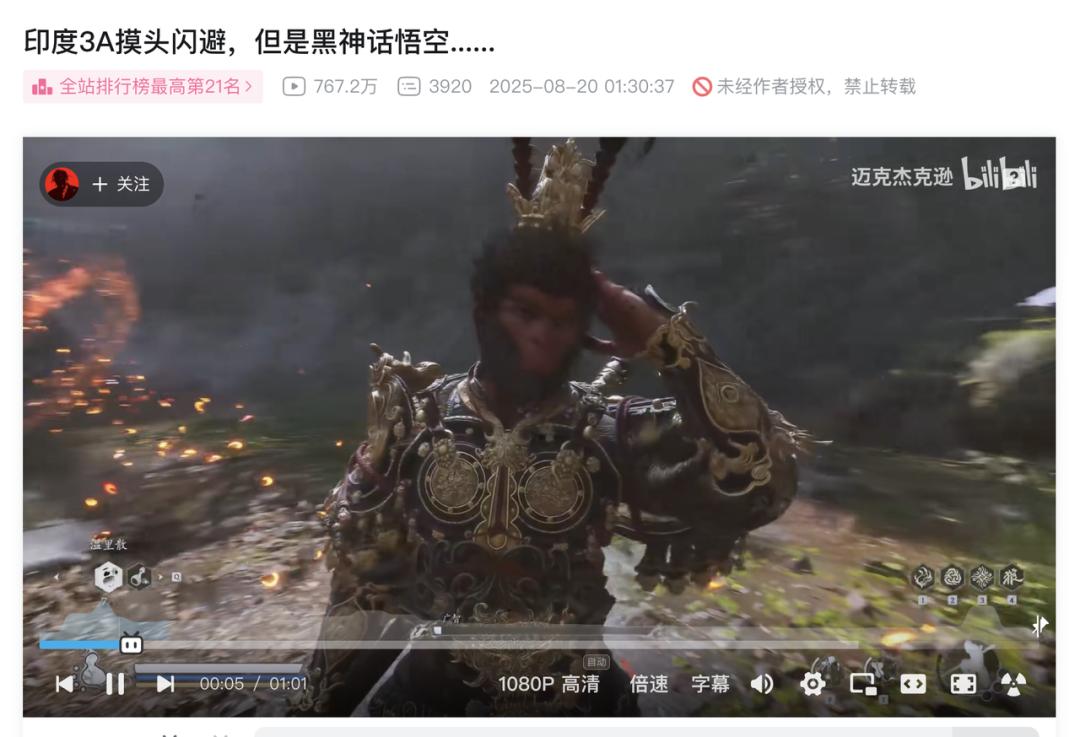
Spoof Mod of *Black Myth: Wukong* made by team members
Li Shuo said that almost all opinion leader-level Modders across the country are here. He himself is also a Mod author, having made multiple Mods for *Valheim*.
In his view, making AI Mod tools essentially requires converting the experience accumulated by senior Mod authors for a long time into product capabilities. "They say in the company every day that I am using AI to distill myself."
In addition to Mod authors, ModCraft also has an AI research team. All members have research backgrounds from top global universities, including multiple gold medal winners of CMO (Chinese Mathematical Olympiad). Their research fields cover the most core cutting-edge technology directions in the current AI field (especially large language models and general game intelligence), and they will be responsible for large language models, reinforcement learning and Agent tuning.
Of course, all the people mentioned above share one common identity - senior game players.
To some extent, ModCraft has not chosen a brand new form of game content. Mod has existed for many years. What has really changed is that AI is opening up the capabilities that used to belong to a small number of Mod authors to more ordinary players.
From this perspective, AI-generated games do not necessarily have to start from scratch. Based on existing games and players' desire for secondary creation, AI can help players expand game content, and in this process understand what makes a fun game, which may be another more realistic path.
At least for ModCraft, this attempt has just begun.
In the next 3 to 6 months, on the one hand, the team will greatly expand the number of supported games, further promote the product to the market, and let more players participate in Mod creation; on the other hand, it will start training the game capabilities of the model.
Games not only carry massive amounts of text, image, audio and video data, but also completely record people's behavioral decisions, interaction methods, aesthetic preferences and entertainment needs in complex and dynamic environments. They are a highly structured "rich ore of human behavior data" that continuously generates feedback.
The team believes that with the further development of technologies such as multimodal models, world models and embodied intelligence, the value of this type of data containing the "environment-behavior-feedback" closed loop is expected to be further improved, and as an important data asset, it will further train AI models with stronger generalization ability and better understanding of human needs. The game data accumulated by the team has already carried out model training cooperation with leading model manufacturers, which further verifies the potential value of game data in AI training scenarios.
This article was first published on "36Kr Games".