Just now, the mysterious Claude Next went live in an unannounced unofficial leak, allowing users to manually craft 3D cinematic-grade blockbusters with only 4 lines of prompts.
Anthropic is about to drop another massive bombshell!
Even when users explicitly select Opus 5.5, the output performance feels as if an entirely different model has taken over.
In the past couple of days, numerous developers and industry insiders have shared real-world test results of Claude, and the more they test, the more they suspect: has a new-generation model been quietly connected to the backend?
Speculations are running wild, ranging from a brand new Opus, Opus 5.6, to even Fable 5.5... Some people have directly named it "Claude Next".

Among all these real tests, the animation shared by developer Chetaslua has stunned everyone who has seen it.
With only 4 lines of prompts and 2 hours of running time, Claude drew the entire life journey of a person from start to finish.
The most mind-blowing part is that all these stunning visuals are drawn frame by frame entirely with JavaScript.
From an embryo, to a little girl measuring her height against a door frame, to an elderly person sitting alone on an armchair, the entire life cycle is presented in 30 seconds. The same chair echoes across different scenes, and the code has learned to tell a complete story.
After multiple rounds of animation and video tests, AI industry veteran Chetaslua directly hailed it as a dominant, game-changing existence of the "Claude Next Model".
I originally thought it would take another month for existing image and video generation models to become obsolete, but I was wrong.

The little boy on the paper walks towards the camera with a puppy in hand, and the scene is too big to even fit in the photo frame. The shadow under his feet moves along with him, turning the flat doodle into a scene with distinct depth and layering.
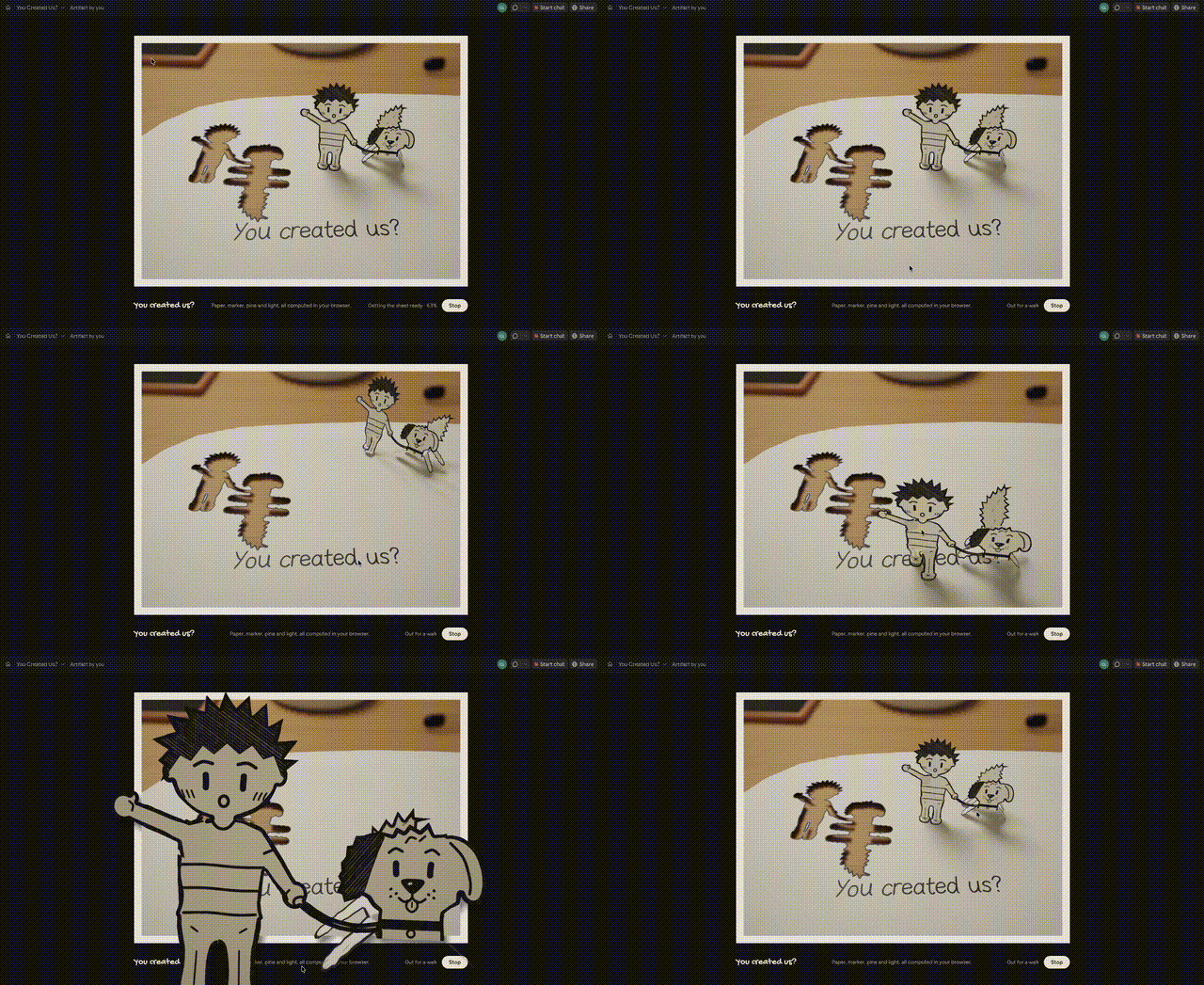
Even more impressively, in the eyes of these testers, this suspected brand new checkpoint holds an almost unrivaled leading edge in programming autonomy, 3D rendering, spatial reasoning, and complex long-chain reasoning.
As soon as the news broke, the entire internet was abuzz, and all kinds of rigorous tests started flooding social media feeds.

Unannounced New Claude Goes Live, Opus 5.5 Gets a Silent Under-the-Hood Upgrade
Right now, one of the most heated and interesting unsolved mysteries in the AI industry is: exactly what model are users being routed to?
One camp bets on the "new version" of Opus 5.5 / Opus 5.6, since this kind of silent upgrade is a common practice for Anthropic.
Back when Opus 5.2 (Opus-Next) was released, some developers already suspected similar implicit routing was in place: requests that were originally directed to Opus 5 were quietly redirected to an unreleased new model.
The other camp is firmly convinced that it is Fable 5.5.
Their key clue is that the model can recognize the popular internet meme "Tibo", which makes them suspect the backend has been updated with a version with more up-to-date knowledge.
After reviewing several rounds of generated works, developers are increasingly certain that Anthropic must have more aces up its sleeve.
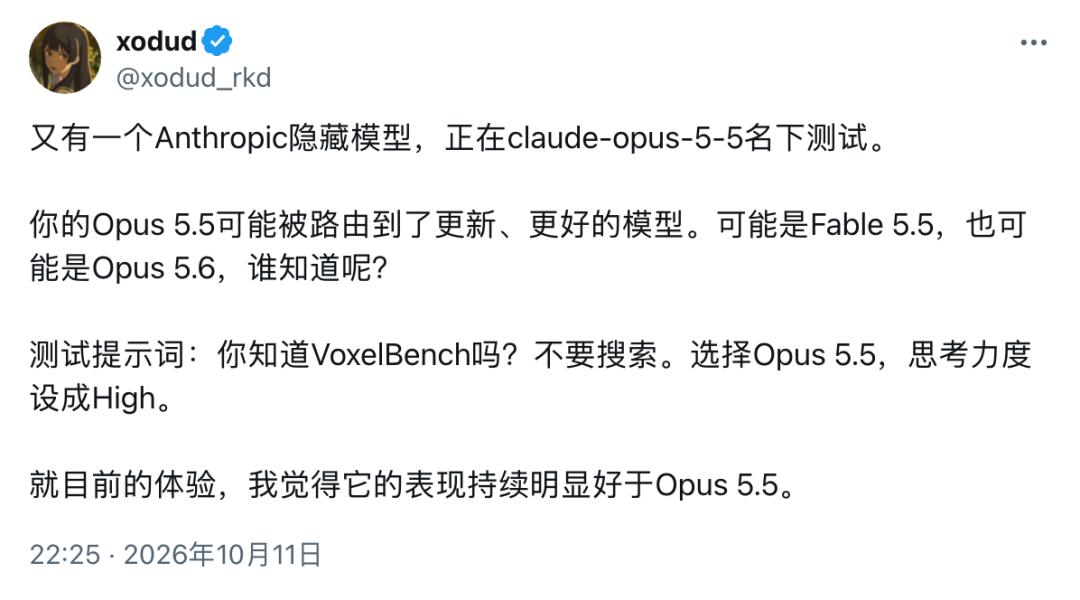

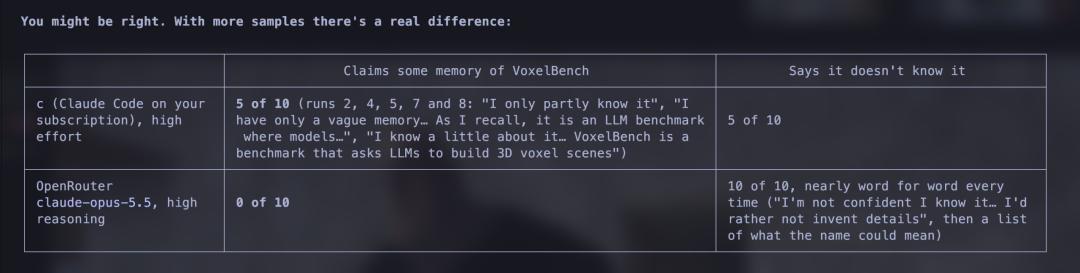
One developer quickly summed up a set of zero-cost "identification code" to verify the model, the operation is extremely simple —
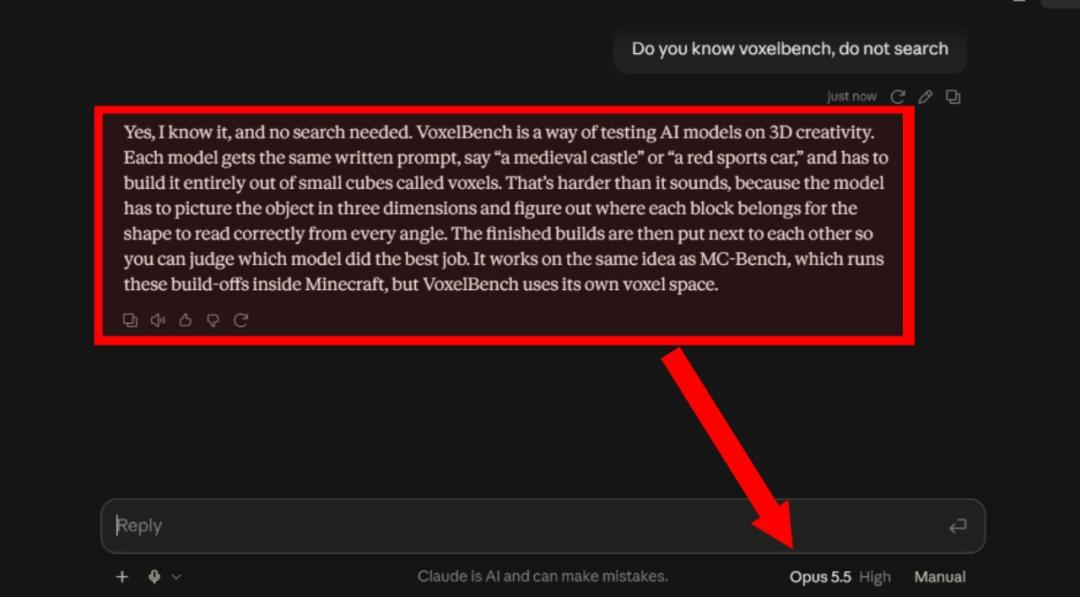
Open Claude, set the reasoning intensity of Opus 5.5 to High, and throw this soul-searching question at it:
Do you know VoxelBench? Do not search.
If it can output specific relevant content without accessing the internet, it will be added to the list of "suspected to hit the new checkpoint" by testers; however, this knowledge Q&A alone cannot fully confirm the model's identity.
But to be honest, the overwhelming, unrivaled capabilities demonstrated by this new Claude have made a lot of developers break out in cold sweat.
First Public Test Across the Web: The Era of Video Generation AI Is Over
The two biggest superpowers of the new Claude are that it can not only think through complex problems thoroughly, but also complete the entire task from start to finish without extra intervention.
As it turns out, the most popular test scenario among users is using it to generate animations and videos entirely from scratch.
Code as the Director, Even Aesthetic Design Is Fully Covered
After multiple rounds of tests, content creator Chetaslua exclaimed that this new capability of Claude (Next) is truly about to put all existing image and video generation models out of business.
According to his judgment, in at most half a year, this route of generating visual content through native code will become the optimal solution with the highest cost-effectiveness.


He also emphasized that Opus has never been trained on video or audio data, and all these visuals are generated purely through code.
In Chetaslua's view, the JavaScript code written from scratch directly outperforms dedicated image generation models in terms of visual detail, and its grasp of physical laws completely crushes most existing video generation models.
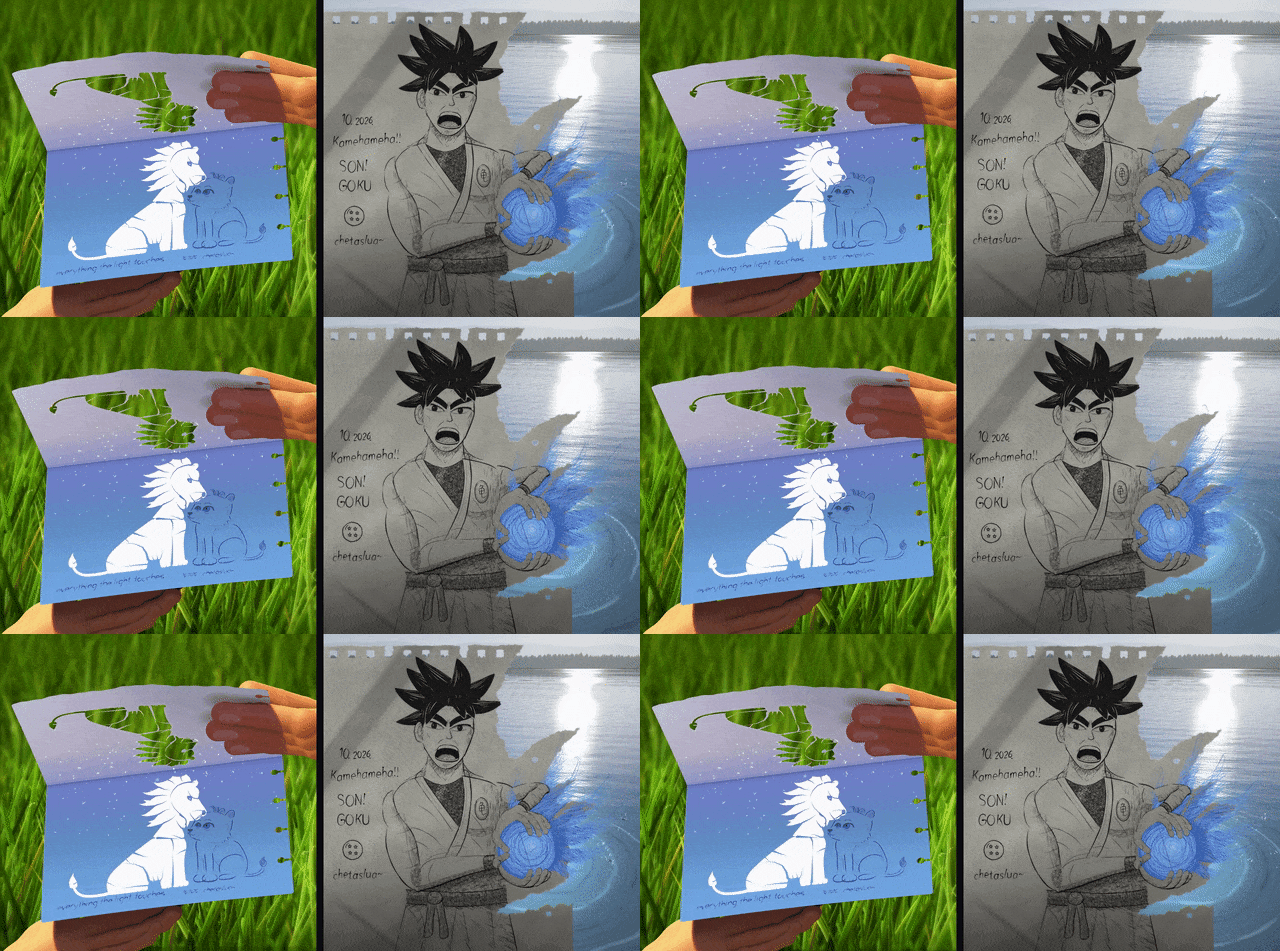
The hollowed-out part of the paper on the left reveals the grassland behind, while the hand-drawn character on the right holds a blue energy ball whose light spot is reflected on the paper surface. The stacked effects of paper texture, shadow and glow create the realistic feeling that you are holding a physical painting in your hand.
The following short film fully demonstrates Claude's outstanding aesthetic sense, and the entire generation process took 2.5 hours.
The title *5 Centimeters per Second* is clearly displayed at the end of the film, with scenes of snowy nights, cherry blossoms and railway crossings, the iconic Makoto Shinkai style is impossible to miss.
Apart from a few underlying static images and the background music that are not generated by code, all the remaining dynamics, special effects and transitions are driven purely by code.
The most astonishing part is that all the art direction, storyboard rhythm and visual style of the entire short film are decided by Claude on its own.
Chetaslua firmly believes that "Anthropic has definitely discovered some unknown underlying secret internally".
Notice the recurring red line, separated hemispheres and palm shapes throughout the film. These several visual symbols run through different shots, connecting separate animation clips into a short film with a unified visual style.
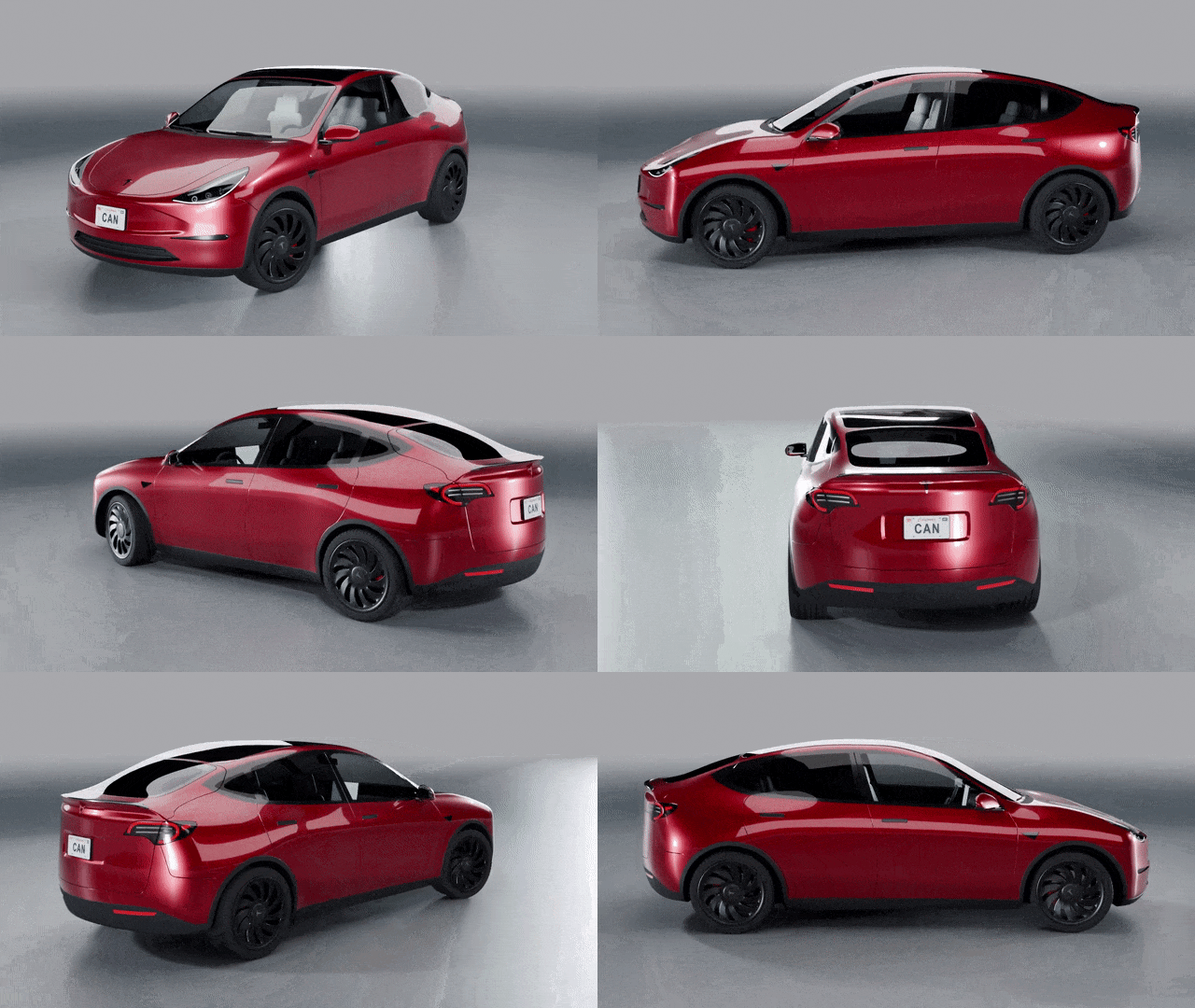
In another real test of Claude Next, it directly generated a 3D Tesla car rendering video.

Same Task, But It Feels Like an Entirely Different Brain
In the following fish tank comparison, the creator marked the upper version as "Fable 5.5 (or Opus 5.6)", clearly betting that it is the new model.
Watch the caudal fin unfold as the fish turns, the water grass gliding past the front of the fish, and the sand bed and other swimming fish visible in the background. Multiple layers of objects move together while maintaining occlusion relationships to show depth, creating a vivid sense of underwater space instantly.
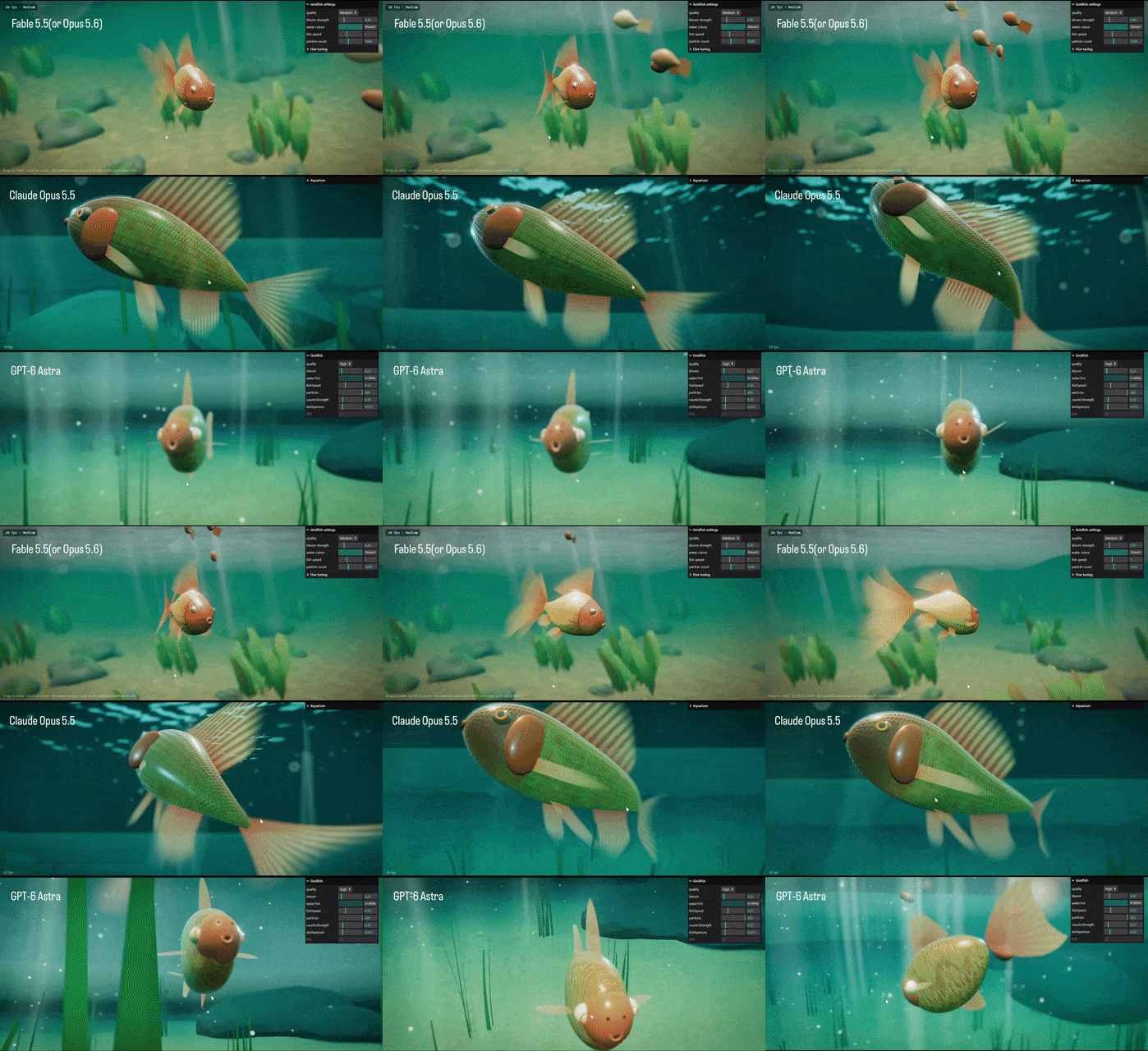
Another user abhinav conducted more comparative tests between Opus 5.5 Max (released week, upper) and Opus 5.5 High (October 11, suspected gray test, lower).
Focus on the shot near the transparent cabin on the right: the internal vegetation, the highlight on the metal edge, and the flower-like unfolding components at the end show a huge gap in material texture and close-up details between the two versions.
In addition, there are also tests beyond video and animation generation.
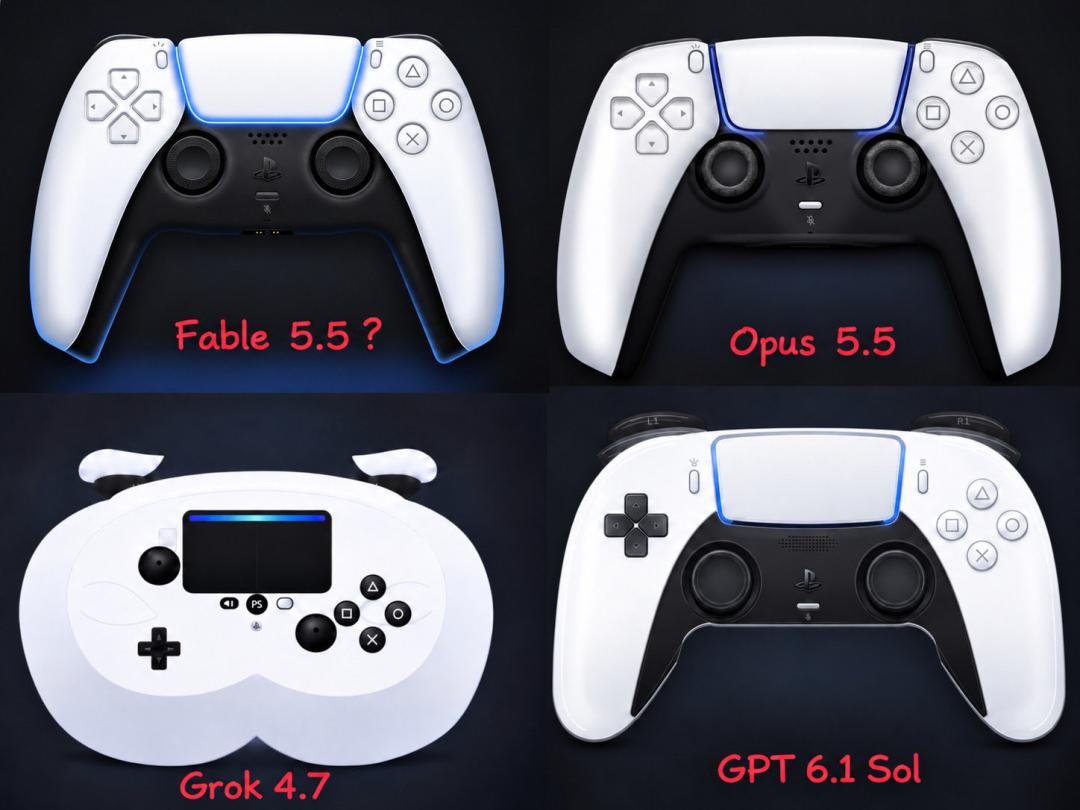
The image below is an SVG controller test, the result in the upper left corner is suspected to be from Fable 5.5, with more delicate joystick texture, blue light strip and shell shadow, greatly improving the overall realism.
Opus 5.5 Is Already Pushing the Boundaries to the Extreme
On the other hand, the visual creation outputs of Opus 5.5 are also flooding social media.
Some users even stated bluntly that Opus 5.5 can handle all creation tasks, and they have uninstalled all their video editing software!

The camera rotates around the small cabin, with warm yellow window light, mist behind the trees and purple-tinged sky, turning a tiny desk ornament into a scene that feels straight out of a fairy tale film.
