VCs are starting to scramble to invest in the post-2005s.
More and more players are entering the market, and the PC competition in the AI era has fully kicked off.
Agent is widely regarded as a technology that is reshaping the way humans produce and collaborate in the future, but there is still no hardware that can truly be called a "finished product" to support such changes. If the mobile internet era finally ushered in the iPhone, the popularization of Agent may also be waiting for its own "iPhone". Even decades ago, Steve Jobs once envisioned that the future of computers should not be just a tool, but a personal "Agent" for users.
At the age of 19, Jobs had not yet found the answer. Shortly after dropping out of university, he accidentally saw an advertisement for an electro-mechanical engineer position at Atari in the newspaper, so he took the initiative to apply for the job, which gave him the only formal job interview in his life. It was not until two years later that he signed a cooperation agreement with Wozniak, and Apple was born.
However, half a century later, another 19-year-old young man named Zain Javaid is about to realize Jobs' vision. Coincidentally, on October 5, the 15th anniversary of Steve Jobs' death, Ghost, the company founded by Zain Javaid as CEO, came out of stealth mode and announced that it had raised $11 million in seed funding. The investors include many star Silicon Valley institutions, led by Andreessen Horowitz (a16z), with participation from Abstract, Audacious Ventures, SV Angel, and Nova, and the valuation has not been disclosed.
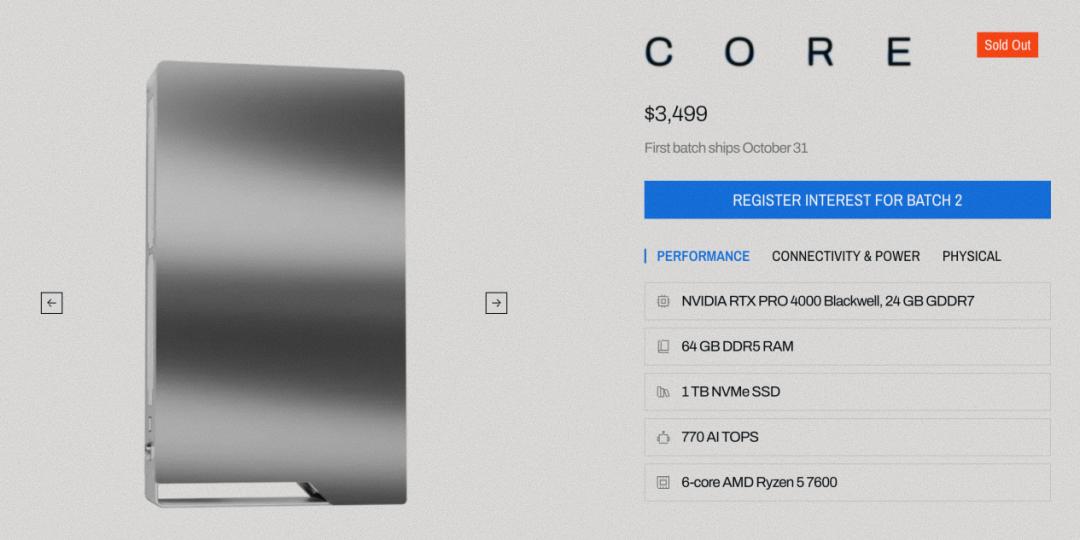
At the same time, Ghost's first product, Core, was officially unveiled. This is a personal computer without a screen, specially designed to run AI Agents, priced at $3,499. According to the official website, the first batch of Core products has been sold out.
Just two days after the release of Core, Jensen Huang also stated at the press conference held in San Francisco, USA, that NVIDIA is promoting an AI computing model centered on local devices. He officially announced a partnership with Microsoft to open a new chapter for Windows PCs with RTX Spark and AI Agents. "This is the only computer in the world that can natively run all applications on the device side," he added. He also said that almost all laptop, desktop and workstation manufacturers have joined NVIDIA's cooperation camp.
More and more players are entering the market, and the PC competition in the AI era has fully kicked off.
19-year-old quantitative trader switches to entrepreneurship
Before joining the AI entrepreneurship wave, Zain Javaid once dreamed of becoming a quantitative trader.
It is said that he has been interested in finding patterns with mathematics and data since he was a child. Later, he joined Millennium, a world-renowned quantitative institution, and became a quantitative trader. However, after actually entering the industry, Javaid found that he did not like the job as much as he had imagined.
In 2022, ChatGPT was launched, which Javaid said gave him an unprecedented sense of excitement. Compared with using mathematics and data to find opportunities in the market, he believes that AI can truly understand a person, and it should not just give answers when users ask questions, but further understand users, connect various tools that users are using, and even take the initiative to complete things for users.
This idea became the original intention of founding Ghost later. In 2025, Javaid began to look for entrepreneurial directions in San Francisco. Cory Levy, founder of Z Fellows, later recalled that the two met for the first time in July 2025, when Javaid lived in a room in Tenderloin, San Francisco, for $35 a night. When Levy first met him, he felt that "the world will soon know his name". Shortly afterwards, Javaid joined Z Fellows and received one of Levy's earliest investments.
But it is very difficult for a 19-year-old young man to independently build a brand new AI computer.
Three other young people soon gathered around Javaid. 23-year-old Gautam Sharda is the technical core of the team. Previously, he worked as a software engineer at Google, participating in the construction and release infrastructure of Cloud SDK, as well as the retrieval-augmented generation and evaluation system related to Gemini Code Assist. Before joining Ghost, Sharda also co-founded a startup focused on computer AI Agents and raised about $500,000 in financing.
Sharda and Javaid got to know each other precisely because of their common interest in Agents. The two exchanged views on local AI models, consumer privacy and other issues, and these discussions eventually prompted Sharda to join Ghost. Since then, he has been involved in both software and hardware development, from Agent architecture and generative interfaces to post-training experiments and reasoning system optimization.
In addition, the design part is completed by 24-year-old Yifei Chen. She previously worked in design at OKX and has learning experience in visual design and human-computer interaction. After joining Ghost, she built the product experience, brand system and design engineering foundation from scratch. For a product without a screen and traditional computer interaction methods, how to let users understand and use it is part of the product itself.
The other youngest co-founder in the team is 19-year-old Nicholas Chua. He graduated from the University of California, Berkeley, majoring in industrial engineering and operations research. He was previously responsible for growth at Wispr Flow and also participated in related AI product work at TikTok. After joining Ghost, he is mainly responsible for growth and the part of bringing products to the consumer market.
As a result, the four formed a very young founding team with a sophisticated division of labor. Their average age is only around 21.
Build a computer without a screen
The difference between Core and traditional computers is obvious from the appearance. It has no screen, no keyboard and mouse, and even no microphone on the body itself. Users mainly interact with it through the Ghost App on their mobile phones or computers, while the real computing and AI operations take place in this black box on the desktop. Javaid calls it a "brain in a box".
In terms of configuration, Core is equipped with NVIDIA RTX PRO 4000 Blackwell SFF Edition graphics card, with 24GB GDDR7 video memory, 64GB DDR5 RAM and 1TB NVMe SSD, and the processor is AMD Ryzen 5 7600. Ghost pre-installs models such as Qwen 3.8-Next, Qwen 3.8-27B, Gemma 4-31B in the machine, and users can also install other models by themselves, including models obtained from Hugging Face or self-trained models. The Ghost official website currently also lists Muse-Glimmer-30B.
In Javaid's plan, Ghost itself does not aim to make a piece of hardware, but hopes to turn the computer into a continuously running Agent. It can connect users' applications, files, browsers, screen recordings, as well as smart watches, smart home and other devices, continuously acquire and organize this information, and form a long-term context for the user's life on the device. Users do not need to re-tell the AI "who I am" and "what I have been doing recently" every time. Core hopes to gradually build up its own memory as the usage time increases.
Javaid himself admits that the difference between Core and Mac Mini lies in the software layer: how the Agent understands a person's life, how to form memories, how to take actions, and how to judge when to take the initiative to contact the user.
Core tries to do all these things in advance. What users buy back is not a general-purpose computer waiting for users to configure, but an "AI machine" with pre-installed models, Agent software and operating environment. Ghost even plans to continuously update the models like car OTA. Users can choose whether to upgrade to the new model version, or turn on automatic updates.
Continuous context is what Ghost believes is the real value of personal AI. Core can access emails, calendars, files, browsers, financial information, recordings, as well as smart home devices such as cameras, lights, speakers, refrigerators, and can also connect to wearable devices such as WHOOP, Oura, and Eight Sleep. Ghost's vision is that these pieces of information that were originally scattered in different apps and devices will no longer be just one-time inputs, but will gradually become the "long-term memory" for the Agent to understand a person.
The Ghost official website calls this capability "Core doesn't wait to be asked". For example, if the user wants to eat more fruits, Core can remind him to bring an apple when going out based on previous conversations; if it finds that the user has drunk two cups of coffee, it can remind him to drink some water first; it can judge according to the weather and schedule that tomorrow's commute may require leaving earlier.
But "letting the Agent work for you" still has a relatively important problem: Why should it get your permissions? In terms of privacy and control, Ghost emphasizes that Core's models, memories and personal data are mainly run and stored locally and encrypted; the company claims that it will not copy these data to its own cloud, nor charge AI subscription fees based on usage. More radically, even if Ghost ceases operations in the future, Core can still continue to work, because the source code, model weights and operation logic are all deployed on the device itself, rather than relying on Ghost's servers.
Ghost is also developing a set of Agent firewalls. According to Javaid, this system will monitor the network requests sent by the Agent. If the Agent tries to perform an unauthorized operation or send data that should not be transmitted externally, the system will block the request and submit it to the user for confirmation. Users can also decide for themselves how much autonomy the Agent has.
However, Core is still at the starting point just after the product is released, and the first batch has not been shipped on a large scale. To what extent the so-called "continuous understanding of users", "active action" and "local AI" can be achieved still needs to be verified after being used by real users.
Agents need a new hardware entry
Over the past few decades, the entry point of computing devices has been changing. PCs brought computing from laboratories to offices and homes, and smartphones moved computing from desktops to pockets. Every time the computing paradigm changes, it seems to be accompanied by the replacement of hardware entry points.
So now, when Agents begin to transfer the initiative of computing from humans to machines, hardware should also be re-discussed.
Recently, more and more tech giants have noticed this. As early as his speech at NVIDIA GTC Taipei in June this year, Jensen Huang proposed to "reinvent the personal computer". In his vision, the future PC will no longer just be a tool that people turn on when needed, but a carrier for Agents to work continuously. Agents can understand users, read files, conduct research, call various tools, and even continue to work when users do not operate the computer. The RTX Spark subsequently launched by NVIDIA is also defined as a new generation of PCs for personal AI Agents.
Jensen Huang further believes that Agents are bringing a new computing paradigm. In the past, people needed to open an application, click, input, and complete tasks step by step; in the future, people only need to tell the Agent their intentions, and the Agent will understand, reason, call tools and complete the tasks. The traditional meaning of "application" may even change as a result. Jensen Huang directly proposed in his speech that applications may be replaced by "Agentic Runtime" in the future, and Agents themselves will become a new form of application.
This means that today we open Word, browsers, Excel and complete the work by ourselves; in the future, we may only need to tell the Agent what we want to achieve, and leave the rest to the Agent to call these tools. The computer still exists, but the relationship between people and computers is changing, from "people operating software" to "people putting forward goals, and Agents completing tasks for people".
What Sam Altman and Jony Ive are exploring may be another hardware entry point.
In September this year, Altman talked about the consumer hardware being developed with Jony Ive on a podcast, and revealed more thoughts about this product, including privacy and the possible form of ambient AI devices.
The focus of this route is not to add more functions to mobile phones, but to rethink what other devices people can use to connect with computers besides mobile phones and PCs. The outside world has repeatedly described this product as an ambient AI device with a weakened screen. Up to now, OpenAI and Ive have not officially announced the final form of the product.
Meta has chosen the third path: wear the Agent on the body.
Zuckerberg has insisted in the past two years that AI glasses are likely to become the next important computing platform. In January this year, he said at Meta's earnings call that it is hard to imagine that a few years from now, the glasses worn by most people will not be AI glasses, and he compared this change to the transition from feature phones to smartphones back then.
At Meta Connect held in September, Meta announced that it would bring Muse, the personal Agent, to AI glasses. According to Meta's plan, Muse will be available on AI glasses in the next few months. Users can directly call the Agent to let it take actions based on what they are seeing, without having to first describe to the Agent what is in front of them. For example, products on the shelf, flyers on the wall, or even a long list of school supplies can be directly handed over to Muse for processing; while users continue to communicate with the Agent, Muse can also complete tasks in the background.
This is also what makes glasses more special than traditional computers and mobile phones. It is a device that people are already using, and it is naturally equipped with cameras, microphones and the conditions for all-weather wearing. For Agents, this means that they get a perception entry that exists continuously in the real world, and do not have to wait for users to open the App and input text to start understanding the user's environment.
It is worth mentioning that although the paths are different, the thinking of these tech giants ultimately points to the same question: if in the future, it is not a bunch of Apps that work for people, but a group of Agents, why should the computers we use today look like what they are now? We can look forward to more different solutions to this problem.
This article is from the WeChat official account "Dongsisitiao Capital" (ID: DsstCapital), written by Wei Xianghui, and republished with authorization from 36Kr.