A Tsinghua University R&D team has developed a rope-driven flexible space robot, which has secured three consecutive rounds of financing totaling hundreds of millions of yuan, with top-tier capital investors placing their bets on the project.
Hard Krypton has learned that recently, Anhui Xianyin Future Technology Co., Ltd. (hereinafter referred to as "Xianyin Future") has disclosed its phased financing progress. From May to September 2026, the company has successively completed the closing of three rounds of financing, namely the angel round, Pre-A round and Series A round, within four months, raising a total of several hundred million RMB.
Among them, the angel round was led by BlueRun Ventures, GL Ventures and Pine River Capital, with institutions including Kaifeng Ventures, Tsinghua Shuimu Alumni Seed Fund, Lianjie Qichen Capital taking the lead in participating, and industrial parties such as Agibot and Trina Solar providing support. The Pre-A round was led by China Vision Capital, with support from Yuanhe Origin; at the same time, old shareholders including BlueRun Ventures, GL Ventures, Pine River Capital and Kaifeng Ventures continued to make additional investments. The Series A round was led by Alibaba and China Mobile Chain Leader Fund, followed by Hongtai Fund, Zhuhai Science and Technology Industry Group, and YuanSheng Capital. With top-tier capital entering the market, the shareholder structure has been iterated and improved, realizing deep synergy between financial and industrial resources.
Founded in September 2025, Xianyin Future focuses on cable-driven flexible space robots and intelligent on-orbit services, committed to enabling robots to replace humans to complete fine, high-value on-orbit operations in space.
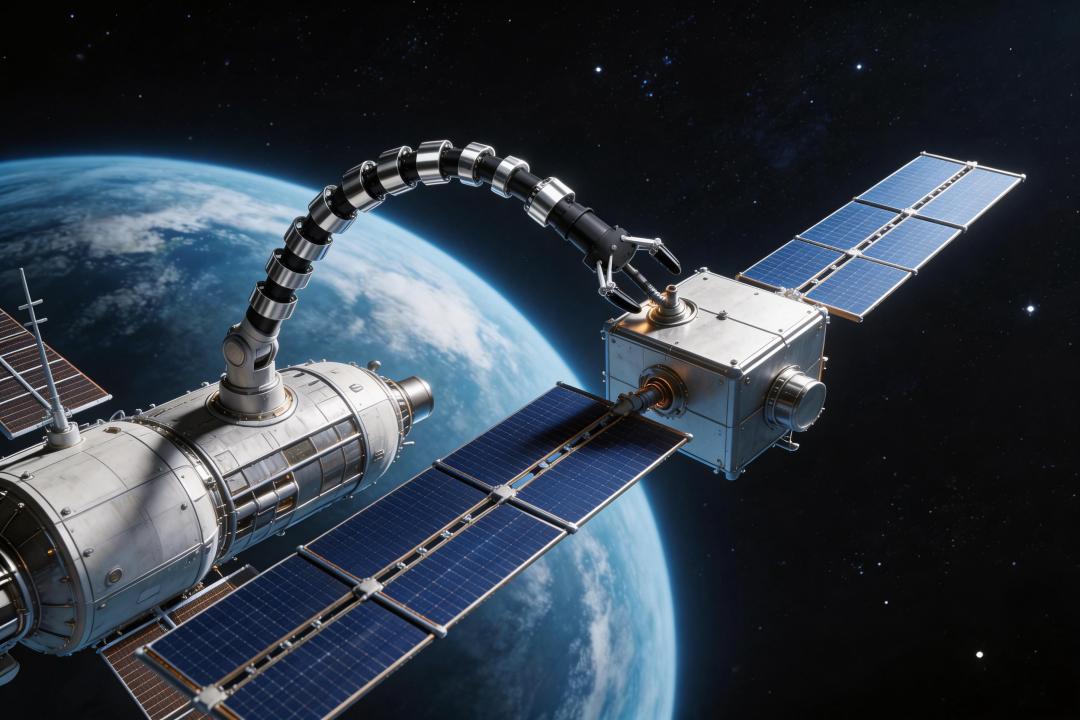
Fuel Refueling (Source / Enterprise)
With the development of commercial aerospace, on-orbit services are becoming an increasingly important field in the industrial chain. NSR predicts that by 2031, the global on-orbit service market will reach US$17.57 billion. Through service satellites with operation, docking or propulsion capabilities, missions such as on-orbit refueling, debris removal, and on-orbit maintenance can be implemented for target satellites, transforming satellites from "one-time consumables" into long-term space resources that are maintainable, reusable and recyclable.
Traditional on-orbit services mainly use rigid manipulators, which have fixed configurations and large volumes, and have certain limitations when facing complex space attitude adjustment and dense docking operations. At the same time, the rigid structure lacks buffering capacity after collision, which is easy to cause accidents such as fuel pipeline damage, and to a certain extent restricts the application of robots in large-scale commercial scenarios.
The cable-driven technology selected by Xianyin Future is a bionic flexible transmission scheme that uses high-strength flexible cables to replace traditional rigid connecting rods and gears. It realizes long-distance power transmission and multi-degree-of-freedom joint motion through cable traction, pulley guidance and precise closed-loop tension control.
Compared with rigid manipulators, flexible arms have higher flexibility in orbit. Relying on cable transmission and lightweight end effectors, flexible manipulators can complete complex actions such as complex winding, obstacle avoidance traversal, and large-scale extension, and have advantages in some scenarios with narrow space and complex structures.
At the same time, the cable itself has soft characteristics, which can absorb part of the impact in the event of a collision, improving the safety of human-machine or inter-satellite interaction. Since the motor is placed at the rear and power is transmitted through the cable, the end of the arm can be further lightweighted to reduce the moment of inertia, thus improving the safety and flexibility of the overall movement.
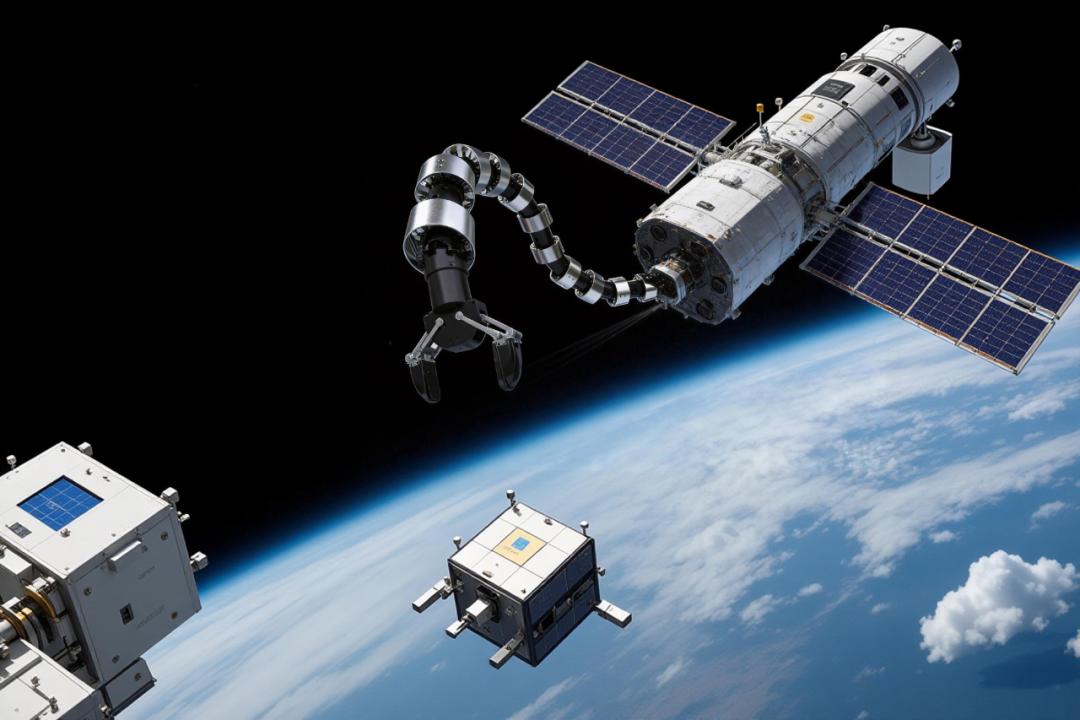
Assisted Deorbiting (Source / Enterprise)
The technical source of Xianyin Future is the technical team from Tsinghua University. The large team gathers outstanding talents from Tsinghua University, Harbin Institute of Technology and other universities. The team has been engaged in the R&D of space robots and hyper-redundant flexible manipulators for more than 20 years, and has participated in on-orbit verification of national projects for many times.
At the technical level, the company has formed a number of original technologies around the motion and control of flexible robots, including a brand-new flexible drive design and generative technology, a position-configuration cooperative motion dynamics planning method, and a compliance control method for the space environment.
In terms of commercialization paths, Xianyin Future's business focuses on three major directions of commercial aerospace on-orbit services: on-orbit refueling, which provides on-orbit fuel replenishment services for spacecraft with exhausted fuel to extend the service life of high-value satellites; assisted deorbiting, which guides faulty and decommissioned satellites to deorbit safely and orderly, contributing to the sustainable governance of the orbital environment; on-orbit maintenance, which carries out on-orbit detection and intelligent operation and maintenance for space facilities to ensure the long-term and stable operation of space assets.
At present, Xianyin Future is conducting scheme docking with related enterprises in orbital transfer vehicles, computing power and other fields. The company plans to carry out a space rendezvous and docking technology verification in 2027 to further verify the operation capability of flexible robots in the actual space environment.
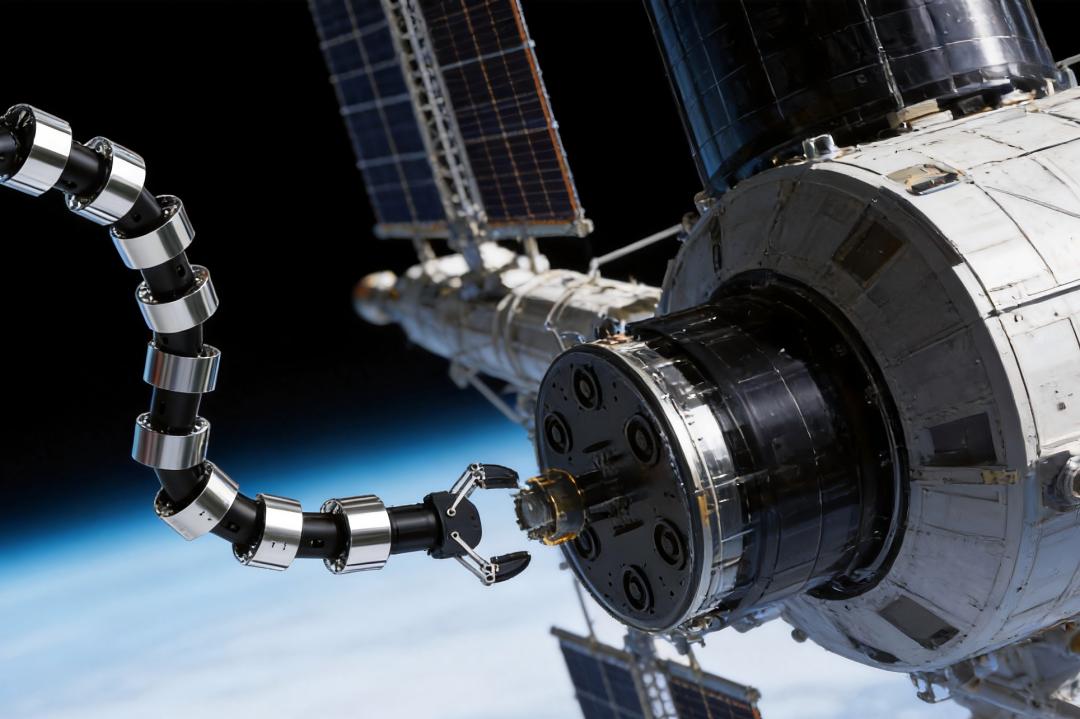
On-orbit Maintenance (Source / Enterprise)
The technology of cable-driven flexible robots is not only applicable to space. The lightweight structure and flexible design can also be used in scenarios such as high-risk ground operations and deep-sea underwater operations, especially in environments that are inconvenient for personnel to enter and difficult for traditional rigid robots to operate. The company chooses on-orbit services as the entry point, on the one hand, it values the market demand, and on the other hand, the space environment puts forward higher requirements for robot safety, control accuracy and environmental adaptability. After completing the on-orbit verification, the company will further expand application scenarios such as high-risk ground operations and deep-sea underwater operations based on the same technical system.
The following is an excerpt from the communication between Hard Krypton and Tao Yanbo, one of the company's founders:
Hard Krypton: What are the advantages of using flexible solutions for on-orbit services?
Tao Yanbo: The essence of flexibility is variable stiffness, which is somewhat similar to the human arm. When the muscles are not exerting force, the arm is relatively soft; but after the muscles are tensed, the force-bearing capacity can be very strong. The stiffness K value of the flexible structure at the physical level is adjustable, while the stiffness of the rigid manipulator is basically fixed.
Flexibility itself has passive compliance characteristics. When a real collision occurs, the elasticity of the cable itself can play a buffering and protective role, which is especially important in the space environment and can avoid satellite damage caused by operational errors.
In addition, the flexible structure can be made more precise and can adapt to more complex space scenarios, such as on-orbit refueling. We hope to move the mode of "aerial refueling" to space, extend a certain distance through a flexible hose or flexible arm, and use its hollow structure for fuel refueling. In this way, the two spacecraft can maintain a safe distance of 30 meters or even 100 meters, and can separate and leave after the operation is completed, which is more flexible, can reduce the risk of collision, and avoid generating additional space debris due to complex docking.
Hard Krypton: How to solve the problem of flexible control?
Tao Yanbo: In the aspect of flexible control, the team has been deeply engaged for many years, and it is mainly solved from two levels.
The first is the kinematics level. The flexible arm has a very high degree of freedom, which can reach dozens, and there are non-holonomic constraints in the movement process, which is prone to singular points. Therefore, effective avoidance needs to be carried out in advance at the stage of motion planning.
The second is the control level. Generally, rigid manipulators adopt force-position control, that is, to control the force and position of the end effector. However, the flexible manipulator needs to control not only the position and force of the end effector, but also the shape of the whole movement process, so the team proposes force-position-shape integrated control.
In addition, the space environment introduces the problem of "floating base". Simply put, a robot floating in the air needs to provide services for another spacecraft that is also in a floating state, which requires extremely high precision of force control and compliance control. At the same time, there are coupled non-holonomic constraints between the spacecraft base and the manipulator. Therefore, in the design of the flexible manipulator, we will adopt a light-weight, low-inertia structure, so that the manipulator has less influence on the attitude of its own spacecraft during the movement in space, which is more conducive to the overall control.
Hard Krypton: Does the cable-driven solution also have the problems of hysteresis and creep in space, and how to solve them?
Tao Yanbo: The cable does have hysteresis and creep characteristics, but from the actual demand of space missions, the impact of these problems on the product is not as great as imagined.
On the one hand, the operation frequency of space maintenance or refueling is actually very low, and generally only dozens to hundreds of actions are required.
On the other hand, the cables on the ground are usually in a certain tension state all the time due to the action of gravity, while in the space microgravity environment, most of the time the cables are in a floating state and will not continuously bear large tension. Therefore, the time for creep to occur will be greatly extended, and the deformation will be very small, which basically will not affect the execution of actual tasks. But at the same time, the safety and compliance characteristics of the cable itself can still be retained, which is also an important reason why we choose the cable-driven solution.
Hard Krypton: How is the intelligent decision-making of the flexible solution realized specifically, and is the underlying model independently developed by the team?
Tao Yanbo: The state of space missions changes very much, and operations such as refueling basically require one-time success, and cannot be restarted after failure like ground robots. Because once a collision occurs, the satellite may lose attitude control or even spin, the cost of subsequent recovery is very high, and even the entire mission may directly fail.
Our core idea is to imitate the way humans operate "take one step, watch one step, think one step", that is, think twice before acting. After the robot completes each action, it needs to judge whether the current state and the next action are feasible, and continue to advance after confirming safety; if risks are found, it will withdraw in time and re-evaluate, instead of blindly executing the preset actions.
The underlying model is independently developed by the team. A large number of verifications will be carried out through simulation and semi-physical simulation platforms in the early stage, and the data will be corrected with equipment such as counterweights and air flotation tables. When the on-orbit mission is actually executed, local optimization is mainly carried out on the end-side server, and the final mission data is transmitted back to the ground, which in turn improves the simulation model, forming a closed loop from ground simulation to on-orbit verification and then back to ground iteration.