Behind the 80 million loss: The "efficiency myth" of Japanese-style fast food no longer exists
Plummeting table turnover rates, 80 million yuan in losses: Japan's "efficiency champions" are slowing down in China
How long has it been since you last had a Japanese-style fast food meal?
Recently, news of the closure of the Hakata Ikkousha store in Chaoyang Joy City sparked widespread discussion among netizens. The outlet had operated for 11 years, with many customers describing it as "a regular go-to canteen". After the closure, only 2 stores of the brand will remain in Beijing. Around the same period, the 21-year-old Yoshinoya outlet in Wangjing, Beijing, also announced its shutdown. For a moment, long-time customers flocked to social media, triggering a wave of nostalgic memories.
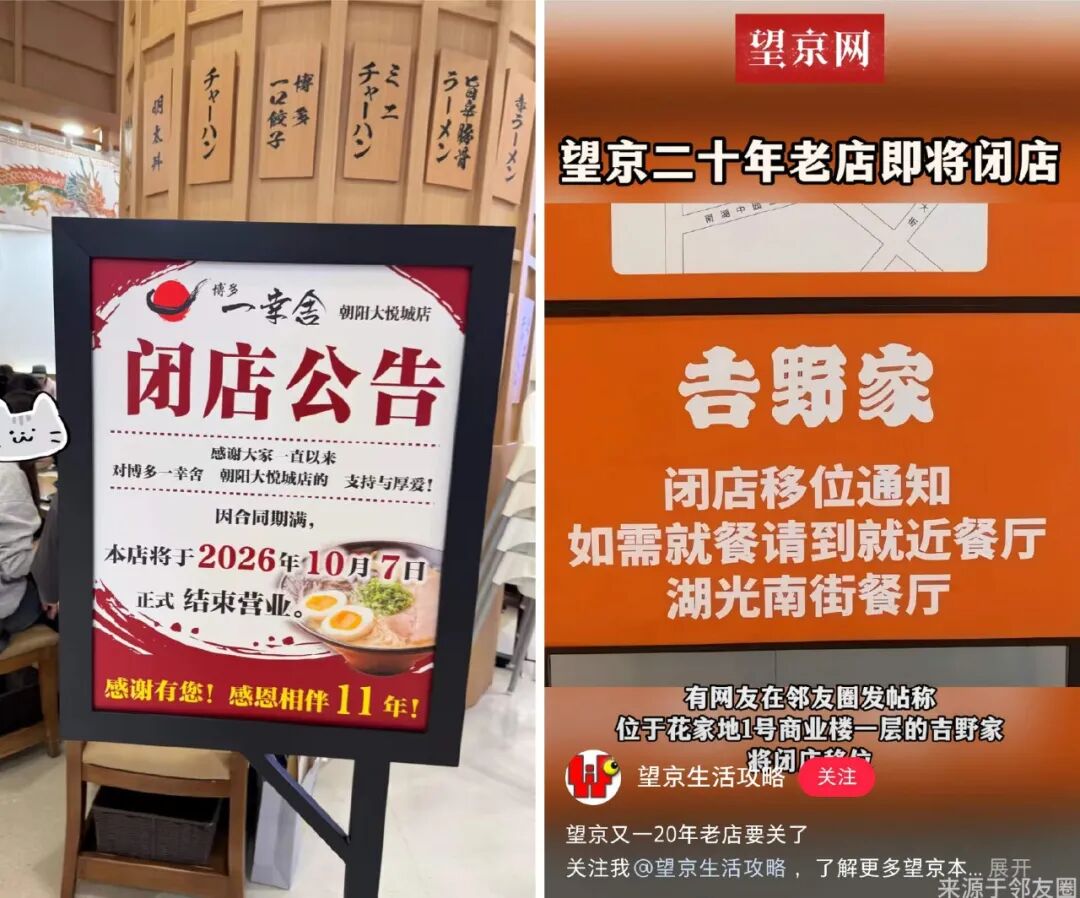
Japanese-style fast food, once hailed for its "exotic cuisine" and "high efficiency" labels and chased by young consumers to check in, now seems to face similar shrinking dilemmas across all popular brands:
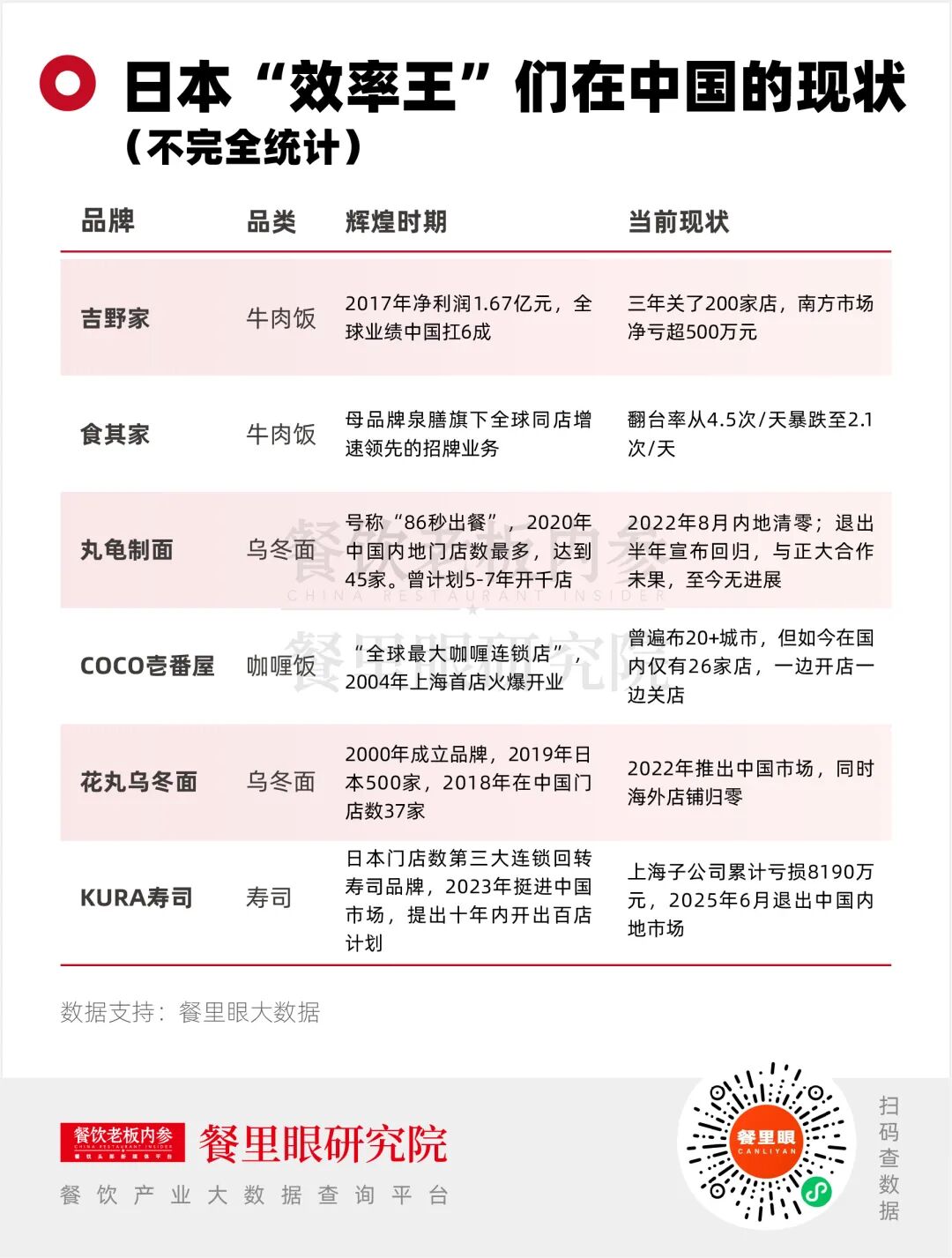
At its peak, Sukiya had over 500 stores across China in 2019, with an annual per-square-meter revenue of up to 68,000 yuan per store, making it the undisputed leader in the Japanese fast food track. However, its subsequent store table turnover rate plummeted from the industry-estimated 4.5 times per day to 2.1 times per day, its China business recorded losses for two consecutive years, and same-store sales dropped by 11.2%;
Yoshinoya, which swept the Chinese market with its signature beef bowl, once set a brilliant record in its early days in Japan of 700-800 daily customers per store, and annual sales of 100 million yen for a 20-square-meter outlet. But under pressure in the Chinese domestic market, it has closed 200 stores in three years, its southern China entity in Shanghai recorded a net loss of over 5.34 million yuan, and the Hop Hing Group that operates its northern China market also delisted from the stock market disappointingly;
CoCo Ichibanya came to China with the title of "the world's largest curry chain" — it has more than 1,400 stores globally certified by Guinness World Records, with 1265 stores in Japan alone back in 2017. The brand entered China in 2004, and after 22 years of development, its total number of stores has remained at around 60, and in recent years it has quietly closed old stores while opening new ones, showing weak expansion momentum;
Marugame Seimen, which claimed to serve meals in 86 seconds, had long queues every day for its "on-site noodle making" when it entered Shanghai in 2012. It once announced a plan to open 1000 stores in 5-7 years, but only had 45 stores at its peak in mainland China. It closed all its mainland stores in August 2022, and announced less than half a year after exiting that it would "return to China and open hundreds of stores before 2028", but no progress has been seen so far;
There is also Hanamaru Udon under Yoshinoya, designed specifically for high table turnover with pre-made raw noodles delivered from central kitchens and in-store semi-self-service. It reached its peak of nearly 40 stores in 2018, but then retreated completely — it announced its exit from the Chinese market at the end of August 2022, and its overseas stores that once peaked at 50 outlets were also all closed in this round of adjustment;
Kura Sushi's mainland China business recorded a total loss of over 80 million yuan in 2023 and 2024 combined, and all its Shanghai stores were shut down overnight in 2025...
While Chinese-style fast food is developing at a high speed, these Japanese "efficiency champions" that rely on "extremely narrow SKUs + ultimate standardization + extreme table turnover rate" are becoming more and more marginalized.
How did the mid-range work meal turn into a "rip-off zone"?
Once upon a time, Japanese-style fast food was a synonym for light luxury and efficiency. The success of these brands essentially relied on the high-efficiency single-product model.
Yoshinoya is the originator of this playbook — it cut its menu down to only two ingredients, beef and onion, simplified the production process, and trained its staff to remember regular customers' specific preferences, realizing the experience of "pay when you enter, leave as soon as you finish eating".
Industry insiders recall that around 2018, Yoshinoya was still the top trending Japanese fast food brand in China, and gathering with a few friends to eat there was considered a relatively expensive light luxury experience.
But the underlying logic of the single-product model is "subtracting choices for consumers", which is premised on the scarcity of consumer options.
When the Chinese fast food market is flooded with supply, consumers demand the richness brought by "adding choices", making the single-product strategy look rather thin. It is not that the model itself has problems, but that the soil that the model depends on has changed — at least in current China, there is oversupply, extremely fierce price competition, food delivery platforms have reshaped consumption scenarios, and consumers want cheap, rich and freshly made meals at the same time.
All these factors instantly broke the light luxury filter of Japanese-style fast food.
First of all, in terms of pricing, the Chinese fast food market has entered an overall "persistent price war" in recent years, pushing many Japanese fast food brands into a dead end. Public industry data shows that the average customer unit price of the snack and fast food track has dropped from 25.1 yuan in 2022 all the way to 21.7 yuan in May 2025. Against this background, the overall pricing of Japanese-style fast food is still relatively high.
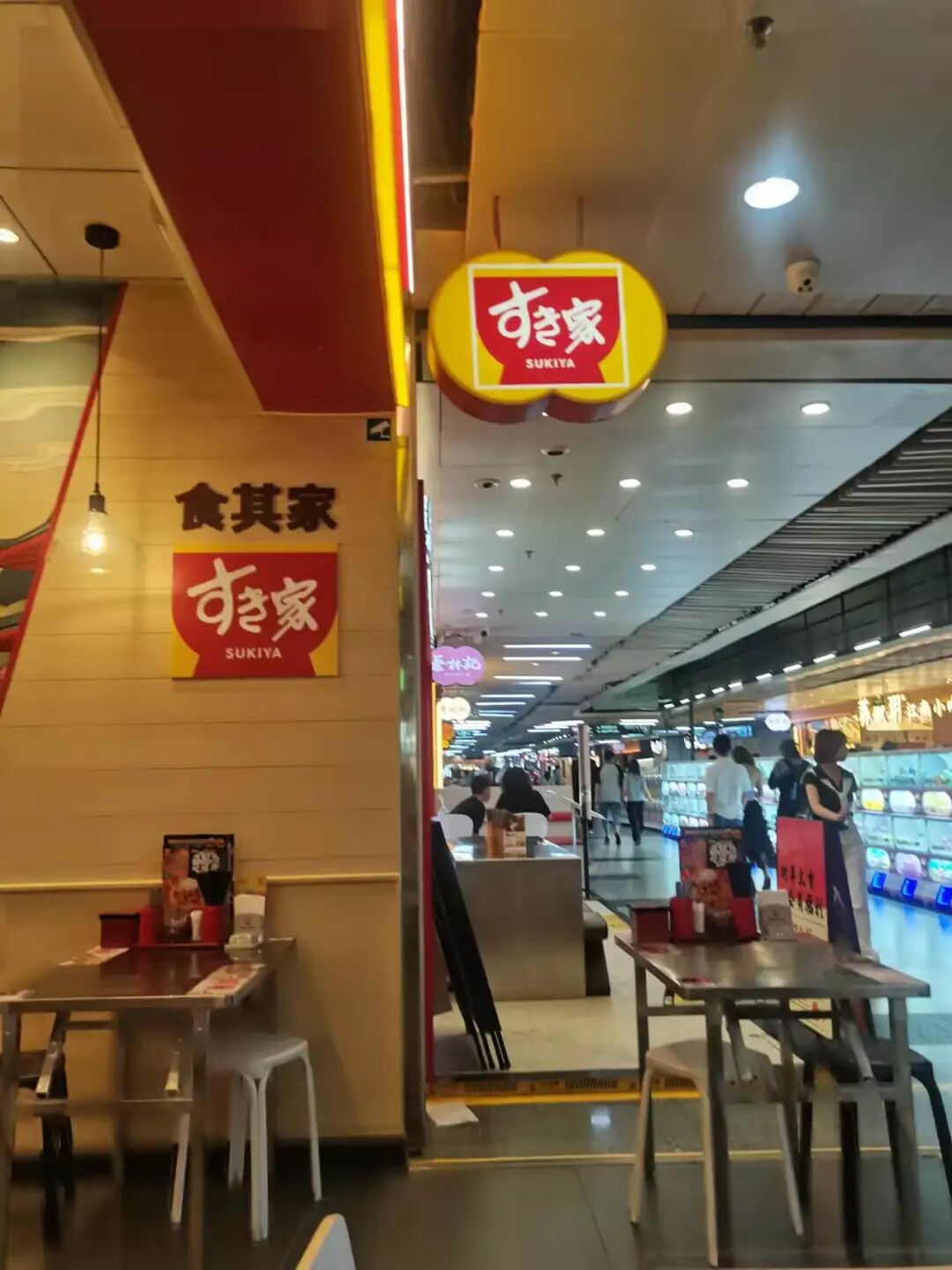
For example, Sukiya raised its 29-yuan set meal that had been priced for ten years to 35 yuan in 2022, completely breaking its cost-effectiveness myth. Hanamaru Udon has almost the same product form as Marugame Seimen, which is udon with tempura and semi-self-service. Its tomato pork cartilage udon is sold at 45 yuan, while in comparison, a bowl of beef noodles at Chinese noodle chain Chen Xiangui is 26 yuan, and that at Hefu Noodle is around 30 yuan.
An interesting contrast is that these brands actually started their business with low prices in their home market Japan: in Japan, a medium-sized bowl of udon at Marugame Seimen sells for 290 yen, equivalent to about 17 yuan RMB; Yoshinoya's beef bowl is a cheap canteen option for office workers in Japan; Sukiya is positioned as "the cheapest rice bowl" in Japan...
The same brand and product, which is a "survival necessity" in Japan's deflation era, was packaged as a "mid-range work meal" in China. It has to be admitted that in the past, consumers' preference for "exotic style" brought a dividend period of development for Japanese fast food, which is not only the brand premium, but also the premium of the times.
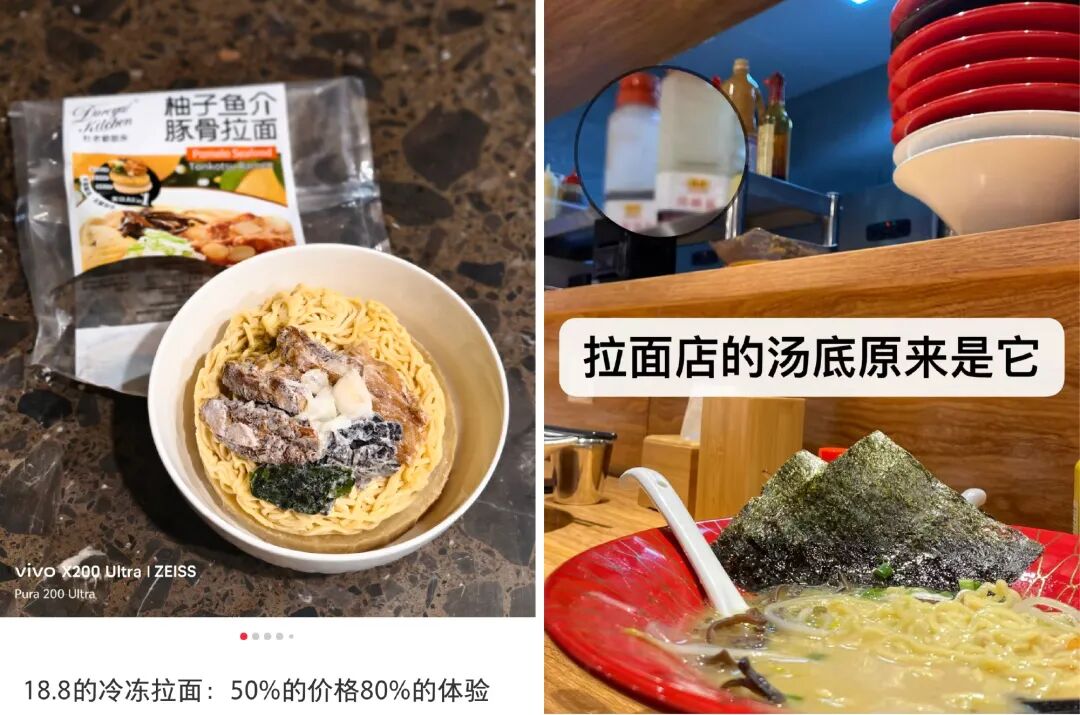
In addition, Japanese-style fast food was one of the earliest categories that mastered the standardization of pre-made dishes. But "success comes from the same move, failure also comes from it". In the years after the pandemic, consumers' resistance to "pre-made food" has risen sharply, the high efficiency of fast meal delivery brought by pre-made products is no longer an efficiency myth, but has become a "original sin".
The microwaved beef bowls sold at 7-Eleven and FamilyMart convenience stores cost only more than ten yuan after discount, and food delivery platforms with various red envelopes and full reduction offers can deliver affordable meals directly to workstations... It has to be admitted that current young people's perception of "Japanese-style fast food" has long been subverted, and they no longer find it special.
When cost-conscious consumers find that they pay twice as much for pre-made food that they can just heat up at home, the concept of "being ripped off" becomes very concrete.
Another important reason that has to be mentioned: Chinese-style fast food is accelerating upgrading and rising rapidly
In addition to internal factors such as products and pricing, another major change that Japanese "efficiency champions" cannot catch up with is: Chinese-style fast food has completed the supply chain revolution, pushing the definition of "efficiency" to an extremely high level.
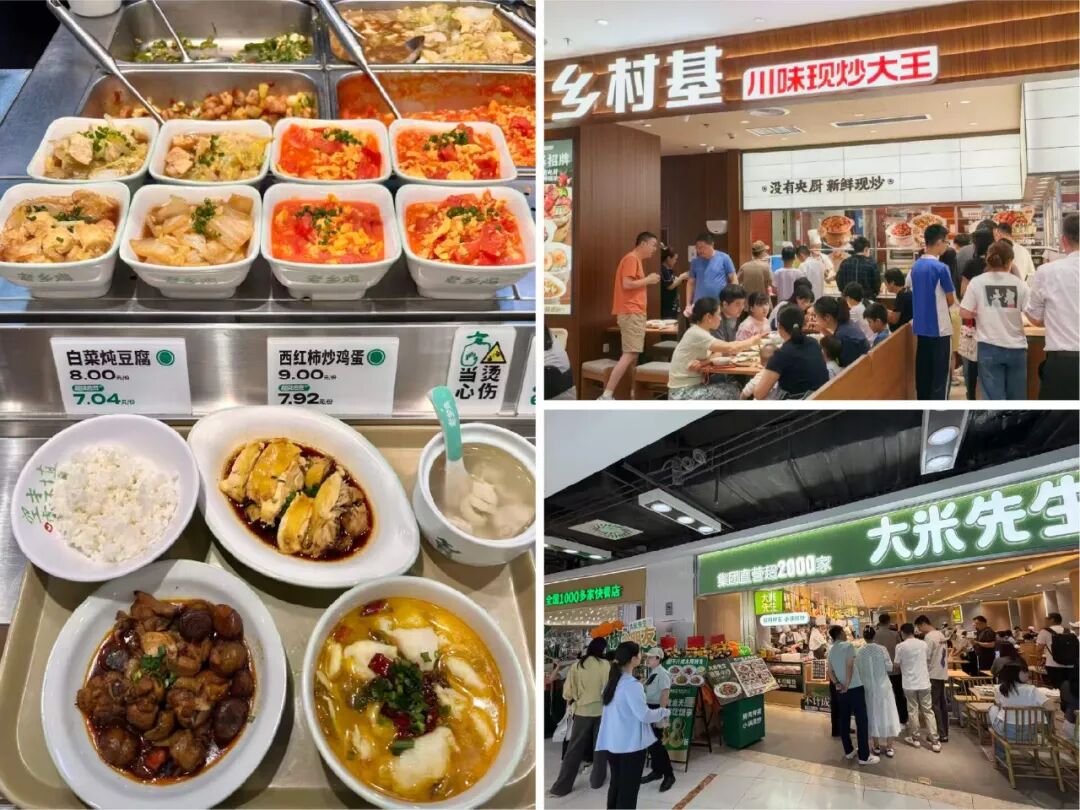
In the past few years, brands including Laoxiangji, Country Style Cooking and Micun Bibimbap have all made successful practices for central kitchens, freshly cooked fast food, and all-day community stores.
Data does not lie: for directly-operated Laoxiangji stores in mature regions, the average daily sales of a single store can reach 15,000 yuan, with a table turnover rate of 4.4, and the payback period for its community stores in Anhui is only about 10 months. Micun Bibimbap has launched an expansion strategy with external support, planning to fully launch national city partner recruitment in 2027, and continue to expand on the basis of more than 1900 existing stores. The Country Style Cooking Group has more than 2200 directly-operated stores, maximizes the advantages of its brand genes by making fresh cooking to the extreme, and its expansion speed is even accelerating...
In comparison, the data of Japanese-style fast food brands are really far behind.
That means, efficiency is no longer the exclusive halo of Japanese brands, but has become the "basic configuration" of Chinese brands.
From the perspective of the overall category market, a set of data mentioned in Laoxiangji's prospectus shows that the market size of Chinese-style fast food grew from 6.167 trillion yuan in 2019 to 8.097 trillion yuan in 2024, and is expected to reach 12.058 trillion yuan in 2029, with a compound annual growth rate of 8.3% from 2024 to 2029, which is higher than that of the previous five years. Chinese-style fast food is the largest sub-sector of China's fast food industry, and its growth rate is higher than the overall level.
Supply density is also a proof: as of September 2026, You Ni Zai Yi Qi has more than 2700 stores, Micun Bibimbap more than 1900, Laoxiangji more than 2000, and the Country Style Cooking Group (including Country Style Cooking and Mr. Rice) more than 2000... In contrast, CoCo Ichibanya only had more than 60 stores after 22 years of operation in China, and Hanamaru Udon only reached nearly 40 stores at its peak — the number of stores opened by Chinese brands in one year is even more than what Japanese brands could open in 20 years.
In addition, Chinese-style fast food obviously better suits the "Chinese stomach", which is an indisputable fact. In recent years, the whole industry has widely introduced intelligent cooking equipment, using "intelligence + fresh cooking" to balance efficiency and the warm atmosphere of freshly made food.
When Japanese-style fast food entered China back then, it relied on scarcity, first-mover advantage and exotic filter, and used central kitchens and single-product standardization to crush Chinese street-side stores, but mistakenly took that as the victory of its own model. Now that times have changed, Chinese brands have launched a "reverse harvest" in terms of efficiency — when brands like Country Style Cooking, Micun and Laoxiangji achieve the same level of efficiency with more mature supply chains, richer SKUs and more aggressive pricing, Japanese-style fast food is left with nothing but the labels of "expensive, limited options and outdated".
Japanese-style fast food: iteration of "new kings"
One generation falls, another rises.
In fact, Japanese-style fast food has not really disappeared, but has ushered in a "textbook-style generational transition".
While Sukiya's table turnover rate dropped to 2.1 times per day, in the same business district just hundreds of meters away, a number of tempura specialty stores can even achieve a daily table turnover rate of 15 times — the efficiency of the same track has increased by 7 times.
In the past year, affordable tempura specialty stores have swept across the country, such as "Hakata Tianyi Tempura & Steak Rice" and "Daily Tempura Specialty Store". These brands have successfully improved the traditional Japanese food model, combining tempura and steak rice to expand dining scenarios, covering everything from single-person meals to small gatherings. At the same time, they generally adopt the "counter dining" style, turning the formal dining experience of traditional Japanese food into a fast food price, with a set meal price of around 60 yuan, allowing customers to watch the whole process of wrapping batter, putting into the oil and frying.
With 80-100 square meter small stores and about 30 seats, all located in top-tier business districts such as MixC, Hopson One and SKP, these brands are called "efficiency monsters" by industry insiders, and have become the "new kings of Japanese-style fast food" in this round.
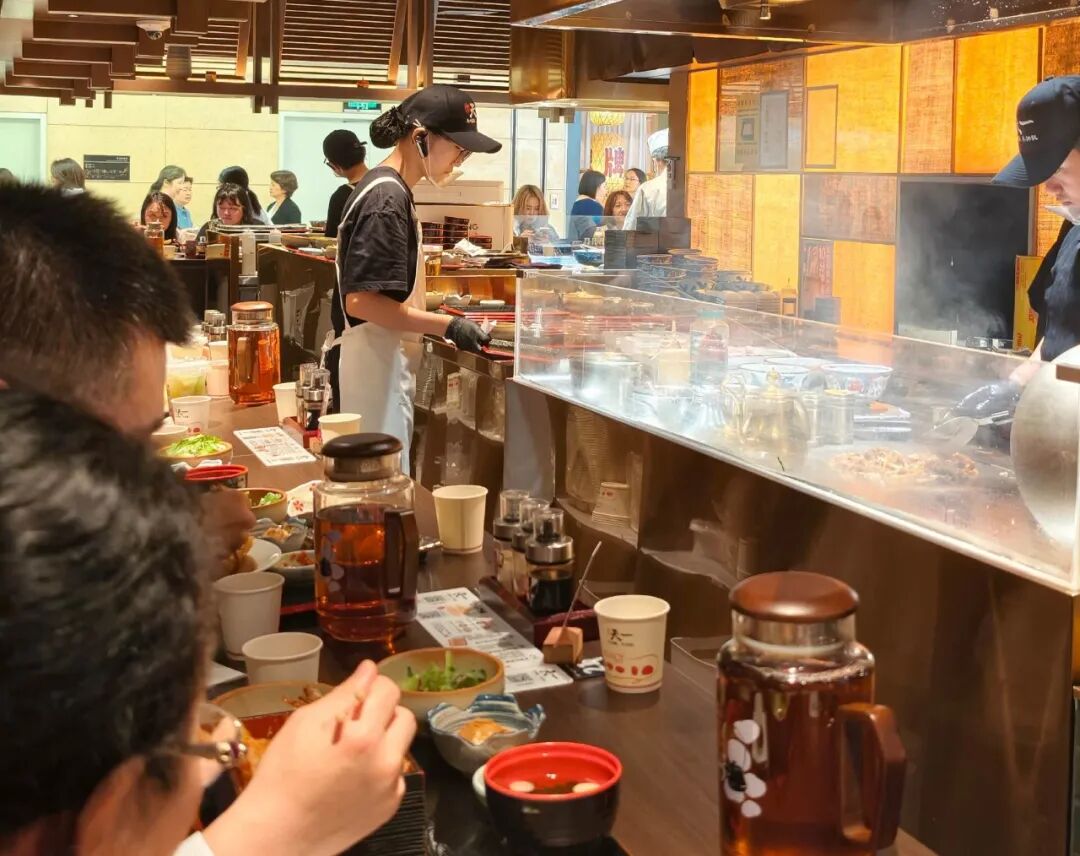
The smart point of the new generation of brands is that they have anchored "efficiency" and "experience" themselves from the very beginning. And the identity label of "Japanese style" has degraded from a premium-worthy identity symbol to a background element.
It is worth noting that after the tempura specialty stores became popular, a restless period of franchise followed. Less than 2 months after the first store of Tianyi opened last June, a number of followers have emerged in Tianjin and Shandong. Some brands were established only in March 2026, and have opened more than 40 stores in less than a year, penetrating into third- and fourth-tier cities...
If we deduce according to the current playbook, the state of "efficiency myth +