After the National Day holiday, hotel owners begin to recalculate the accounts of their distribution channels.
01
Yesterday evening, as tourists gradually dispersed from the Yingtianmen Scenic Area in Luoyang, Zhang Guoquan stood in the lobby of his own hotel, watching the last two guests finish check-out and drive away.
Zhang Guoquan has been investing in and operating this standalone designer hotel in Luoyang for five years. Throughout the entire seven-day long holiday just past, he was constantly rushing back and forth between the front desk in the lobby and the linen rooms on each floor.
When talking to me about the operating performance during this year's National Day Golden Week, he sighed: "It's better than expected, the hotel was almost fully occupied for all seven days, but after I settled the accounts this afternoon, the actual profit is just so-so."
I asked him what he meant by "just so-so".
He sent me a screenshot from the hotel's backend, which records the daily accommodation revenue in the form. The total operating revenue has increased compared with last year's National Day holiday, but the expected net profit failed to reach the level of last year.
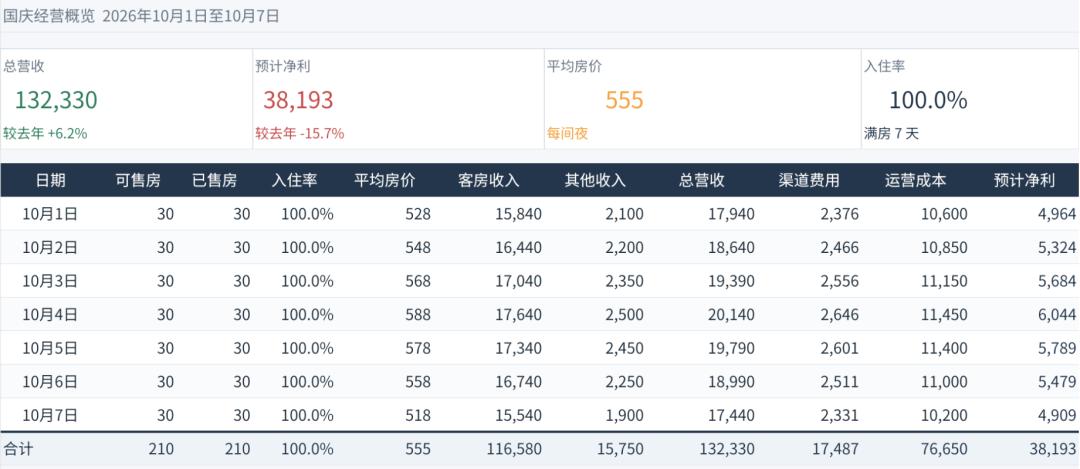
When talking about the reasons why this year's performance is worse than last year's, Zhang Guoquan counted them out on his fingers over the phone: the room rates for guests were locked in early, each room was dozens of yuan cheaper than usual, while the labor cost and energy consumption during the holiday all rose, eating up another chunk of the profit.
At the end of the conversation, he sighed and said these losses are still bearable, what he is really worried about is the period after the holiday.
After mid-October, the tourism popularity in Luoyang will drop significantly, and he still has no idea how to fill his dozens of rooms.
In fact, the phenomenon of high occupancy but low profit experienced by Zhang Guoquan is widespread in China's non-chain accommodation market this year.
According to the *2026 China Hotel Industry Development Report* released by China Tourism Hotel Association, by the end of 2025, the total number of hotel rooms in China reached about 18.74 million, of which nearly 11 million are non-chain rooms, forming the fundamental base of China's accommodation industry, which has long been facing the situation of weak bargaining power and low brand recognition.
However, it should be pointed out that a considerable number of non-chain rooms belong to high-quality boutique designer hotels and featured homestays operated by people like Zhang Guoquan. Their product competitiveness is no less than that of chain brands, but they just lack an efficient channel to reach target customers.
During the long holiday, in several local accommodation industry exchange groups that Zhang Guoquan joined, practitioners kept forwarding system screenshots showing full occupancy of their hotels. But nowadays, as bed-car travel is becoming increasingly popular, ADR (Average Daily Rate) and RevPAR (Revenue Per Available Room) have always been the hidden pain for every hotel owner.
However, one thing gave Zhang Guoquan some new ideas: two days ago, he noticed that someone in the group forwarded the long holiday data newly released by Fliggy.
During the holiday, the number of fulfilled hotel room nights on the platform refreshed the historical record for four consecutive days, with the average daily fulfilled room nights increasing by nearly 70% year on year, and the hotel room nights in more than 100 cities across the country doubled.
He vaguely remembered that the hotel business of Fliggy seems to have maintained growth for a long time. After searching with AI, he found that during last year's National Day holiday, the number of global hotel room nights on Fliggy increased by 78% year on year, and during this year's Spring Festival and summer vacation, the platform withstood the travel peak and continued to achieve high double-digit growth.
Putting several sets of data together, it is difficult to explain this continuous growth only by short-term promotions.
Then he noticed a detail: the per capita hotel consumption of 88VIP users on Fliggy is 34% higher than the overall average of the platform.
Several peers who run boutique homestays in Zhejiang and Yunnan echoed in the chat interface, mentioning that during this year's long holiday, the proportion of orders from Fliggy in their respective backends has increased significantly.
After much consideration, Zhang Guoquan made up his mind and said in the group that he was thinking that he must no longer pin all hopes on a single channel in this off-season, and he has to develop multiple channels at the same time.
02
In the group chat, the first person to respond to Zhang Guoquan was Mr. Xu, who runs two boutique resort hotels in Zhejiang.
He acted earlier than Zhang Guoquan. Half a month before the National Day holiday, Mr. Xu made a rather bold decision in the eyes of his peers: he moved 30% of the room inventory and promotion budget that were originally concentrated on traditional mainstream channels directly to Fliggy.
Right after the long holiday, Mr. Xu sent me the accounting data from his backend. During the seven days, the Fliggy channel not only had smooth sales performance, but also its input-output ratio was significantly better than his expectation. In the order details, orders placed at the exclusive 88VIP price account for a quite prominent proportion of new customer sources.
In his opinion, every hotel owner has a clear account in mind: 88VIP brings in high-spending crowds, this group of people have requirements for quality, which forces the platform to introduce more high-quality hotels, and high-quality hotels in turn retain more users. This positive cycle has already started, and many owners adjust their budget to this channel precisely because it is in the acceleration period.
Judging from more public data, the judgment of hotel owners is well-founded.
During this year's National Day holiday, the number of room nights of more than 70 hotel brand flagship stores on Fliggy doubled, and the number of new members of brands through Fliggy increased by more than 30% year on year. When a channel can not only bring in matching new customers, but also help merchants accumulate their own member pool, its value goes far beyond one-time traffic transaction.
After all, for the owners of independently operated standalone hotels and homestays, channel selection is ultimately an issue of calculating input and output.
Long-term dependence on a single customer acquisition source often means losing the room to negotiate on commission rates and pricing rules. By allocating part of the limited room inventory dynamically and distributing part of the resources to other platforms, they can reduce the passivity of being constrained by a single point while maintaining their fundamental base.
This is also the direct reason why some high-quality standalone hotels are re-evaluating their channels.
To put it bluntly, the reason why unfamiliar guests choose a standalone hotel with low brand awareness among numerous hotels often depends on what kind of people the platform can bring to it.
In the past, most of the customer groups with high consumption characteristics were absorbed by leading chain brands and international high-end hotels with mature membership systems, and it was difficult for standalone hotels to cross the brand threshold to reach them directly.
But Mr. Xu believes that with the help of the air ticket refund discount policy launched by Fliggy some time ago and the interconnection of 88VIP membership rights and interests, a large number of people with stable purchasing power have been directly precipitated into the travel and hotel sector.

According to public statistics by the middle of this year, the scale of 88VIP members has reached about 64 million. Users who are used to high-quality online shopping do not want the uniform standard rooms of chain hotels, but differentiated experiences with unique design sense and local characteristics, which naturally matches boutique standalone hotels.
In addition to the change of customer group structure, the reduction of operation threshold is also one of the reasons why Mr. Xu is willing to switch the customer acquisition channel.
Large chain hotels are generally equipped with dedicated revenue management teams, which can adjust the price curve according to market supply and demand at any time. However, in many boutique hotels and featured homestays, the owner has to take charge of procurement and supervise the front desk at the same time, and often cannot take care of everything when facing the complicated backend system.
This year, Fliggy also launched an intelligent assistant for merchants, through which operations such as modifying room status, adjusting room quantity, and pulling operation reports can be completed quickly with simple instructions, which is equivalent to equipping standalone hotels with a basic digital helper, reducing the manpower consumption in daily operation.
At the same time, Fliggy Helper, the AI assistant for consumers, is quietly changing users' traditional search logic.
In the past, if a listing wanted to get high exposure, it usually had to spend real money to buy top positions and pile up keywords. Standalone hotels with weak capital strength could hardly gain an advantage over large chain hotels.
Now the intelligent interaction focuses more on understanding the real scenario demands of guests. As long as the hardware facilities and service reputation are excellent, hotels with unique features also have the opportunity to be accurately recommended to target customers.
According to the data, during this year's National Day holiday, the number of flight and hotel bookings guided by Fliggy Helper AI increased by 110%. Although the scale may still be small, the trend is worth paying attention to.
AI is reconstructing the decision-making entry for travel consumption. In this new entry, the weight of product quality itself is exceeding the weight of marketing budget, which is a future-oriented benefit for boutique hotels with strong product competitiveness but insufficient promotion budget.
03
When talking in high spirits, Mr. Xu simply made the account clear.
Mr. Xu said to me: "Don't overcomplicate the channel switch. The reason why everyone is willing to try Fliggy is simply that the cost performance of betting on it is very high now."
Hotel owners who have been operating in mature channels for many years know very well that in the existing system with a large number of merchants, for standalone hotels without brand endorsement, to squeeze into a prominent position, in addition to bearing the regular commission, they often have to keep purchasing promotion tools.
After deducting various marketing expenses from the actual revenue of each sold room, the profit left in their own account is very limited.
The deeper logic behind this is that in channels with saturated supply, merchants basically bid for stock traffic. But if the supply channel is still expanding, what merchants get is the natural distribution of incremental traffic.
At the current stage, Fliggy is exactly at such a special cycle node. After being incorporated into the e-commerce system, the platform continues to expand more characteristic listings to meet the natural spillover travel demands of a large number of e-commerce users.

Photo taken by Travel Daily
In the words of more peers, this has nothing to do with sentiment, it is purely an accounting process after careful evaluation.
The momentum brought by the platform's supply expansion period allows standalone hotel merchants to get relatively rich exposure and actual transaction turnover with the same effort, which is enough to attract many cost-conscious owners to take the first step to try.
If we take a longer-term perspective, the instantaneous passenger flow peak brought by the long holiday is only a phased verification.
The operators of standalone hotels do not have the professional technical middle platform and operation guidance of large groups, many stores even have only two or three employees to take charge of all the work. Whether the basic service capability of the platform can be further optimized is directly related to the real daily operation experience of merchants.
In the final analysis, for hotel owners on the front line of the market, channel selection can never be regarded as a one-off deal.
For Fliggy, the growth during this year's National Day holiday provides a good start. The next task is to keep the users who entered the platform during the holiday maintain their travel consumption habits, and make hotels see stable returns in normal months.
After the group chat ended, Mr. Xu sent the channel accounting sheet he used to Zhang Guoquan.
The next morning, Zhang Guoquan sat back in his office and filled in the orders of the past three months into the form one by one. He did not make large adjustments to the room quantity for the time being, but only opened more part of the working day inventory in Fliggy's backend, preparing to observe the occupancy situation in the next few weeks.
This National Day, Zhang Guoquan's hotel did make money. After looking at the profit on the book, he also realized one thing more clearly: full occupancy in peak season cannot solve the problems of the whole year. Finding the right channel is the key to making the off-season days also run steadily.
This article is from WeChat official account "Travel Daily", author: Simon skysong, authorized for release by 36Kr.