CATL's capital play is eerily similar to that of NVIDIA.
Earning 240 million yuan per day, CATL still believes its battery business is not large enough.
After investing 5 billion yuan in June this year to become the second-largest external investor of Deepseek, CATL was recently revealed to have once again led a new round of financing of nearly 100 billion yuan for DeepSeek.
This is just the tip of the iceberg of CATL's cross-sector investments. Since 2026, CATL has poured in more than 100 billion yuan, covering AI large models, data centers, HVDC power supply and energy storage systems, and even extended its reach to nuclear fusion.
Zeng Yuqun, founder of CATL, once stated his ambition bluntly: to build the "four pillars and eight beams" of the new energy era, and the battery is only one of the pillars; some capabilities cannot be cultivated internally quickly, so the gaps will be filled through mergers and acquisitions.
This makes the "Ning King" increasingly similar to NVIDIA in the new energy era.
In the AI industry, NVIDIA takes GPUs as the fulcrum, on the one hand investing in model, cloud computing and application companies to expand computing demand and technical cooperation; on the other hand, it closely binds key customers and embeds its computing platform into the entire AI industrial chain. CATL is also taking batteries as the fulcrum, extending its capabilities to computing power, electricity and energy infrastructure through investment and mergers and acquisitions.
Transforming from a power battery supplier to the underlying platform of the new energy industry may be a historic opportunity for CATL.
Striving for upstream and downstream layout
There is a famous scene in the history of China's new energy vehicles:
Zeng Qinghong, then chairman of GAC Group, publicly complained that "all car companies are working for CATL". Wu Kai, chief scientist of CATL, immediately complained in response that the company was only "struggling on the edge of profit", pointing the finger at the skyrocketing prices of upstream battery raw materials.
Neither car companies nor battery manufacturers were willing to take the blame, and the problem finally fell on a piece of "stone".
Key raw materials such as lithium carbonate are important variables affecting the cost of power batteries. However, the mining industry is a typical strong cyclical industry, with prices fluctuating sharply along with the supply and demand cycle. Back in 2022, lithium prices soared all the way, pushing the profit contradictions of the entire industrial chain to the forefront.
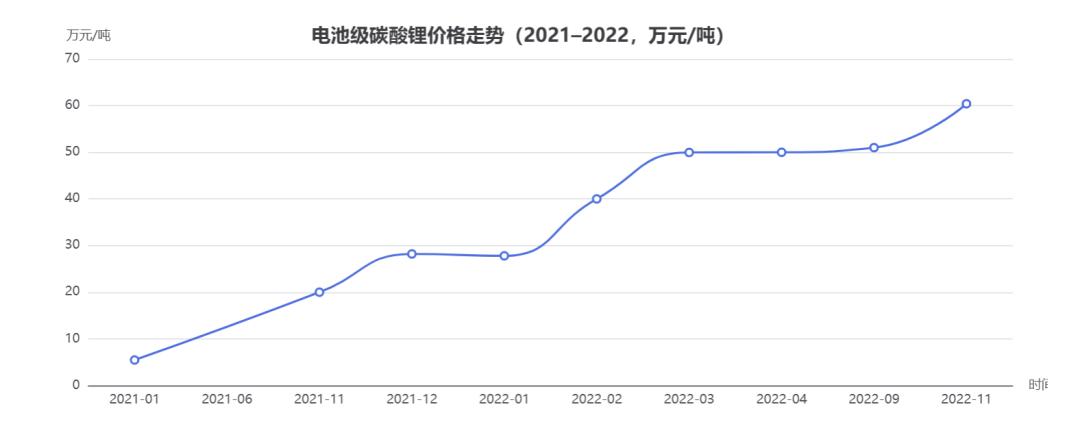
Perhaps having suffered enough from the pain of "no mines in hand", CATL has accelerated its expansion to the upstream. Through self-construction, equity participation, joint ventures and acquisitions, it has invested in lithium mica projects in Yichun, Jiangxi, spodumene projects in Sichuan, copper and cobalt mines in the Democratic Republic of the Congo, nickel mines in Indonesia and lithium mine projects in Africa, trying to grasp the resources that affect battery costs in its own hands as much as possible.
After 2023, as lithium prices went down, CATL's mining investment also shrank to some extent. In April this year, the company announced its plan to establish Times Resource Group with a registered capital of 30 billion yuan to integrate its mining assets under its banner.
On the other hand, by taking shares in Jiangxi Shenghua, a subsidiary of lithium iron phosphate supplier Fulin Jinggong, Hunan Yuneng, a phosphate cathode material supplier, and investing in Xinmai Semiconductor, a power management chip supplier, CATL is also strengthening its ties with the supply chain.
In the upstream, CATL and NVIDIA do not use the same set of strategies — in the face of manufacturing oligarchs such as TSMC and SK Hynix, NVIDIA mostly uses orders, advance payments and joint development to lock in production capacity; while CATL, facing the more scattered mining and material links with greater cyclical fluctuations, relies more on equity plus long-term agreements.
However, when optical communication becomes the new bottleneck of AI clusters, NVIDIA has also begun to invest in Coherent and Lumentum.
This means that although their "toolkits" may not be the same, the two chain leaders are highly consistent at their core: The real hegemony of the industrial chain is not only to master the links that others cannot bypass, but also to ensure that you do not have to rely on others that you cannot bypass.
If investing in the upstream is to solve the problem of neck sticking and ensure that batteries can be manufactured stably, then making moves in the downstream is to solve the market demand.
Power battery is a capital-intensive and not fully standardized business. From production line construction, equipment procurement to commissioning and ramp-up, huge amounts of funds need to be invested in advance; different car models have different requirements for cell specifications, battery pack structure, fast charging and thermal management. If a production line is misaligned, the cost will be huge.
To this end, CATL has successively invested in car companies such as AVATR, BAIC New Energy, Zeekr, IM Motors, Neta and Chery. In 2021, it directly contributed 770 million yuan to become the second largest shareholder of AVATR; in addition to equity investment, it also established joint venture battery companies with SAIC, GAC, Geely, Changan, Dongfeng (note: later withdrew) and other car companies, and explored the "factory in factory" cooperation model with Seres.
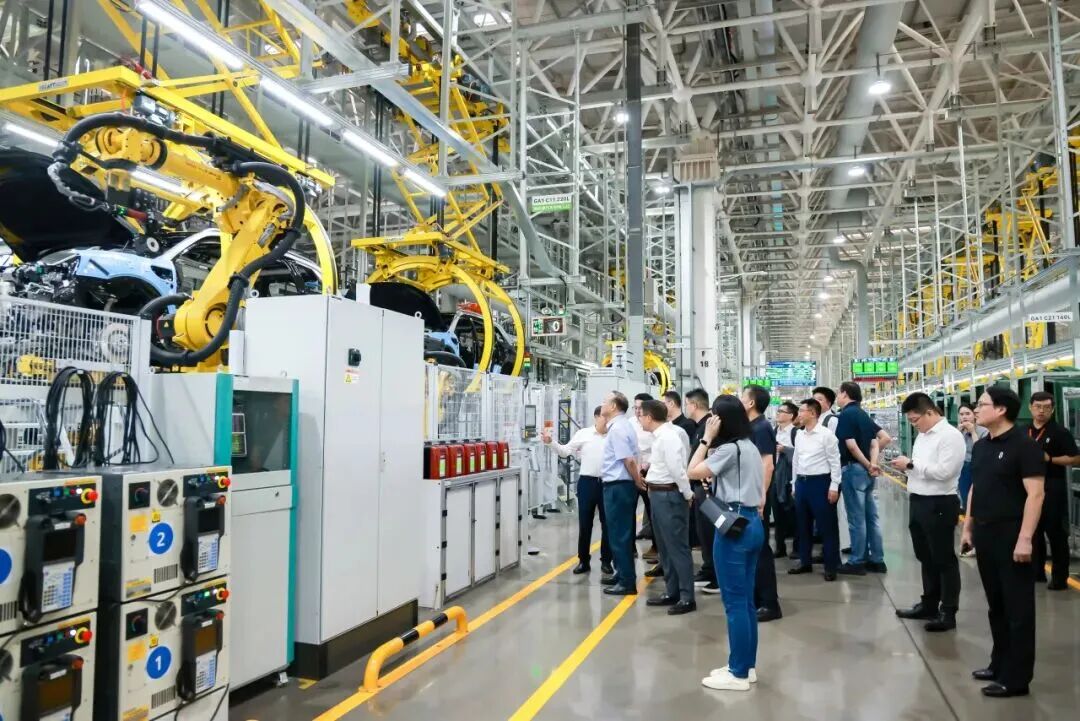
These capital relationships allow CATL to enter the vehicle R&D, procurement and production systems earlier, increase the probability of its batteries being selected, and also raise the cost for car companies to replace suppliers.
Of course, CATL's vision does not stop there. In recent years, the "Ning King" has made frequent moves in the fields of battery swapping and autonomous driving, such as investing in Hello Energy Swap, SAIC Mobility, Inceptio Technology, Hello Robotaxi, announcing the establishment of a battery swapping joint venture with Didi, promoting the sharing of battery swapping networks and coordination of technical standards with NIO, and pushing forward a strategic investment of no more than 2.5 billion yuan in NIO Energy...
This is quite similar to NVIDIA's logic of investing in AI cloud vendors such as CoreWeave and Nebius: Use capital to support downstream demand and expand the export of batteries/computing power. NVIDIA hopes more AI companies will use its own computing platform, while CATL hopes more vehicles and operators will access the same set of battery and energy replenishment networks.
Based on this logic, CATL also invested in Autoflight to put batteries on eVTOL (note: electric vertical take-off and landing aircraft); established a joint venture with Jining Energy to enter the construction and operation of pure electric cargo ships; cooperated with Incal Tech, Lingong Heavy Machinery and other enterprises to promote electrification to unmanned mines and construction machinery.
From two-wheeled electric vehicles, passenger vehicles, commercial vehicles, trucks to ships and aircraft, CATL seems to want to put power batteries into every link of the transportation system.
In order to manage its "circle of friends" well, Zeng Yuqun, who rarely appeared in public in the past, is increasingly showing the shadow of Jensen Huang: at the signing site of the battery swapping cooperation between NIO and CATL, at the SAIC-GM-Wuling "Tribute to Strivers" conference, and when the 1 millionth Li Auto exclusive battery pack of CATL rolled off the production line, Zeng Yuqun's figure appeared on all these occasions.

By the way, in May this year, he also appeared in the video of drinking tea and talking with Li Bin as a product experience officer of the NIO ES9.
Broader path ahead
Recently, as CATL is at the center of the "de-CATL" whirlpool among car companies, the outside world has begun to worry about its basic market.
But CATL's eggs are not only placed in the basket of car companies. Apart from power batteries, energy storage is becoming the second independent fulcrum that can stand on its own.
In 2018, CATL's energy storage business revenue was only 189 million yuan; by 2025, this figure had increased to 62.44 billion yuan, with a global market share of 30.4%, ranking first for five consecutive years. In the first half of 2026, the revenue of energy storage battery systems further reached 53.261 billion yuan, completing 85% of the total revenue of the previous year in just half a year.
From design, integration to construction, grid connection and operation, an energy storage power station needs to cooperate layer by layer with power generation enterprises, power grid companies and project developers. Only by entering the project end can it participate in technical solutions and equipment selection earlier, extending the battery business from the manufacturing link to the power station construction and operation.
To this end, CATL has successively invested in Yongfu Co., Ltd., established joint ventures with State Grid, China Energy Engineering Corporation and other enterprises, and then entered wind power, photovoltaic and energy storage projects through CATL Green Energy.
This investment line continues to extend to the more upstream power generation end. At the end of 2025, CATL participated in the Danba Hydropower Station with a total investment of 15.273 billion yuan; in July 2026, it jointly invested in the Yagen Second-Stage Hydropower Station with a total amount of 33.394 billion yuan with Yalong River Hydropower Development Company.
From wind power, photovoltaics to hydropower, what CATL cares about is not just how to store electricity, but also where the electricity comes from. It has gradually moved from the position of equipment supplier to the shareholder seat of energy projects.
In 2026, while large model companies are busy competing for rankings and users, following the logic of "where the electricity goes", CATL has intensively bet on the power consumption of computing power in the AI era.
In April, CATL planned to contribute about 4.1 billion yuan to obtain 49% equity of Zhongheng Technology, the controlling shareholder of Zhongheng Electric, to supplement the capabilities of high-voltage DC power supply, power conversion and power supply and distribution for data centers. A month later, its related capital party spent about 942 million US dollars to acquire up to 38.1% of the shares of 21Vianet, a data center operator, and completed the delivery in September.
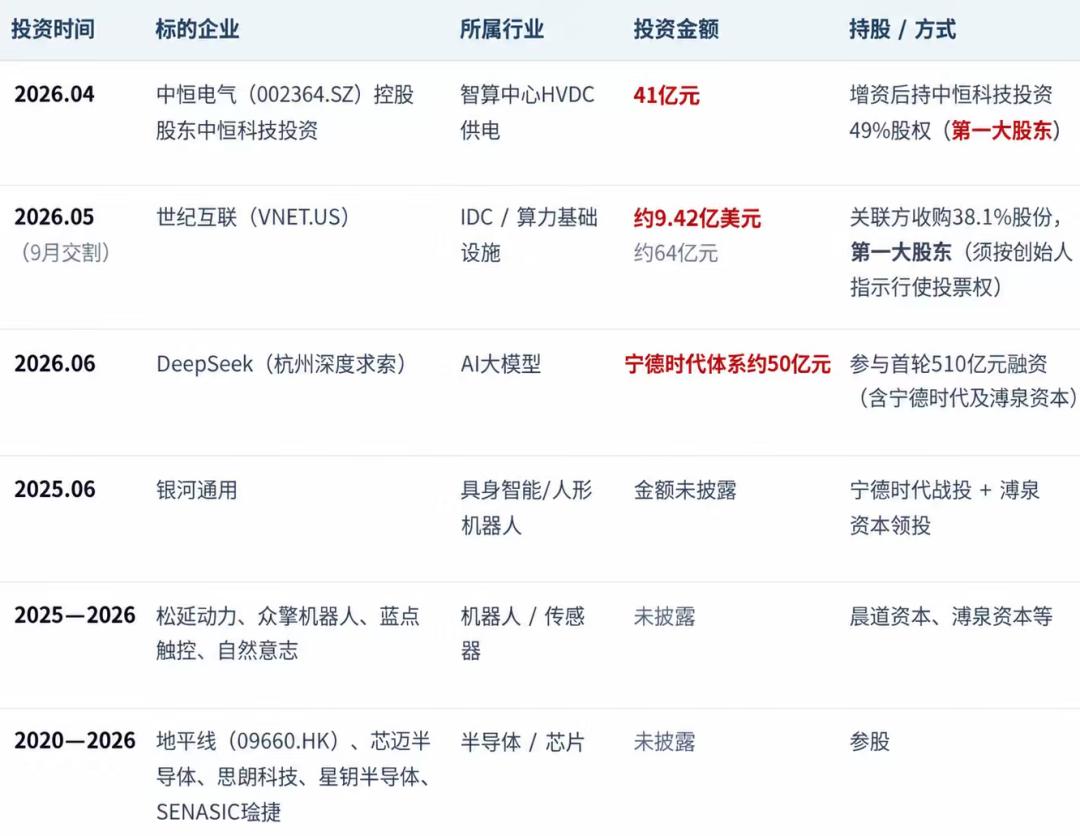
According to media reports, CATL has also participated in two rounds of financing of large model manufacturer DeepSeek in the past six months.
Investing all the way from power equipment and data centers to large models, CATL's capital is going deeper and deeper along the AI power consumption chain: Zhongheng Electric is responsible for efficiently sending electricity into the data center, 21Vianet carries computing power, and behind DeepSeek's ever-expanding computing power demand is still electricity.
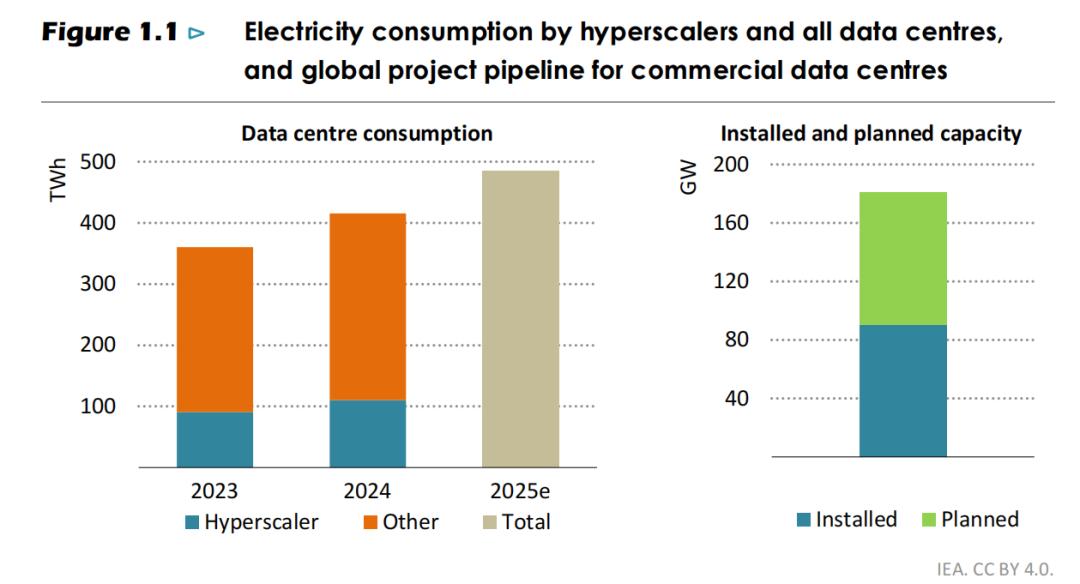
Data centers need continuous and stable power supply, as well as energy storage, power conversion and backup power systems. For CATL, every new AI data center is not only a new large power consumer, but also may become a new energy storage customer.
The explosive growth of AI is accelerating the expansion of global data centers. According to TrendForce's forecast, starting from 2026, the power supply capacity of the global grid will gradually fail to keep up with the power demand of data centers, and the gap will further widen after 2028. By 2030, the global data center power demand capacity is expected to reach 490.7GW, with a supply and demand gap as high as 268GW.
In addition to fixed computer rooms, mobile machines have also been included in the investment map. In June 2025, CATL, together with its subsidiary Puquan Capital, led the 1.1 billion yuan financing of embodied intelligence enterprise Galaxy Universal Intelligence, directly entering the embodied intelligence track for the first time as a strategic investor.
In the future, once embodied intelligence becomes a large-scale mobile terminal, the demand for computing power electricity and batteries will have the opportunity to flow back to CATL's pocket.
In June 2026, CATL led the seed round of financing for nuclear fusion enterprise Beta Fusion; in July, it continued to lead its new round of financing with hundreds of millions of yuan. Compared with the commercialized energy storage and hydropower, nuclear power is still far from CATL's existing business, more like a chip thrown to the final destination of energy.
It seems that the path is getting wider and wider, but the center remains unchanged — wherever the new energy wave goes, CATL stands there.
This series of layouts not only expands CATL's business territory, but also gradually makes it an unavoidable player in the new energy industrial chain.
The unavoidable "toll station"
CATL, which has made large-scale repurchases in the secondary market, is reaping returns in the primary market.
In the first half of 2026, CATL's investment income was 6.153 billion yuan, more than doubling over the same period of the previous year, equivalent to 11% of the total profit. Among them, associates and joint ventures alone contributed 5.722 billion yuan.
However, the 6.153 billion yuan on the books is only the most countable part of the investment return. Some other benefits are not separately listed in the income statement, and quietly turn into cheaper raw materials and more stable orders.
The most typical case is that in 2023, when the price of lithium carbonate reached 400,000 yuan per ton, because CATL held mines in hand, it generously proposed a "lithium mine rebate" plan to its strategic customers: in the next three years, part of the power batteries will be settled at the lithium carbonate price of 200,000 yuan per ton. In exchange, car companies need to hand over about 80% of their battery procurement volume to CATL.
This move not only locked in orders, but also controlled the choices of car companies in the next three years. The fact that "de-CATL" was discussed in 2026 did not happen without omens.
Although car companies have supported second and third-tier suppliers, developed batteries independently, and built joint factories, preparing all possible fallback plans, CATL's factories are not idle at all.
