Shipments of humanoid robots have skyrocketed four times. Who has earned all the profits?
At the end of September, market research institutes Sullivan and IDC successively released humanoid robot reports, both judging that the industry is seeing rapid volume growth, but their statistical calibers differ by 40%: IDC counted that global shipments in the first half of the year were nearly 25,000 units, a year-on-year increase of 432.1%; Sullivan counted 36,000 units in the same period, with revenue of 540 million U.S. dollars, exceeding the full-year figure of 2025 in just half a year.
The books of robotics companies tell a different story. UBTECH, which ranks first in revenue share, posted a loss of 339 million yuan in the first half of the year; another leading company, Unitree Robotics, shipped more than 5,500 units in 2025, with a non-recurring net profit margin of about 34.8%, including revenue and profit from its quadruped robot business. The main humanoid robot products are half-size models priced at tens of thousands of yuan, such as the G1 series.
High-priced robots account for 80% of the industry's revenue, but they have not yet generated profits for any player.
Of the 25,000 units shipped in the first half of the year, most are "affordable products" priced below 30,000 U.S. dollars. The number of full-size robots that can perform actual work and sell at high prices is far smaller. This also explains why the industry scale continues to surge while enterprises cannot make profits.
Ranked first in share, still losing money
In the first half of this year, Sullivan ranked global humanoid robot enterprises by revenue in its report, and the top five are all Chinese companies: UBTECH, Agibot, Unitree, Galbot, and Leju. UBTECH took two first places, with a 16.5% market share in the overall humanoid robot revenue, and a 26% revenue market share in the full-size embodied intelligence track.
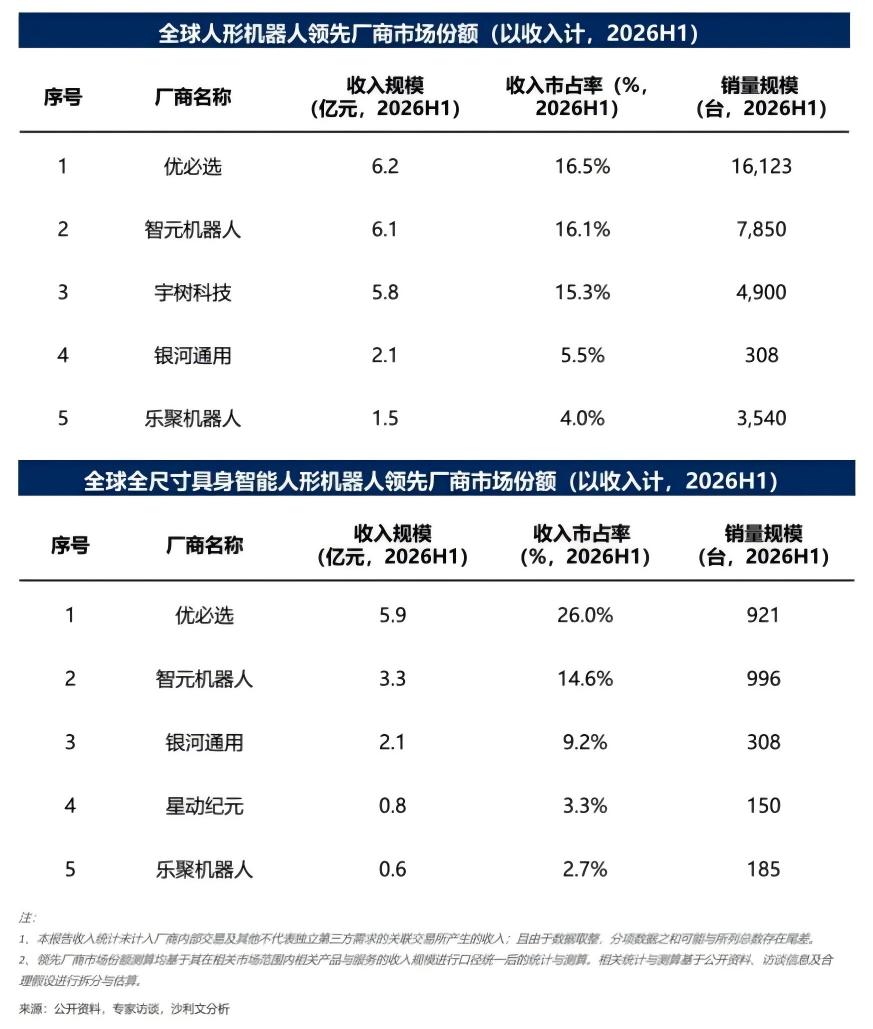
Full-size embodied intelligence is the category with the highest threshold in Sullivan's definition: non-remote-controlled, non-pre-programmed, with a height of more than 160 cm, and the ontology computing power is usually more than 200 TOPS. According to Sullivan's statistics, UBTECH's total sales of humanoid robots in 2025 were 13,838 units, of which only 1,079 were full-size embodied intelligence products, accounting for less than 10%. In the first half of 2026, 921 full-size embodied intelligence units were sold, while the company's total humanoid robot sales in the same period were 16,123 units, and the proportion of full-size embodied intelligence products further dropped to 5.71%. From the perspective of financial data, UBTECH has continued to lose money in the past few years and has not yet turned profitable in the first half of this year.
Unitree is in a slightly better situation. In 2025, it shipped more than 5,500 units, with revenue of about 1.7 billion yuan and a non-recurring net profit margin of about 34.8%. Its main products are half-size models such as the G1 series, and its customers are mainly in scientific research and education sectors.
In fact, the two companies are taking the same path, relying on non-full-size models to boost shipment volume. The difference is that Unitree has already made profits, while UBTECH has not. The gap does not lie in product size, but in business models: Unitree sells standard products that are delivered immediately after order placement, with fast payment collection; UBTECH's full-size models need to be deployed in factories and real scenarios, with long delivery cycles and high service costs. The full-size track, the most "valuable" segment in the industry, has not yet produced a profitable case.
Volume growth comes from low-cost products, while revenue is generated by high-priced robots
Converted according to IDC's data, the average unit price dropped from 37,000 U.S. dollars in the same period last year to 29,600 U.S. dollars in the first half of this year, but this change mainly comes from product structure: the surge of low-cost models has pulled down the weighted average price, not that every robot is 20% cheaper. The 432.1% year-on-year growth rate of sales volume is far higher than the 322.7% year-on-year growth rate of revenue, so the incremental volume of this round of growth is concentrated in low-priced models.
According to Sullivan's data, embodied intelligent robots (machines that can perceive, make decisions and perform work independently) sold 8,800 units in 2025, generating revenue of 375 million U.S. dollars, accounting for 75% of the industry's revenue; in the first half of 2026, 10,500 units were sold, with revenue of 448 million U.S. dollars, and the proportion rose to 83%. In the same period, the sales volume of pre-programmed and remote-controlled robots remained stable, while their revenue continued to decline.
The inverse relationship between volume and price holds true under both statistical standards. By size, 8,400 full-size models were sold in the first half of 2026 — accounting for only about 20% of total shipments, but generating 408 million U.S. dollars in revenue, accounting for more than 75% of the industry's total revenue; small-size models sold 19,700 units, accounting for more than half of total shipments, but only generated 19 million U.S. dollars in revenue.
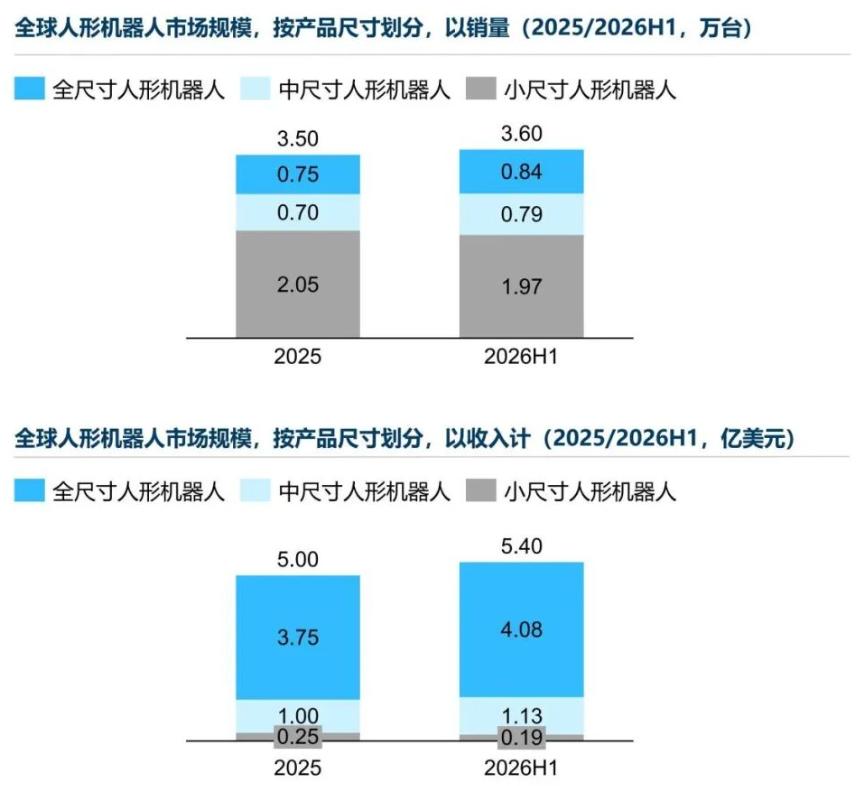
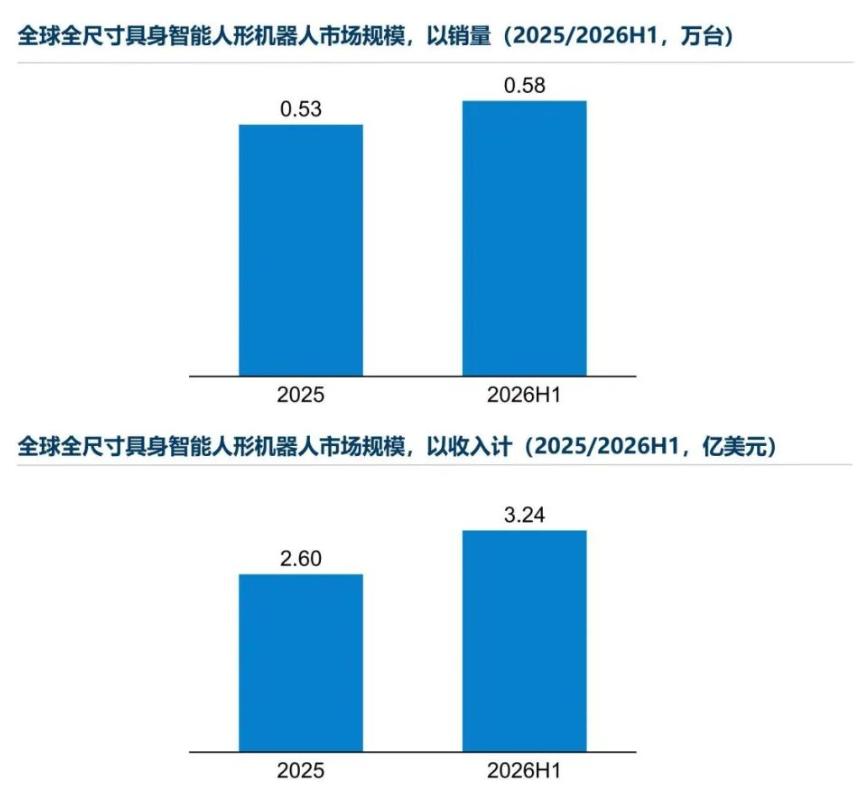
By intelligence level, the highest-threshold full-size embodied intelligence robots (non-remote-controlled, non-pre-programmed) only sold 5,800 units in half a year, generating revenue of 320 million U.S. dollars; comparing the data of the first half of this year with the full-year data of last year (5,300 units, 260 million U.S. dollars), the sales volume increased by less than 10%, but the revenue increased by nearly 25%, the unit price is moving upward.
The contrast in quantity is more straightforward. A recent survey by Morgan Stanley shows that among the shipments in 2026, half-size models (such as Unitree G1) account for about 70%, while full-size operation models only account for 30%. Shipment volume is supported by low-cost robots, while revenue is supported by high-priced robots, and products with different unit prices are counted into the same "shipment volume".
Robots that "can do actual work" contribute less than 15% of revenue
To understand the current development stage of the industry, looking at application scenarios is clearer than looking at shipment numbers.
Sullivan divides application scenarios into four categories: entertainment performance, scientific research and education, data collection, and production operation. In the first half of 2026, entertainment performance is still the largest segment, scientific research and education saw a slight decline, data collection remained roughly stable, and only production operation saw a significant increase in revenue, with half-year revenue of 78 million U.S. dollars, 65.9% higher than the full-year revenue of 47 million U.S. dollars in 2025. However, the 78 million U.S. dollars only accounts for less than 15% of the industry's total half-year revenue of 540 million U.S. dollars.
According to Sullivan's five stages of commercialization maturity, production operation has to go through five steps: technology demonstration, customer pilot, paid deployment, normalized operation, and large-scale replication. Most orders are still between customer pilot and paid deployment, and very few have reached the stage of normalized operation.
Several posts on WeChat Moments in September brought this topic to the forefront. Mech-Mind, which went public on September 1, its founder Shao Tianlan posted several consecutive posts on Moments, publicly criticizing "gimmick-focused" enterprises in the industry: they sell robots to data collection centers built by local governments, and then buy back the collected data, "money circulates among 'insiders', and book revenue is artificially 'created'". He directly named Galbot in the comment section, adding the qualifiers "based in Beijing and Shanghai, very well-known, with high valuation, and once appeared on the Spring Festival Gala". Galbot responded that it "will not participate in unnecessary verbal disputes", and released a statement two days later saying that the relevant content circulating on the Internet is untrue, and it has reported the case to the public security organ.
There is no audit conclusion on who is right or wrong at the moment. But the problem pointed out by this debate is highly consistent with the reports of IDC and Sullivan: on one hand, 69% of the counted shipments come from scientific research, performance and data collection; on the other hand, in terms of revenue, the actual work scenarios that generate real value account for less than 15%.
Data collection centers themselves are not a bad thing. Embodied intelligence training requires tens of millions of hours of real machine data, while the total high-quality data available globally is only hundreds of thousands of hours, with a gap of about 95%, and the training fields are exactly filling this gap. According to the statistics of the China Academy of Information and Communications Technology, by the middle of 2026, more than 70 embodied intelligence training fields have been completed and put into operation in China, and another 46 are under construction or in the planning stage.
The problem lies in the transaction structure. Data collection centers purchase robots, but the purchasers may have equity associations with the manufacturers, and the transactions are completed between related parties, rather than driven by real end-user demand. Jin Ge, CEO of Lingyu Intelligence, said in an interview with the media in September that the company's TA series robots are priced from 119,900 yuan to 199,900 yuan, and in cross-regional remote operation scenarios, each unit can generate a labor arbitrage space of about 4,000 yuan per month, which doubles when operated in two shifts. Based on this calculation, customers can recover their cost within one year; the comprehensive annual data collection cost can be controlled within 300,000 yuan, equivalent to about 100 to 150 yuan per hour.
Jin Ge's calculation is the payback account on the customer side, and the premise for this calculation to hold is that end customers have real and continuous usage demand. If the buyer is originally a related party of the shareholder, it is doubtful whether the product will actually be put into the scenario and play its role.
According to public information, there were 218 publicly announced winning bid projects for humanoid and embodied robots in the first half of 2026, with a total amount of 1.723 billion yuan, of which projects related to industrial and technology enterprises only account for 21.1% (education and scientific research account for 55.5%, government and public platforms account for 20.6%, and others account for 2.8%). This statistic does not include K12 small desktop devices, engineering construction projects and small-scale leasing projects under 100,000 yuan, and "winning the bid" does not mean delivery, acceptance or revenue recognition.
It should be noted that when counting revenue, Sullivan's report excludes internal transactions of manufacturers and related-party transactions that do not represent real third-party demand, and its statistical caliber is aligned with IPO audit standards. That is precisely why Sullivan's counted revenue from production operation is only 78 million U.S. dollars, accounting for less than 15% — after squeezing out the moisture, the ceiling of real third-party demand is presented.
Different calibers support different narratives
Even without looking at these obvious problems, there is much room for "manipulation" in the statistical data of humanoid robots.
According to IDC's data, global shipments in the first half of 2026 were nearly 25,000 units, a year-on-year increase of 432.1%; the market size reached 740 million U.S. dollars, a year-on-year increase of 322.7%, with an average unit price of about 29,600 U.S. dollars. While Sullivan's data shows that 36,000 units were sold globally in the first half of the year, with revenue of 540 million U.S. dollars, and the average unit price is about 15,000 U.S. dollars. For the same "global humanoid robot market", the shipment volume differs by 40%, and the unit price differs by nearly double. The main difference lies in the statistical caliber: IDC counts the complete "humanoid robot" units, while Sullivan includes medium-size, small-size and remote-controlled models, and at the same time excludes related-party transactions. Once low-cost models are included, the average price is immediately pulled down.
The calibers of full-year forecasts are even more confusing. The Ministry of Industry and Information Technology refers to the output of complete machines, which is "expected to exceed 100,000 units"; Morgan Stanley refers to shipments, and raised its domestic forecast from 28,000 units to 50,000 units. One talks about output, the other talks about shipments, which should not be directly compared in the first place, but these numbers are often cited side by side to prove the same conclusion.
In the same half year and the same market, the two reports can calculate a nearly double difference in average unit price; for full-year forecasts, the gap between different institutions is huge. This is not a problem of statistical technology, but that the industry has not yet established a commonly accepted set of standards, and the data is defined by each institution itself. The difference in statistical caliber is the space for storytelling.
Who will be the first to achieve profitability?
White Horse believes that at the current stage of the humanoid robot industry, "shipment volume" is the most misleading indicator. This number adds up entry-level products and full-size high-end models, and the calculated 432.1% growth rate looks very "booming", but it cannot show who is making profits or who is most likely to make profits.
Therefore, to see clearly the humanoid robot industry, there are three more practical calibers.
First, what is the proportion of full-size models? Morgan Stanley predicts that the shipment proportion of full-size operation models will rise from 30% in 2026 to 50% in 2027 and 70% in 2028. Only when this proportion actually rises can it show that robots can truly "perform practical work". Sullivan's data already points in this direction: embodied intelligent models only account for about 30% of total shipments, but generate 83% of the total revenue.
Second, what stage has the scenario application reached? According to Sullivan's five stages of commercialization maturity, most orders are currently stuck between customer pilot and paid deployment; when a number of enterprises can stably reach the stage of normalized operation, commercialization can be regarded as truly landed.
Third, what is the trend of unit price? At present, the change of average price mainly comes from product structure, not that the robot itself is 20% cheaper. What is really worth paying attention to in the future is whether the price of similar models will go down. If even high-priced categories such as full-size models begin to see price drops, it means that the focus of competition has shifted from "can we make it" to "how much does one unit cost". However, launching a price war in an industry that has not yet produced any profitable case is a signal that needs to be guarded against.
IDC raised its 2030 forecast in the report to "global shipments exceeding 750,0