As full-reduction promotions are withdrawn and national subsidies are phased out, what will drive growth during this year's Double 11?
Today, JD's Double 11 spot sale officially kicks off, marking the official start of the Double 11 shopping event. Tmall will open pre-orders on October 15 and launch spot sales on the 20th. The 18th Double 11 has been extended into a shopping season lasting more than a month. By November 11, the official date of the event, many consumers will probably have already unpacked their parcels.
Consumers have fewer arithmetic problems to handle. Tmall continues to adopt official instant discounts, while Douyin maintains direct discount for single items and an official 15% instant discount. The platforms have reduced the necessity of adding extra items to meet the discount threshold, but they have not reduced their efforts to compete for orders.
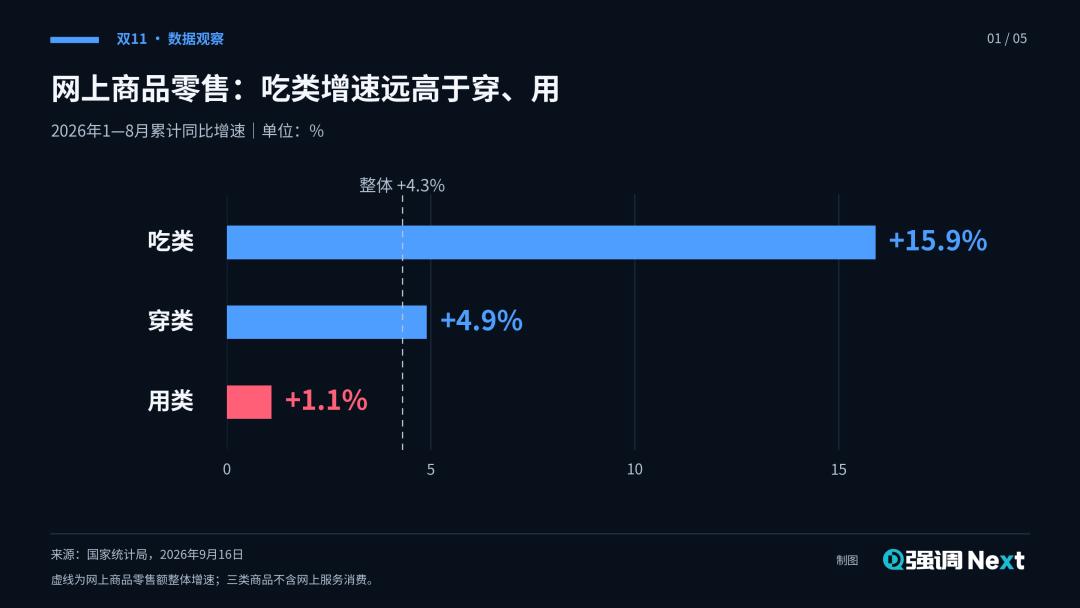
From January to August this year, the national online retail sales of physical goods increased by 4.3%, among which daily-use goods only grew by 1.1%. With the promotion moved forward, consumers' wallets will not expand accordingly.
The more noteworthy changes this year are hidden in the merchant backends.
Platform subsidies are linked to advertising investment, content platforms allocate traffic based on settlement performance, and AI has begun to participate in shopping guide and delivery. Taobao and JD are striving to maintain transactions, while Douyin and Xiaohongshu are working to convert more content traffic into orders.
This year's Double 11 is a competition for which platform consumers choose to complete their purchases on, and how much merchants are willing to pay for this business.
Platforms Offer Subsidies, Merchants Need to Hand Over Their Budgets
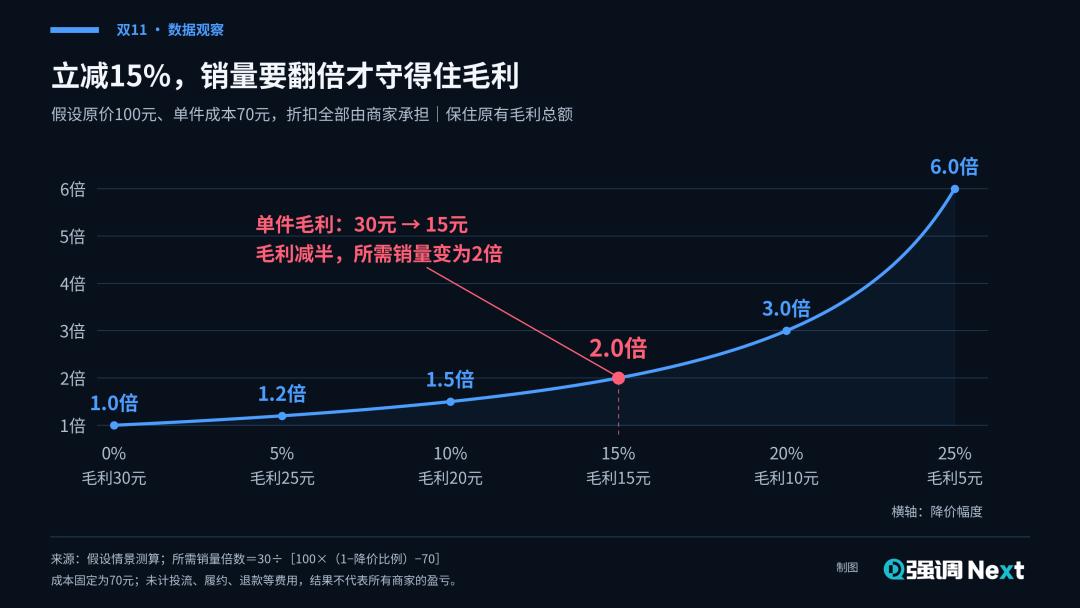
The official instant discount puts the price directly on the product, and also puts the cost in front of the merchants. The instant discounts stipulated by Tmall are borne by merchants, and some offers can be stacked. Assuming a product is sold for 100 yuan with a cost of 70 yuan, and the merchant bears a 15% discount, the gross profit of the product will drop from 30 yuan to 15 yuan. To only maintain the original total gross profit, sales volume has to double, not to mention the cost of traffic investment and fulfillment.
Merchants need orders, and platforms provide support, but they have begun to attach more specific conditions.
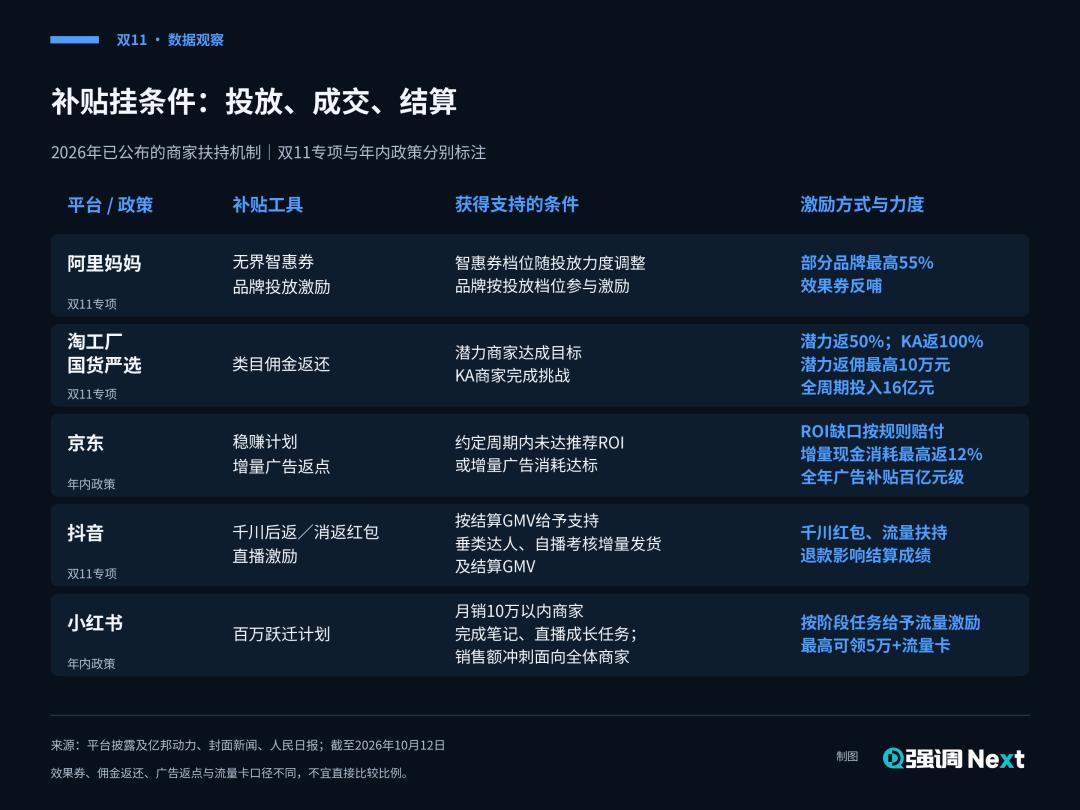
Of the 1.6 billion yuan full-cycle investment announced by Taobao Factory and National Quality Selection, potential merchants that meet the standards can get a 50% refund of category commission, and KA merchants that successfully meet the challenge can get a full refund.
For this year's Double 11, Alimama's "Boundless Smart Coupon" uses AI to determine the subsidy tier according to the merchant's delivery intensity. Some brands whose delivery reaches the corresponding tier can get a maximum of 55% effect coupon feedback.
Alibaba's financial report for the fourth quarter of fiscal year 2026 has been disclosed, stating that subsidies for some merchants are linked to their platform investment, with the aim of increasing merchants' willingness to invest. This year's Double 11 has concentratedly applied this mechanism to the big promotion.
JD chooses to provide guarantees for eligible placements. The annual Chunxiao Plan has raised advertising subsidies from the ten-billion-yuan level to the hundred-billion-yuan level. The "Steady Profit Plan" compensates for the gap that fails to reach the system-recommended target ROI according to the rules within the agreed period; if the incremental advertising consumption meets the standard, a maximum of 12% rebate can be obtained. The promotion return is guaranteed, and the product profit is still calculated by the merchants themselves.
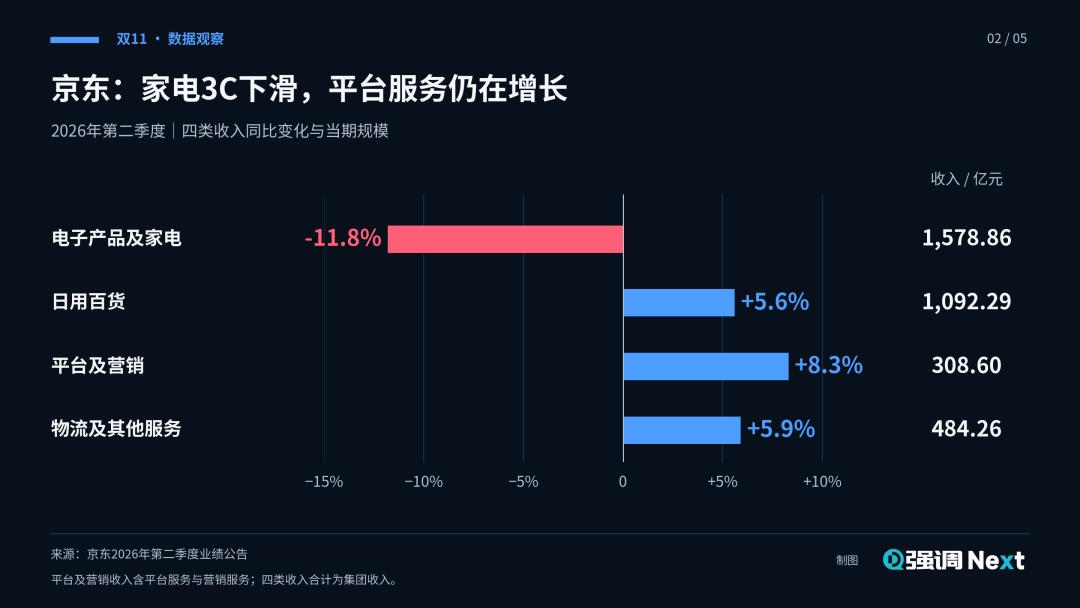
There are clear revenue changes behind this. In the second quarter, JD's self-operated product revenue decreased by 5.4%, while platform and marketing revenue increased by 8.3% to 30.86 billion yuan, and JD Retail's operating profit margin reached 4.6%. The company listed the performance of high-margin service revenue as one of the reasons.
Platforms can increase the contribution of service revenue when the growth rate of goods sales slows down. Therefore, Double 11 is both a commodity promotion and a battle for merchants' budgets. Advertising coupon rebates and production guarantee are all competing for the same sum of money.
Douyin Expands Entries, Xiaohongshu Aims to Catch Orders After Grass-planting
Douyin's Double 11 plan this year has gone beyond a single App. The platform's consumer coupons cover ByteDance's products including Douyin, Doubao, Hongguo Short Drama, Toutiao, and Fanqie Novel, trying to guide users in different scenarios to transactions. Its advantage has also expanded from stimulating purchase desire through short videos to product exposure when users ask questions, search, and browse daily.
The conditions for allocating traffic are also more detailed. Some live stream incentives are issued according to the settled GMV; vertical influencers and self-broadcasting merchants also need to deliver incremental shipments and settlement results to get support such as Qianchao consumer rebate red envelopes. The assessment focuses on orders that are actually shipped and settled, and refunds will affect the final rewards merchants can get.
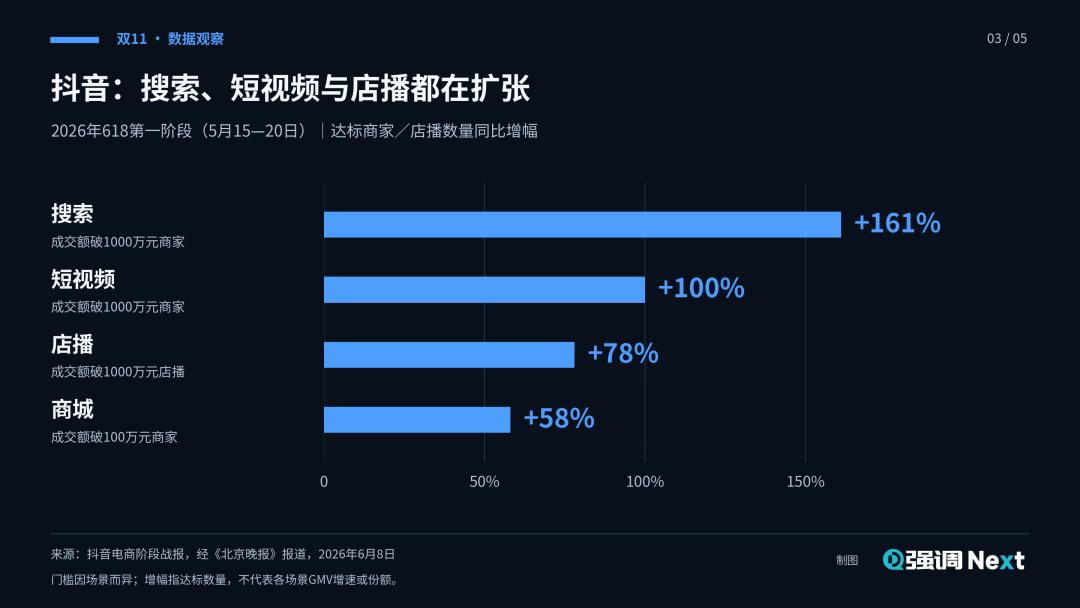
In the first phase of this year's 618, the number of in-store live broadcasts on Douyin with transaction volume exceeding 10 million yuan increased by 78% year-on-year. Brands running their own live streams and the mall undertaking search functions give Douyin the opportunity to extend a purchase inspired by content to the next active product search. What it needs to prove is that after users remember a certain live stream room, they are also willing to go back to the mall to make purchases.
Xiaohongshu faces different challenges. Users research products here, but orders may be placed elsewhere.
The "Red Cat Plan" and "Red Jing Plan" have connected notes with Tmall and JD. Xiaohongshu revealed that during last year's Double 11, there were more than 100 single products that achieved transaction volume of over 10 million yuan on other e-commerce platforms through the "Grass-planting Direct Access" feature. This shows that grass-planting can bring business, and it also proves that transaction platforms still play a key role in the transaction completion link.
Xiaohongshu obtains advertising business through external cooperation while building its own marketplace, buyer services, and in-store live broadcasts. The two paths can run in parallel, but the in-station transaction capability determines how much transaction value it can retain. For brands, there is no need to move their mature Tmall or JD stores just to acquire users on Xiaohongshu.
In May this year, Xiaohongshu terminated the "Million Commission Waiver Plan" in advance and launched the "Million Leap Plan". The official plan sets note and live stream growth tasks for merchants with monthly sales within 100,000 yuan. Those who complete the phased goals can get traffic incentives, and can receive traffic cards worth more than 50,000 yuan at most. The support has further shifted from reducing store opening costs to promoting merchants to continuously publish content, go live, and complete transactions.
Entering the Double 11 event, Xiaohongshu needs to verify whether this operation model can meet the demand after grass-planting. Products such as apparel, beauty, and home goods can explain their differences through matching, ingredients, and usage scenarios, and buyers can also help consumers make choices. It does not need to chase the lowest price across the entire network for all standard products, but there must be reliable products and services after recommendations, otherwise users will still return to the familiar platforms to make payments.
AI Starts to Determine Which Products Can Be Seen
The more new entries there are, the more important the way products are recommended becomes.
Douyin's merchant backend Compass for this year's Double 11 has opened a Doubao zone, which supports querying the business scale and high-frequency shopping demands of the Doubao channel. This is closer to business operation than simply announcing the monthly active users of AI applications: Merchants can finally observe what questions users ask and how much business this entry brings.
Taobao's Qiantao Shopping Assistant and JD's smart shopping guide are doing the same thing. In the past, consumers entered keywords and flipped through product lists, but now they may directly state their budget and usage scenarios. The platform needs to decide how to respond, and merchants need to make their product information accurate enough to be included in the recommendations.
JD upgraded its Jingmai AI Operation Center in September, integrating more than 60 tools. According to the platform's public comparison test, the materials optimized according to the product information standards have an order cost 15% to 27% lower than ordinary AI materials, and the detail page conversion rate has increased by 0.56 percentage points. Beyond the quantity of materials, the platform has used actual transactions to test the AI effect.
This has evolved the competition from "who can generate images" to "who masters product and transaction data". A large number of similar materials will soon be copied by peers, and only systems close to real orders can more easily judge which content can drive purchases. The surge of consultations, clicks, and transactions during Double 11 will accelerate this round of verification.
AI will not automatically help merchants get rid of traffic costs. In-store live broadcasts reduce some influencer commissions, and digital humans lower the cost of going live, but consumers still need to be guided into the live stream rooms. The money saved may continue to flow to platform advertising. If AI only speeds up material production and budget consumption, merchants' total customer acquisition cost may not necessarily decrease.
Instant Retail Competes for High-Value Orders, National Subsidy Dividends Have Thinned
What instant retail competes for is another part of the shopping process: how long are consumers willing to wait after placing an order.
Taobao Flash Purchase and JD Instant Delivery have already participated in Double 11 last year. The instant retail sales of Double 11 in 2025 monitored by Star Map are about 67 billion yuan. This year, while continuing to compete for this market, platforms need to improve their order structure.
According to Alibaba's latest quarterly financial report, while Taobao Flash Purchase maintains its market share, its unit economic benefit has improved month-on-month, mainly due to the increase in per-order unit price and fulfillment efficiency, and it is expanding high-per-order unit price catering orders and non-catering categories. The digital, beauty, and daily necessities products during Double 11 just provide an opportunity to expand non-catering orders.
Higher customer unit price has the opportunity to increase revenue per order, while delivery costs may not rise proportionally with product prices. However, whether the nearby stores have stock and whether they can pick goods in time determines whether the order is finally established. For instant retail, the accuracy of product assortment and inventory will directly affect subsidy efficiency.
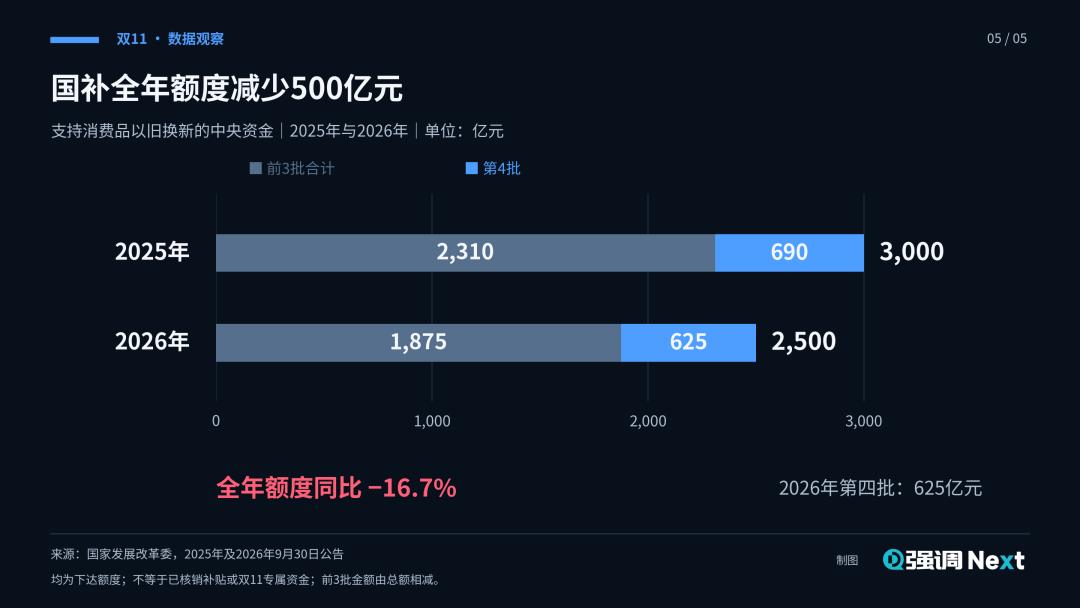
Traditional e-commerce also needs to select increments more carefully. On September 30, the fourth batch of 62.5 billion yuan in national subsidy funds was allocated, and the full-year 250 billion yuan of central funds was all in place. Compared with 300 billion yuan in 2025, the total quota has decreased by about 16.7%.
In the second quarter, JD's electronics and home appliances revenue decreased by 11.8% year-on-year, while daily necessities revenue increased by 5.6%. The high base pressure in the categories with strong national subsidy support has been written into the financial report.
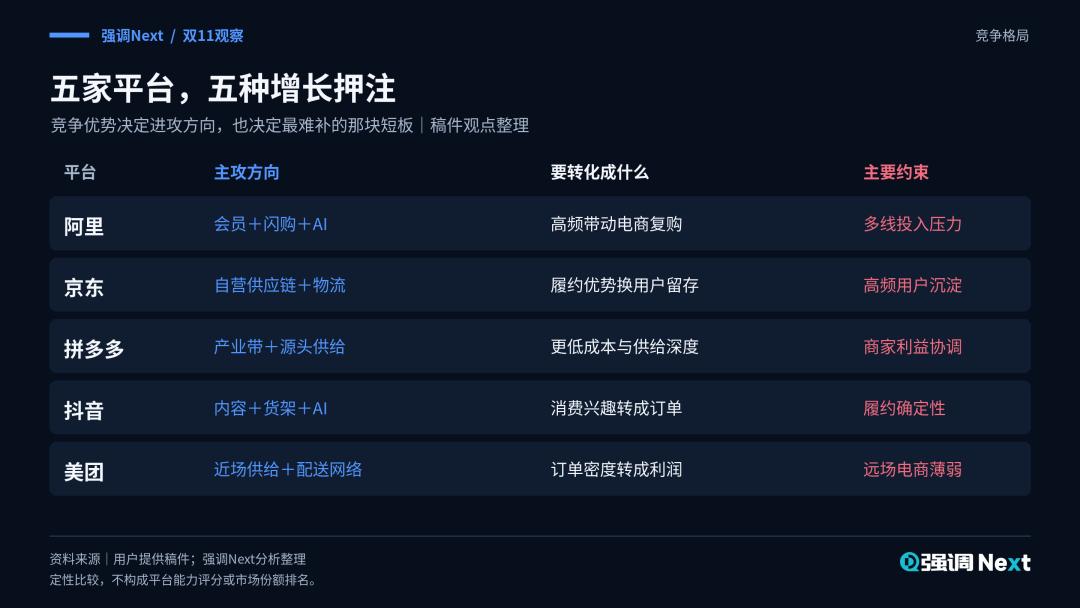
This year's Double 11, JD not only needs to undertake home appliance and 3C product replacement demand, but also needs to expand consumption in daily categories. Taobao has 64 million 88VIP members, who can be provided with brand products and flash purchase services. Pinduoduo continues to extend its support to industrial belts and agricultural producing areas, striving to maintain price advantages through source supply. Each platform has its own strengths, and cannot solve growth problems with the same kind of subsidy.
Meituan relies more on local stores and distribution networks. In the second quarter, the operating profit of its core local commercial business recovered to 5.67 billion yuan, with a profit margin of 7.9%, still lower than the 21% in the first quarter of 2025. This division includes in-store and travel business, and profit recovery does not mean that instant delivery already has thick profits to spend. Increasing non-catering orders during Double 11 is an opportunity for it to improve its revenue structure.
According to reports related to the financial report conference call, Taobao Flash Purchase aims to achieve a positive monthly unit economic model in fiscal year 2027 and overall profitability in fiscal year 2029. This year's Double 11 is on this profitability path, so the order amount, fulfillment efficiency, and purchase willingness after subsidies are withdrawn are all more important than a single peak value.
After the promotion ends, merchants also need to recalculate their orders. How much sales have increased should be viewed together with the expenses of advertising, discounts, and refunds. Platforms can increase service revenue when self-operated product sales slow down, but merchants have to pay these fees with product profits. The same Double 11 growth report may not bring the same harvest to both sides.
Note: The data in this article comes from public sources and does not constitute investment advice.