Literally everything can be framed as a wealthy family drama. Who on earth is watching these increasingly unhinged AI-generated short dramas?
Recently, AI-generated family inheritance short dramas have flooded users' mobile phones en masse.
Open short video platforms such as Douyin, Xiaohongshu and Kuaishou, and you will enter a content world completely divorced from common biological sense:
Wood ear fungi are fighting over family property, manicured nails are getting divorced, wooden chopsticks and stainless steel chopsticks are arranging inter-family marriages, and the third child born to an iPhone with a foldable screen is taunted and discriminated against by the Pro Max model as a "spineless wretch with creases".
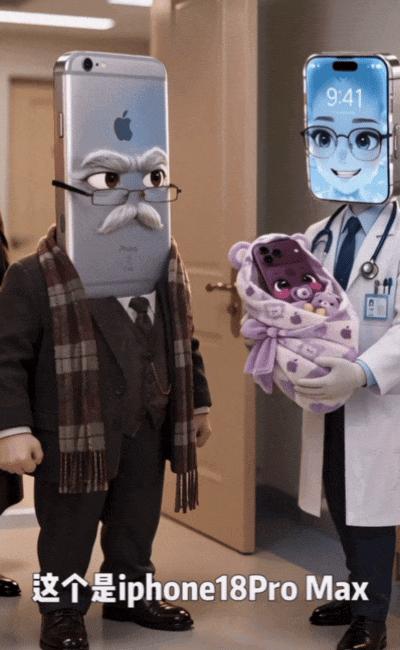
Image source: Xiaohongshu
Once you scroll across one of these dramas, the rest will multiply endlessly like stretched noodles.
Manicured nails, mooncakes, wood ear fungi, chopsticks, single-day weekends, cars, toilet bowls, gamepads, bananas, iPhones... It can only be said that there are not many species and categories left for AI short dramas to use.
The exact same plot template can swap out the protagonists at any time. When AI drives the content creation threshold down to rock bottom, the simplest cultural unit of "family ethics + identity reversal" spreads like a virus looking for new hosts: today it is attached to wood ear fungi, tomorrow to manicured nails, the day after tomorrow to toilet bowls.
Today, TopKlout will take you to explore the content production logic behind this absurd wave of short dramas where "everything can be a wealthy family"~
Everything Can Be a Wealthy Family: The "Species Dividend" of AI Short Dramas
First, let's take a look at what this template looks like.
The title is basically fixed, named *The Heir of the XX Family*. There is a high-ranking elder in the family, the daughter-in-law is pregnant, and the rules are fixed: as long as the child is born with the right bloodline, they can inherit the family property, otherwise they will be kicked out.
The rest of the runtime is filled with waiting, interspersed with framing by a stepmother, vicious relatives, a confrontation in the corridor, and a test result that is delayed indefinitely.
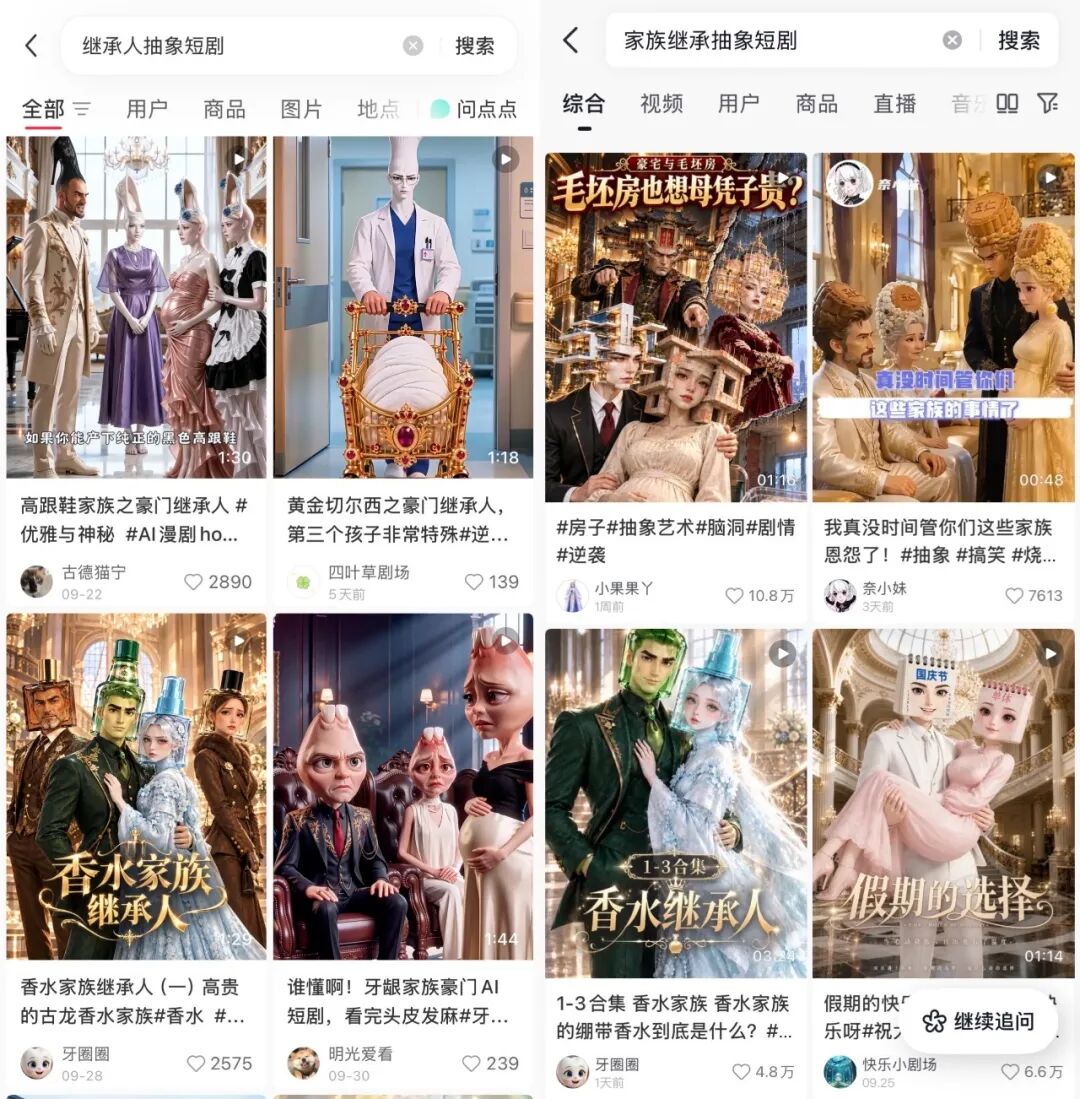
Image source: Xiaohongshu, Douyin
The fill-in-the-blank part is even more abstract. For example, in the wood ear fungus plot, a pink baby is considered mediocre, a white baby is deemed guilty, and only a pure black wood ear fungus can carry on the bloodline. The manicure family plot follows the twin trope: the elder sister wears an ornate porcelain-style manicure, while the younger sister only has an ordinary shell manicure. Eighteen years later, the younger sister shows up at the banquet with a brand new manicure, and the whole venue falls silent. There is even a plot tied to current trends where single-day weekends and two-day weekends have to give birth to public holidays. All kinds of items in daily life have been pulled into playing the role of wealthy families arranging political marriages.
"Just the thought that memory and graphics card prices are rising to make this kind of stuff." "Sometimes I really want to send my phone to a psychiatric hospital."
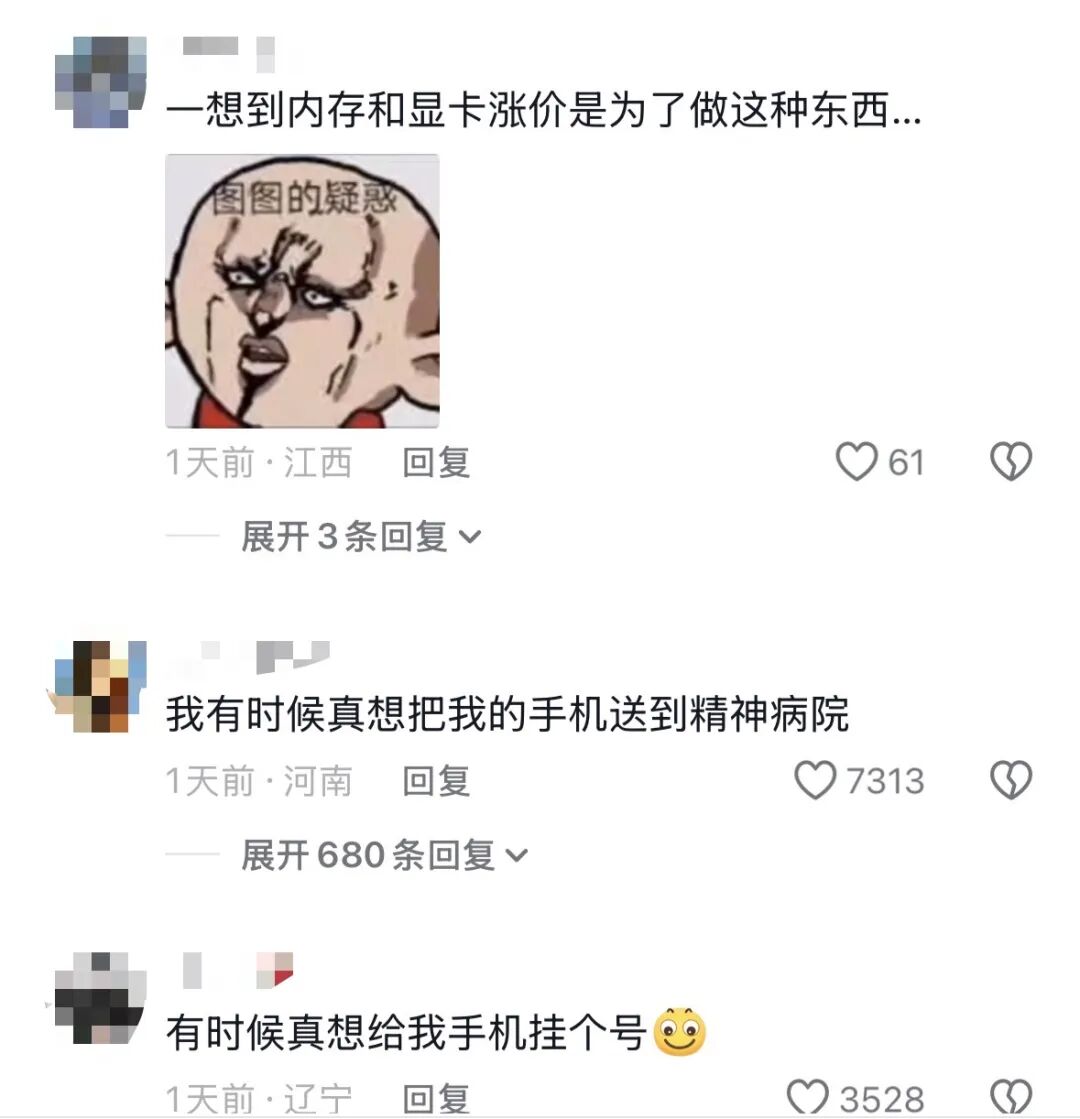
Image source: Douyin
Anyone who sees this for the first time will find it utterly ridiculous and absurd.
The sense of absurdity comes exactly from this sense of misalignment. The bloodline theory, which is the most unreasonable logic in wealthy family dramas, is now applied to things that could not possibly have a bloodline. A single wood ear fungus has no right to talk about family background, and a toilet brush has no concept of social status, but the plot forces them to fight to the death over these things.
This is exactly what makes this template so easy to use. Family, bloodline, inheritance, and counterattack are all proven high-click combinations that anyone can apply, and anything can be the protagonist.
For creators, it greatly saves the effort of script conception and designing plot highlights. There are even templates for generation prompts, turning content creation into a fill-in-the-blank exercise where all AI has to do is fill in the blanks.
Since people find AI-generated content unrealistic, and absurd content attracts more views, creators simply push the nonsense even further.
Audience Members Play Along with Jokes in the Comment Section, While the Plot Goes in Circles
The plot full of strong contrast and mismatched protagonists indeed attracts a lot of people immediately.
The phrase "won't make you feel heartburn after eating" has spread from the food content sector to all areas of daily life as a social code, and the suspense of "what color exactly is the gamepad" has become a question the whole internet is asking. After the content goes viral, it brings some interesting side effects: netizens cooperate enthusiastically by discussing and building on the jokes in the comment sections.
Tomatoes and eggs were a perfectly matched pair, but Miss Egg insists on being with Mr. Dumpling, and the audience immediately empathizes with the wealthy parents. Someone commented, "Stir-fried eggs with dumplings? I disagree with this marriage too!" Others seriously analyzed the feasibility of making eggs and dumplings into a single dish.
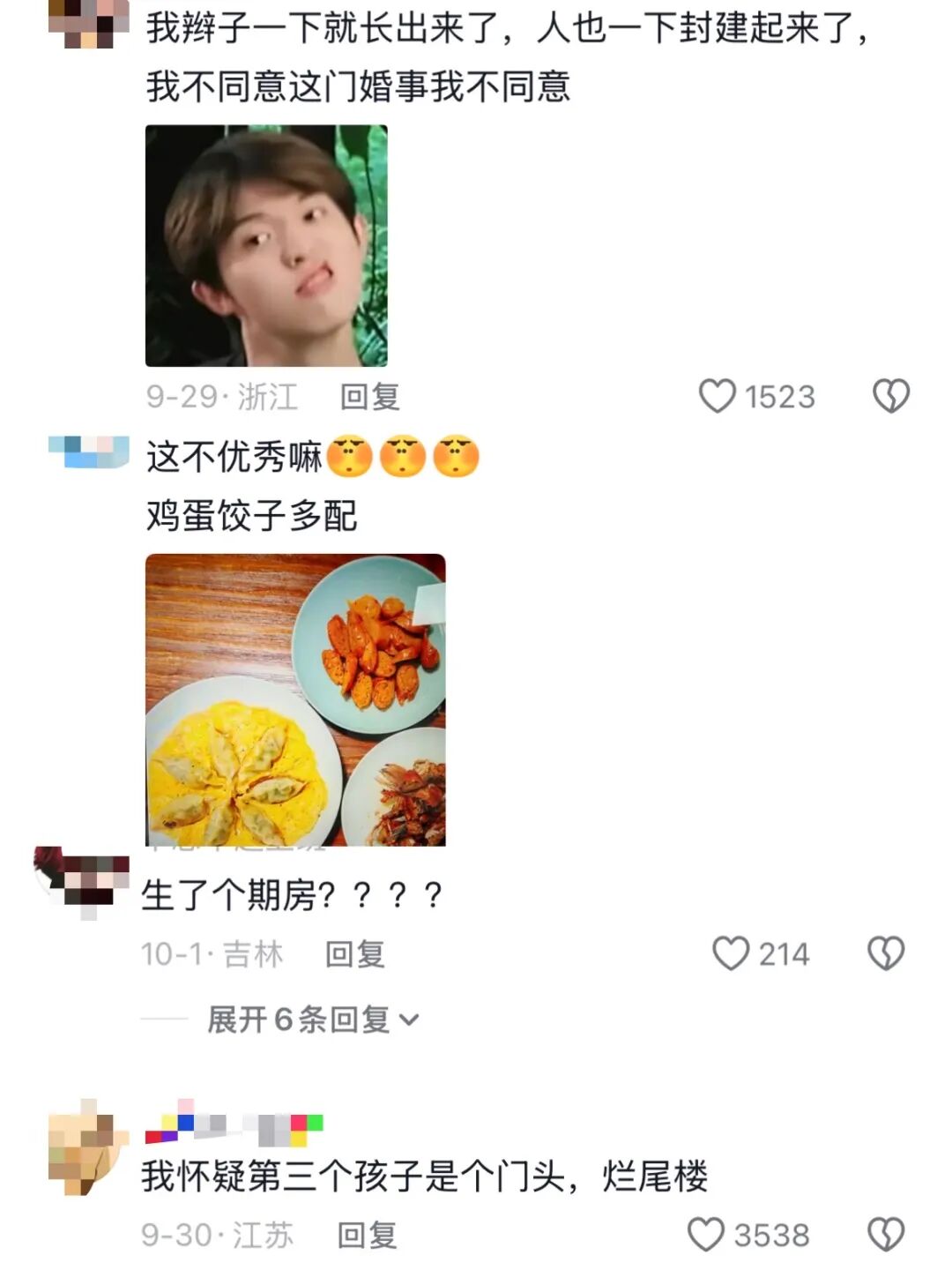
Image source: Douyin
In the single-day weekend plot, someone in the comment section wrote, "Single-day weekends are such a low-class thing, it's completely delusional to even think about this," and "Don't use your low-quality single-day weekend genes to tarnish the noble bloodline of the long-holiday family."
The humor of these lines is easy to understand. Social status, family background, bloodline, household registration, public sector employment, education level, single-day or two-day weekends - these concepts have always operated around us, hidden in the price lists of matchmaking corners and the filter conditions of recruitment apps.
This is exactly the most labor-saving part of AI short dramas. They don't need to develop characters or explain clear motivations. They just need to wrap the familiar prejudices from real life in a ridiculous shell, and the audience will fill in the rest of the associations themselves. What keeps the audience engaged is their own real-life situation, and the plot only provides an excuse.
But the audience's participation stops at playing along with the jokes, and the limitations of this content are exposed faster than expected.
After scrolling through several episodes of similar content, you will find that besides the jokes, there are also many complaints: "Watching this kind of drama is as pointless as cutting prices for group buys on Pinduoduo," "The author just keeps beating around the bush, it's so annoying."
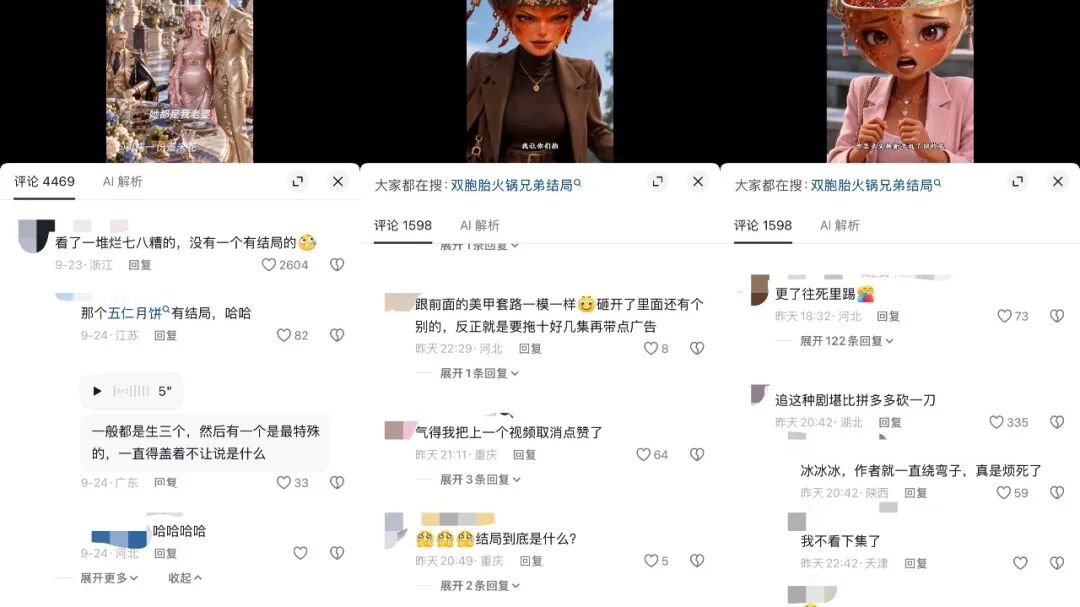
Image source: Douyin
This type of drama usually only has one single suspense: what the baby will be, what bloodline the third child has, or what is under the bandage. To drag out the number of episodes, creators will circle around this single suspense, revealing a tiny bit each episode.
The jokes come from the audience, the plot itself cannot provide new content. Being absurd and full of memes can help the content get the first wave of traffic, but it cannot stop the loss of viewership. The audience is willing to play along with the jokes, but they are not willing to put up with unnecessary dragging of the plot.
Behind the Absurdity: Traffic, Blockbusters, or a Survival Challenge
The answer behind the creation of these absurd works does not lie with the creators themselves, but in their business accounting books.
When production costs are driven down to a very low level, everyone is pushed to focus on one single thing: making content that can be noticed by algorithms. Under the production logic of chasing traffic, chasing viral hits, and rushing to monetize, developing distinct character personalities, coherent story logic, and building emotional resonance are all not cost-effective.
What is cost-effective is to pile up the most click-inducing elements together, hook the audience with a sufficiently absurd setting, and drag out the runtime with a suspense that never gets revealed.
The pressure then shifts to the "species" of protagonists. Since the script is a universal template, the only variable left is the protagonist. Whoever grabs an unused item first will get an extra chance to be seen by the audience. This is the real driving force behind hundreds of new dramas released every day.
The line that "there are not many species and categories left for AI short dramas" is a real observation. Every object that can be personified has already been used to act in wealthy family dramas. Going further, creators will only swap carrots for white radishes, or swap stainless steel chopsticks for bamboo chopsticks.
But relying purely on churning out more variations of the same content cannot sustain this path for long. From TopKlout's perspective, what this batch of content lacks is a compelling story and memorable characters.
Nowadays, some creators have already proven that the audience is willing to pay for well-developed characters and excellent stories.
Some creators used the drama *The Laid-off Girl* to tell a real story of a model who switched careers to become an AI director, which has exceeded 200 million views on a single platform. Others created the drama *Exiled to the Borderlands: The Convict Wife Builds a New Life and Raises a War God* in their bedroom, which has accumulated 4.1 billion views. Another creator made the drama *Li Shimin's Soul Travels to Adou* with just one person and a cost of over 10,000 yuan, which exceeded 100 million views and earned 400,000 yuan in revenue sharing.

Image source from the internet
According to data on native AI short dramas from Douyin, from January to June 2026, a total of 221,900 new AI short dramas were released, of which 1,055 exceeded 100 million views, with total new views reaching 515.738 billion.
Breaking 100 million views is no longer a rare achievement. What is rare is characters and stories that people can remember. The tools used by these outstanding works are essentially no different from those used for the "family inheritance" dramas, the only difference is that the former has a concrete, well-rounded character at its core.
The number of available protagonist species is indeed almost exhausted, but what is truly rare has never been the species. It is the willingness to fully tell a complete story outside the guidance of algorithms.
Conclusion
The family inheritance template will probably remain popular for a while. It is low-cost, easy to replicate, and genuinely funny.
It is more like a transitional form, a product of the gap period where the whole industry has not yet figured out where to go after AI has flattened the threshold of content creation. On the day when all possible protagonist species are used up, the only thing left will be stories.
And AI cannot replace human storytellers for the time being.
This article is from the WeChat Official Account "TopKlout" (ID: TopKlout), written by 77, published with authorization from 36Kr.