The AI-cloned full Adobe suite has exploded in popularity overnight, but don't rush to uninstall your genuine licensed copy just yet.
Budget alternatives that are only slightly cheaper than the original products are not appealing enough. But if something as notoriously pricey as the full Adobe Creative Suite becomes completely free out of the blue, everyone will definitely want to give it a try no matter what.
Developer Brandon Thomas has launched a set of seven software programs, covering design tools across image editing, video, audio and other fields. Although he made minor modifications to their logos and names, it is still immediately recognizable that they correspond to Photoshop, Illustrator, Premiere, Lightroom, Acrobat, After Effects and InDesign respectively.
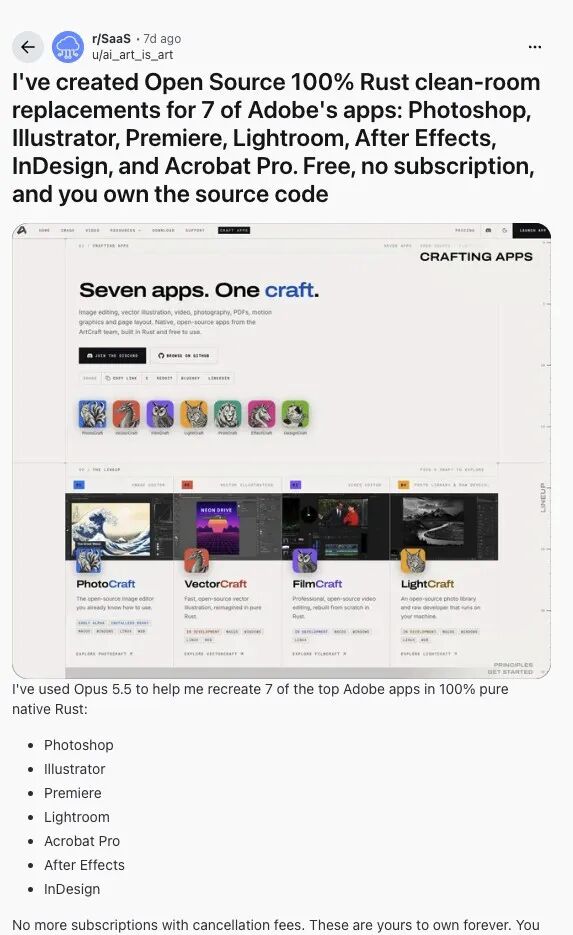
All the repositories of these "budget alternatives" are open source on Github. They are written in Rust, can run locally on computers, and are completely free. Thomas said he used Claude Opus 5.5 to rebuild seven Adobe products, and promised to achieve full feature parity within one month.
Detailed introductions for all seven programs are available on the official website at https://getartcraft.com/
This great piece of news spread quickly on Reddit: "One person used AI to recreate the full Adobe Creative Suite". The decades of R&D work of the software giant was condensed into just a few days by one individual and one AI model.
Thomas is not a beginner who just learned vibe coding out of the blue. He claims to have 15 years of development experience, has worked on large-scale software projects, and his earliest professional experience dates back to the payment software Square. After generative AI emerged, he built a text-to-speech product that imitates the voices of celebrities. Later, he continued to develop generative AI creation tools that can control characters, camera angles and actions.
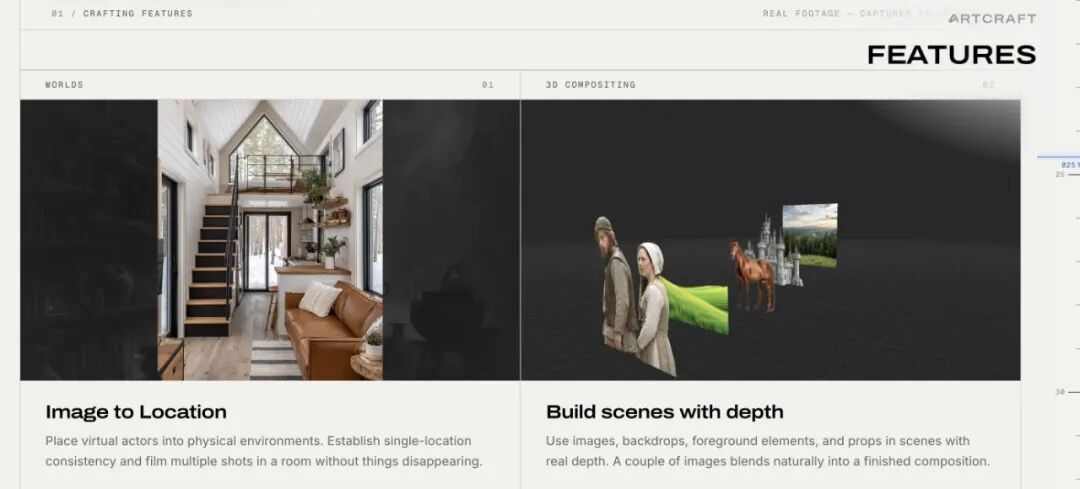
Judging from his resume, the launch of ArtCraft is not entirely unexpected. Each of the seven software programs has its own dedicated page and download entry, though five of them are still marked as "in development", while the PhotoCraft and PDF tools are labeled as "Early Alpha".
Are these "budget alternatives" really that miraculous?
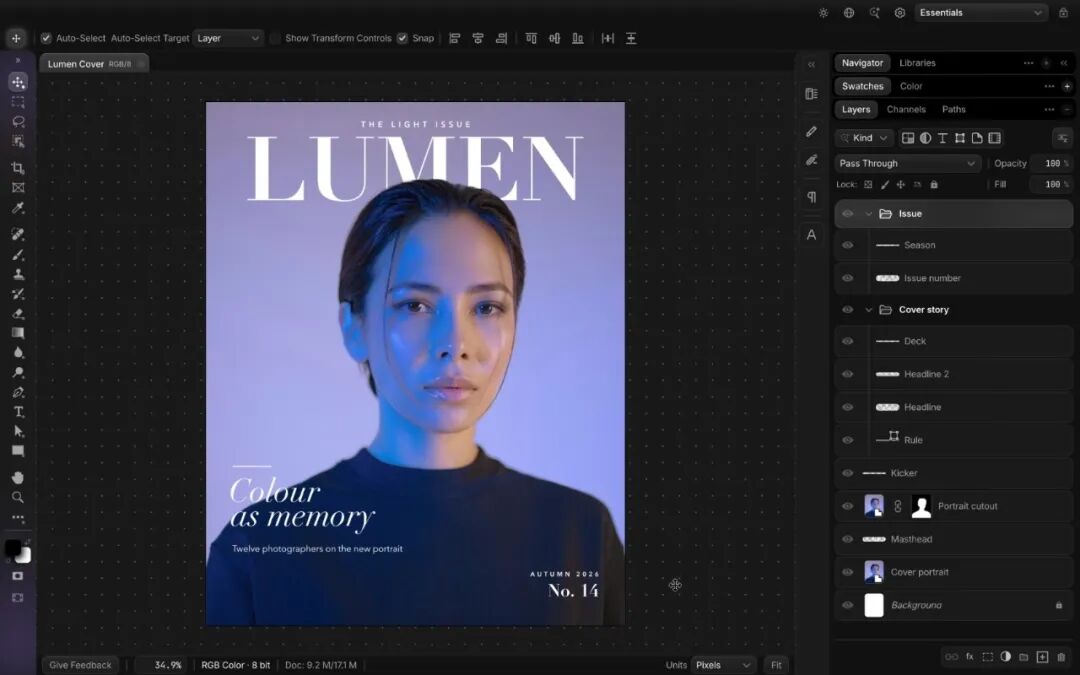
PhotoCraft first caught public attention. It has layers, masks, brushes, curves and text tools, its interface layout and operation methods are deliberately designed to feel familiar, and it also supports opening and saving PSD files. The official website showcases screenshots, feature lists and installation packages for different operating systems; the code repository continues to add new features and fix issues.
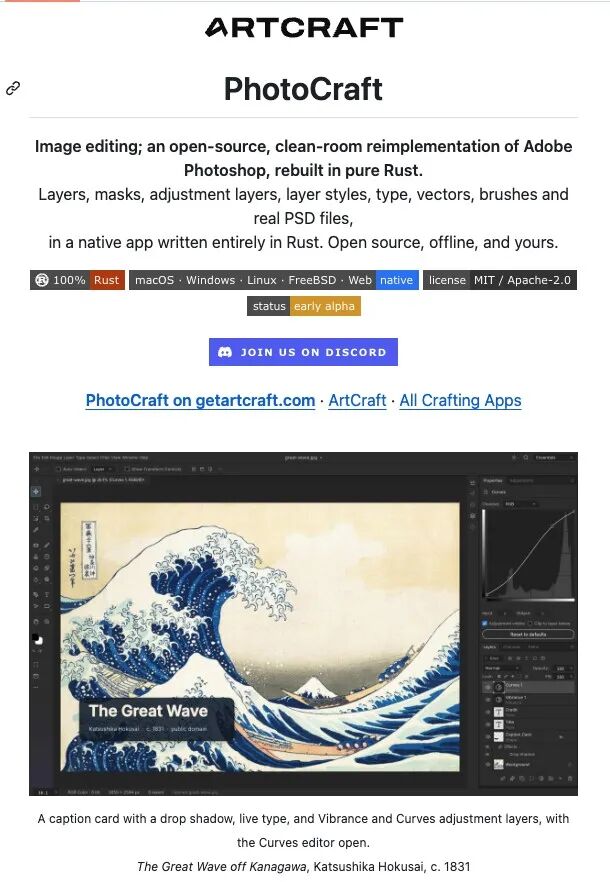
This is clearly built to rival Photoshop. Many netizens downloaded and tried it out, and their feedback is mostly positive: PhotoCraft starts up very fast, can open images, and its basic operations work quite well. But performance becomes less satisfactory beyond these basic functions: one user found that PSD files with smart objects went wrong after opening; another designer found that a not-too-complicated professional file could be opened, but the operation was very slow, and small but frequent errors would occur. Testers of FilmCraft reported issues such as crashes when importing a large number of video clips, and abnormal display of some materials.
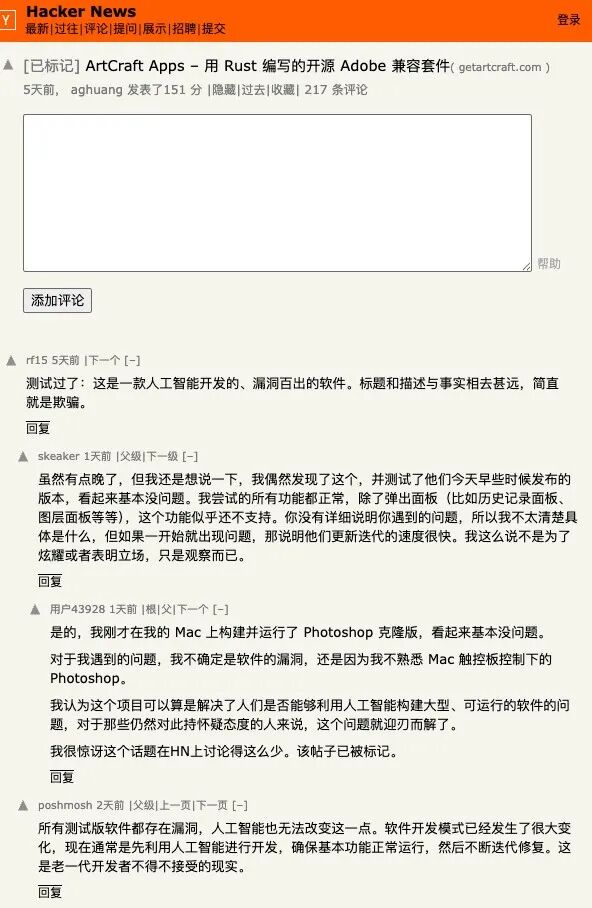
The original timeline Thomas gave to "achieve 100% feature parity in one month" has been delayed again and again. In response to inquiries from Hacker News users, he later said that approaching full parity may take months instead of being completed in just one month. He said he made the project public because he wanted to gather a group of users first, asking them to submit issues, test the software and participate in development.
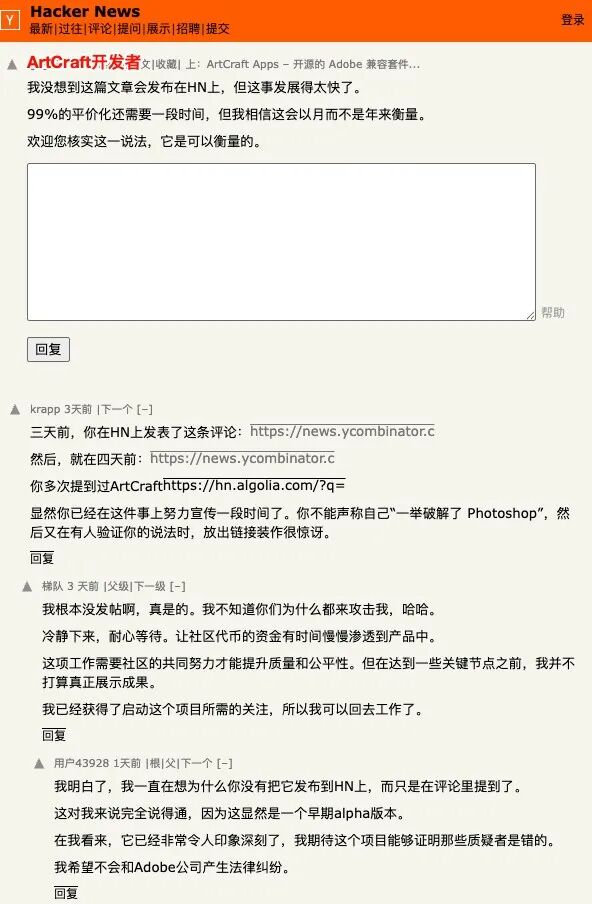
Huh? Where did the super-fast development speed empowered by AI go at this point? Technically speaking, it is possible for one person with the help of AI to build seven "runnable, Adobe-like" programs in a short period of time.
But it has not happened yet that one person can catch up with Adobe's years of R&D achievements overnight.
Just two months ago, Adobe's director of engineering publicly talked about the architecture of Photoshop in a blog post, saying that it is almost impossible and unnecessary to rewrite the entire Photoshop from scratch.
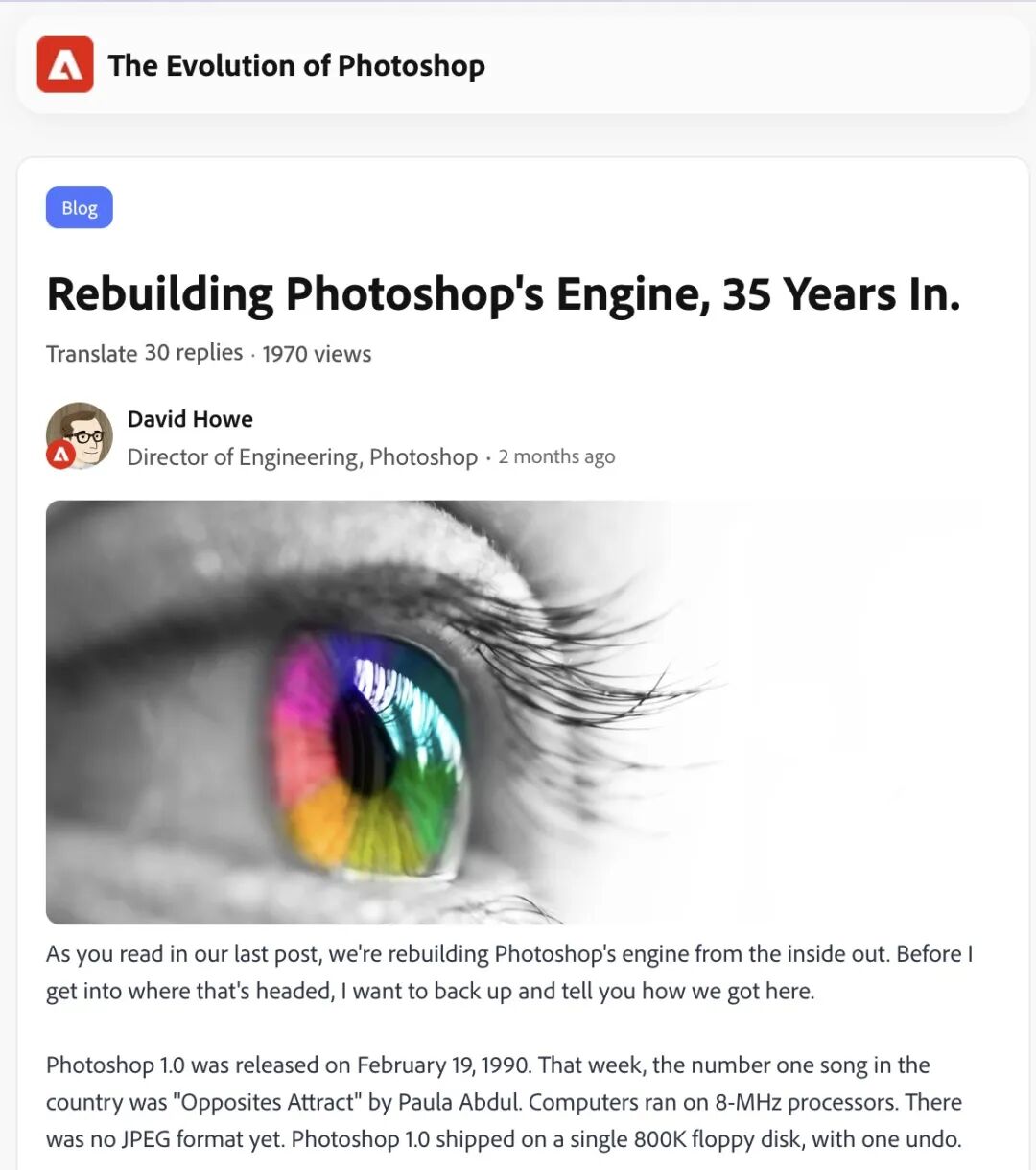
Of course, this comment was not targeted at ArtCraft. His original intention was that Adobe is currently reshaping Photoshop from the inside out, gradually adding and updating engines based on existing tools and capabilities. When Apple released the iPad Pro in 2016, the hardware had developed enough to meet the needs of mobile terminals, so Adobe ported the existing Photoshop codebase to mobile and web platforms instead of rebuilding it completely from scratch.
In fact, almost no one believes or expects that a software coded with AI can rival Adobe: being free is good, being open source is good, but being unrealistic is not.
Take PhotoCraft as an example: it splits PSD file reading and writing, image composition, filter calculation and interface into different Rust modules, which forms a proper software structure. Repository tests show that smart object and filter information in the samples can now be saved and read back along with the files; but when PhotoCraft recalculates the filter effects of Photoshop, only 5 out of 30 test cases achieve matching results.
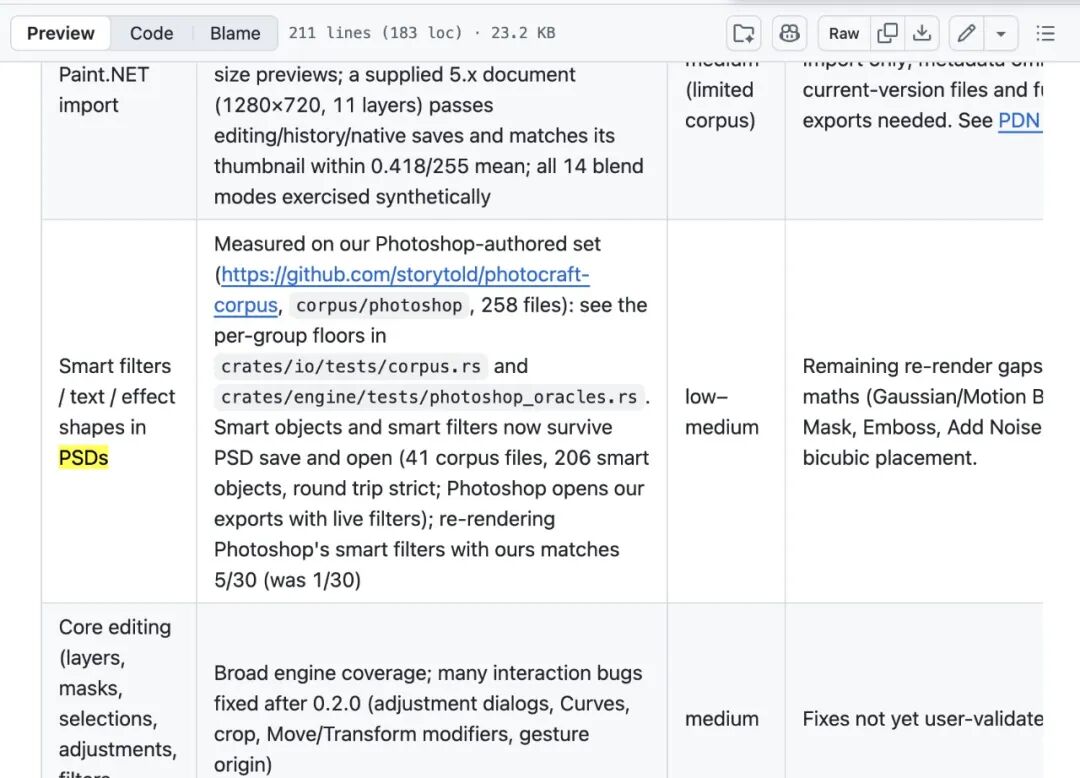
Photoshop's smart filters are a complete workflow that allows users to adjust parameters, order, blending modes and masks repeatedly. Users need to convert the layer to a "smart object" first, then attach effects such as blur and sharpening under it, without rewriting the original pixels directly. When users adjust parameters or filter order, Photoshop will recalculate the image; therefore, the fact that PhotoCraft can save and read back these operation records does not mean it can produce the same results.

Take Premiere, which is commonly used for video work, as another example: it provides hardware-accelerated playback and export workflows, and supports a wide range of plugins. For editors, these plugins significantly improve efficiency when applying effects, processing long footage, and transferring files between post-production teams. The "budget alternative" FilmCraft can indeed perform multi-track editing, color grading and export, with separate modules for video codec, timeline editing, rendering, GPU processing and export, and its interface and command interfaces for AI calls are placed at the upper layer. But currently, some commonly used special effects and Lumetri color grading still rely on the CPU, which leads to very slow processing speeds, and it cannot load third-party plugins such as VST3 and Audio Units yet.
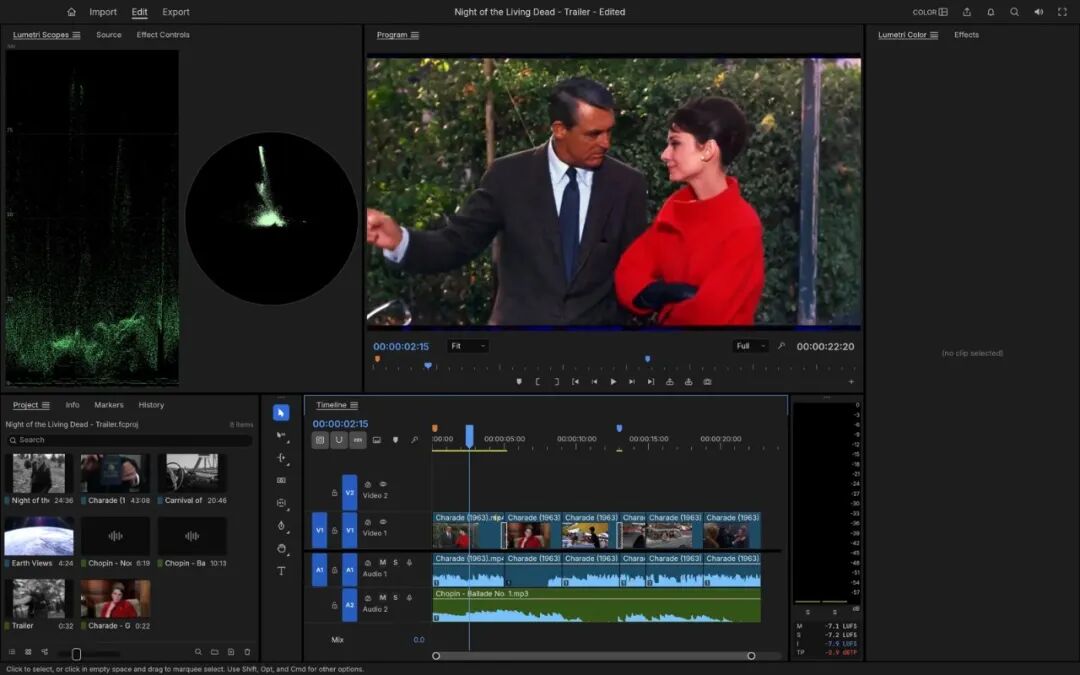
While these "budget alternatives" are still solving these basic problems, Adobe is already planning a new generation of image processing engines. Its goal is to integrate operations such as filters and layer blending in a document into a GPU program compiled specifically for that document, so as to reduce the repeated generation of temporary bitmaps in the process. It is working on solving problems such as whether complex documents can be edited in real time, and how to maintain image quality after repeated processing.
Each generation has its own dream of slaying the dragon
Before ArtCraft, people were already asking "Why hasn't anyone used AI to write a Photoshop yet?" Several projects that emerged later almost all took mature commercial software as their target one after another.
Photon Studio is another newly released AI-coded work that tries to challenge Photoshop's dominant position. The developer claims that he spent about 2000 USD on model calls, and used tools such as GPT-6 Astra to build a free photo editing software; it reportedly attracted 170 active users on its first day. He also admitted that the initial version has bugs and instability, and he will continue to iterate the product based on user feedback after release.
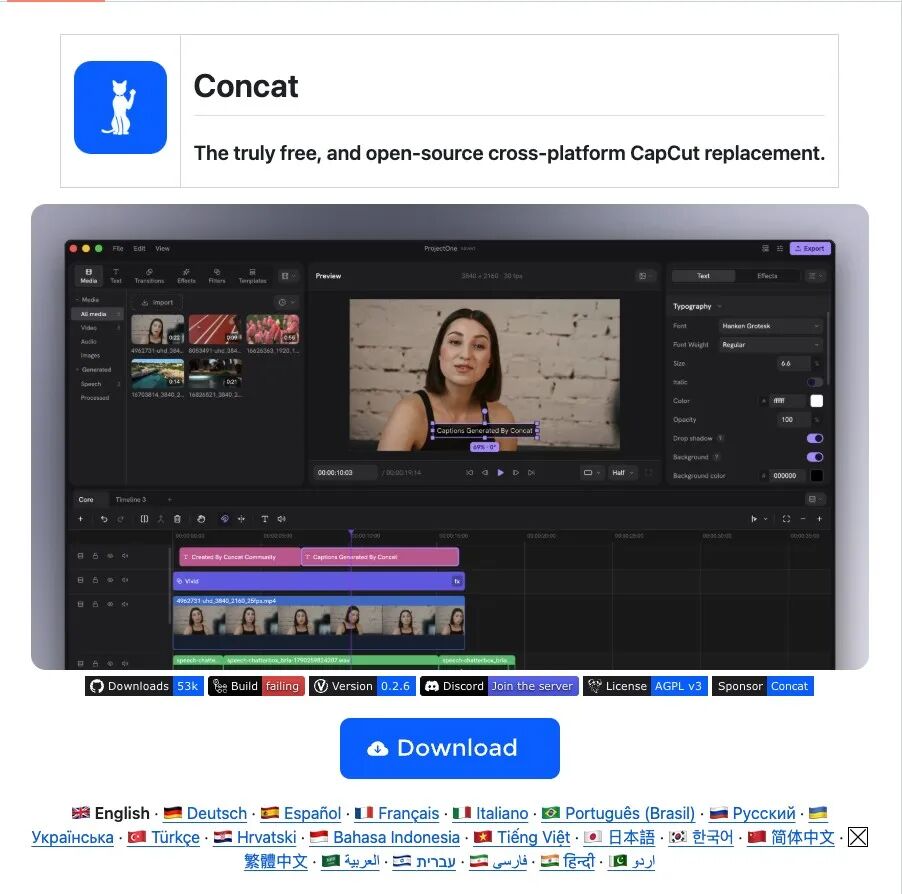
There was also a "partial budget alternative" called Concat for CapCut, the international version of Jianying. It is an open source editing software built with Claude Code, focusing on allowing users to run functions such as automatic subtitles and text-to-speech on their own computers, eliminating the need to pay continuous subscription fees just for exporting videos.
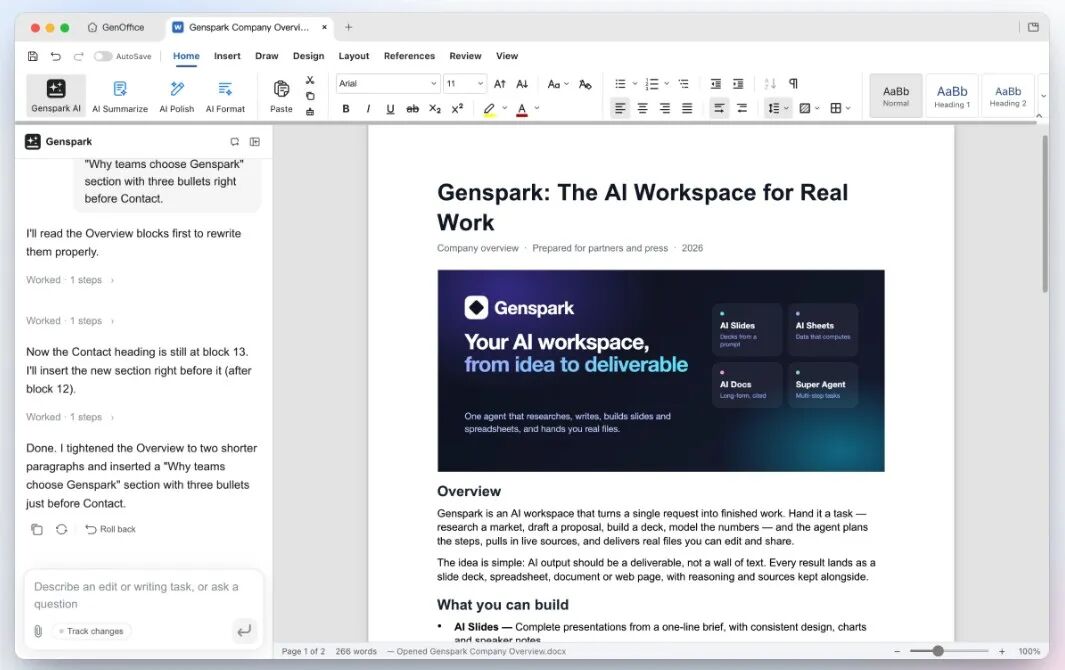
What is even more notable is GenOffice, a project that directly positions itself as an open source alternative to Microsoft Office, aiming to challenge Word, Excel, PowerPoint and PDF files, and integrate AI Agents into the editing process.
The increasing popularity of AI coding has made many experienced developers come up with new ideas. Building small tools that meet their daily needs is manageable, but challenging the decades of accumulated experience of mature commercial software is more about grand slogans than practical actions.
Moreover, these open source projects even use the slogan "welcome joint development" to try to make up for the practical experience that can only be polished through repeated testing on countless real files, devices and user operations — you cannot achieve such a huge goal in one go.
AI coding can quickly write layer panels, filter menus and file parsing programs, but having a "smart filter" option in the menu is a completely different level of completion from ensuring that a complex PSD file made ten years ago still displays correctly after opening, and can be opened and edited continuously in Photoshop after saving.
AI coding has changed the way people perceive "completion". In the past, if you wanted to rebuild Photoshop, it would take a very long time just to build the window, toolbar, layers and several filters, and developers would constantly encounter difficulties in the process. Now these visible parts can be completed in just a few days, and can respond to clicks, open images and export files. The time when a software "looks like a finished product" for the first time has been greatly advanced.
Even if you encounter difficulties and find several bugs, just tell the AI Agent, and it will fix them in a few minutes and pass the test. After going through this process dozens of times, it is easy to assume that the remaining problems are just a matter of running a few more rounds of iteration and consuming a little more tokens.
But the hardest part of mature software is often the exceptions that are not written on the feature list, not listed in the repository. These exceptions come from past user feedback, and may even come from future usage scenarios, requiring insight to discover and solve, rather than just more tokens.
This article is from the WeChat official account "APPSO", written by the team that discovers tomorrow's products, and is published with authorization from 36Kr.