Farewell, "bragging in the name of technology"
"The hidden door handles are finally on their way out!"
"Zero-gravity seats can no longer be hyped up!"
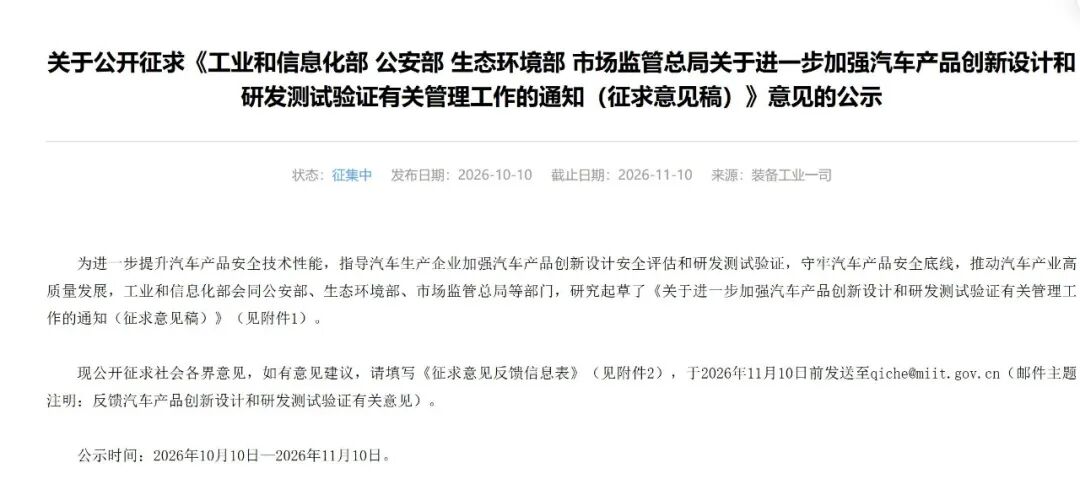
On October 10, 2026, the draft for comments on the management of innovative automotive product design jointly issued by four government departments including the Ministry of Industry and Information Technology of China sparked a huge public outcry.
On WeChat Moments, some call it "the strictest innovation control in history", while others joke that product managers have quietly dug out their half-steering wheel and hidden door handle solutions that were stashed away long ago, preparing to rework them from scratch.
But from the perspective of Auto Community, the weight of this document is far more significant than the several bans it appears to lay out on the surface.
What it truly touches on is a fundamental issue that has been covered up by rapid growth: as automobiles become more and more like consumer electronics, and "tech features" become the most prominent selling point, have we forgotten what the primary attribute of an automobile is?
The core labels accumulated by the automotive industry over more than 100 years are only three words: reliability, safety, and steadiness. This is not conservatism, but an industry consensus forged from countless accidents, recalls, and painful lessons.
But in the past few years, swept up by the intelligentization wave, these three concepts are being replaced by "iteration speed", "feature density" and "user experience".
The geek mindset — the kind of technical fanaticism that pursues the ultimate, breaks boundaries, and acts first before thinking — has spread from the internet industry to the automotive industry, bringing exciting innovations as well as disturbing hidden risks.
If we let this extreme geek mindset dominate car manufacturing without any boundaries, the consequences will be multi-faceted: the frequency of daily failures rises, accidents become more frequent, personal safety and property suffer losses, and the more far-reaching impact is that the public's attitude towards technology will slide from "excessive trust" to "rebellious aversion".
Excessive trust and rebellious aversion seem to be two extremes, but in fact they are two sides of the same coin — both treat technology as a belief or a devil, rather than a tool. This is detrimental to the long-term development of the automotive industry and the coordinated integration of technology into automobiles.
This draft for comments is precisely at this node, trying to calibrate the direction for the deviated industry.
All the pitfalls that those "innovations" have stepped into are written into the document
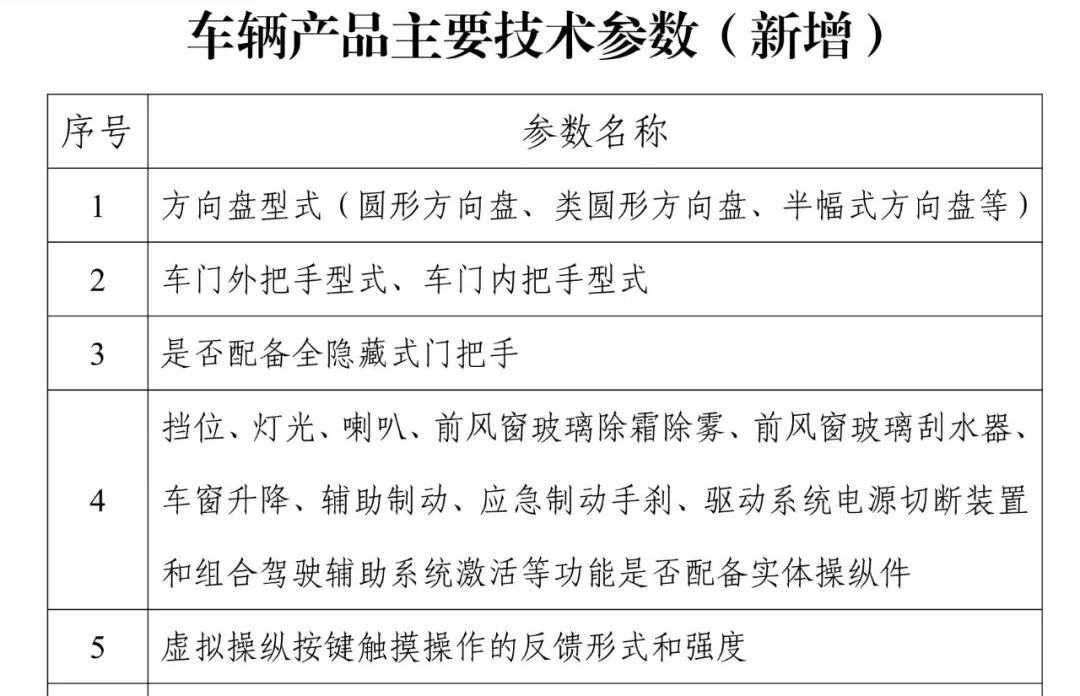
The appendix of the draft for comments lists 51 technical parameters, of which items 1 to 41 are for innovative design, and items 42 to 51 are for R&D testing and verification. This is not a simple compliance checklist, but more like a "real record of the industry's pitfalls".
Auto Community has done a category sorting, and it can be said that most of the new functions that car companies have promoted and focused on marketing in the past few years have been named and "taken care of".
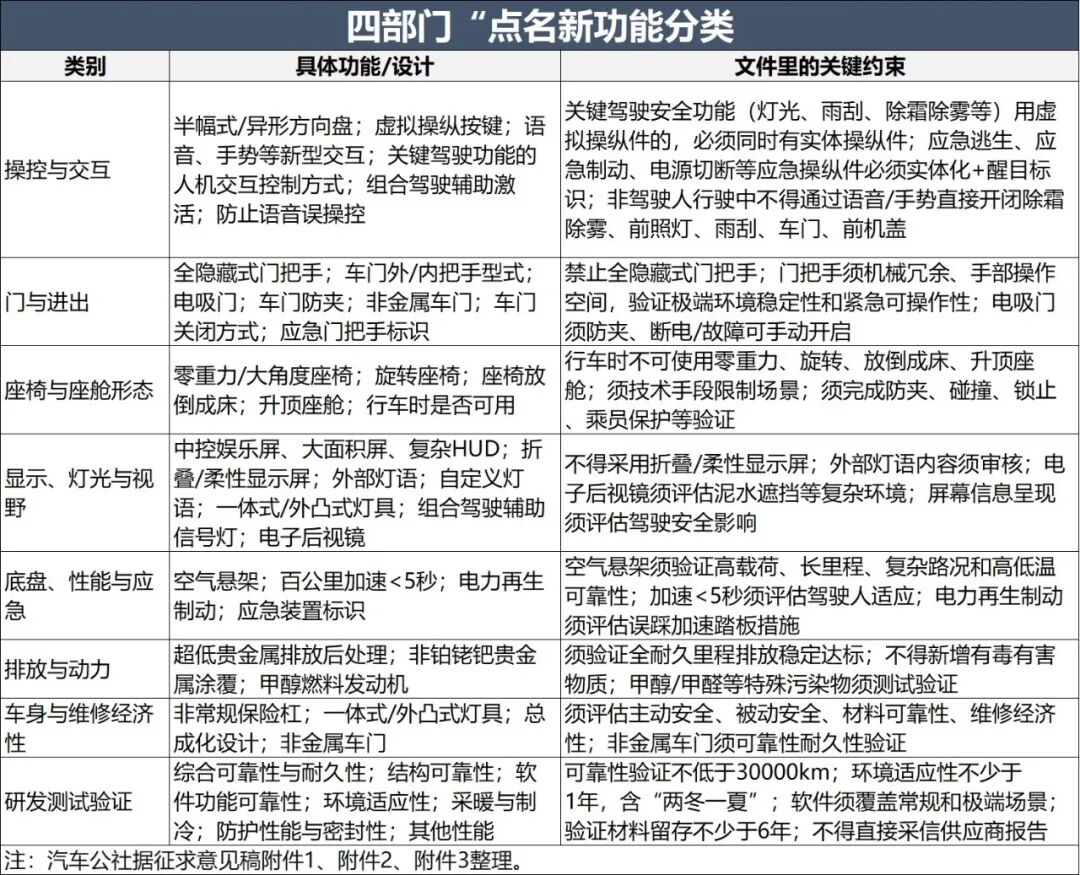
Hidden door handles are the first to bear the brunt. The document clearly states that "fully hidden door handles are prohibited", and requires that they must "have mechanical redundant design and hand operation space".
The intensity of this wording is rare in the entire document. Why? Because the cost has already been paid with lives.
In 2025, on Tianfu Avenue in Chengdu, a Xiaomi SU7 caught fire after a collision. Many passersby tried to rescue the people inside, but failed to open the door from the outside. Eventually, firefighters had to cut the door open with a chainsaw, but casualties had already occurred.
Finally, on August 21, 2026, 9 car companies filed recalls on the same day. The main reason was related to hidden door handles, with a total of more than 4.27 million vehicles, including 2.976 million Tesla vehicles and 390,000 Xiaomi vehicles.
A crash test by an institution shows that for vehicles equipped with electronic door handles, the success rate of door popping out after a side collision is only 67%, while that of mechanical door handles is 98%. Looking at this set of data together, who dares to say that "aesthetics" is more important than "being able to open the door"?
Then let's talk about seats. The document requires that functions such as "zero-gravity" seats, rotating seats, or seats reclined into beds cannot be used while the vehicle is running, and "technical means must be used to restrict the usage scenarios".
Note that it does not rely on user manual reminders or in-vehicle pop-up warnings, but on technical means. The implication is very clear: stop shifting responsibility with phrases like "please the driver pay attention".
In the past year, Auto Community has had contact with some complete vehicle enterprises and component suppliers. "Through pre-tensioning and fast adjustment mechanisms, zero-gravity seats can also be used while the vehicle is running" has become a new selling point. But after all, there is no mature rule system and technical standards to escort this function, which may be the reason for this "one-size-fits-all" ban.
There is also the raised roof cabin. The document requires carrying out "assessment and verification of anti-pinch safety, collision safety, wind resistance and other performances", and clearly states that "the raised roof cabin function cannot be used while the vehicle is running".
This is directly related to the quite dramatic marketing battle between Xiaomi Pengcheng and Xiangjie G9 in July 2026. The two companies almost simultaneously took the "original factory roof tent" as their core publicity point. Yu Chengdong showed off the raised roof tent of Xiangjie G9 and got 230,000 likes. But later, some car reviewers found after seeing the real car that Xiaomi's raised roof is mainly designed to increase the interior space and cooperate with the flat floor to allow people to walk inside the car, and the "tent" is more of a nice add-on.
The problems brought by the raised roof cabin, including the upward movement of the center of gravity, the stability at high speed, and the occupant protection after rollover, have been systematically avoided in the marketing discourse of "outdoor lifestyle".
If the above are hidden safety risks at the "design level", the brake pedal support fracture incident of Zunjie V800 brings the problem back to the design level plus the most basic engineering level. In addition to insufficient reinforcing ribs and poor angular stress design, the cross-section shape shows that there may be melt marks and bubbles.
That's not all. It is generally believed that intelligentization is the most concentrated embodiment of automotive tech transformation, and the intelligent cockpit and intelligent driving are the two most eye-catching modules.
This time, the driving assistance or autonomous driving functions are also named. They must not only meet the requirements such as "Safety requirements for combined driving assistance system of intelligent and connected vehicles" (GB 47955) and "Safety requirements for autonomous driving system of intelligent and connected vehicles" (GB 44721), but also establish necessary R&D design, testing and verification capabilities, and various safety guarantee capabilities.
In fact, intelligent driving has already caused casualties and large-scale recalls. Tesla AutoPilot has cases such as Joshua Brown in the United States and Gao Yaning in China. Xiaomi recalled more than 116,000 SU7 standard versions in September 2025, because the L2 high-speed navigation assisted driving function had insufficient recognition, warning or disposal capabilities for extremely special scenarios.
Connecting these events together, the logic of the draft for comments is very clear: when the iteration speed of innovative design far exceeds the construction speed of verification capabilities, the industry is conducting open tests with consumers' life safety.
It is strictly prohibited to make industrial products in the way of consumer electronics
Back to a more fundamental question: why are there so many products that hit the market before full verification?
The answer is hidden in the narrative of China's automotive industry in the past five years.
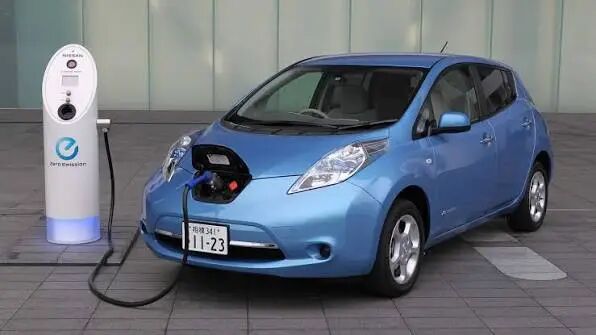
The rise of Chinese automobiles is essentially a "lane change overtaking". Pure electrification is not enough to achieve overtaking — Nissan Leaf is not bad in terms of electric drive, and Chevrolet Bolt was once regarded as the orthodox of automotive electrification, but what really subverted the industry is the chemical reaction generated by Tesla after combining electrification and intelligentization.
OTA turns automobiles from tools that are finalized after leaving the factory into evolvable terminals. Large screens and software ecosystems redefine the cockpit experience. With the world's strongest intelligent hardware supply chain and internet talent reserve, China's automotive industry has further amplified this trend, which leads to its current market position.
Intelligentization is the core driving force for lane change overtaking, which is beyond doubt. The problem lies in the phrase "going too far is as bad as not going far enough".
When intelligentization becomes the core competitiveness, the industry's thinking paradigm will inevitably be deeply influenced by consumer electronics and the internet.
What is the logic of consumer electronics? Rapid iteration, small steps and fast running, launch first then optimize, and user feedback drives improvement. This logic works well in the mobile phone industry, because if the phone crashes, you can just restart it, and if the APP crashes, you can just update it. But the fault tolerance space of automobiles is completely different — a 2-ton metal object driving on the highway at a speed of 120km/h, any small bug may turn into a fatal accident.
The "grayscale release" and "agile development" culture of the internet industry is eroding the verification bottom line that the automotive industry should have adhered to.
Some industry insiders pointed out that many car companies have compressed the complete vehicle R&D process that originally takes 3 to 5 years to more than one year or even shorter. The "three high" limit actual measurement is only for shooting promotional materials, the full-cycle durability verification is compressed, and AI simulation is over-relied on to replace real vehicle road tests.
The old saying "A hasty monk makes bad steamed buns" accurately summarizes the current car manufacturing logic of some car companies.
What is more worthy of vigilance is that this kind of "speed" is often accompanied by marketing exaggeration.
Calling "assisted driving" "autonomous driving", packaging "roof tent" as "mobile home", and promoting the half-steering wheel as "future technology" — marketing rhetoric runs ahead of product capabilities, and there is a huge gap between consumers' perception of innovative functions and the actual usage boundaries.
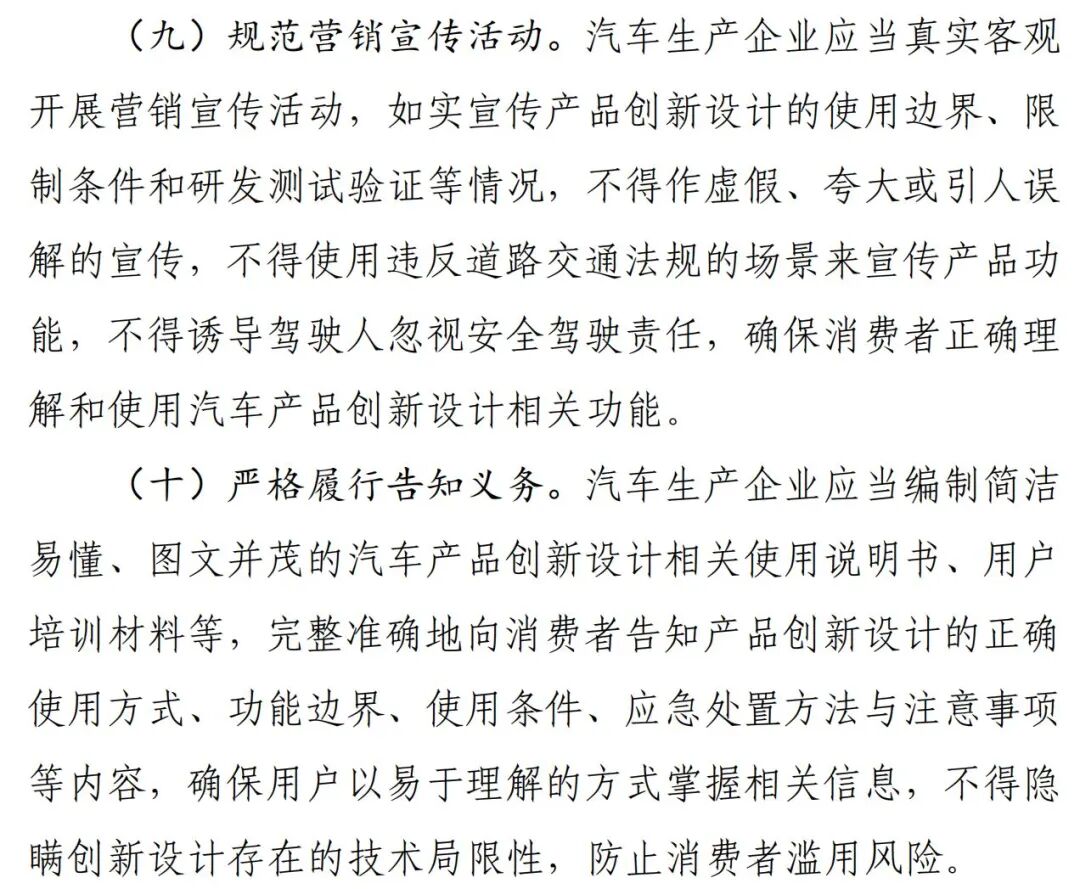
The draft for comments devotes a whole section to "standardizing marketing and publicity activities" and "strictly fulfilling the obligation of notification", requiring "no false, exaggerated or misleading publicity, and no use of scenarios violating road traffic regulations to promote product functions", which is obviously not aimless.
Find a balance between speed and slowness
There is an easily overlooked but extremely important institutional design in the draft for comments: dynamically update technical requirements. The document proposes that the Ministry of Industry and Information Technology will "dynamically adjust the Technical Guidelines for Innovative Design by incorporating software and hardware innovative designs that affect vehicle safety performance into the scope of review and assessment in a timely manner according to the industrial application and standard development and revision situation".
What does this mean? Regulations and standards also need an "OTA-like evolution mechanism".
In the past, the development and revision cycle of automotive standards often took three to five years. By the time a standard was released after a car was launched, it was already too late. But now the rhythm of technology iteration is measured in months. If the standards are still updated on an annual basis, supervision will never catch up with the pace of innovation.
The establishment of the dynamic adjustment mechanism essentially enables the regulatory framework to evolve synchronously with the industry — it neither bans innovation in a one-size-fits-all way, nor lets it go unchecked with the "act first then think" attitude, but establishes a movable boundary between "allowing trials" and "keeping the bottom line".
This reminds people of the sentence in Tao Te Ching: "Governing a large country is like frying small fish". Governing a huge industry is the same as frying a small fish — if the fire is too fierce, the fish will break; if you flip it too often, the fish will fall apart.
The current situation of China's automotive industry is exactly that there is a problem in the control of "heat". The fire of innovation needs to burn, but it cannot burn through the pot; the iteration needs to be fast, but it cannot be so fast that safety verification cannot keep up.
There is another detail in the draft for comments worth pondering: for products that have obtained the Announcement, car companies need to supplement and submit technical parameters and verification materials before July 1, 2027. For products that have not been submitted after the deadline and have hidden safety hazards, they should "immediately stop production" and "proactively implement recalls".
This is equivalent to giving a buffer period for existing products, but after the buffer period, it will be a hard landing. This arrangement of "new products follow new rules, old products have a transition period" embodies the wisdom of frying small fish — it does not overturn the table and start all over again, but gives the industry a window for self-correction.
Of course we cannot reject innovation. The reason why China's automotive industry can grow from a follower to a leader is that it dares to try and break new ground. But "daring to break new ground" does not mean "breaking ground recklessly", and "daring to try" does not mean "treating users as guinea pigs".
True innovation should be confidently crossing the boundary after fully understanding the risk boundary, not rushing forward with eyes closed without knowing where the boundary is.
The primary attribute of an automobile is an industrial product. It carries not only travel needs, but also life safety. The iteration logic of consumer electronics can be used for reference, but cannot be copied completely. Screens can be replaced once a year, but brake pedals cannot. APPs can be updated next week, but crash safety verification cannot.
The deep significance of this draft for comments is not that it bans several specific functions, but that it tries to recalibrate an unbalanced scale — one end of the scale is innovation speed and market popularity, and the other end is safety bottom line and industrial laws. In the past few years, the scale has tilted severely. Now it is time to pull it back.
Governing a large industry is like frying small fish. When the heat is right, the fish will naturally be delicious. If you flip