As it conducts share placement amid falling valuations, the capital-devouring "gold-eating beast" Biren Technology is preparing to raise another 4 billion yuan.
Listed for less than a year, Biren Technology, one of the "Four Little Dragons of Domestic GPUs", has launched two rounds of placement in succession. If the latest round of placement is completed, Biren Technology has raised a total of HKD 17.261 billion from the capital market since its listing, ranking first among domestic listed GPU companies in terms of fundraising amount. With the support of the raised funds, Biren Technology will seize the first-mover advantage in commercialization.
On October 8, Biren Technology announced a new round of share placement. According to the announcement, Biren Technology plans to place 130 million H shares to no less than 6 placees at a price of HKD 31.8 per share, accounting for about 4.76% of the total share capital after issuance. The net proceeds from the placement are expected to be HKD 4.02 billion.
This placement price represents a discount of about 9.76% compared with the closing price on the day before the announcement. After the announcement was released, Biren Technology's share price plummeted, closing down 11.85% at HKD 30.36 per share on the same day. As of the close on October 9, the company's share price stood at HKD 31 per share, with a total market value of HKD 80.6 billion.
Since December 2025, domestic AI chip companies have ushered in a wave of listings, with Moore Threads, Muxi Co., Ltd., Biren Technology, Iluvatar CoreX, and Enflame Technology successively landing on the capital market.
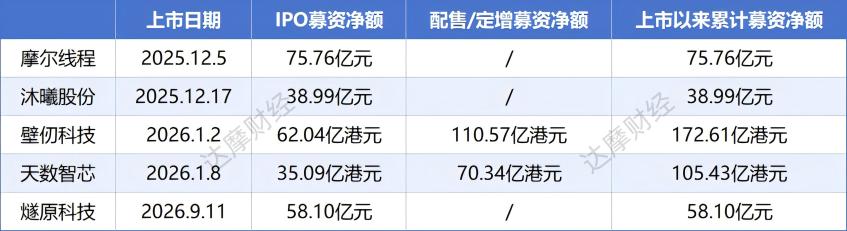
Among them, Biren Technology and Iluvatar CoreX are listed on the Hong Kong Stock Exchange. As the Hong Kong stock market has a more convenient placement system, both companies have restarted equity financing after listing. Iluvatar CoreX raised about HKD 7.034 billion in July, while Biren Technology completed two fundraising rounds in July and October, with net proceeds of HKD 7.038 billion and HKD 4.02 billion respectively.
At present, Biren Technology has become the AI chip enterprise with the highest fundraising amount among the five companies, having raised a total of about HKD 17.261 billion (equivalent to about RMB 14.7 billion) since its listing.
The development focus of the current AI chip industry can also be glimpsed from the use of Biren Technology's raised funds. At the beginning of its listing, R&D was the key investment direction for AI chip enterprises. However, as various enterprises have made breakthroughs in the R&D of new-generation chips one after another, commercialization has become a new core issue.
Seize the First-mover Advantage in Commercialization
Biren Technology's continuous fundraising after its listing in Hong Kong stems from the company's new judgment on the market pattern of AI and GPUs.
In January this year, Biren Technology was listed in Hong Kong, with net proceeds of about HKD 6.204 billion. At that time, the company planned to use 85% of the raised funds for the R&D of GPGPU chips and related hardware and software platforms. In contrast, only 5% of the raised funds would be invested in product commercialization.
In the annual report released in April of the same year, Biren Technology also believed that its cash on hand and net proceeds from the listing would provide sufficient financial support for continuous technology R&D, capacity expansion and commercial implementation.
However, with the rapid development of the AI industry, the market situation has also iterated rapidly. Since 2026, the global demand for computing power infrastructure has continued to rise, and domestic Internet manufacturers and computing power infrastructure suppliers have also significantly increased their AI capital expenditure. Affected by this, the potential market for GPGPU products has expanded significantly, and stable delivery capacity and large-scale supply capacity have become the key criteria for customers to choose GPGPU partners.
In this context, Biren Technology's own R&D has also entered a critical node. According to the company's announcement, the group's new-generation products have completed the start-up test and entered the post-taped-out verification stage, and their progress has been greatly accelerated compared with expectations. This also urges the company to accelerate the product commercialization process to seize a dominant position in the competition.
There is no significant generation gap in the performance of cutting-edge products of leading domestic AI chip enterprises. In the promotion of most enterprises, their latest products are benchmarked against NVIDIA H100 or H200.
For example, the main product MTT S5000 of Moore Threads has a measured performance benchmarked against NVIDIA H100. The Xiyun C700 product under development by Muxi Co., Ltd. also has performance benchmarked against NVIDIA H100. Biren Technology's new-generation flagship product BR20X is benchmarked against NVIDIA H200. This product is expected to enter the post-tapeout verification and testing stage in the fourth quarter of this year, and achieve large-scale deployment in 2027.
Public information shows that H100 and H200 are two computing chips launched by NVIDIA in 2022 and 2023 respectively. The two products have the same architecture and process, with no changes in GPU chips, core count and frequency. The performance improvement of H200 mainly benefits from the HBM3E video memory it is equipped with, which gives H200 larger memory and bandwidth.
Therefore, in the case where there is no generation gap in chip capabilities, the domestic chip enterprise that first completes the commercialization path will have the opportunity to build its own chip ecosystem first, and establish a commercial moat based on this.
This is also determined by the characteristics of AI chips. When users choose an AI chip, they need to build a compatible AI framework, model and other ecosystems based on this chip, which is difficult to reuse on AI chips of other brands, with extremely high migration costs.
However, the premise for chip enterprises to achieve commercialization is to lock the upstream supply chain in advance, including the supply of advanced process capacity and storage product HBM, which requires a large amount of capital support. Biren Technology's two recent placement fundraising activities are precisely to prepare funds for locking the upstream supply chain.
In July this year, Biren Technology raised HKD 7.038 billion, of which 60%, or HKD 4.223 billion, will be used for the commercialization and production expansion of GPGPU solutions. Specifically, the funds will be used for customer sampling, development of rack-level and super-node reference designs, expanding mass production scale and strengthening supply chain security.
According to Biren Technology's forecast, most of the above funds will be used up by the end of this year, which is much earlier than the originally scheduled deadline of the end of 2027.
Therefore, the company has launched another placement to raise HKD 4.02 billion this time, 70% of which will continue to be invested in strategic supply chain procurement, production preparation and commercialization of new-generation products, so as to increase supply, improve delivery preparation and accelerate the commercial shipment of next-generation products.
In addition to Biren Technology, other domestic AI chip vendors are also increasing their efforts in commercialization. In July this year, Iluvatar CoreX raised HKD 7.034 billion through placement, 60% of which was used for strategic supply chain resilience and procurement planning of key materials and components. In addition, in June and August this year, Muxi Co., Ltd. and Moore Threads both announced plans to conduct secondary listings in Hong Kong.
Share Price Correction in the AI Chip Track
When Biren Technology launched its first placement in July this year, the placement price was HKD 46.20 per share. By the second placement in October, the placement price had dropped to HKD 31.8 per share. Behind the decline in placement prices, Biren Technology and even the entire AI chip industry have experienced a round of share price correction after July.
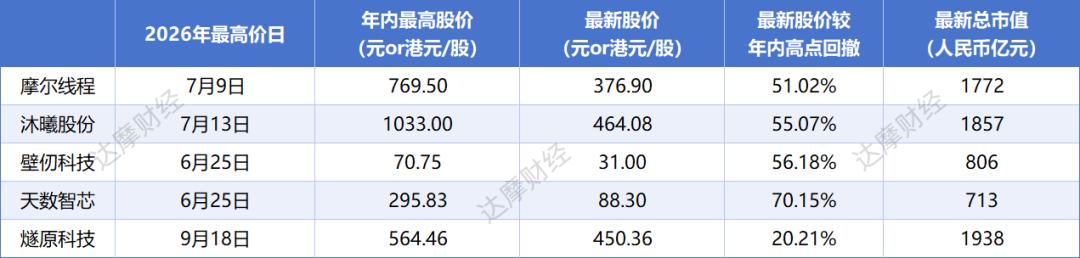
Among them, the share prices of Moore Threads, Muxi Co., Ltd. and Biren Technology have all been cut by half compared with their intraday highs this year. Enflame Technology was listed later, but its latest share price has also corrected by about 20% from its intraday high. The latest share price of Iluvatar CoreX has fallen by more than 70% from its intraday high.
The share price correction of AI chip companies is related to the AI industry entering an overheating correction cycle.
In July this year, Michael Wilson, chief U.S. stock strategist at Morgan Stanley, sent a clear signal to the market. He believed that the time for sector rotation had come, and investors should reduce their holdings in semiconductors and turn to hyper-scale cloud computing providers. Since July, the global AI computing power industry chain has experienced a round of deep correction.
From the perspective of domestic GPU companies themselves, although several companies have achieved rapid revenue growth in the first half of the year, their revenue scale is still low, and none of their main businesses have achieved profitability, making it difficult to support a high market value for a long time.
Taking Biren Technology as an example, in the first half of this year, the company achieved revenue of RMB 1.236 billion, a year-on-year increase of 1997.59%; the net loss attributable to shareholders was RMB 377 million, and it still failed to turn losses into profits. The company's latest price-to-sales ratio is still as high as 32 times.
In addition to market factors, the substantial increase in chips brought about by the lifting of restricted shares has also become one of the triggers for the sharp correction of AI chip enterprises' share prices. In July and October this year, 6.12% and 5.88% of Biren Technology's restricted shares were lifted respectively. By January next year, another 33.59% of the shares will be lifted from restrictions, and the market may pre-emptively game the expectation of share reduction.
Calculated at the latest share price, the market value corresponding to the restricted shares of Biren Technology to be lifted in January next year is as high as HKD 27 billion.
This article is from the WeChat official account "Damofinance" (ID: damofinance), written by Damofinance, and authorized by 36Kr for release.