The share prices of the sports footwear and apparel sector slumped collectively in the third quarter. Which companies might have been unjustly dragged down in the market sell-off?
The stock prices of the sports footwear and apparel sector experienced a collective decline in the just-concluded third quarter. Among 15 major domestic and international brands, only two local brands, Anta and 361°, posted a rise in their quarterly closing prices.
The biggest drop was recorded by Under Armour, whose decline exceeded 30%. Deckers, the parent company of HOKA, adidas and Amer Sports saw their declines exceed or approach 20%; Puma, VF Corporation, Li-Ning, On Running, Nike and lululemon all slid by more than 15%; Columbia's stock price decline also approached double digits; Asics and Xtep, with declines controlled within 5%, were the two brands with the relatively smallest drops.
The declines of these brands are generally higher than the overall decline of the sports footwear and apparel sector. According to a report released by Raymond James on October 1 cited by Investing.com, apparel and footwear brands fell by an average of 8% in the third quarter of this year, while the sports footwear and apparel sector declined by 15%, with the price-to-earnings ratio contracting from the five-year average of 19x to about 14x. The report attributed the decline to rising oil prices, higher interest rates and the continuous impact of inflation on consumers' purchasing power.
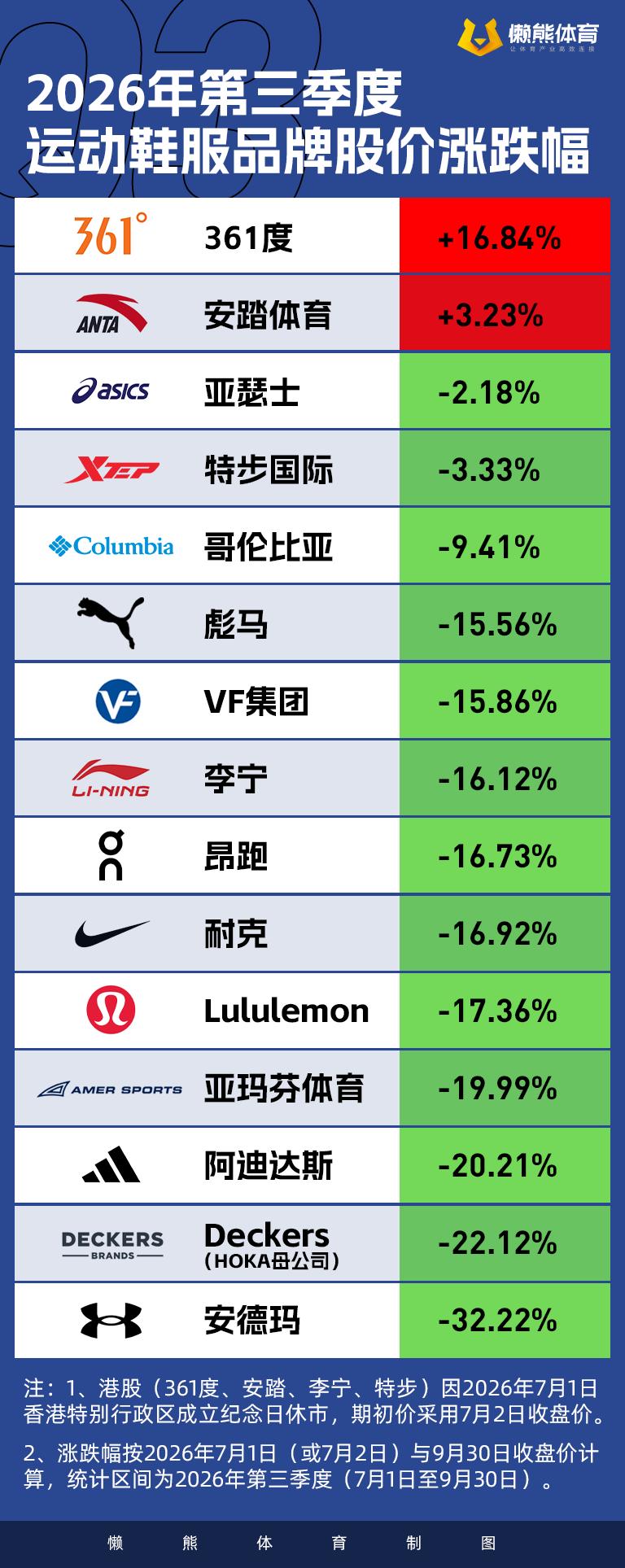
The rating adjustments of multiple institutions in this quarter directly reflect their judgments on the industry prospects.
In mid-to-late September, a number of institutions collectively downgraded the rating of the sports footwear and apparel sector. Baird analyst Jonathan Komp downgraded five stocks including Nike, adidas and VF Corp all to "Neutral" at one go; Bank of America downgraded Nike to "Underperform" and postponed the expected sales recovery to 2028, while Citi believes Nike is "turning into a cost-cutting company"; BMO Capital gave lululemon an "Underperform" rating in its first coverage of the brand; Morgan Stanley's judgment on the current environment is that demand is fragmented, discounting is intensifying, and consumers are spending more cautiously.
Nike's stock price once fell below $40 in August, then rebounded slightly due to bargain hunting, but its cumulative decline so far this year still exceeds 40%. According to Bloomberg, the proportion of analysts who are bullish on Nike has dropped to the lowest level in at least 25 years.
Adidas' stock price fell by 20.21% in the third quarter, but after it received a "Buy" rating from StoneX on September 22, its stock price surged 3.7% in a single day to 148.50 euros, breaking through the 21-day moving average. The market interpreted this as recognition from institutions that adidas' fundamentals have bottomed out. This is a relatively obvious rebound among international brands, but it did not change the overall trend.
On Running's stock price trend fluctuated significantly in the third quarter. Its share price once approached $40 in July, fell to around $26 in September, then rebounded after announcing a $1 billion share repurchase plan on the Investor Day on September 22, and closed at $29.61 on September 30. Since the beginning of the year, On Running's cumulative stock price decline still exceeds 40%. Share repurchases are usually regarded by investors as a signal that the company is confident in its own cash flow and future prospects. However, as a high-valuation growth stock, On Running is facing valuation pressure in a high interest rate environment.
Among Chinese local sports brands, 361° and Anta are the only two that posted positive returns in the third quarter. In an earlier report, CCB International pointed out that 361°'s retail discount is stable at 70% of the original price, performing better than its peers. Goldman Sachs maintained Anta's "Buy" rating on September 16, believing that China's sports market can achieve a medium-to-high single-digit year-on-year growth rate in the medium and long term. Li-Ning's stock price decline in this quarter is basically in the same range as On Running's. Nomura pointed out in a report released in September that Li-Ning's sales growth rate from July to August still slowed down compared with the previous quarter. Xtep's stock price decline during the period was smaller than most domestic and foreign similar brands, but it did not achieve positive returns. In fact, the overall market situation this year is not good. Since the beginning of the year, the stock prices of the four major local sports brands have all shown a downward trend: Anta (-6.81%), 361° (-20.35%), Li-Ning (-29.09%), Xtep (-29.89%).
These brands faced challenges from different sources in the third quarter. One of the influencing factors in the third quarter came from the release of the first-half financial reports of various brands. In terms of overall revenue and profit, the number of brands that can still maintain rapid growth in the first half of the year has decreased compared with previous years. Regardless of whether there is a decline or even a loss, even if the growth rate is lower than expected, it will still make the current secondary market extremely jittery. However, the stock price fluctuations caused by financial reports are, after all, short-term when viewed throughout the entire quarter.
One immediate challenge facing global brands is weak demand in wholesale channels and discount pressure, while Chinese brands are facing weak domestic demand, as well as the price pressure factor brought by the channel adjustment of leading company Nike. Other brands can only follow suit to offer discounts to maintain price competitiveness. BOCI International also pointed out in the research report on September 24 that the pressure from Nike distributors on other peers may last longer, and the price disturbance in some small and medium-sized e-commerce channels may not be completely curbed. It is expected that this competition will reach its peak during the Double 11 period, which will put greater pressure on the retail discounts and sell-through rates of Chinese brands.
Investment institutions are naturally less optimistic about the profit expectations of the entire sector than in previous years, but no flower can bloom for a hundred days. The sports footwear and apparel industry is inherently highly cyclical, and the current decline is, to a certain extent, a return of value from the continuous rise in the past. It is also at such times that there are often companies that are mistakenly killed by the general trend. Exploring targets with deviation between fundamentals and valuation that already have a safety margin is exactly the moment that tests your cognition of the sports footwear and apparel field.
This article is from the WeChat Official Account "Lanxiong Sports" (ID: lanxiongsports), written by Wang Shan, and published with authorization from 36Kr.