The hottest post-2000s talent in Silicon Valley thoroughly elaborates on 5 non-consensus viewpoints about AI assistants.
Recently, Silicon Valley giants have collectively set their sights on a new business: personal AI assistants.
Meta has just launched Muse, OpenAI has Dots, and xAI has also rolled out Grok Bot. From models to computing power, and then to user entry points, almost all advantages are in the hands of these giants.
But interestingly, the fastest players on this track are not all giants.
Take Instinct for example. This company was founded only one year ago, its product entered internal beta in February this year, and it still adopts an invitation-only system to this day, without even a standalone independent App.
Yet this startup has already reached a post-money valuation of 10 billion US dollars.
Recently, 23-year-old Noah Shinn, the founder of Instinct, made his first appearance on a podcast and accepted a long-form interview.
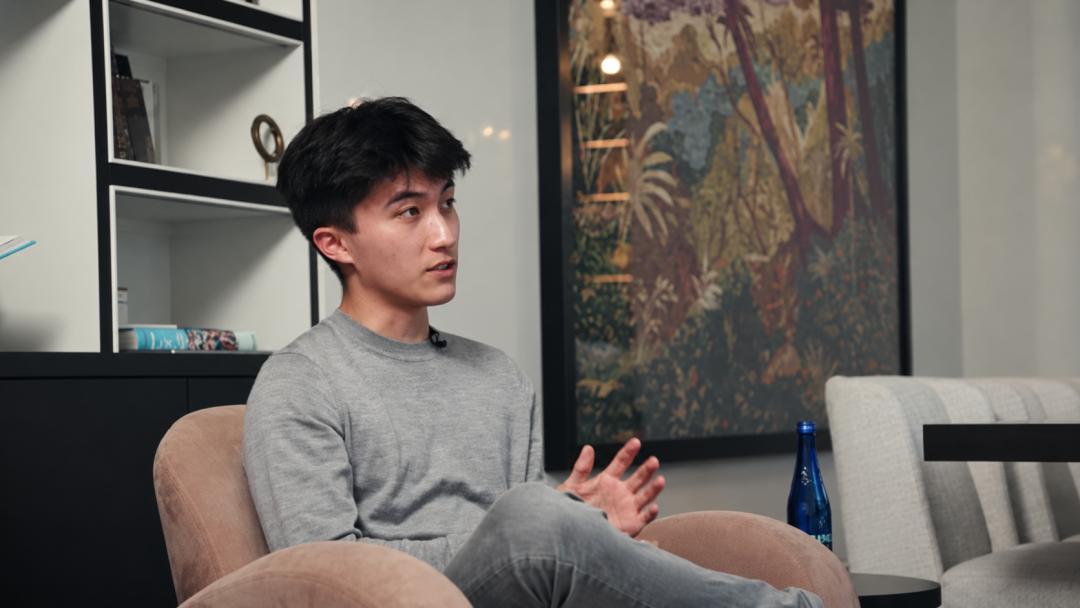
Instinct founder Noah Shinn was interviewed on *Invest Like the Best*
In this interview, he put forward several "unconventional views" on personal AI assistants that are well worth discussing.
First, the assumption that an AI product must have an App is a self-imposed limitation.
Instinct has neither a standalone App nor a product website in the traditional sense. Users can get the AI to complete various tasks mainly via SMS, WhatsApp or email.
From Shinn's perspective, the most ideal form of a personal AI assistant is that users do not need to open a dedicated software specifically.
Second, there is a very special data flywheel for personal AI assistants.
The more personal data users hand over, the better the AI understands the users, and the better the service experience will be.
Instinct has a striking set of data: after about three weeks of use, around 40% of users are already willing to provide their credit card information. Among users who have connected at least one piece of sensitive information, the retention rate reaches about 80%.
Third, AI products can also have network effects.
Many people believe that AI products can hardly form the network effects seen in traditional internet. But Shinn believes that future networks will not only connect people, but also the Agents behind each individual.
Two AI assistants can directly coordinate schedules, arrange gatherings, and even complete cross-account collaboration on behalf of their respective owners. The more people around you use the same Agent network, the more things the AI can do.
Fourth, AI assistants are starting to take over real consumption.
According to data disclosed by Shinn, Instinct's annualized transaction volume has exceeded 1 billion US dollars, while the total number of users is only just over 100,000.
Roughly calculated, the annualized transaction volume per capita is close to 10,000 US dollars. If estimated based on the annual per capita consumer expenditure of about 60,000 US dollars in the United States, that is equivalent to one sixth of the total amount.
Although this does not mean that every user actually hands over one sixth of their consumption, this scale is already quite staggering.
Fifth, AI assistants may rewrite the profit model of the internet.
In Shinn's view, traditional internet platforms are highly dependent on advertising revenue. Platforms hope users stay longer and click more ads, but these behaviors do not necessarily align with users' interests.
AI assistants have the opportunity to take another path: directly help users search, compare prices, make purchases, and then draw commissions from completed transactions.
Instinct even wants a billion users to use the AI assistant for free, and cover the underlying computing power cost through transaction commissions.
Today, we will use this long-form interview as an opportunity to talk about how the personal AI assistant business actually operates.
Treating the product as an app is a self-imposed limitation
From Noah Shinn's perspective, making a personal AI assistant into an App that waits for users to open is a limitation in itself. Because a real assistant should not only have a set of preset functions, but allow users to assign tasks to it at any time as soon as they think of something.
For example, when a couple was watching a match at the US Open, they unexpectedly appeared on the big screen of the stadium and wanted to save that video clip.
They sent their seat number to Instinct, and the AI spent about 18 hours contacting the event organizer, looking for the match replay, consulting customer service, and finally finding the staff in charge of video editing to get that footage.
There was no ready-made operation process for this matter, but the AI could still find a way to solve it on its own.
There are many similar cases.
Some users who are keen on online shopping will take photos of every top, pair of pants and pair of shoes in their wardrobe, and then provide their face and body shape information.
Instinct can not only match a week's outfits, but also directly generate the effect of the clothes worn by the user themselves. If it finds that a suitable item is missing, the user can also ask it to select and buy items online, and even actively recommend three new matching sets every day.
The same goes for unsubscribing. The AI can check bank bills, filter out unused services, log in to corresponding websites with the user's consent, process email verification codes, until the cancellation is completed, and tell the user how much money they have saved.
The starting point of a personal AI assistant is to let AI truly integrate into daily life and solve problems for users at any time. Compared with what form the product takes, the actual usage experience is far more important.
This line of thinking is also reflected in the specific interaction methods.
At present, more than 90% of the interactions for some Instinct users are completed via voice. Shinn himself even set the shortcut button on his mobile phone as a voice entry, so that he can ask the AI to send emails without unlocking the phone or opening a chat window.
In the future, he also envisions continuous interaction with AI through earphones. When walking or cycling, the assistant can report pending work, and the user can directly decide which items to keep and which to cancel via voice.
Of course, text and voice cannot solve all problems. For complex tasks such as travel planning and wedding arrangement, Instinct can also temporarily generate a dedicated page for users to view and adjust details.
Personal AI assistants also have network effects
Many people believe that AI products can hardly form the network effects seen in traditional internet. But Noah Shinn does not think so.
In his view, personal AI assistants can also form their own network. However, the connections in this network are not only the relationships between people, but also the Agents behind each individual.
To this end, Instinct has launched a set of Agent collaboration networks, allowing the AI assistants of different users to communicate directly and collaborate to complete tasks.
For example, when you want to invite a colleague to dinner, both parties only need to tell their respective AI that they want to meet, and the two Agents can automatically exchange free time, negotiate locations, and finally write the arrangement into the calendar.
There are even six friends who let their respective Instinct automatically find activities that all of them are interested in every week, and then coordinate the time and arrangements.
This brings about a very interesting change: personal AI assistants are starting to automate collaboration between people.
Moreover, this connection itself may generate network effects.
For traditional social platforms, the more friends you have, the greater the value of the platform usually is, and the harder it is for users to leave.
Personal AI assistants also have similar potential. The more friends and colleagues around you use Instinct, the easier it is for each other's Agents to collaborate, and the more things that can be completed automatically.
When this kind of collaboration becomes a daily habit, personal AI assistants will have the opportunity to gradually evolve from an independent efficiency tool to a network connecting users' social relationships and real life.
However, compared with traditional social platforms, the Agent network has a more complex problem: permission. After all, for two Agents to truly collaborate, it is inevitable that they need to exchange information.
Here, Shinn mentioned a very interesting feature of personal AI assistants: the more personal data users are willing to hand over, the better the AI assistant understands them, and the better services it can provide.
Instinct has a set of data that can well illustrate this point.
Generally speaking, users will not easily hand over sensitive information such as credit cards and emails to a product they have just come into contact with. But as usage time increases, this trust relationship is changing.
According to Shinn, after using Instinct for about three weeks, around 40% of users are already willing to provide their personal credit card information. Among users who have connected at least one piece of sensitive information, the retention rate reaches about 80%.
This means that personal AI assistants may be forming a special data flywheel, a phenomenon that traditional products have never seen before.
Of course, when AI starts to collaborate with other Agents on behalf of users, to what extent this personal data should be opened is also a problem.
To this end, Instinct has designed a mechanism called "trusted interpersonal network".
Different interpersonal relationships correspond to different information authorizations. For example, spouses can share more personal information, while colleagues may only be able to view work schedules and part of emails.
This design allows Agents to exchange information and complete collaboration within a certain authorization scope, but it also brings new security challenges.
In Shinn's view, personal AI assistants need to protect sensitive data such as credit cards and emails, and also prevent malicious content from inducing Agents to perform wrong operations.
This is also a problem that personal AI assistants must solve if they want to build network effects.
Seize the fatal flaw of the internet model
According to data disclosed by Shinn, the platform's annualized transaction volume has exceeded 1 billion US dollars.
This number is actually quite staggering.
It should be noted that Instinct currently only has just over 100,000 users. Roughly calculated, the average annualized transaction volume completed by each user through the platform is already close to 10,000 US dollars.
If estimated based on the annual per capita consumer expenditure of about 60,000 US dollars in the United States, it is equivalent to users having handed over one sixth of their consumption to Instinct.
Of course, this is only a rough comparison, but it is enough to show that AI assistants are starting to truly take over users' consumption decisions.
The most typical scenario is travel. At present, about 50% of consumption commissions on Instinct come from travel scenarios.
For example, users only need to say one sentence: "I will arrive in New York tonight." Instinct can find flights based on the current location, select airlines, seats and cabins according to the user's habits, then book hotels, arrange airport transfers, and synchronize the itinerary to the calendar.
In the past, these consumptions had to go through travel platforms, hotel websites and ride-hailing Apps. Now AI can string them into one task, and a simpler entry point has emerged.
Shinn also mentioned a key difference between AI assistants and traditional internet platforms: their business models may determine who they actually serve.
In Shinn's view, there is a long-standing problem with traditional internet platforms, that the interests of the platform and users are not always aligned.
Take Google, TikTok and Instagram as examples. These platforms are highly dependent on advertising revenue. To earn more advertising fees, they need to continuously increase user stay time, improve ad click-through rate, and even use algorithms to influence users' consumption decisions, making users buy products they do not originally need.
But AI assistants provide another possibility.
Users only need to tell AI their needs and preferences, and AI can directly complete search, price comparison and purchase. This is a service that stands completely on the user's side.
However, for this model to work, there is a very practical problem: the AI assistant saves users time and money, but what does it rely on to make profits?
Shinn once considered a $100 per month subscription model, but ultimately did not choose this path.
Because what Instinct really wants to do is to let a billion-level users use personal AI assistants for free, and then make profits through the huge transaction scale.
Specifically, Instinct hopes to draw a certain percentage of commission from transactions facilitated by AI assistants.
According to data disclosed by Shinn, the scale of payments completed through Instinct is currently growing at a rate of about 10% per day.
His vision is that as more and more suppliers are connected, more and more transactions can be completed by AI assistants. Even if no subscription fee is charged to users, as long as the transaction scale is large enough, commission revenue will have the opportunity to cover the back-end model inference and computing power costs.
This is actually an attempt to transform the advertising business of internet platforms into a transaction business in the AI era.
Computing power accounting is getting harder and harder
However, before this business is fully validated, Instinct still has to solve a very practical problem: computing power cost.
Previously, Instinct's invitation codes were once speculated to around 300 US dollars on eBay. But up to now, it still has not fully opened registration.
The reason is very simple: user growth is too fast, and computing power may not keep up.
Initially, Instinct was only open to about 200 relatives and friends, and each person could invite five new users. As early users began to share their usage experiences on social platforms, the product spread rapidly, and the user scale became larger and larger.
The trouble is that the computing power consumption of AI assistants is far more complex than that of ordinary chatbots.
Chat products like ChatGPT mainly perform calculations after users initiate requests. But Instinct is different. Even if users do not ask questions, AI may continue to work in the background, such as checking emails, organizing schedules, tracking orders, or executing tasks assigned earlier.
This means that the computing power demand brought by user growth may grow even faster than the user number growth.
According to Shinn, he now spends about 40% of his time on computing power issues. At the current growth rate, Instinct's computing power demand almost doubles every week.
But the supply of computing power is difficult to expand synchronously.
New computing power usually needs to be booked several months in advance. If purchased temporarily, the cost may be three or four times higher.
This puts Instinct in a very real contradiction: the faster the users grow, the higher the computing power cost the platform needs to bear; but if too much computing power is purchased in advance, once the growth slows down, it may cause resource waste.
In addition to continuously purchasing GPUs, Instinct has also begun to reduce costs from two aspects: task scheduling and model selection.
First, separate real-time tasks and background tasks for processing.
For example, if the user is waiting for a reply from AI, a delay of a few seconds may affect the experience, and such tasks must be processed with priority.
But for background tasks such as sorting out materials, checking schedules, and summarizing emails, if they are completed a few minutes or even a few hours later, users usually will not have obvious perception.
These tasks can be gathered together and completed through batch inference.
Since it is not necessary to reserve real-time computing resources for each task at any time, GPUs can be more fully utilized. According to Shinn, the processing efficiency of some tasks can be increased by three times, five times, or even eight times.
Second, let different models handle tasks of different difficulty levels.
Complex planning and reasoning can be handed over to more capable cutting-edge models; simple information extraction, classification and execution tasks are handed over to lower-cost models as much as possible.
According to internal tests of Instinct, some low-cost solutions have been able to approach cutting-edge models in user experience indicators.
Why can Instinct challenge Meta and OpenAI?
The competition in personal AI assistants is turning into a contest between giants and startups.
Meta has Muse, OpenAI has a huge user base of ChatGPT, and xAI is also laying out Agents. These giants not only master the foundation models and computing power, but also can reach massive users through their existing products.
In contrast, Instinct has neither its own foundation model nor existing distribution channels.
What is more troublesome is that it mainly