Hardly anyone writes code by hand anymore, IDEs are disappearing, what is happening in the tech industry in 2026?
AI is reshaping the entire tech industry, and software engineering is arguably one of the fields experiencing the most dramatic shifts.
Gergely Orosz is a software engineer and engineering manager who has previously worked at companies including Uber, Microsoft, Skype and Skyscanner, and has long been tracking how AI is transforming software development.
Recently, he attended the LDX3 Engineering Leadership Conference in New York and spent several weeks preparing a keynote speech. During that period, he visited AI labs including OpenAI and Anthropic, exchanged insights with companies such as Ramp and Uber, and obtained undisclosed data from organizations including GitHub, Factory AI and Linear.
The question he wanted to figure out was straightforward: How far has AI pushed software engineering today?
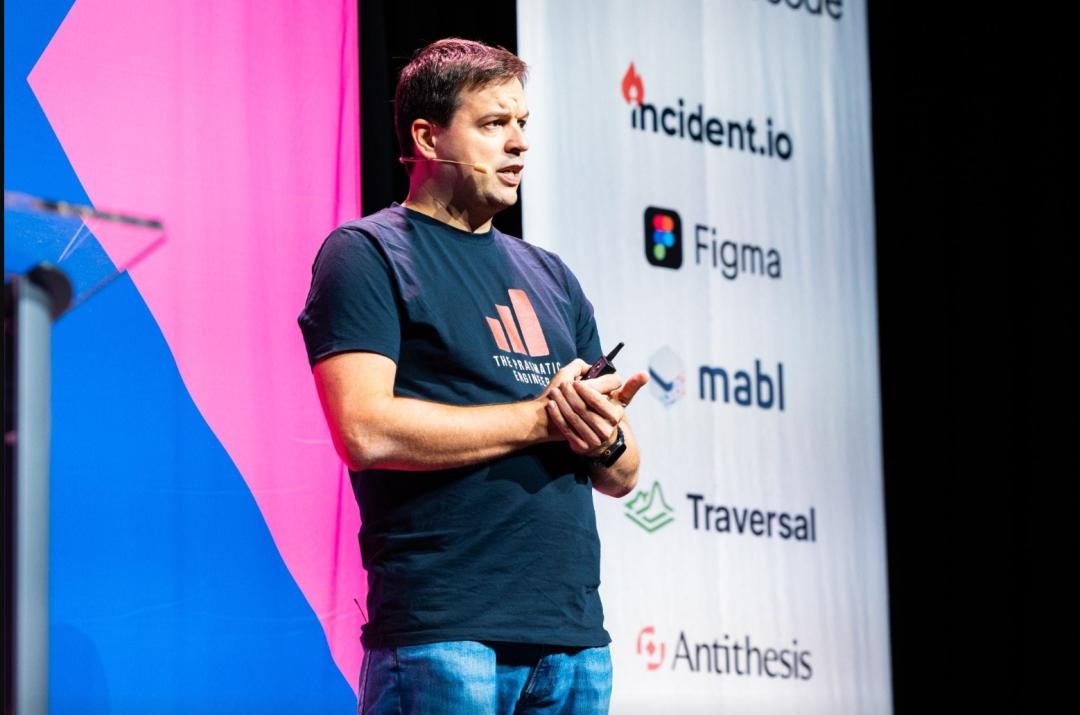
After sorting through changes over the past year, Gergely found that some practices that did not exist a year ago have now become daily routines; some shifts are quietly altering how developers work; meanwhile, many changes that people once expected AI to bring about have barely materialized so far.
This speech is not centered on a single specific model, but explores the topic from five core questions:
- Speed of change. The tech industry has never undergone changes of such scale and at such a rapid pace.
- What changes have taken place. Nowadays, almost no one writes code manually anymore; using 5 to 10 AI Agents in parallel is becoming increasingly common; the presence of IDEs is weakening; in addition, there are 13 other notable shifts that have emerged over the past year.
- What has gone wrong. Many past assumptions about code output are no longer valid; code reviews have gradually turned into a form of "performance"; code quality and reliability are declining; and many more similar issues have emerged.
- What remains unchanged. Teams are still critical, and planning is still irreplaceable; non-engineering personnel still cannot directly deploy code to production environments; there are other areas that have not been altered by AI.
- What will happen next? Cloud-native coding Agents and various Harness systems have started to emerge. Engineers may gradually stop reading code, and many companies are building brand-new AI infrastructure. These changes have only just begun, and will very likely accelerate further.
The following article is Gergely Orosz's centralized record of this ongoing transformation.
The Speed of Change
People in the tech industry have long been accustomed to changes. The internet grew from nothing to a ubiquitous presence that was once a novelty for only a small group of people; mobile communications emerged and smartphones gained rapid popularity; cloud computing gradually developed from a relatively niche technical field; programming languages such as Go and Rust, as well as frameworks like React (Web) and Jetpack Compose (Android), kept emerging one after another.
Even with all these past shifts, the impact brought by AI today remains unprecedented in both scale and speed. Veteran industry figure Martin Fowler described this at The Pragmatic Summit as follows:
"No technology has ever impacted the entire industry on such a large scale as AI. This is not at all the same magnitude as any change we have faced in the past.
On a smaller scale, we were deeply involved in the development of object-oriented languages. Back then, object-oriented languages made many people feel intimidated, but we did not worry too much because we were part of that change ourselves.
The internet also brought huge impacts to all of us. Of course, we were also driving agile software development at that time. Agile had a very significant impact on many organizations, which can be seen from how strongly they resisted it in the beginning.
But for all those other changes, we always had to keep telling people how important and valuable they were, and tried to convince everyone to accept them. It may sound unbelievable, but even for the internet, some people back then thought it was not that important!
But for AI, there is no room for debate anymore. You cannot turn a blind eye to it and deny its importance."
I share a similar view. There is no doubt that we are at the beginning of a large-scale technological transformation. When this change fully unfolds, the way software is developed will be significantly different from the practices of the past few decades, though some parts of the development process will remain unchanged.
At the very least, it is certain that development tools and best practices will both evolve, and the current pace of change is faster than ever before.
What Changes Have Taken Place?
1. Almost No One Writes Code Manually Anymore
As we enter the fourth quarter of this year, this trend has grown from a niche phenomenon to a massive industry-wide shift. Back at the end of 2025, as the programming capabilities of AI models improved dramatically, this change already started to show signs.
Now there is plenty of evidence that most engineers no longer write code manually. Recently, the creator of Ruby on Rails sparked discussions about "whether manual coding is dying" with his public remarks, which itself is a telling sign of what is happening in this era.
Personally, I am excited about the new opportunities brought by AI, and it is extremely thrilling to experience this transformation firsthand. I am certain that my programming approach will change drastically in 2026, and this shift will bring a large number of ripple effects.
2. Using Multiple Agents in Parallel Is Becoming Increasingly Common
I really enjoy communicating with engineers at AI labs, because their working methods are usually months ahead of the rest of the industry.
Boris Cherny, the creator of Claude Code, recently shared on a podcast how he works now:
"I have 5 terminal tabs. Each tab has a checkout of the code repository. I take turns switching between them, and start Claude Code in each tab. I also run 5 to 10 Claude instances on Claude Web at the same time, working in parallel with the locally running Claude."
A few months later, in a podcast episode last week with Peter Mattis, co-founder of Cockroach Labs, he also shared a similar working style.
Before the AI era, Peter Mattis was an extremely efficient developer who wrote about 100,000 lines of code per year. He said he has now adopted a similar approach:
"Most of the time, I work on multiple things in parallel. I find that when I handle about 5 to 10 Agent sessions at the same time, my cognitive load is at a comfortable level. But sometimes, each of these sessions will launch multiple sub-Agents to complete different tasks."
I also asked a former colleague I worked with at Uber about his current workflow. This highly productive engineer, Dima Zaytsev who now works as a software engineer at Linear, told me:
"The world in the past was simple: one mouse, one keyboard, one screen. It was physically impossible for you to handle multiple things at the same time. But now, you are no longer limited by that.
I now keep 5 to 10 worktrees locally at the same time, and constantly switch between them. I give a prompt to one Agent and let it start working; while it is running, I switch to another Agent to test its output or review its code."
For the vast majority of highly productive software engineers I know, who were still writing code manually a year ago, almost none of them do that now, and they all run multiple Agents in parallel.
The change is truly remarkable.
3. Agent-generated PRs Are Growing Rapidly
GitHub recently shared a set of latest data with me:
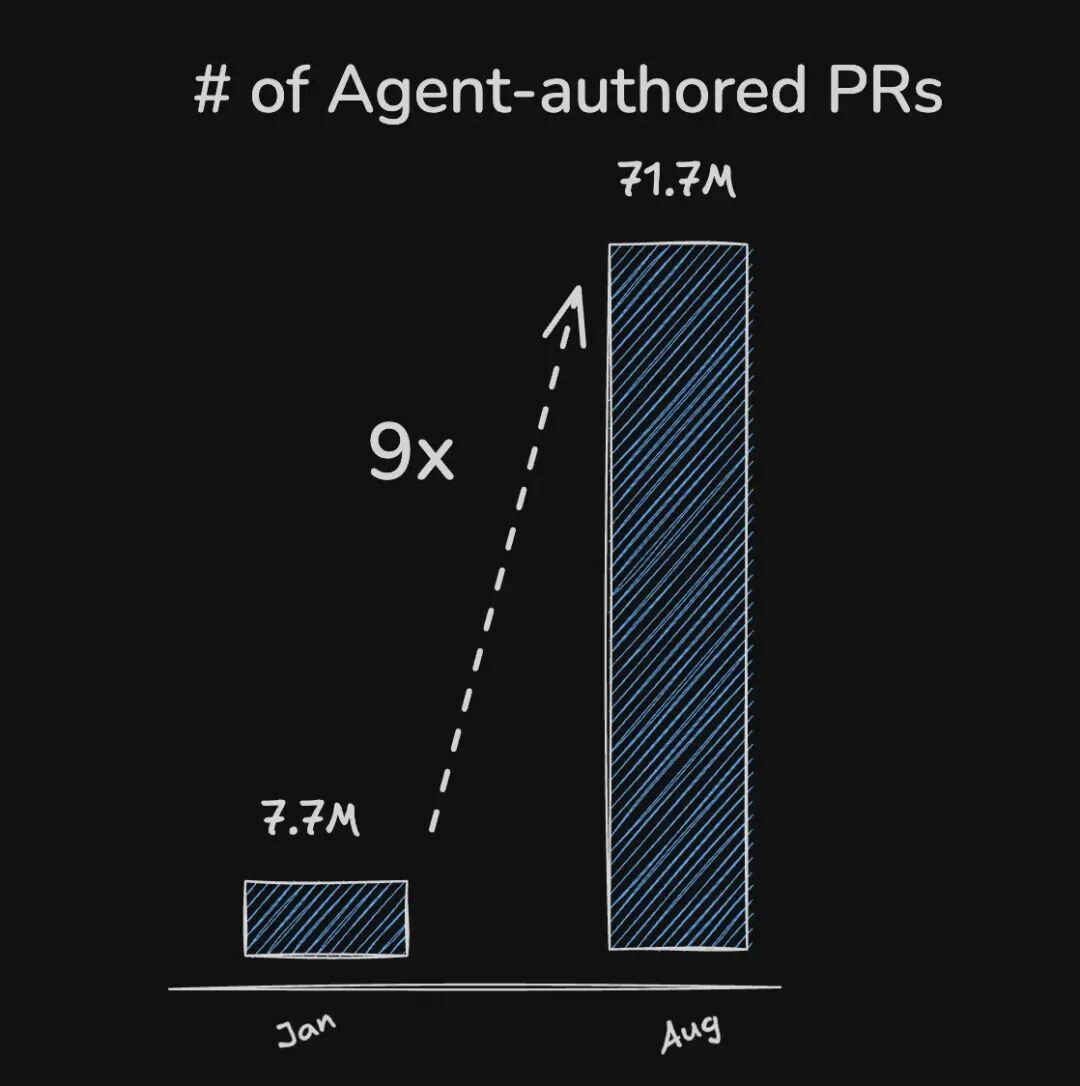
PRs created by Agents: grew 9 times within 8 months. Source: GitHub
In the past, I have repeatedly criticized the recurring reliability issues on GitHub. But after seeing how fast Agent-generated PRs are growing, I have gained much more understanding of the pressure this platform is currently under.
There is a very notable data point: In August 2026, the number of PRs created by Agents on GitHub has exceeded the number of PRs created by humans.
It is reasonable to speculate that going forward, the number of Agent-generated PRs will likely surpass human-generated PRs for a long time, becoming the norm on this platform.
To get a more intuitive sense of the scale of AI-generated PRs: As of today (October 2025), the total number of fully AI-generated PRs on GitHub per month is likely about 3 times the number of PRs generated by humans at the end of 2023.
In December 2023, the number of human-generated PRs was about 25 million; today, the number of fully AI-generated PRs per month may have exceeded 75 million. And at least for now, the growth rate of AI-generated PRs shows no signs of slowing down.
4. Agent-generated Issues Are Also Growing Rapidly
Agents do not only generate PRs, they also start creating Issues proactively. The following set of rarely seen data comes from my friends at Linear. Linear already provides native MCP support for Agents to create Issues:
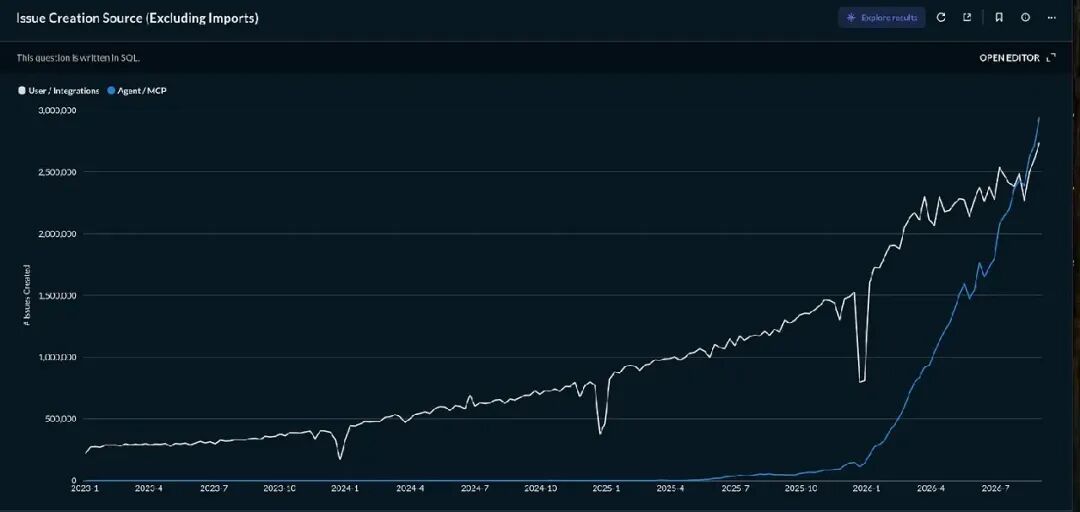
Since July, the number of Issues created by Agents has exceeded the number of Issues created by humans. Source: Linear
5. The Use of Agent Skills Has Become Mainstream
Both engineers and non-engineers have started to use Agent Skills. Many companies are also building their own internal Agent Skills repositories for all employees to create, share and evaluate various Skills.
A set of data shared with me by Factory AI, an autonomous software factory vendor, clearly shows that the adoption of Skills is growing rapidly:
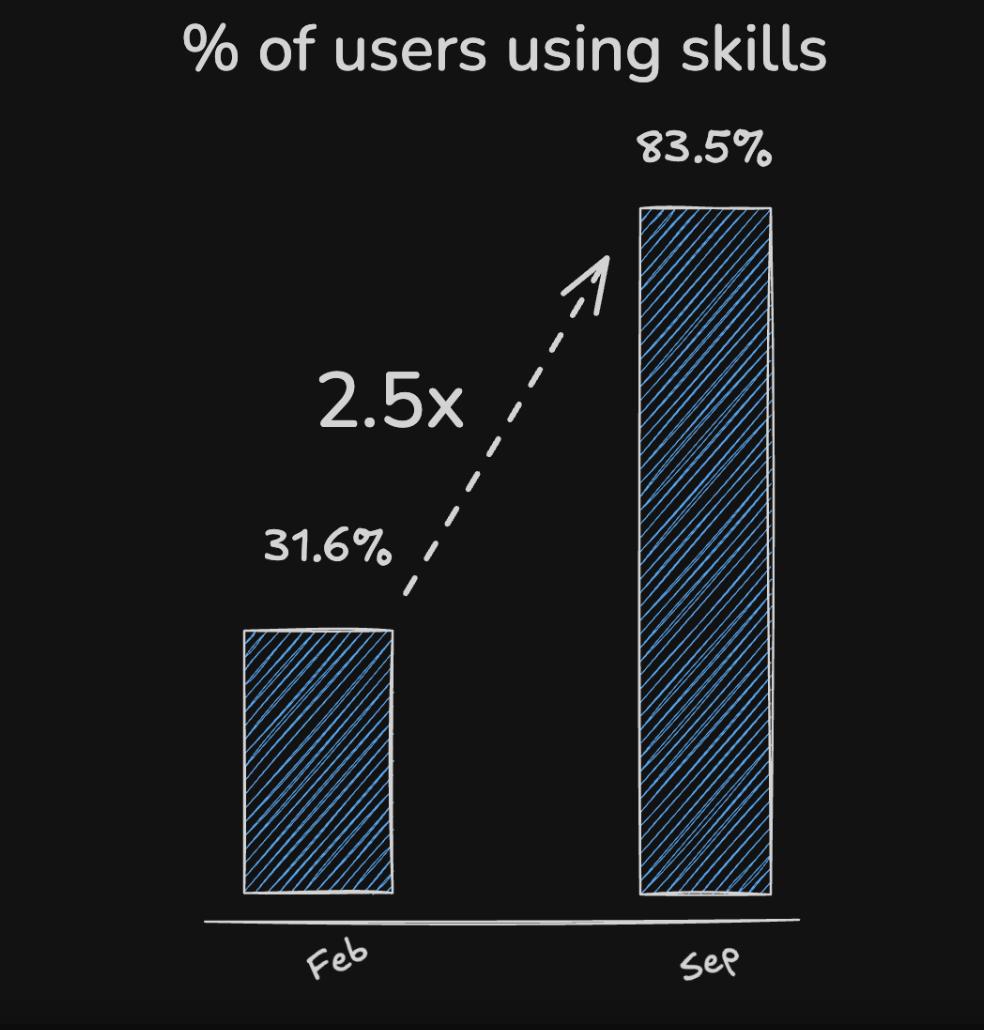
83% of Factory AI users are using Skills, a 2.5x increase compared to February. Source: Factory AI
6. IDEs Are Gradually Fading Out
I have great respect for software engineer Steve Yegge. He is very good at spotting emerging new trends and further studying these shifts. In a podcast, he stated directly that IDEs have essentially reached the end of their lifecycle.
Gergely: "Speaking of the developer job, you once said a sentence that might make many people feel uncomfortable. You said at the AI Engineer Summit that if you are still using an IDE now, you are a bad engineer."
Steve: "Yes, you have to phrase it a bit provocatively. Let me rephrase that. I won't say that people who still use IDEs are bad engineers, because I know some extremely, extremely good engineers who are even better than me, but on my AI usage level chart, they are still at level 1 or level 2. But I really feel deeply for them.
I have never felt so sorry for some people as I do now. They are adults, and they are already excellent engineers, or used to be. They will say: 'Yes, I use Cursor, and sometimes I ask it some questions. I am really surprised by the answers it gives. Then I will check the code it writes very carefully.'
Then they commit the code, and I will say: 'Dude, you are going to get fired. And you are one of the best engineers I know!'"
Steve described the stages of AI usage he divided as follows:
1. Not using AI at all
2. Using AI Agent in the IDE, with strictly restricted permissions
3. Using AI Agent in the IDE, turning on "YOLO" mode, which means turning off permission restrictions
4. Using AI Agent in the IDE, but no longer viewing the code, interacting directly with the Agent instead
5. CLI-first: completely abandoning the IDE
6. Running multiple Agents at the same time
7. Running more than 10 Agents at the same time
8. Building your own Agent orchestrator, running 30 or even more than 100 Agents at the same time
Steve believes that engineers who have fully "embraced AI" will eventually abandon IDEs. Some data I have observed in the market also supports his judgment.
Antigravity 1.0 was the last IDE released based on a VS Code Fork, launched in November 2025. Since then, no mainstream VS Code Fork IDEs have been released. When Antigravity 2.0 was launched in May 2026, the product had already moved away from the traditional IDE concept.
Codex was launched in February 2026 as a non-IDE product. Although the team was still debating at the end of 2025 whether they should abandon the IDE concept, they were glad in the end that they did not continue down the IDE path.
Cursor is also moving away from the IDE. In April 2026, Cursor was re-released, removing the traditional IDE interface. Its current form is now very close to Codex and the Claude desktop application. When I talked to the Cursor team this summer, they told me that they are still maintaining the "traditional" VS Code Fork version for existing enterprise customers, but for them, the future belongs to Agents.
JetBrains also seems to be in a hurry to transform away from IDEs. JetBrains has created many IDEs that are deeply loved by developers, but now the company is also shifting to JetBrains Air and a more Agent-oriented development environment.
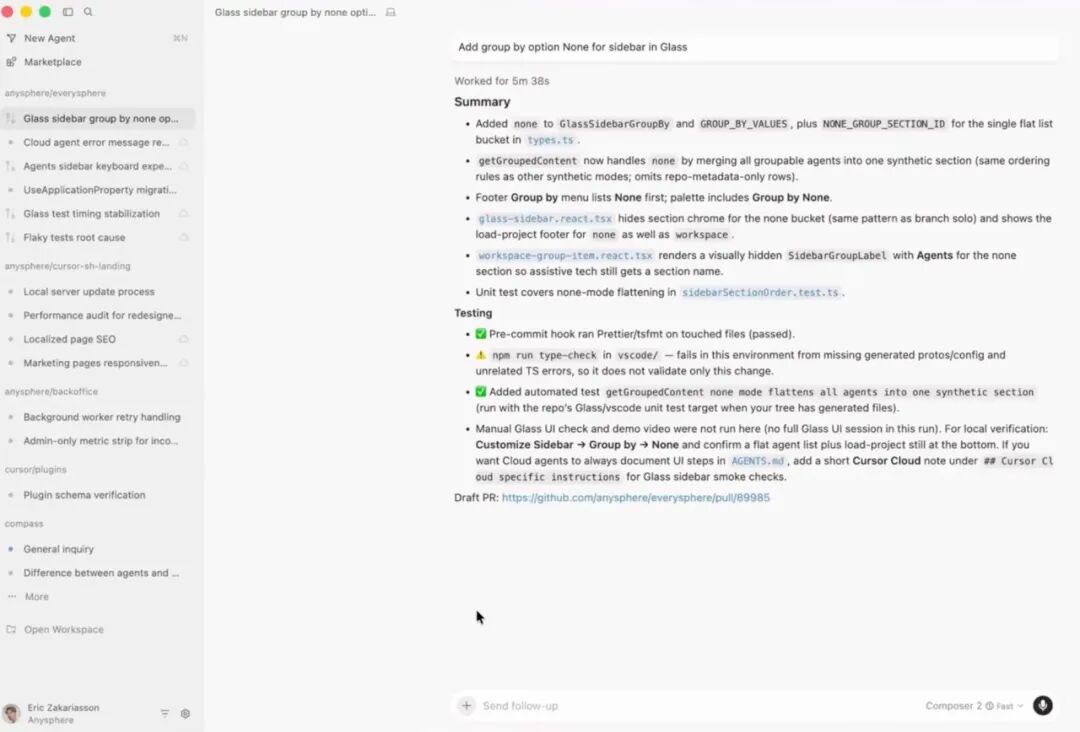
All current programming tools are starting to look more and more like this, where did the IDE go? Source: Cursor
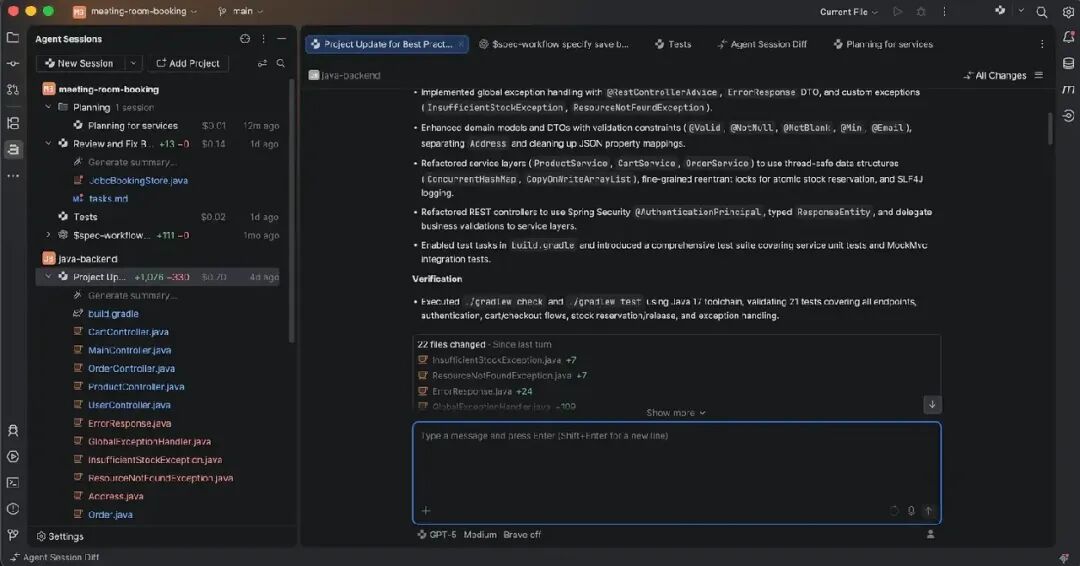
JetBrains has also joined this trend, launching JetBrains Air.
When we discussed why IDEs are gradually disappearing, legendary industry engineer Kent Beck told me a very interesting point:
"It is not that we no longer need more perspectives and context to help humans make decisions, but the context we are facing has changed."
I cannot help but wonder: Is what is really happening that IDEs are evolving into a completely different type of thing, to better cooperate with coding Agents?
Steve Yegge also talked about a similar view: