SenseTime and Galaxy General Robotics have started to compete for the business of 7-Eleven and Jinlimen.
The retail industry is on the verge of major disruption.
During the just-concluded National Day holiday, major scenic spots across the country remained crowded with visitors. Official data shows that during the holiday, the number of domestic tourist trips reached 826 million, with total tourism spending hitting 738.375 billion yuan, representing year-on-year growth of 6.3% and 4.3% respectively in comparable calibers (daily average).
Beyond the growing figures, the operation strategies of major scenic spots have also changed quietly this year: they have started to use robots to attract customers.
According to incomplete statistics, more than 30 embodied intelligence and robotics enterprises have entered cultural tourism, retail and consumer service scenarios this year, with the number of "on-duty" robots at scenic spots reaching thousands during the National Day holiday.
Galaxy General, SenseTime, Cross-Dimensional Intelligence and other enterprises have opened robot stores in popular scenic spots across the country.
Agibot took a step ahead, partnering with Chimelong on the eve of the National Day holiday to launch the world's first large-scale embodied intelligence theme park at Hengqin Chimelong Spaceship Park in Zhuhai, deploying more than 300 robots at one time covering retail, tour guidance and science popularization. Its Lingxi robot even worked as a "one-day store manager" at stores including BURTON and AD VITAM.
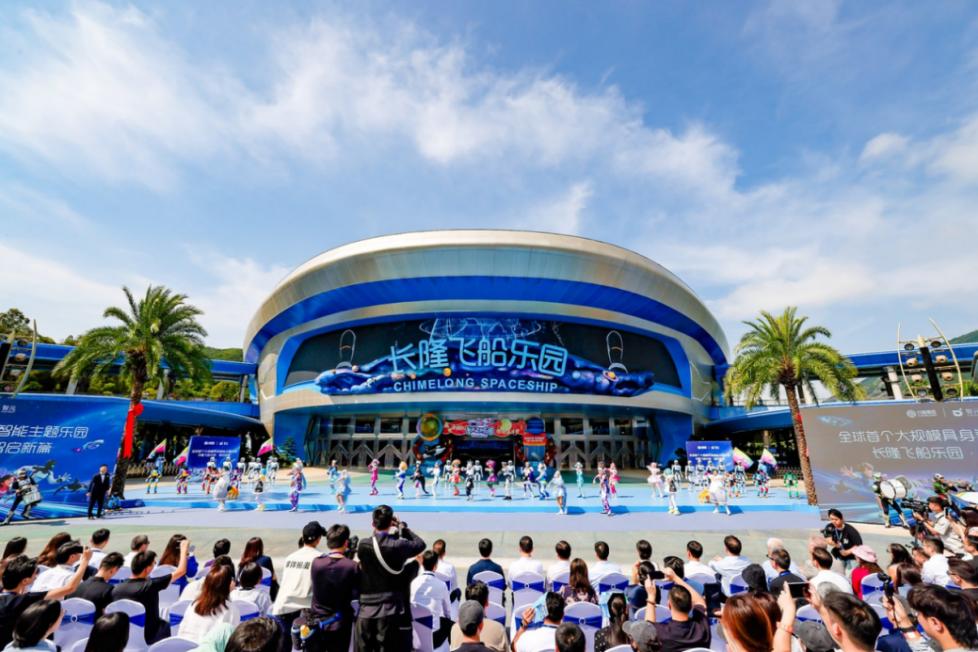
Caption: The world's first large-scale embodied intelligence theme park
On the surface, robots have become the new favorite and new traffic password for scenic spots to attract customers.
What is overlooked behind the boom is that these enterprises are betting heavily on the commercial implementation of robots in scenic spot retail scenarios starting from the cultural tourism track.
01. Traditional convenience stores are becoming "boring"
When talking about the most eye-catching robot retail format during this National Day holiday, the "Galaxy Space Capsule" of Galaxy General is definitely a representative case.
Public information shows that the smart retail stores of Galaxy Space Capsule have successively settled in scenic spots including Yuanmingyuan, Summer Palace, and Mingsha Mountain in Dunhuang. Among them, the humanoid robot Galbot G1 under Galaxy General can independently welcome guests, process orders and payments, as well as grab and deliver products.
At present, this type of retail store has covered about 50 cities with around 200 locations. At the Taoxichuan Scenic Area in Jingdezhen, we saw that the G1 robot works as a salesperson in the mobile vending vehicle of Galaxy Space Capsule, selling drinking water and cultural and creative products, attracting many parent-child tourists to interact with it.
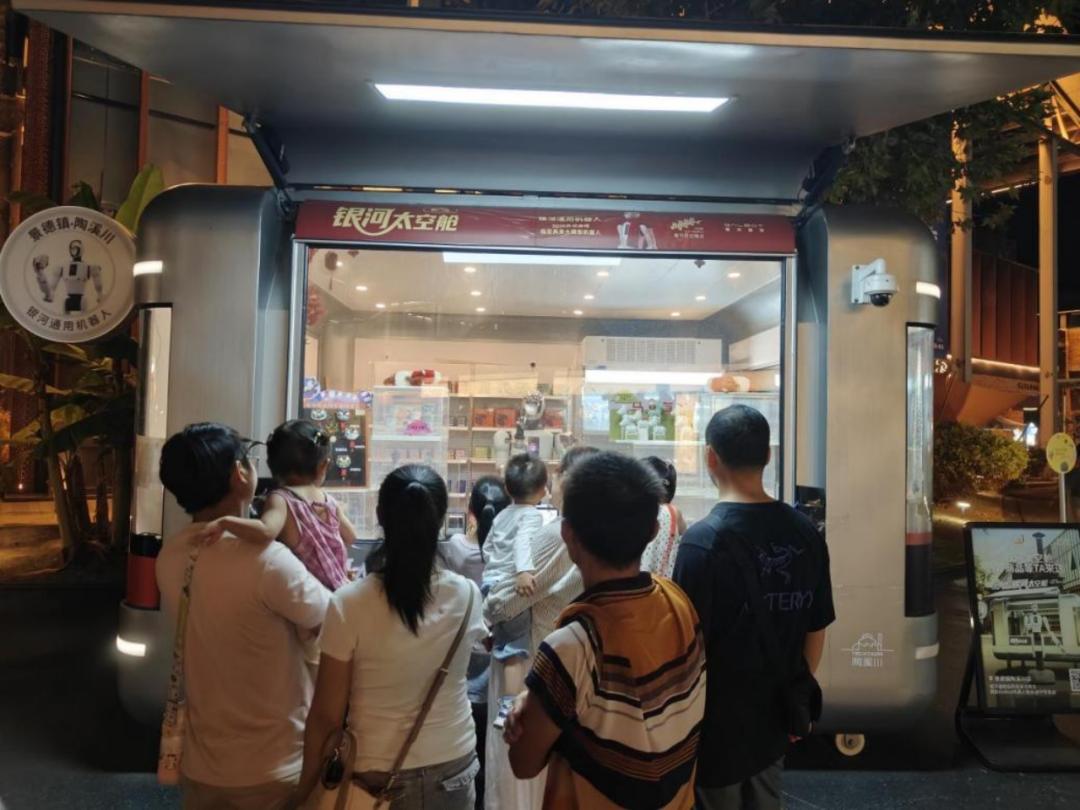
Caption: Galaxy Space Capsule at Taoxichuan Scenic Area, Jingdezhen, Jiangxi
Such scenarios are not staged for demonstration or shooting. The robot retail format in cultural tourism scenarios is making substantial profits from tourists.
The more than 30 robot commercial service stations operated by Cross-Dimensional Intelligence in cultural tourism scenic spots received a total of over 110,000 visitors during the National Day holiday, with the flagship store generating revenue of up to 150,000 yuan, and each robot serving more than 500 orders per day on average; the embodied intelligence robot store in the Hechai 1972 Cultural and Creative Park in Hefei receives about 100 orders per day, with a daily turnover of around 1,500 yuan.
According to further disclosure, for some scenic spot stores of the robot retail project "Smart Cube" under Zhifang Robotics, the monthly revenue of a single store has exceeded 200,000 yuan.
Compared with ordinary small shops in scenic spots, this figure is not particularly high.
If we shift our sight from scenic spots to the streets and alleys, the operation of traditional convenience stores has actually become "boring".
Data from the China Chain Store & Franchise Association shows that in the first half of 2026, 50% of the sampled convenience stores saw a year-on-year decline in sales, 60% experienced a drop in net profit, and over 70% had fewer customer visits. The number of newly added net stores shrank from 9,570 in 2024 to 1,391.
The data of individual stores is even more striking. In 2025, the average daily revenue of a single convenience store dropped to 4,453 yuan, 3.9% lower than the previous year, and the number of customer visits decreased by 8.7% year on year.
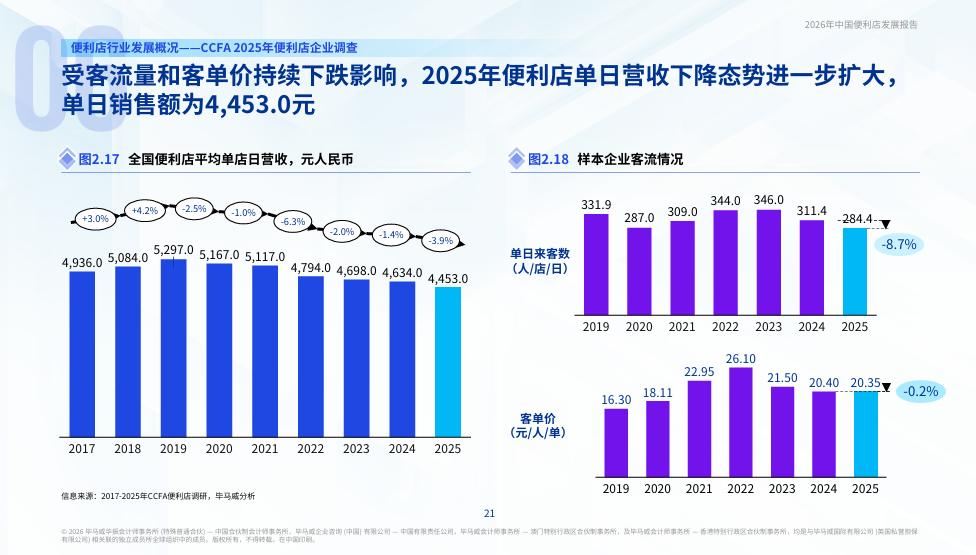
Caption: 2026 China Convenience Store Development Report
Compared with novel robot retail stores, the only products that traditional convenience stores can rely on to attract customers are restricted items such as cigarettes.
An owner of a chain convenience store once told the media that his number of stores shrank from 10 to only 6, with turnover dropping by about 20% year on year. "If it weren't for regular customers coming to buy cigarettes, there would be hardly anyone visiting the stores."
In addition, bulk snack stores have pushed the price of beverages down to the purchase price of convenience stores, while front warehouses for food delivery provide free delivery services to customers' homes.
Traditional convenience stores are losing their core advantage of "convenience". On the other end of the customer flow loss, they are also facing rising rents and labor costs.
02. Robot retail stores are far more competitive
Convenience stores are not trying to save themselves.
Previously, 7-Eleven China planned to equip all its stores with "fresh food kitchens" before 2027, selling noodles, dumplings and freshly made customized products.
At the same time, a trend of "fresh snacks" is also quietly spreading in offline retail channels. Chain convenience store brands including Lawson and Meiyijia are also deploying fresh food business formats.
Fresh snack brand Jinlimen has launched Central China's first "fresh food cloud warehouse" in Wuhan, focusing on short-shelf-life and freshly made snacks, promising delivery within 2 hours within a 200-kilometer radius. Most of its stores are located near communities and business districts, taking freshness as the core selling point, trying to win back customers from bulk snack stores and food delivery platforms.
To a certain extent, this type of model can increase the customer unit price and win back food delivery orders through instant fulfillment.
But the fresh food business is essentially a game of scale, while most individual stores are stuck at the critical survival line of scale. Beyond scale, fresh food and short-shelf-life snacks impose higher efficiency requirements on the supply chain and shelf management, which means not only higher product loss, but also continuous investment in labor costs.
For chain convenience stores and fresh food retail stores, profits are often squeezed out from product loss and labor costs.
Theoretically, this brings us back to the "comfort zone" of robot retail.
Take the robot retail store of SenseTime Shanhui as an example, it only requires an average of 0.2 to 0.3 full-time employees per store. Compared with traditional convenience stores that need two people to work in shifts, one employee can manage three to five robot stores, directly cutting labor input by 70% to 80%.
FamilyMart has already noticed this cost advantage — it has cooperated with Galaxy General to integrate robots directly into the daily operation system of its chain convenience stores.
In April this year, Galbot G1 officially settled in the Dinghao store of FamilyMart in Zhongguancun, Beijing. It can independently complete the fetching and delivery of grilled sausages, cold drinks and cooked food, and can even make coffee independently and deliver it to customers.
Zhang Zhizheng, co-founder of Galaxy General, mentioned that with robot on-duty service, the all-weather smart pharmacy it built has realized independent operation at night, and staff only need to complete a small amount of work during the daytime.
The problem of labor shortage at night, which is the biggest headache for convenience stores, can be perfectly solved by robots.
03. The logic of retail business is changing
However, the development story of robot retail is far from as smooth as it seems.
The lesson from Hongqi Chain is there for all to see.
This A-share listed convenience store enterprise suspended its robot vending system project after one year of deployment, for the simple reason that it has not yet reached the standard for large-scale commercial implementation.
For a long time, products in stores vary greatly in shape and material, making it difficult to unify the force and angle for robotic arms to grab different products — this also leads to a high grabbing error rate for many products that work well in laboratories when they are placed on real shelves.
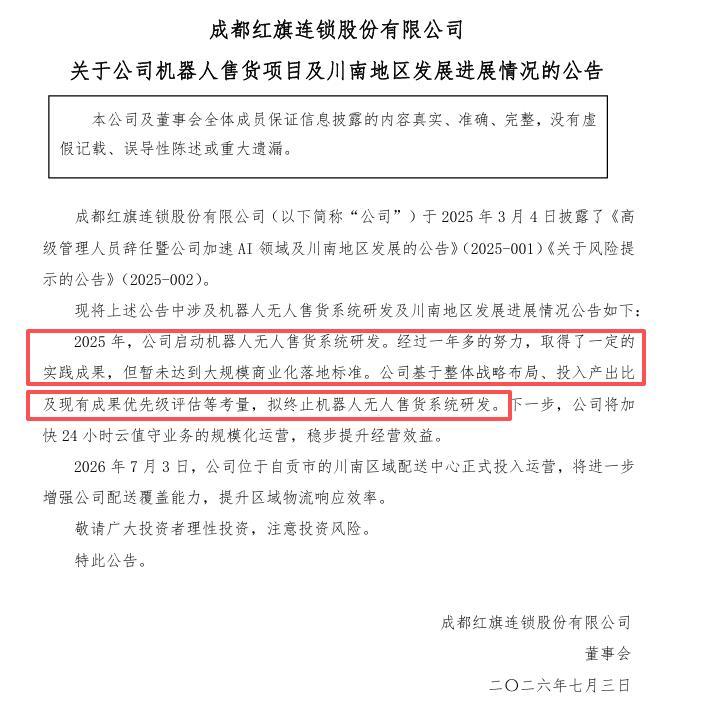
Image source: Announcement of Hongqi Chain
What's more, community convenience stores have low customer unit prices, complex product specifications, and diverse customer groups including the elderly and children. Robot restocking, fault maintenance, and handling of sudden customer complaints will all generate high hidden costs.
In addition, it is worth noting that one of the biggest shortcomings of robots is after-sales service — there is no mature after-sales system that can provide rapid on-site maintenance for broken robots, as we have for air conditioners and televisions.
There is also an easily overlooked detail: many door switches, buttons and knobs designed for humans do not fit the current robot grippers. Operations such as heating food and making coffee are difficult not because of the grabbing action itself, but because of the long sequence of tasks and the "unfriendly" interaction with equipment.
Simply put, it is easy for a robot to grab a bottle of water, but it is very difficult for it to make a cup of hot coffee from start to finish and then steadily hand it over to you. Any problem in any link of the whole chain will lead to failure.
These are all undeniable realistic factors, but they cannot stop the general trend of unmanned retail development.
Comprehensive data shows that the global retail robot market is entering a period of rapid growth, with its scale expected to increase from 6.84 billion U.S. dollars in 2025 to 23.07 billion U.S. dollars in 2034, representing a compound annual growth rate of 14.47%.
As an important part of the global market, China's smart retail robot market is also growing simultaneously, expected to rise from 700 million U.S. dollars in 2025 to 1.8 billion U.S. dollars in 2033, with a compound annual growth rate of 13.2%.
Facing this trend, different enterprises have proposed different solutions.
Galaxy General adopts an end-to-end architecture of "brain - cerebellum - neural control", with its core capability lying in autonomous decision-making — after a customer puts forward a demand, the system can immediately complete the linkage of intent understanding, path planning and action execution.
SenseTime has built a dual-engine system of "classic AI + embodiment", integrating 3D Gaussian reconstruction and world model to endow robots with the closed-loop capability of "perception - understanding - decision-making - execution".
Despite different technical routes, all enterprises are moving in the same direction: enabling robots to complete their work efficiently in unstructured real environments.
04. Conclusion
Now, looking back, why did this wave of robot retail first start from scenic spots?
The reason is not complicated. Scenic spots have large passenger flow, relatively low requirements for operation efficiency, large fault tolerance space, and inherent communication attributes — a robot selling goods in a scenic spot has novelty and communication value, which is natural "free advertising" for robot enterprises.
Wang Chuang, Partner of Agibot, put it bluntly: The theme park receives more than 10 million visitors every year, gathering tourists from all over the world and of all age groups, which can comprehensively test and continuously improve the capability of robots.
Scenic spots are not only "novice villages" but also training grounds. The real large-scale battlefield will definitely be in daily convenience stores and community retail scenarios.
SenseTime Shanhui has launched the "Thousand Cities and Ten Thousand Stores" plan, aiming to cover diverse scenarios including urban riverside trails, commercial parks, and community business districts. Galaxy General has opened a fully autonomous retail store "Galaxy Space Capsule" in Hong Kong. Wang He, the founder, said he is not worried about the problem of breaking even, because "there is relatively broad room for pricing and profit margins".
What these enterprises are betting on is actually a simple logic: when the daily rental cost of robots drops from the 10,000-yuan level to less than 1,000 yuan, while the labor cost of convenience stores keeps rising, the economic calculation of robot retail is becoming more and more feasible day by day.
But whether the business model can be profitable depends on two things:
The first is stability. Whether robots can really work stably in complex environments instead of breaking down every few days.
The second is after-sales service. Whether the entire service system can keep up — after all, no convenience store owner is willing to wait for a week just to get a broken robot repaired.
The robot boom in scenic spots during the National Day holiday is just the beginning.
The real test is whether, after the holiday ends and the novelty fades, those robots standing behind the counter can still make store owners think — "this machine is worth it."
Note: The materials of this article are derived from official reports and public information, and the views are for reference only. Some images are from the Internet, please notify us to delete them if there is any infringement.
This article is from the WeChat official account "Yuan Media Hub", written by Xie Chunsheng, and published with authorization from 36Kr.