Where Are Programmers Heading?
Until early 2026, DHH (David Heinemeier Hansson) still refused to give up the "ancient craft" of writing code manually.
This programmer, renowned for his passion for coding, created Ruby on Rails, a software development framework that has helped countless people turn their ideas into websites and businesses. For more than two decades, he has always believed that coding itself is worthy of love. Faced with the temptation of letting AI do the work, he once wrote in his blog that he would rather retire than permanently hand over the keyboard to AI.
But on September 23 this year, he stood on the stage of the Rails World conference in Austin, USA, stating that his company no longer regards handwritten code as a conventional way of software development, and announced to peers that "Pencils down". This benchmark figure who has long criticized AI-generated code and defended human programmers has also had to compromise with technology.
DHH believes that programmers will not lose all their value completely. But he also admits that some companies may no longer need so many programmers. Long-term progress that is beneficial to all humanity may bring short-term difficulties to specific individuals.
This situation has made the programmer group more anxious. Large models are rapidly catching up to their capability boundaries. The more fully the AI large model's capability "health bar" is loaded in benchmark tests, the smaller the value space for programmers will be squeezed.
Google disclosed at the Cloud Next conference in April that nearly 75% of new code within the enterprise has been generated by AI, while this proportion was only 15% two years ago. Statistics from Layoffs.fyi show that in the first half of 2026, the global technology industry has cumulatively cut more than 120,000 jobs within the year, matching the total figure of 2025, and most of these layoffs are related to AI.
For large domestic internet companies, the situation of reducing costs and increasing efficiency is equally severe. How can programmers prove that they are more useful than AI?
More programmers have experienced this point directly in the interview process. Many of them may have spent their entire careers just mastering everything that AI can do, but these capabilities are no longer valued now. The enterprises that employ them have adopted a more distinct attitude — "You'd better master something that AI cannot do".
Acceptance
Wu Tianyu came into contact with AI programming as early as 2023. At that time, Vibe Coding products represented by Cursor were not yet mature, and he only used ChatGPT to write code before copying and pasting it. By the beginning of 2024, he clearly felt that the code written by AI was of better quality than his own, more concise and faster, "It can finish the work that takes me a whole day in a few minutes".
Different from the feelings of "excitement", "thrill" and "amazement" that are frequently seen on social platforms, Wu Tianyu's initial reaction was anxiety, which then turned into resistance. For several consecutive months, he fell into the subconscious that "using AI means insufficient ability, which seems like slacking off".
At that time, Wu Tianyu was in his second year of doctoral study, majoring in "Intelligent Manufacturing and Robotics". The senior fellows in his laboratory generally had extremely high programming skills, and almost all of them wrote code from scratch. When he occasionally opened the AI programming window, he had to sneak around to avoid the sight of his classmates.
The following two years witnessed the explosive growth of AI large models' programming capabilities. From early 2024 to mid-2026, the core models of six companies including OpenAI, Anthropic, Google, Zhipu AI, Minimax and Kimi have seen significant improvements in their scores in mainstream programming capability tests such as HumanEval, MBPP and SWE-bench Verified (including the first generation), and the scores of the first two tests in particular have generally increased by nearly 10 percentage points.
Most programmers actively embraced AI during this period.
Wang Guangyan, who works as a back-end developer in a large internet company, also had extreme distrust in AI at the beginning, because early models still had serious hallucination problems. "I thought at that time that it might become a hit like Alpha-Go, and then its development would slow down." Until he used AI intensively in the past year, he found that the efficiency improvement effect of AI Coding is becoming more and more obvious.
In the past, Wang Guangyan might spend 60% to 70% of his day writing code, and the rest of the time confirming requirements, making designs and troubleshooting problems. After AI was involved in the workflow, this time allocation ratio was reversed.
Wu Tianyu also "gave up resistance" when he started his graduation project in mid-2024. His tutor wanted him to independently develop a robot-related App, and he had to rely on AI due to the huge workload.
After AI easily generated some UI interfaces that he could not realize, all of Wu Tianyu's anxiety and resistance dissipated. He clearly realized that what AI replaces is the mechanically thinking part in "ancient-style programming", which instead allows people to have more time to think about innovative points and aesthetic details. He not only began to use AI openly, but also actively recommended it to his senior fellows.
In the process of accepting AI, almost no one has not reflected on this question: Will AI replace me?
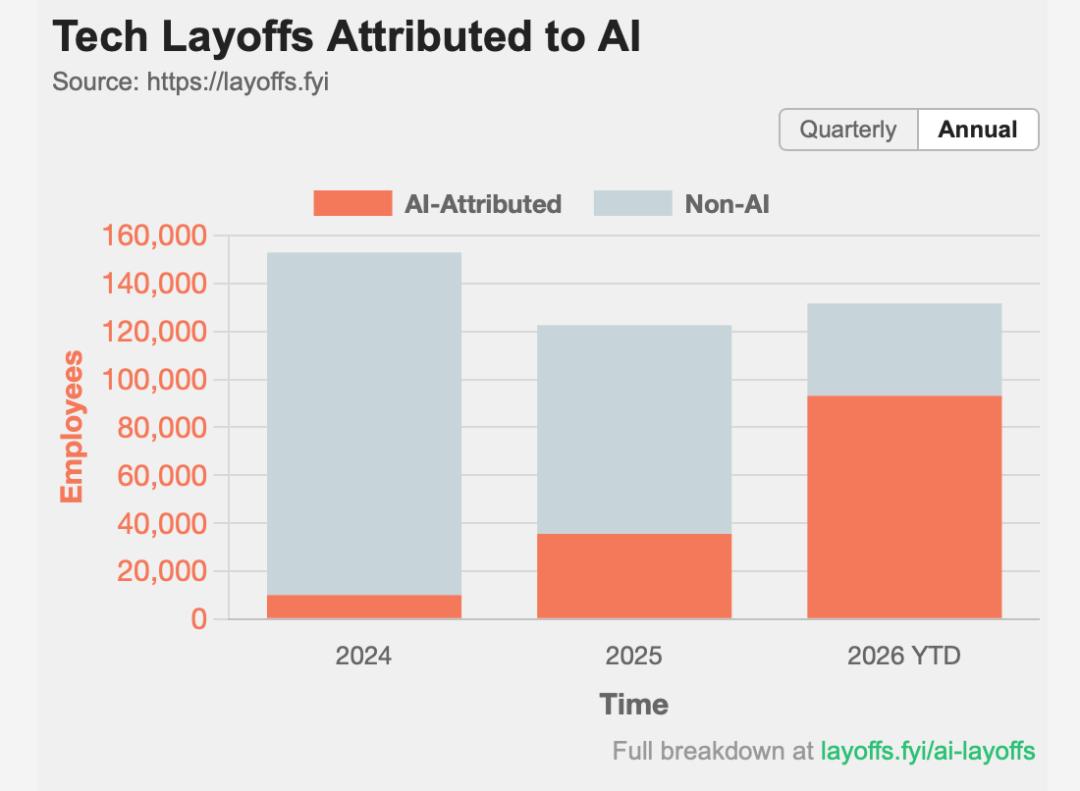
Data on AI-triggered layoffs in the global technology industry Image source: layoffs
More respondents said that this situation is indeed unfriendly to office workers. Many of them believe that 2026 is the "first year" of layoffs in the technology industry. In the next 1 to 3 years, the industry will lose 30% to 50% of its jobs, and the final reduced number may be even higher, possibly 80% to 90%, or it may stop at a certain number.
But they believe that it is still necessary to stay calm in the short term and optimistic in the long run — they can still see the value of human beings, and see that behind the AI replacement trend is the transformation of people's capability dimensions.
For example, a relatively counterintuitive judgment is that AI programming may have a positive impact on the career of programmers over 35 years old.
Before the emergence of AI, the saying that "programmers can only work until the age of 35" has become a popular consensus. For these "senior programmers", their career cycle is only so long, and whether there is AI or not will not cause too much extra turbulence to their careers.
"AI has instead brought a little freshness, it highlights the value that people can generate." Wang Guangyan said.
"Indirect Replacement"
Technological replacement does not happen suddenly most of the time.
In large companies, it is usually reflected in an indirect way. For example, setting strict KPIs for teams to promote internal competition, and implementing survival of the fittest in the form of horse racing, so that the number of staff in the team can be maintained at 70% to 80% of the previous level, or even half.
Another more obvious change is that the interview experience or skills for "ancient-style programming" have become invalid.
A fresh graduate who just went through the spring recruitment said that last year's experience is no longer applicable this year, and every specific change needs to be summarized through personal trial and error. "If you do not match the requirements of this position very well, the interviewer will test you with some very difficult questions to prove that you have the potential to solve unknown problems."
According to the experience summary of job seekers, enterprises now only recruit talents in two ways: one is to pay for experience, "you have deep experience in this field, and you have gone through enough pitfalls and risks"; the other is to pay for potential, such as fresh graduates from top domestic universities like Peking University and Tsinghua University, or doctors from Ivy League schools. The willingness of enterprises to pay for talents in the middle zone is declining, "because AI can do most of the work".
Headhunters are also very sensitive to the changes in the industry "temperature".
Qiu Yuewen has been a headhunter in the internet industry for nearly ten years. In the past two years when AI programming has become prevalent, he consciously gave up the traditional internet track and turned to the booming embodied intelligence sector.
He observed that large companies' requirements for the verticality of talent business have risen sharply, leading to a sharp reduction in the scope of candidates available for headhunters. A Java programmer at the Alibaba P7 level was "very easy to sell" seven or eight years ago, but there is no headhunting budget for such talents today, and almost all related recruitment has turned to RPO (bulk manpower outsourcing) or ITO (project technology outsourcing). What is still in high demand now are high-end vertical positions of at least architect level or above P8.
Behind this is the decline in the weight of technical value and the rise in the weight of business understanding.
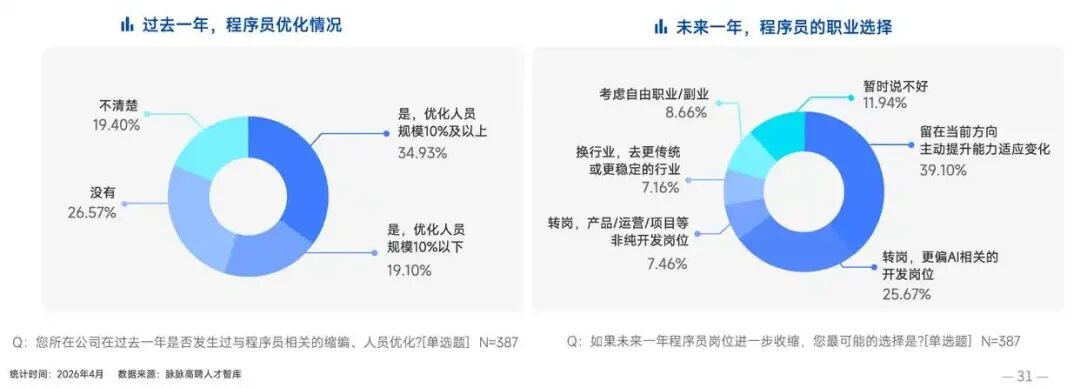
Image source: "2026 Spring Recruitment Workplace Insight Report" by Maimai
Another talent trend in large companies is that outsourcing positions are replacing regular positions, and AI is replacing outsourcing positions.
While the number of regular front-line staff positions has dropped sharply, many large internet companies and even second-tier internet companies are using a large number of outsourced personnel to fill basic and highly replaceable work, such as testing, front-end development, data labeling and so on.
Not long ago, the news that a large internet company had laid off a large number of outsourced personnel spread widely. "I can't tell the exact data, but the large-scale layoff of outsourced personnel did happen for real." Qiu Yuewen said, "The essential reason is AI replacement."
Looking at all programmer positions, algorithm positions are the least replaceable because they highly rely on "understanding the business and proposing algorithm strategies". But even in algorithm positions, a polarization trend has emerged where high-end talents are in high demand while the low-end market is shrinking.
From the perspective of a headhunter, Qiu Yuewen pointed out the truth of this "indirect replacement", that is, AI has only improved labor productivity, but has not created a huge number of new jobs.
The traditional internet industry has not spawned new business forms that can create large-scale employment opportunities in the AI era. In fact, from food delivery, travel services to content platforms, they are becoming more and more "involution" in the stock market.
"At present, AI only makes the efficiency of dividing the cake higher, but the cake itself has not become larger." Since there is no new business increment, once the efficiency is improved, fewer staff will be needed naturally, and this state may not change until new technological breakthroughs emerge.
Find a New Way Out, Form a New Awareness
In the past two years, under the advocacy of people like Elon Musk, a futurology hypothesis has become increasingly popular among the public, that is, carbon-based humans may only serve as a phased carrier of intelligent civilization, and the essential purpose is to create artificial intelligence and migrate intelligence to the silicon carrier of chips to complete civilization iteration.
There are indeed some people who face the future with such a mindset. But they are not anxious or panicked, they just take rational risk prevention measures, such as reducing meaningless consumption and investment, and maintaining cash flow.
But from a positive perspective, under this irreversible trend, do programmers have a Plan B for their career?
A quite incremental business direction of Qiu Yuewen's headhunting company is to transfer former programmers who left large internet companies to traditional industries such as medicine, retail, FMCG and manufacturing. These industries are facing digital and intelligent transformation, and there is a large demand for AI Agent development inside.
"Now many programmers who have AI skills but do not want to continue to involute in the internet industry will choose to go to traditional industries to lead AI business." Their total salary package will shrink, but since the work intensity is far less than that in the internet industry, their hourly wage has not changed much.
Traditional enterprises also have an advantage that they do not have strict age restrictions like the internet industry. "People aged 40 can get in, and if the position is at a relatively high level, people under 45 are also acceptable." The core R&D personnel of some pharmaceutical companies are mostly doctors, and their average age is inherently higher than that of the internet industry. In addition, these enterprises relatively recognize the underlying technology of large internet companies, and very favor talents with internet background to join them.
This can be regarded as a "forced landing path" to traditional industries, which can at least extend the career life of programmers by 5 to 10 years.
In addition, AI programming has also opened up a new path of "One Person Company (OPC)" for many people.
Zhou Ziyou, who majored in Computer Science as an undergraduate, is currently overseas. He works as a senior developer in a large company while running a small startup on his own.
Apart from his full-time job, his daily personal work is to receive tasks or requirements from clients, and then write "Tickets" for AI Agent. Since the Agent he has trained for a long time has mastered a large amount of background knowledge, Zhou Ziyou usually only needs to provide it with basic information (sometimes even just the chat records with clients). After starting the programming process in the background, he only needs to conduct code review, and be responsible for the final quality control and branch merging.
"Our (startup) team has always had two people before. At the beginning of 2025, I thought we had to recruit new people, but we didn't recruit a single new member in the whole year, and the team's delivery volume was several times that of previous years." Zhou Ziyou said, "I am confident that I can compete in efficiency with a traditional 10-20 person programming team that does not use AI tools, and even my output quality is better."
Wu Tianyu's wish during his undergraduate period was to become a programmer in a large internet company, but now he has given up this idea and chosen to start a business, running a robot company in the embodied intelligence field.
In Longhua District near Shenzhen North Railway Station, Wu Tianyu's team rented a 180-square-meter residential apartment in a community. Three of the four bedrooms are used as offices, and the remaining one is used as a warehouse. Wu Tianyu's workstation is in the living room, which is also the robot "test field", with four prototype robots and a robotic arm placed there.
There are three monitors in front of him, with windows related to code and modeling open at the same time, and almost all of them are running AI programming tasks.
It is half past seven in the evening on a weekday. A technical executive from a leading embodied intelligence unicorn will come to visit later to discuss cooperation in human-computer interaction; tomorrow morning, he will go to meet an investor.
"Full of challenges." Wu Tianyu described his current life in this way, "I do not resist, nor am I afraid, and I even enjoy it very much."
(As requested by the interviewees, Wang Guangyan, Qiu Yuewen and Zhou Ziyou are pseudonyms in this article)
This article is from WeChat official account "Jiemian News", author: Wu Yangyu, published with authorization from 36Kr.