Tanker freight is more expensive than launching a rocket.
The global tanker market is undergoing an unprecedented freight storm.
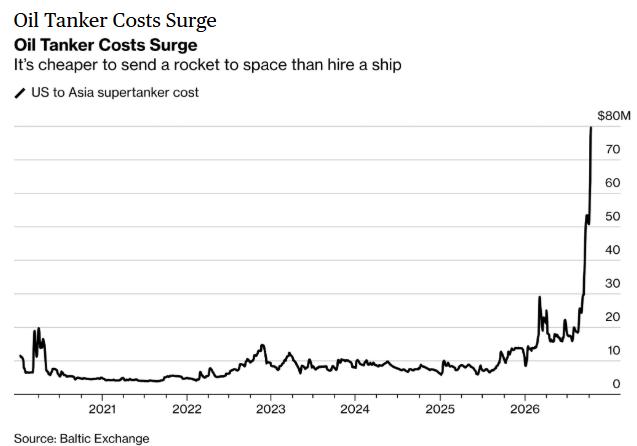
The Iran conflict has reshaped the Middle East crude oil trade pattern, coupled with a severe shortage of fleet supply, the freight rates for Very Large Crude Carriers (VLCCs) have soared to the highest level in sixty years — The cost of shipping a full cargo of crude oil from the United States to China is as high as 80 million US dollars, exceeding the launch cost of a SpaceX Falcon 9 rocket.
According to Bloomberg's report on October 9, for a tanker order departing from the United States this week, The converted freight rate is equivalent to a transportation cost of 41 US dollars per barrel, while the average value of the same route in the same period last year was only 4.50 US dollars. This cost accounts for about 45% of the futures price of West Texas Intermediate (WTI) crude oil.
Shipbroker Gibson pointed out that The cost of this voyage is about 80 million US dollars, which is higher than the standard launch quotation of about 74 million US dollars for the SpaceX Falcon 9; and the same amount of money was enough to buy a similar tanker directly earlier this year.
Shipbroker SSY stated that Even adjusted for inflation, the current freight rate is the highest level since the advent of supertankers in the 1960s, surpassing the "Tanker War" period during the Iran-Iraq War in the 1980s.
At the same time, The skyrocketing freight rates are being transmitted to the entire energy industry chain. European refiner Repsol recorded a refining margin of 36 US dollars per barrel in the third quarter, but according to estimates by RBC analysts, it has narrowed to about 15 US dollars in October, partly due to the high tanker costs.
Russell Hardy, CEO of Vitol Group, the world's largest independent oil trader, said at a conference this week, "There is indeed insufficient available shipping capacity in the market, and we have seen an almost parabolic price trend."
Supply Gap: The Chain Reaction in the Strait of Hormuz
The root cause of this round of freight surge is a structural capacity shortage triggered by the Iran war.
After the outbreak of the Iran war, the passage risk in the Strait of Hormuz rose sharply, a large number of shipowners chose to take detours, and the global effective shipping capacity was drastically reduced.
As Middle East crude oil exports gradually recover, according to estimates by industry executives, the current volume of oil transiting through the Strait of Hormuz has rebounded to about 80% of the pre-war level, but the trade process is far more complex than before the war.
Middle East oil-producing countries are increasingly relying on "ship-to-ship" transshipment at sea, and each transshipment often adds about one extra week of sailing time, further lengthening the turnover cycle of the global fleet.
Repeated disruptions to trade flows have exacerbated this dilemma.
The Strait of Hormuz passage was once stagnant, and a large number of tankers wandered empty between the Middle East and other regions looking for cargo sources; now as the Gulf shipping recovers, vessels need to be reallocated and redeployed, a process that often takes several weeks.
At the same time, Iran's crude oil exports to China have been effectively interrupted, forcing Chinese buyers to turn to other sources, pushing up tanker demand in mainstream markets. In addition, Iran's attacks on merchant ships have caused some vessels to suspend operations for maintenance, and some other ships have taken detours around Africa to avoid the threat of Houthi forces, adding thousands of extra miles to their voyages.
Lauren Gallinari, Head of Commercial Intelligence at shipbroker MJLF & Associates, said, "We have indeed seen extreme freight markets before, but the speed, magnitude and breadth of this market rally are remarkable."
Freight Figures: Transportation Cost Per Barrel Approaching Half of Crude Oil Price
The absolute value of freight rates has reached a level that the market finds difficult to price.
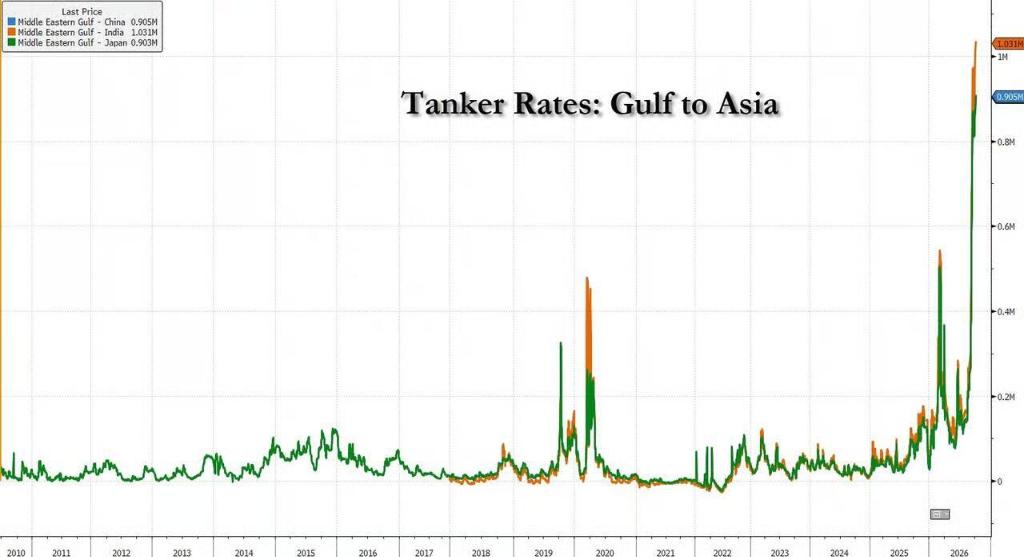
According to Bloomberg data, the cost of chartering a VLCC to ship U.S. crude oil to Asia has risen to 77 million US dollars, while the average value for the whole of 2025 was only 9.2 million US dollars. Hardy of Vitol said that freight rate fluctuations have been so drastic that traders cannot even estimate transportation costs within an error range of several US dollars.
Analysts at Clarksons Securities wrote, "With almost no extra capacity available, freight rates increasingly depend on the upper limit that charterers can afford."
This round of market rally has spread far beyond VLCCs. The average daily earnings of Suezmax tankers have jumped to over 680,000 US dollars, about five times the level at the beginning of this month; freight rates for vessels transporting gases such as propane are close to historical records, more than tripling from the end of last year.
The comprehensive shipping index also confirms the breadth of this market trend. According to Clarksons data cited by Shipping Online, the ClarkSea index has hit new all-time highs for four consecutive weeks as of October 2, reaching 75,658 US dollars per day, with a monthly increase of 73%, the average value for the year rose 66% year-on-year, 84% higher than the 10-year average.
It is worth noting that This round of market rally is not driven solely by tankers, and multiple sub-segments including LNG carriers, dry bulk carriers, container ships and car carriers are all at "abnormal or strong" levels simultaneously.
Downstream Transmission: Refining Margins Under Pressure, Inflation Risks Rising
The skyrocketing freight rates are accelerating transmission from the midstream to the downstream, and the profit margins of refiners are being eroded rapidly.
Shell said in a trading update this week that some of its third-quarter results will be affected by "rising variable costs for long-term shipping charters under the current macro environment", which echoes similar disclosures the company made earlier this year.
Tor Svelland, founder of hedge fund Svelland Capital, warned, "The market is climbing higher and higher, but at a certain critical point, refineries can easily choose to cut production. When transportation costs rise from 5% of the value of goods to 50%, trade flows will come to a halt."
At the political level, the Trump administration is facing an urgent need to curb inflation ahead of the mid-term elections, and rising diesel prices are hitting industrial and agricultural sectors. The U.S. oil industry has pressured the government to push relevant parties to expand diesel exports to ease the global shortage.
Morrow also said that he believes China will gradually increase its exports of refined oil products, describing it as a "key hub" for the global refining shortage problem.
At present, the core issue in the market has shifted from "how much higher can freight rates go" to: Before the continuous rise of freight rates erodes refining margins, how much pressure can the global crude oil trade system withstand.
Asset Revaluation: Secondhand Ship Prices Rarely Exceed Newbuilding Ship Prices
The skyrocketing freight rates are reshaping the valuation logic of the entire shipping asset market.
According to data from Clarkson Research Services, the market price of secondhand tankers has climbed to a historical record of 240 million US dollars per vessel, more than 60% higher than the end of last year.
According to data from shipbroker Clarksons, the average price of a 15-year-old VLCC is about 160 million US dollars, up 44% from three months ago, which is already higher than the newbuilding price of 131 million US dollars — This phenomenon where secondhand ship prices exceed new ship prices is extremely rare in the industry.
At the same time, the monthly salary of captains willing to sail through the Strait of Hormuz has reached as high as 100,000 US dollars, and the daily rent of supertankers on Middle East routes once hit a historical high of 1.3 million US dollars.
The combined market value of the world's largest listed shipping companies has exceeded 70 billion US dollars, hitting a new all-time high.
Middle East oil-producing countries such as Iraq, the United Arab Emirates and Kuwait have recently entered the market to buy tankers, trying to lock in capacity and avoid price fluctuations. Shippers in West Africa and South America have begun to split cargoes originally carried by VLCCs into two smaller Suezmax vessels to cope with capacity shortages.
This article does not constitute personal investment advice, does not represent the position of the platform. The market is risky, and investment requires caution, please make independent judgments and decisions.
This article is from the WeChat Official Account "Wall Street CN", Author: Dong Jing, published with authorization from 36Kr.