DeepSeek, what on earth do you actually want to recruit for this position?
DeepSeek... what on earth does this position aim to recruit?
"Cross-disciplinary AI technical talent", no restriction on majors, no restriction on working years, with only one sentence in the job description.
An AGI-focused company has specially opened a position to recruit people who do not work in the AI field.

Five bonus points are written down in great earnest.
The first four are easy to understand: gold medals in competitions, top-tier expertise in a certain field, influential open-source projects, and previous entrepreneurial experience.
The fifth one, "taking an unconventional path", is placed on an equal footing with the competition gold medals.
The same poster also prints a line saying "We never look for geniuses", but the first line of the job description reads "extraordinary capabilities beyond ordinary people".
They do not look for geniuses, but demand capabilities beyond ordinary people. No restriction on majors, but you have to take an unconventional path.
After reading for a long time, you still can't figure out what trick Liang Wenfeng is playing this time. The only certain thing about this position is that it wants a "unusual" person.
"Not looking for geniuses", but demanding "capabilities beyond ordinary people"
Competition gold medals, top-tier expertise in a certain field, influential open-source projects, entrepreneurial experience, taking an unconventional path...
These five points depict a personality profile of people who can carve out their own path where there is no existing road.
The word "cross-disciplinary" is written in the job title, and none of the bonus points require AI experience. So who on earth does this position want to screen out?
A headhunter once revealed DeepSeek's actual recruitment practice: the upper limit of working experience is set at 3 to 5 years, and candidates with more than 8 years of experience are often eliminated directly; for competition results, candidates without gold medals are basically not considered.
DeepSeek's HR also confirmed to the media that they do not recruit people with "big tech factory vibes", and they mean it.
What does "big tech factory vibes" mean? Being proficient in processes, having a whole set of methodologies, writing beautiful PPTs, but when facing a problem with no precedent at all, the first reaction is to find reference cases, benchmarks, and see how others did it.
The exact words from a headhunter are, "Veteran employees from large tech factories often lack the driving force for innovation."
They really dare to say that...
But after screening out these people, what kind of people are left?
According to KR-Asia reports, there is a person with a physics background in DeepSeek's team who switched to AI after self-study; there is also an operation and maintenance engineer who was a complete layman to model training before joining.
But after joining DeepSeek, all these people are engaged in core work.
Liang Wenfeng himself once said that most of the core technical positions are filled by people who just graduated or have 1 to 2 years of working experience. It is this group of young people without industry baggage that supports the entire V2, V3 and R1 product lines.
Liang Wenfeng once described this team: "They are all fresh graduates from top universities, ungraduated Ph.D. candidates in their 4th or 5th year, and some young people who have graduated for only a few years." The recruitment criteria focus on foundational capabilities, innovation, curiosity and dedication, while seniority and resumes are ranked lower.

△
So if you look at that job description carefully again, you will find contradictions everywhere.
"We never look for geniuses", but the first bonus point is competition gold medals; "no restriction on working years", but candidates with more than 8 years of experience are eliminated directly; "no restriction on majors", but you have to reach the top level in a certain field.
What kind of "no restriction" is DeepSeek asking for? It is clearly looking for a specific type of person:
Young, not tamed by the industry, not filled with "how things should be done" in their minds, but wild geniuses who can get things done.
"Experienced people will directly tell you how to do it"
So why does Liang Wenfeng favor "wild talents" so much? What is wrong with experienced people?
Liang Wenfeng once said a tough word: "Experienced people will directly tell you 'this is how it should be done', but inexperienced people will explore repeatedly and find solutions that fit the actual current situation."
This sentence would be complete nonsense if placed in the traditional software industry.
When you develop a payment system or a recommendation engine, an experienced engineer can help you avoid hundreds of pitfalls and save half a year of time.
In these scenarios, experience is equivalent to money. If you recruit a non-major person to write back-end code in such scenarios, you are just making trouble.
But the cutting edge of AGI is different, there is no ready-made answer for frontier problems.
No one knows whether the scaling law, RLHF and MoE accumulated in the past decade of deep learning will still work in the next paradigm.
Rich experience, on the contrary, may mean that you will reach a dead end faster.
Conversely, a person who crosses over from physics, mathematics, or a completely unrelated field may not even know where this dead end is, so they are more likely to blaze a new path.
DeepSeek itself is a vivid example of this.
The significant drop in V3 training cost is mainly driven by an architectural innovation called MLA (Multi-head Latent Attention).
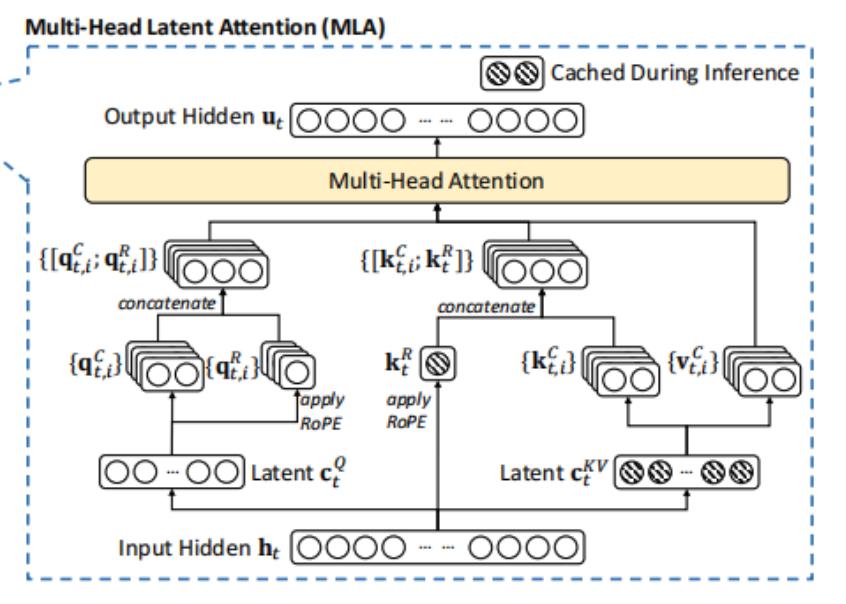
This innovation originally came from a young researcher's personal interest: he thought there was something wrong with the existing attention mechanism, so he started to study it on his own.
After DeepSeek noticed this idea, they formed a dedicated team around it and spent several months making it a reality.
An engineer later said that the reason MLA could be born is that DeepSeek has been questioning the default architecture from the very beginning. While other companies may copy MLA, they "will not question those underlying original assumptions behind MLA".
An engineer with 10 years of experience will not question the default architecture. He will optimize it, adjust parameters, and squeeze the performance to the limit within the existing framework.
But he most probably will not stop and ask: is this framework itself wrong?
Innovations like MLA rely entirely on a young person who dares to question the default architecture.
That's why in DeepSeek's recruitment criteria, the dimension of experience is deliberately removed, replaced by something more vague like "taking an unconventional path".
More companies than DeepSeek are recruiting cross-disciplinary talents
If you look further afield, AI labs on the other side of the Pacific are doing the exact same thing.
Anthropic expanded its team from 400 to 3000 in the past two years, among which there are a group of people who seem to have nothing to do with AI at first glance.
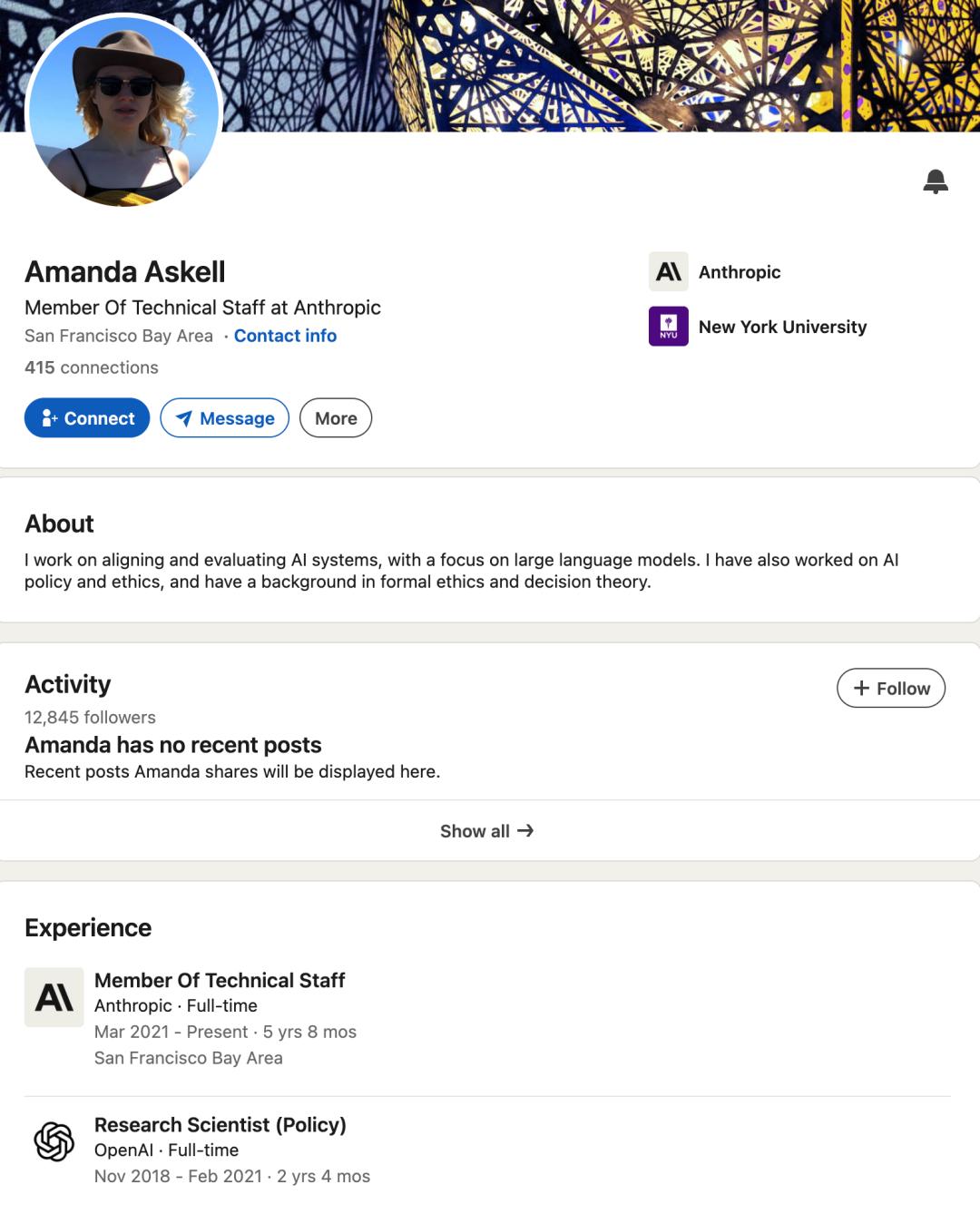
The most famous one is Amanda Askell, who is called "Claude whisperer" inside Anthropic.
Askell's major is philosophy, focusing on infinite ethics. Now she leads Anthropic's "character training" team, and personally drafted a set of behavioral norms that define what kind of AI Claude should be.
And before joining Anthropic, Askell's last job was at the neighboring OpenAI.
Why do these judgments need to be made by philosophers? Askell's explanation is that her goal is to make Claude behave like "what a good person would do if they were in its position".
The "good" here refers to "good in the Aristotelian sense", which means having judgment, being humorous when appropriate, caring for people when needed, and stepping back when it comes to respecting people's right to make their own decisions.
An engineer who has been working on recommendation systems for 10 years cannot define such things.
Similar to Askell is Ben Levinstein, a philosopher studying epistemology and decision theory, who gave up his tenured position at the University of Illinois in 2026 and joined Anthropic full-time.
Some people have gone through the resumes of 1680 Anthropic engineers: 70 have a physics background, 78 have a mathematics background, and 13 have a philosophy background. Philosophy ranks among the top 20 majors. In an AI company, there are more people with philosophy backgrounds than many engineering majors.
Google DeepMind has gone even further.
In May this year, they hired Henry Shevlin from the University of Cambridge, giving him a title that has never existed in the company's history: Philosopher.
Shevlin's research directions include machine consciousness, the relationship between humans and AI, and AGI readiness. To put it simply, he studies "what kind of entity can be considered intelligent, and what kind of entity can be considered conscious".
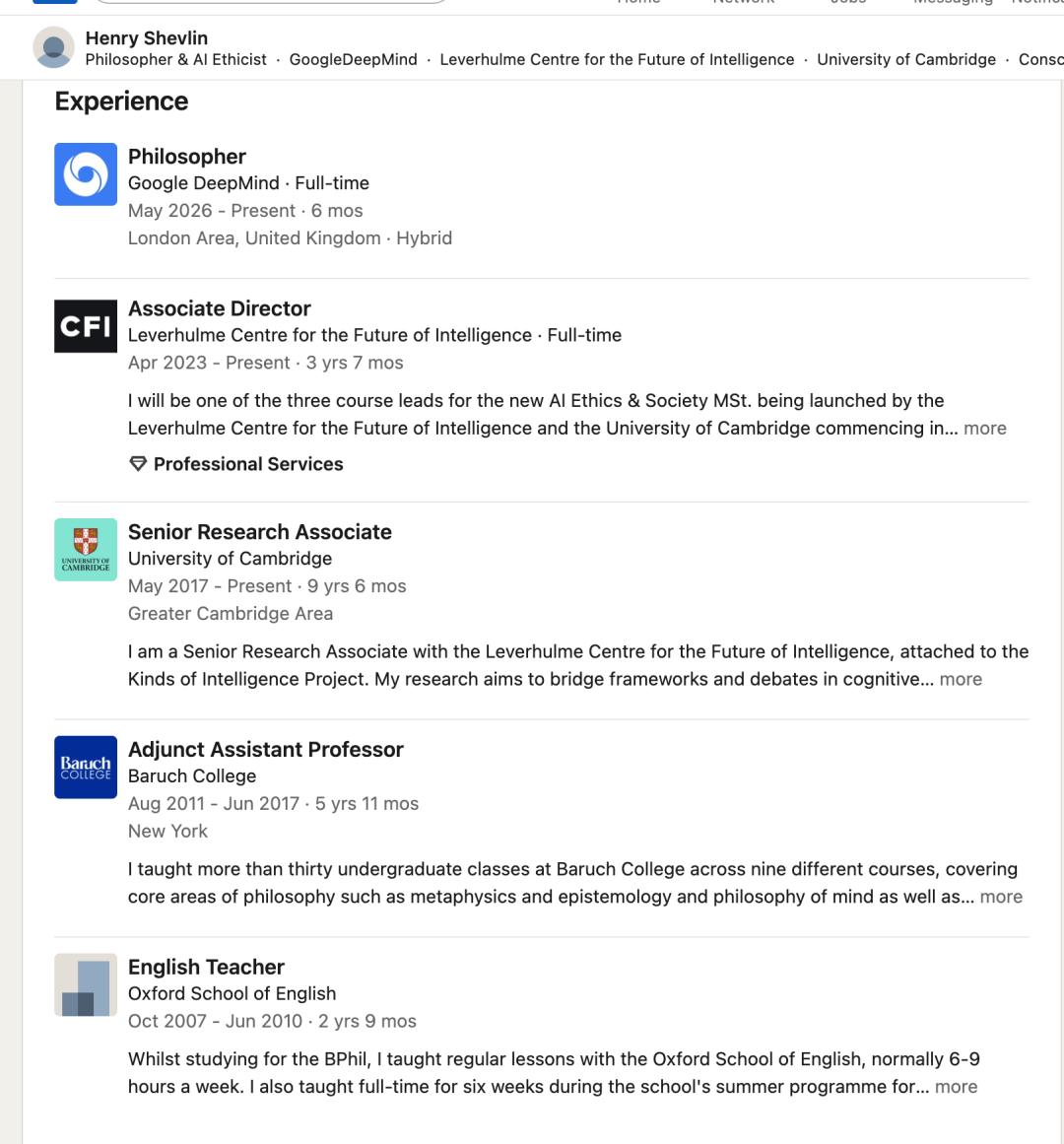
Looking back, Anthropic recruited a philosopher who studies "what is good" to define what kind of character an AI should have; DeepMind recruited a philosopher who studies "what is consciousness" to judge whether AI can possibly have an inner life.
DeepSeek on this side also released a position called "Cross-disciplinary AI technical talent", with "taking an unconventional path" written in the bonus points.
The three companies have different recruitment methods, but share the same underlying judgment.
At the current stage of AGI development, people who only know how to write code cannot solve the problems that lie ahead.
DeepSeek has now reached this stage.
It placed the phrase "taking an unconventional path" on the same line as the competition gold medals, which probably means they have seen something clearly.
This article is from the WeChat official account "QbitAI", author: Kresey, published with authorization from 36Kr.