On Amazon's showcase, Zhipu and DeepSeek have evolved into "two completely different types of models".
Recently, a Chinese supermodel named Li Dongheng from Sichuan has started a side hustle as a video content creator online, and every piece of his published work has gained remarkably high traffic.
He uses his phone camera to record his personal story of traveling alone to major luxury fashion shows across Europe: from attending several auditions a day and getting rejected by all, to hitting a turning point of new hope when he suddenly receives an offer call from a top fashion brand and finally steps onto the runway.
Modeling is a very tough job, but through his videos, the public has learned for the first time the full process of how models are selected and get on the T-stage, which brings new incremental information, with every detail presented in an extremely authentic way.
All roads lead to the same destination. In the large language model industry, if we talk about one of the most representative T-stages across the world, it must be Amazon Bedrock under Amazon Web Services (AWS). It gathers all major global models, and can also be understood as a highly independent "flea market".
From Anthropic's Claude, Meta's Llama, Mistral, Cohere, to Chinese-origin models including DeepSeek, Kimi, MiniMax and Zhipu AI, all are behind the same glass showcase waiting to be selected by developers around the world.
However, even if they are all "models", their fates may vary drastically. On the international stage of Bedrock, Zhipu AI and DeepSeek have become two distinct representatives of Chinese large language models — one is a listed company that needs to prove its profitability by generating revenue, while the other is in no hurry to make profits and simply aims for a far more ambitious technological future.
Zhipu AI: Heading to the International T-stage for Profit Generation
During the October National Day holiday, Zhipu AI's GLM-5.3 was officially launched on Amazon Bedrock. The service runs on AWS, Amazon's cloud computing platform, and will share revenue with Zhipu AI based on model invocation volume.
On the day the news was released, Zhipu AI's Hong Kong stock price rose by more than 7%. Goldman Sachs, which often sets valuation for global economic entities with a single A4 sheet of paper, immediately upgraded Zhipu AI's rating from "Neutral" to "Buy", set a target price of HK$1560, and raised its expected 2026 year-end ARR forecast for Zhipu AI from 2.7 billion USD to 3.2 billion USD.
Goldman Sachs gave a straightforward reason: the growing demand for Tokens, and the execution of new commercial cooperation terms with large cloud vendors in China and across the globe starting from October. Goldman Sachs also expects that such revenue sharing will be injected directly into Zhipu AI at an "extremely high gross margin close to 100%", as the inference cost is mainly borne by the cloud platform.
This cooperation is nothing less than a timely help for Zhipu AI. Since its listing on the Hong Kong Stock Exchange on January 8 this year, Zhipu AI's stock price and market capitalization have retreated by nearly 80%. There are multiple reasons behind this: the small floating share capital that makes its scarcity as a "pure large model target" easily driven up by capital, the expectation of early shareholders' share reduction, and dilution concerns brought by intensive capital operations.
Zhipu AI urgently needs to inject certainty, namely market confidence, into the market amid all kinds of uncertainties. The top priority is to ensure that its revenue growth curve keeps trending upward.
Since it was spun off from the Knowledge Engineering Laboratory of Tsinghua University and started its business in 2019, Zhipu AI's core business model has long been localized deployment: it sells models to governments and large enterprises, deploys them on customers' own servers, and charges licensing fees and technical service fees. This model features high unit price per customer and stable cash flow, but its growth ceiling is obvious and the cost burden is heavy.
After February this year, Zhipu AI voluntarily ended the phase of trading low API prices for usage volume, and began to raise prices systematically. It found that "as long as the model is good enough, customers' price sensitivity will decline". By raising prices, Zhipu AI has successfully taken the initiative in pricing. This is the status quo of its domestic market business.
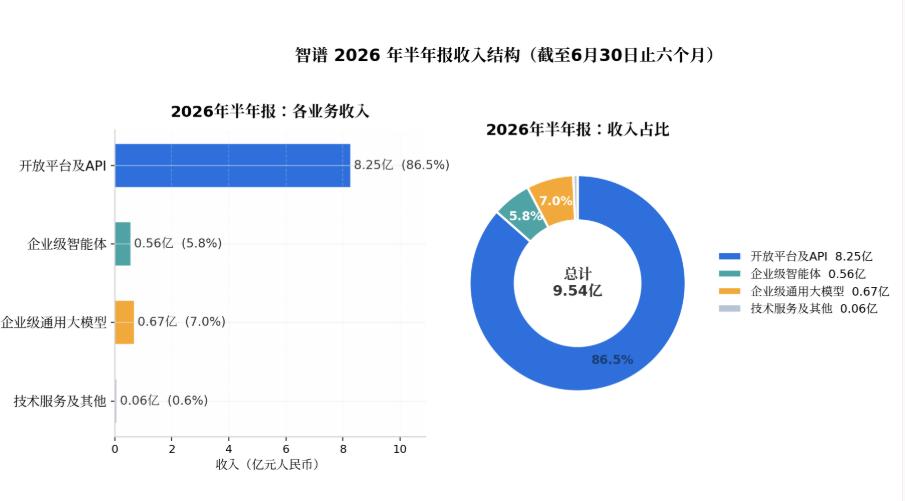
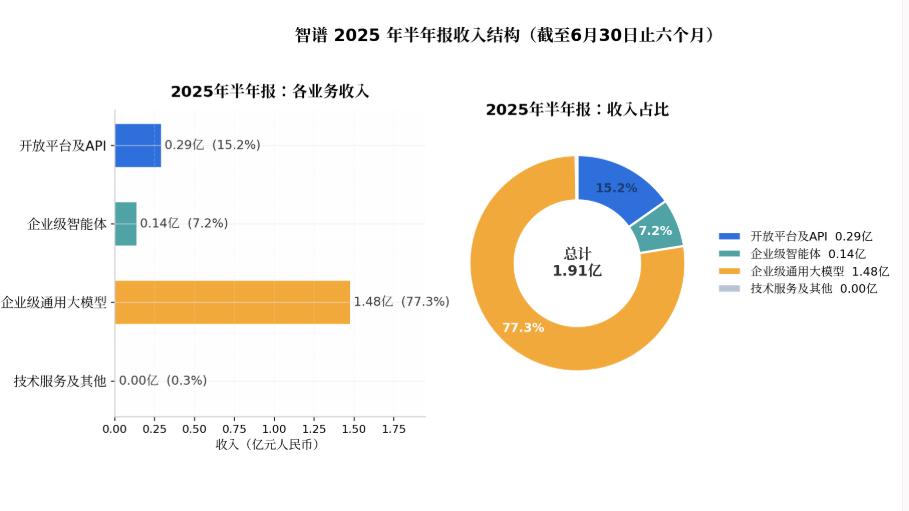
Figure | Zhipu AI's revenue structure has changed completely from 2025 to 2026
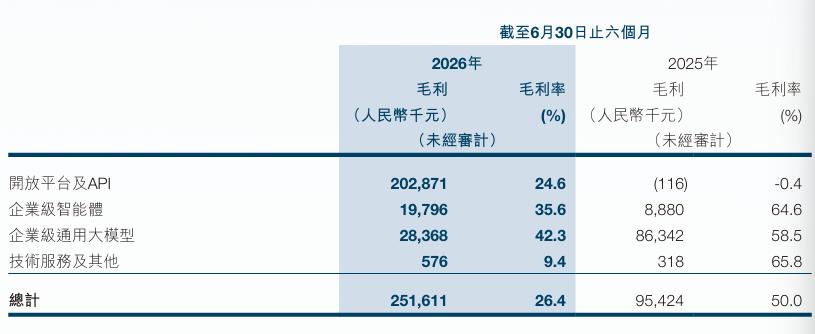
Figure | Screenshot from Zhipu AI's 2026 interim report, showing the gross margin of each business segment
This time, GLM-5.3 is officially launched on Amazon Bedrock and starts the revenue-generating mode, which opens up another revenue line for Zhipu AI in the international market.
The global market's willingness and capacity to pay for high-quality models are considered to be at a completely different level from the domestic market, which is full of temptation for all Chinese large model enterprises. At the same time, the domestic API market has started a fierce price war, so going global has also become a realistic choice.
But on the other hand, building an overseas sales network on your own, accumulating enterprise trust, handling cross-border payment and compliance all require years of time and huge investment.
By leveraging AWS's resources, Zhipu AI, which has an academic origin, only needs to focus on what it is best at — R&D, and leave all the rest work including sales, invoicing, technical support and customer retention to AWS. This is considered a rational choice of "traveling light".
It is equivalent to that Zhipu AI only needs to polish its internal capabilities, and then put its model on the showcase with the largest traffic owned by others.
Of course, how Zhipu AI and AWS share and allocate the revenue has not been officially disclosed for the moment. This means that the scale of Zhipu AI's revenue sharing essentially depends on two variables: the revenue sharing ratio, and the invocation volume.
Some people say that the former is the black box of commercial negotiations, while the latter is a long journey of market verification. In the business world, people often only recognize the days when the market gives the final answer, regardless of other irrelevant factors.
The spotlight on Zhipu AI has been turned on, but how many people will stop for this "work" depends on the result given by time.
The Same Showcase, Two Different Development Paths
In fact, Zhipu AI is not the first "Chinese model" to step into this AWS showcase.
As early as March 11, 2025, DeepSeek-R1 has been available to global users through Bedrock and Custom Model Import.
But the underlying support behind DeepSeek and Zhipu AI stepping onto this international fashion stage is completely different.
The core demand for Zhipu AI to land on Bedrock is monetization. Zhipu AI's native DNA lies in dedicated R&D. In the highly regulated international market, it needs AWS's sales network, enterprise customer relations and global brand endorsement to sell its models to those "out-of-reach" customers. This is a smart application of "going global by borrowing a boat", and at the same time, it can use overseas profits to support its capital market performance.
The core demand for DeepSeek to enter Bedrock is not direct monetization, but more about "maximizing distribution", which means it hopes its model can be used, invoked and deployed by as many people as possible.
DeepSeek's API pricing is extremely low, its web version is free, and open source is its core strategy. For Liang Wenfeng, who has long been financially independent, the revenue generated by API invocations "may not be attractive at all". His greater ambition is not short-term commercial monetization, but the basic research of AGI large language models.
If we compare them to models on the T-stage, DeepSeek is more like a model that does not lack money, and only wants the exquisite design of the "fashion work" it represents to be seen by more people.
This difference in underlying logic is rooted in their financial performance, and also affects their development direction in the market.
According to Zhipu AI's 2026 interim performance announcement, the company achieved a revenue of 954 million yuan in the first half of 2026, a year-on-year increase of nearly 400%, with a loss of 2.071 billion yuan in the period, and an adjusted net loss of 1.964 billion yuan. It is burning capital to expand its scale, and the overseas cloud platform revenue sharing model is a high-margin incremental channel that Zhipu AI has opened up for itself.
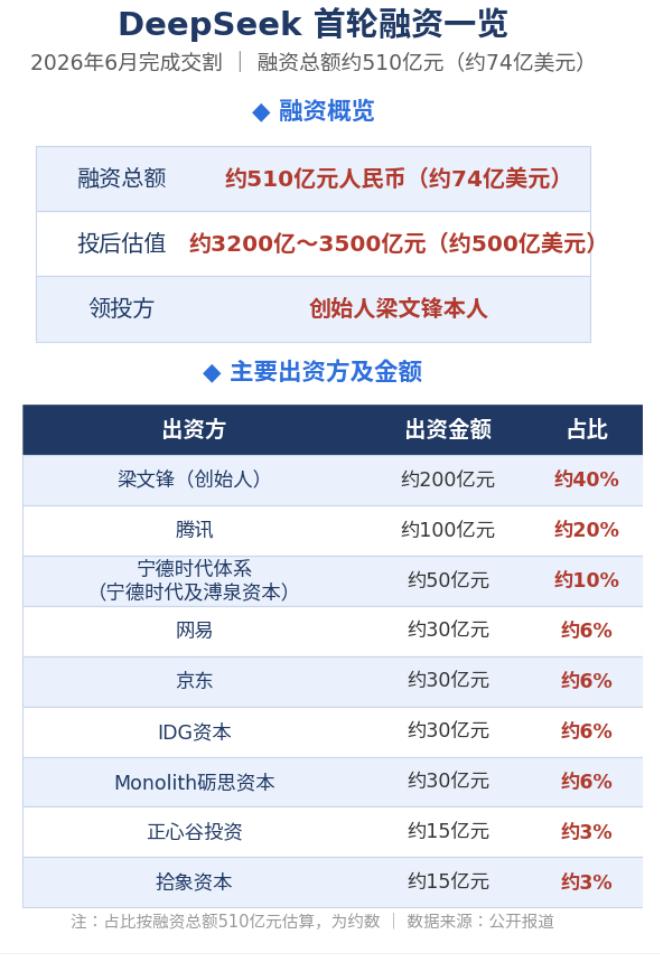
DeepSeek did not complete its first round of external financing since its establishment until June 2026, with a total amount of 510 billion yuan, and a post-investment valuation of nearly 4 trillion yuan. Before that, it was fully supported by the profits of its parent company High-Flyer, and had almost no external revenue.
As a listed company, Zhipu AI needs to prove that it "can make money", and its profit model will make it be priced repeatedly in the capital market.
But DeepSeek's ambition lies in "whether it can become stronger". These two things happen at the same time in the same showcase of Amazon, no one is more advanced than the other, it only depends on whether each of them can go their own way well.
Who is Building the Showcase
Let's go back to the story of Bedrock.
In 2020, Atul Deo, Director of Product for Amazon Web Services (AWS), wrote an internal memo proposing to develop a code generation tool based on large language models. Andy Jassy, the then CEO, responded after reading it that it was a "daydream".
Three years later, the AI programming assistant CodeWhisperer was officially launched. But more importantly, the AWS team figured out one thing in the process: No one can predict which model will become popular, so it is better to build a T-stage that everyone can step on.
Therefore, Bedrock came into being. It is essentially a model-as-a-service distribution platform that takes a cut of revenue.
The revenue sharing mechanism between model providers and AWS is similar to the APP download sharing mechanism in app stores — AWS, as the distribution and operation party, takes a part of the revenue, and the model provider gets the remaining part, just like the showcase owner takes its own share of rent from every transaction.
As for the specific sharing ratio, it is not publicly disclosed at present. It is said that the ratio depends on the specific negotiation between each large model manufacturer and Bedrock. Public information shows that Kimi once proposed a demand of "up to 30%", but the final terms have not been disclosed. The specific ratio between Zhipu AI and AWS is also unknown.
Only one market operation rule is certain: As long as the model itself is irreplaceable, the original R&D manufacturer will have enough confidence to get its own share of the profit cake from the huge cloud platform transaction volume.
The US has Bedrock, so can China have its own "large model showcase"?
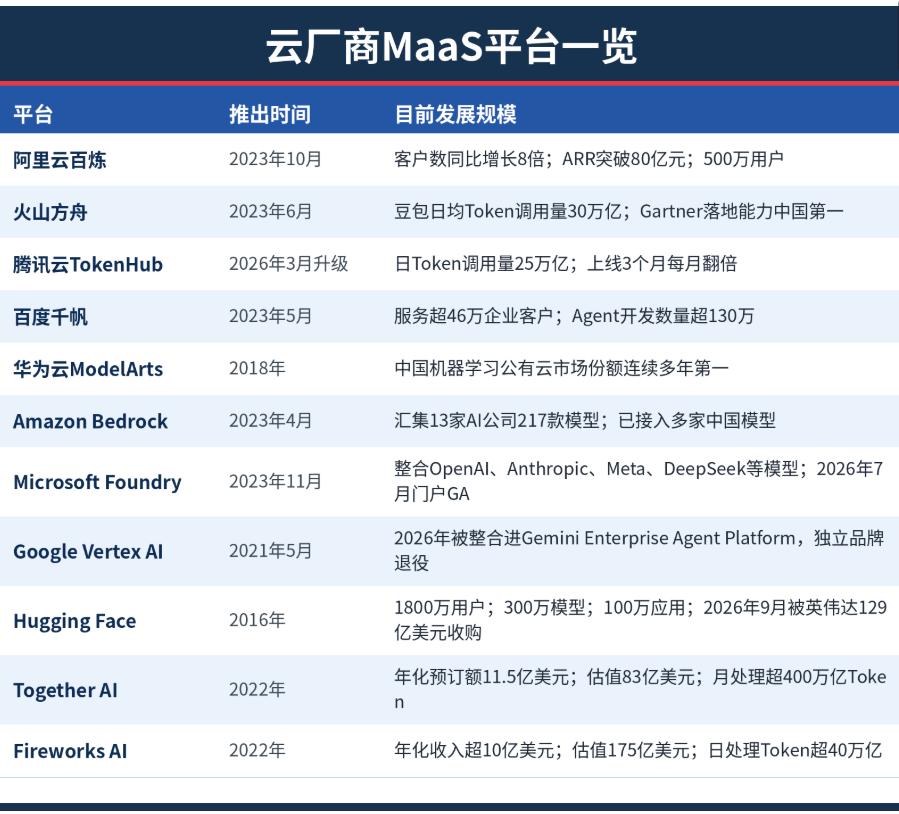
The answer is yes, but the logic of the shelves is different. Current market players include Alibaba Cloud Bailian, Volcano Engine Ark, Tencent Cloud, Baidu Qianfan, Huawei Cloud ModelArts and so on.
From the perspective of model coverage and platform positioning, Alibaba Cloud Bailian (launched in October 2023) has the highest third-party model integration, which is closest to Bedrock's "multi-model shelf" logic.
It integrates the Tongyi Qianwen series, and at the same time launches mainstream third-party models such as DeepSeek, Kimi, GLM and MiniMax.
At present, Zhipu AI has signed a revenue sharing agreement similar to that with AWS with Alibaba Cloud Bailian. Huawei Cloud has also launched GLM-5.3 and reached an intention for similar cooperation.
But there are still differences between domestic model platforms and Bedrock.
Bedrock is an independent model distribution layer. AWS itself does not produce the strongest model, it just puts other people's models into its own showcase and invites them to the runway. Customers choose Bedrock because it provides rich cross-model options.
Domestic cloud platforms are different, most of them are derived from major model manufacturers, and first of all, they serve their own self-developed models.
For example, the core shelf of Alibaba Cloud Bailian is Tongyi Qianwen, and third-party models are supplementary. The foundation of Huawei Cloud ModelArts is Huawei's self-developed Pangu series. Tencent Cloud Hunyuan also gives priority to its self-developed models.
The opening of these platforms to third-party models is more of a complement to "ecological richness", rather than a core strategy. On their own home turf, their own brands are always placed in the most prominent position, just like more and more supermarkets now placing their own private brands on the core shelves.
This means that Chinese large model companies that want to replicate Zhipu AI's path of "embedding Bedrock" will face a game table with different logic in the domestic market. You can launch your model on Alibaba Cloud Bailian, but your model will compete for attention with Tongyi Qianwen in the same showcase. But on Bedrock, the boundary between home turf and away turf is not so clear.
In fact, in the overseas market, Bedrock is not the only one building large model showcases. Microsoft's Azure AI Foundry, Google's Vertex AI, as well as MaaS platforms including Hugging Face, Together AI and Fireworks, are all turning themselves into "app stores" in the AI era.
But what makes Bedrock unique is that it is backed by AWS's dominant position in the global cloud market, and a clear strategic choice: it does not bet on the victory or defeat of a single model, but becomes a channel that all models must pass through.