More than a quarter of the new cutting-edge AI companies were founded by them.
AI entrepreneurship seems to have become a grand feast for professor-founders.
Investment China Jiachuan has counted the newly established AI industry chain companies this year, and found that 182 relevant enterprises (established after January 1, 2026) have received investment.
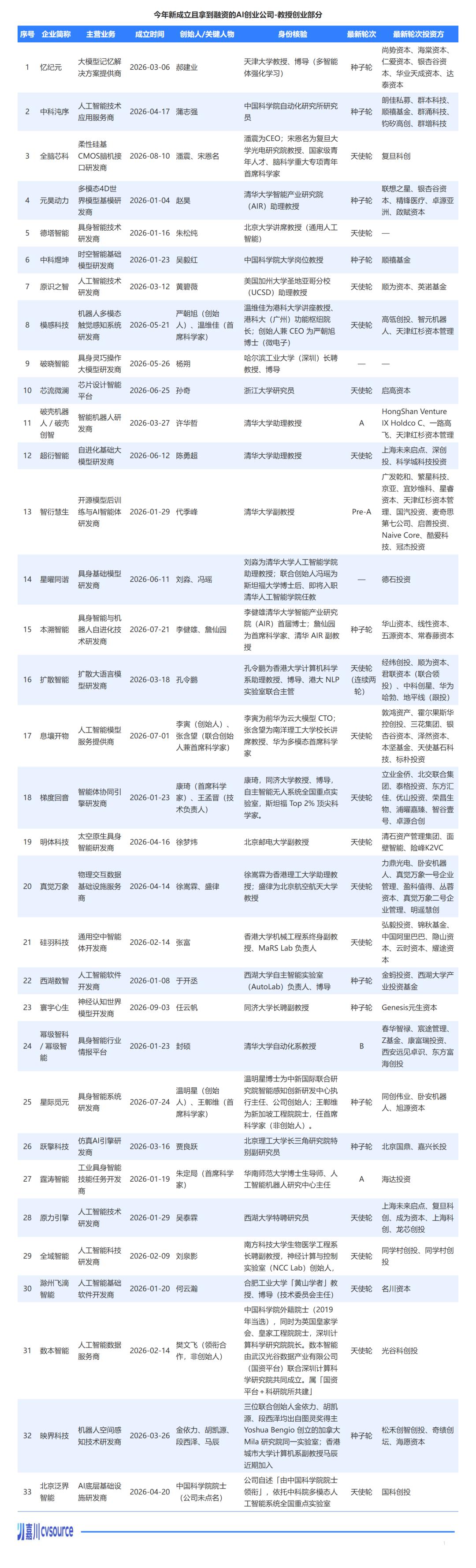
Among them, 33 companies are clearly founded by official faculty members or researchers from universities and scientific research institutes, and 16 companies are established through the transformation of scientific and technological achievements of universities and research institutes or entrepreneurship by faculty-student teams. The two add up to 49, accounting for about 27%. In other words, one out of every four newly established and financed AI startups comes from scholars.
For example, the market has recently announced the financing status of two companies.
One is Hypersphere Technology, founded by Liu Weiyang, assistant professor at the Chinese University of Hong Kong, which has received investment from Legend Capital, CAS Star, SenseTime Guoxiang Capital and Huashan Capital; the other is Diffusion Intelligence, founded by Kong Lingpeng, assistant professor at the University of Hong Kong, whose investors include Matrix Partners China, Shunwei Capital, Legend Capital and other institutions.
These cases seem to indicate that the success rate of scientist entrepreneurship is no longer a concern for investors. On the contrary, what should be most worried about is whether these top talents can be contacted as early as possible.
Of course, it needs to be clarified that the 182 companies here include not only general artificial intelligence large models, AI applications, embodied models, but also pan-artificial intelligence industries such as AI chips and brain-computer interfaces. In addition, the statistics of the founders' backgrounds are incomplete, and the backgrounds of the founding teams of some enterprises are vague, so their specific identities cannot be confirmed yet.
01. Assistant Professor at CUHK Secures Investment from Top Institutions Just 2 Months After Starting His Business
A number of professor-founders have emerged in the large model track, such as the company Hypersphere Technology we are going to talk about today.
According to the data from CVSource of Investment China Jiachuan, Shenzhen Hypersphere Technology Co., Ltd. has completed its angel round of financing, with investors including Legend Capital, CAS Star, Huashan Capital and Guoxiang Capital under SenseTime. The company wrote on its recruitment page that it "focuses on the R&D of next-generation large AI models", and claims that it "has received investment from top-tier US dollar funds, with a valuation of over 100 million".
The company was founded on August 5 this year, and the financing disclosure date is at the end of September. That means the company has received investment from top-tier institutions right after its establishment.
This situation is not uncommon in the current AI entrepreneurship boom. Founders with strong industrial backgrounds or top scientists from universities often lock in early investors before starting their businesses. Hypersphere Technology is the latter case.
Hypersphere Technology currently has a scale of less than 20 people. "All employees are doctors from top overseas universities and scientific research institutions in the field of artificial intelligence". The founder is Liu Weiyang, assistant professor and doctoral supervisor at The Chinese University of Hong Kong.
Liu Weiyang is a leading researcher in the AI field. He obtained his Ph.D. in Computer Science from the Georgia Institute of Technology in the United States, and his Ph.D. in Machine Learning from the University of Cambridge in the United Kingdom. Later, he went to the Max Planck Institute for Intelligent Systems in Germany to engage in postdoctoral research, and his co-supervisor is Bernhard Schölkopf, one of the founders of machine learning. He also held research positions at Google, NVIDIA and Mitsubishi Electric Research Laboratories (MERL).
Since 2025, he has served as an assistant professor at Shenzhen Hetao Institute, and at the same time as an assistant professor and doctoral supervisor in the Department of Computer Science and Engineering of The Chinese University of Hong Kong, and is the person in charge of "SphereLab".
Public information shows that Liu Weiyang has published more than 70 papers in top journals/conferences such as Nature Machine Intelligence, PNAS, and IEEE TPAMI, and won the 2023 IEEE Signal Processing Society Best Paper Award.
Around 2017, Liu Weiyang proposed a spherical face recognition algorithm, which normalized the feature vector of each face to the same hypersphere. This research later evolved into a set of "angular margin" methods, which are adopted by a large number of face recognition systems. The company's name Hypersphere Technology may be related to his research topic in that period.
In 2023, Liu Weiyang shifted his research focus from face recognition to diffusion models and language models, using orthogonal transformation to constrain parameter updates as the core of the method. The so-called orthogonal transformation means only rotating without stretching. No matter how you rotate, the length of the vector and the angle between any two vectors remain unchanged. It is equivalent to adding a geometric constraint to the training process, so that the training is not easy to diverge.
According to the information disclosed at the Shenzhen stop of the GOSIM Conference, Liu Weiyang will give a technical sharing on the 17th of this month, with the topic "Efficient Training of Large Language Models via Orthogonal Transformation". This may point out the technical path of Hypersphere Technology.
Looking at the investors, Legend Capital, CAS Star, SenseTime Guoxiang Capital and Huashan Capital have invested in many artificial intelligence companies. Data from CVSource of Investment China Jiachuan shows that Legend Capital has invested in 32 artificial intelligence enterprises, CAS Star has invested in 45 related companies, and Guoxiang Capital has invested in 18 companies.
Almost at the same time, Legend Capital and CAS Star also jointly invested in another large model company Diffusion Intelligence in Shenzhen. The founder of this company is Professor Kong Lingpeng, co-director of the NLP Lab at the University of Hong Kong.
One is an assistant professor at the Chinese University of Hong Kong, and the other is an assistant professor at the University of Hong Kong, which reveals one of the current trends in AI entrepreneurship: entrepreneurs from university professors are becoming the core group of AI investment in the primary market.
02. 182 New AI Companies Established, More Than a Quarter Co-founded by Scholars
So how many AI companies founded by professors have received investment this year?
Data from CVSource of Investment China Jiachuan shows that by the beginning of October, 182 newly established AI industry chain enterprises this year have received investment (including large language models, AI applications, embodied models, brain-computer interfaces, AI chips and other pan-AI fields).
Among them, 33 companies are clearly founded by official faculty members or researchers from universities and scientific research institutes, and 16 companies are established through the transformation of scientific and technological achievements of universities and research institutes or entrepreneurship by faculty-student teams. The two add up to 49, accounting for about 27%.
Moreover, many of these enterprises have received multiple rounds of financing in a short period of time. Power Intelligence and Silicon Feather Technology are representative cases.
The most prominent title of Feng Shuo, the founder of Power Intelligence, is the cover paper published in the main issue of *Nature* in 2023. As the first author, he proposed the "sparsity disaster", which refers to the fundamental problem that dangerous scenarios are extremely sparse in autonomous driving safety testing. The intelligent equivalent accelerated testing system he proposed improves the efficiency of simulation and real vehicle testing by 3 to 5 orders of magnitude. The official *Nature* evaluated this work as "a critical advance in autonomous driving safety".
In 2022, Feng Shuo returned to the Department of Automation of Tsinghua University as a national high-level overseas talent. Within three years, he was exceptionally promoted from assistant professor to doctoral supervisor and special researcher, and served as deputy director of the Institute of Systems Engineering.
In January this year, he founded Power Intelligence, which is committed to developing the world foundational model of physical artificial intelligence. Its path is to predict the next state of the physical world, which he summarizes as "Claude for physical artificial intelligence". The co-founder Shi Mengkai completed his bachelor's and doctoral degrees in the Department of Automation of Tsinghua University. Power Intelligence completed two rounds of financing in June and September this year, with Chunhua Capital, Oriental Fortune Capital, Z Fund and others on the investor list.
The resume of Zhang Fu, the founder of another company, Silicon Feather Technology, has both academic and industrial backgrounds.
He is a tenured associate professor in the Department of Mechanical Engineering of the University of Hong Kong, and the head of the HKU Mechatronics and Robotics Systems Lab. He was selected as one of the top 1% scientists in the world by Clarivate. In the past five years, he ranked 5th in the world and 1st among Chinese scholars in the global ranking of robotics scholars' influence. The team's output FAST-LIVO2 won the Fu King-Sun Memorial Best Paper Award of *IEEE Transactions on Robotics*, the top journal in the field of robotics. This is the second time in the history of this award that it has been awarded to a Chinese team.
At the same time, he served as a senior consultant scientist at DJI for eight years, participating in the R&D of key directions such as flight control systems, multi-sensor fusion, and LiDAR. The open-source technology he developed has been verified and used by enterprises such as DJI and Unitree Robotics.
In February this year, Zhang Fu founded Silicon Feather Technology, focusing on AI+ drones. The goal is to enable drones to understand the environment and determine the flight path by themselves without relying on satellite positioning. The team integrates LiDAR, vision and inertial navigation to achieve centimeter-level positioning without satellite signals; the end-to-end cerebellum compresses the obstacle avoidance response to within 5 milliseconds; the next step is the world navigation model, which enables the aircraft to understand the space and predict the flight action in the next second.
Silicon Feather Technology received the exclusive seed round from Yun Tu Capital in the month of its establishment, and has completed 3 consecutive rounds of financing so far, with a cumulative amount of hundreds of millions of yuan. Yunshi Capital, Hony Capital, Alibaba, GLP Hidden Hill Capital, and Jinqiu Fund have all entered the list of shareholders.
The pace of the two companies is exactly the same: they received the first sum of money in the month or the next month of registration, and completed more than one round of financing within half a year. These cases show that there is no need to debate the success rate of professor entrepreneurship anymore. The 27% proportion verifies that the primary market is extremely eager for AI scientists.
This article is from the WeChat official account "Investment China Jiachuan", the author is the Editorial Department of Jiachuan, and published with authorization from 36Kr.