From pursuing scale expansion to securing profits, the beauty sector faces four tough battles during the Double 11 shopping festival.
"Is the live streaming schedule finalized? Are the influencer resources confirmed? Is the marketing budget approved? Have the core promotion categories and pricing plans been implemented?" The 2026 Double 11 Shopping Festival has entered the countdown phase. How should beauty brands deploy their resources to efficiently allocate self-broadcast and influencer broadcast resources? How can they drive new user acquisition and boost repurchase growth? How to leverage various AI tools to improve efficiency, seize the promotion window, achieve sales growth while maintaining profits?
Jialuo, President of Tmall, once defined the 2025 Double 11 as "the first Double 11 with fully implemented AI capabilities". Compared with previous years, what are the differences of this year's Double 11 promotion? What new variables will AI bring to the beauty industry's big promotion? When the logic of traffic explosion shifts to the logic of full-cycle refined operation, how should brands reconstruct their own marketing systems?
Long Operation Cycle, Shifting from "Pursuing Scale" to "Refined Operation"
Compared with the 2025 Double 11, the 2026 promotion still maintains the feature of a long cycle. According to the promotion timelines of 8 domestic e-commerce platforms, this year's Double 11 will start in mid-October and last until mid-November, with an overall cycle of 30 to 40 days.
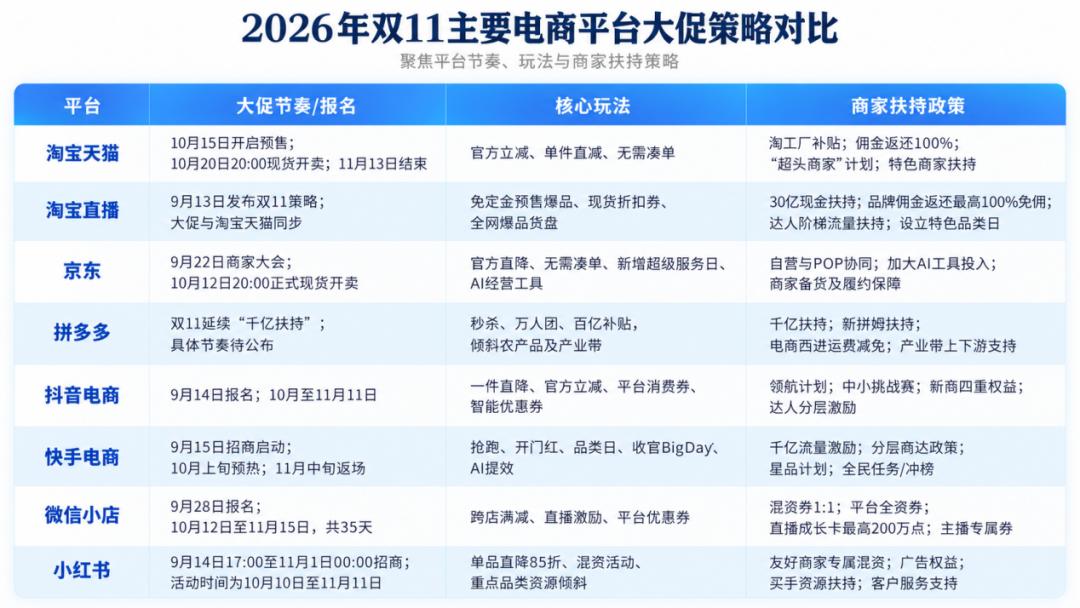
(Source: Compiled based on public information)
Although the marketing rhythm planning of major e-commerce platforms varies: Taobao Live has formed an operation path of "verification in September - optimization in October - volume release during Double 11", Kuaishou E-commerce divides the promotion into three major stages: the Opening BigDay, All-category BigDay, and Closing BigDay, while Douyin E-commerce plans the promotion as the opening stage in October, the official stages in October and November, and the carnival stage in November.
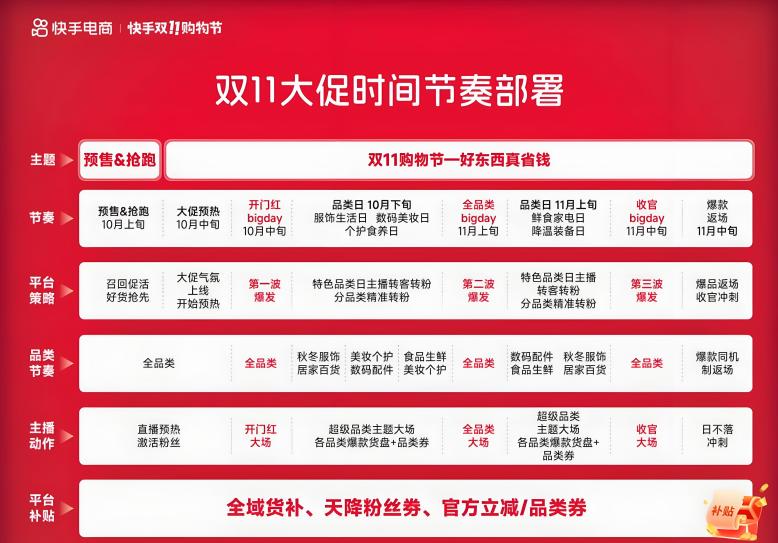
(Source: Kuaishou E-commerce)
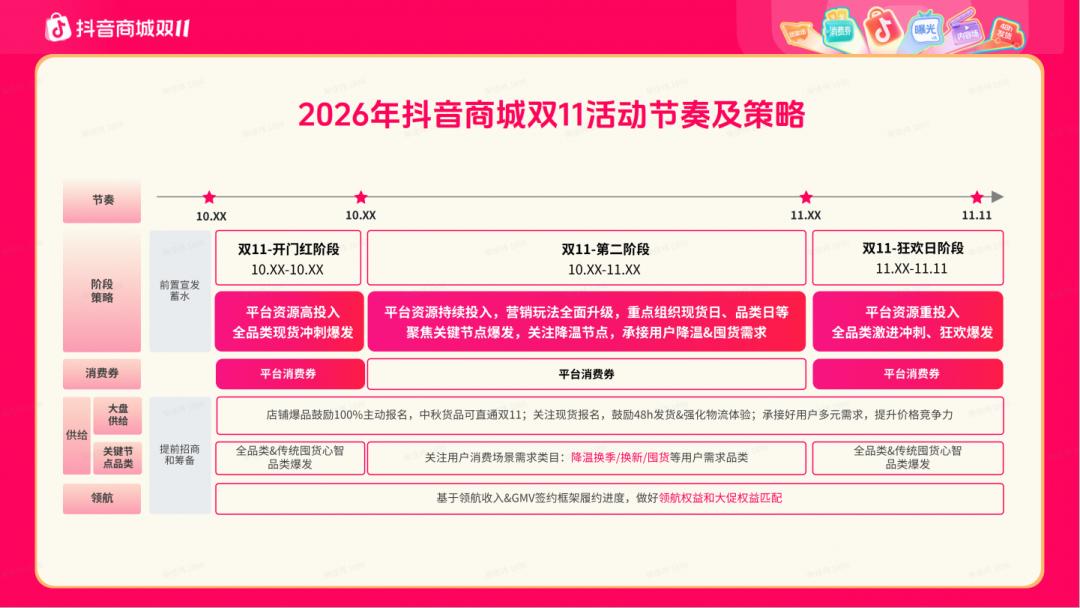
(Source: Douyin E-commerce)
However, the extended promotion cycle makes this year's Double 11 likely to present the feature of "advancing resource allocation" — key actions such as inventory preparation, influencer cooperation, delivery rhythm, and product production scheduling are concentrated in the pre-sale stage. Many practitioners said that the core layout of Double 11 is concentrated in October, and November is mainly for finalizing work and maintaining stability; the layout quality in the pre-sale stage largely determines the overall result of the promotion, and Double 11 day is no longer the core traffic peak.
What has changed is that first, WeChat Mini Shop participates in Double 11 for the first time, with its confidence coming from the proven full-domain operation capability: live streaming, short videos, shelf, and search scenarios are fully connected, combined with the trust-based operation practices accumulated by a large number of brands such as Forest Cabin, PurCotton, Skechers, and supported by the platform's new promotion subsidy tools, making WeChat Mini Shop no longer just a supplementary channel for live streaming, but a complete operation position for brand user assets.
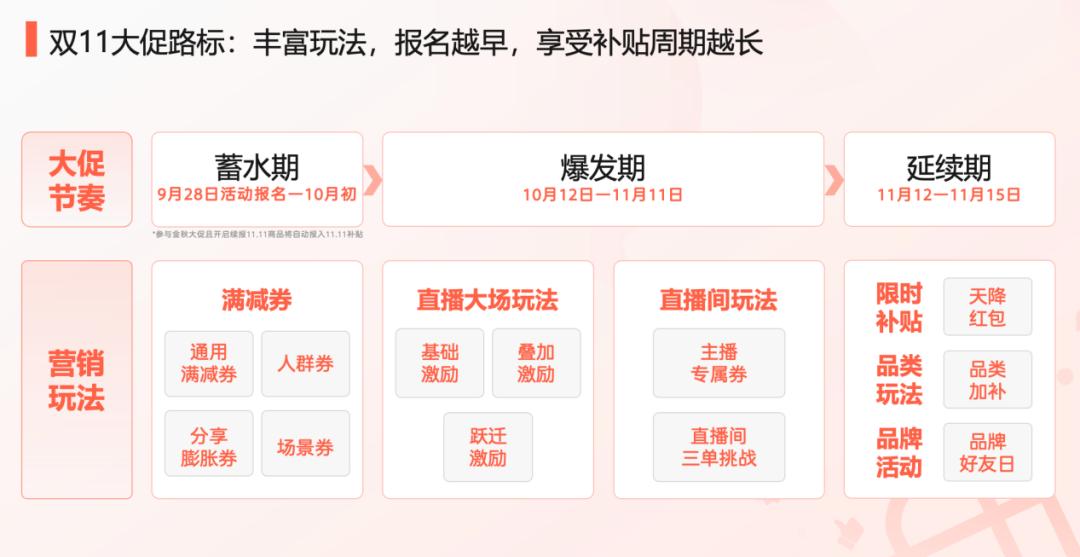
(Source: WeChat Mini Shop)
Second, the platform support logic shifts from "flood irrigation" to "precise drip irrigation": Douyin implements tiered incentives for large and small merchants, Kuaishou launches a tiered commercial content policy, WeChat Mini Shop gives priority to subsidizing high-quality stores, and Xiaohongshu implements the strategy of "precisely supporting high-quality goods", so as to alleviate the difficulties of small and medium-sized merchants such as high delivery cost, low conversion efficiency and insufficient willingness to participate during the promotion period.
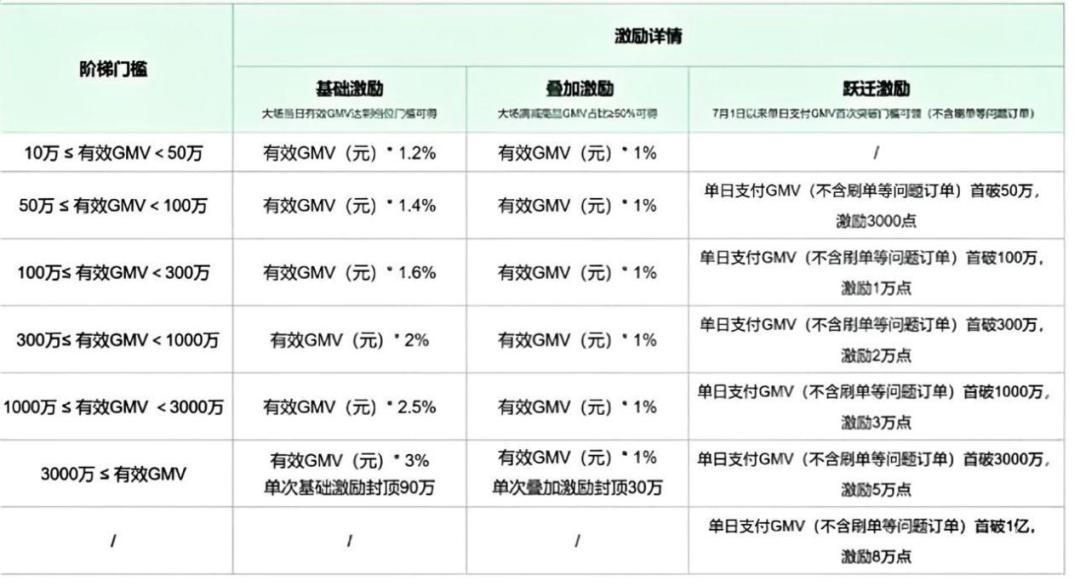
(Source: WeChat Mini Shop)
Tian Liming, Vice President of Handm&H, an operator of imported daily chemical products, once said in an interview that the company held a Double 11 mobilization meeting, and the internal consensus was not to make a big fuss and just follow the trend. "Super large promotion festivals like Double 11 belong to top big brands, small merchants are just accompanying runners, and they may even stumble if they are not careful."
Third, the participation threshold for consumers is lowered, and platforms continue to simplify promotion rules: Douyin E-commerce continues to implement the policy of "direct price reduction for one item" and "15% official discount", Tmall and Taobao launch official price reduction, Xiaohongshu adjusts to a direct reduction of 15% or more (starting from 15% off), and JD changes the price comparison benchmark from the low price in the historical cycle to the user's historical actual payment price, making the old trick of raising prices first and then reducing them no longer work.
Behind the platforms' simplification of promotion rules is consumers' resistance to complicated promotion tricks. Especially with the increasing penetration of C-end large models such as Doubao and DeepSeek, consumers can quickly identify price tricks with the help of AI, so it is not worthwhile for platforms and merchants to continue to use the old model.
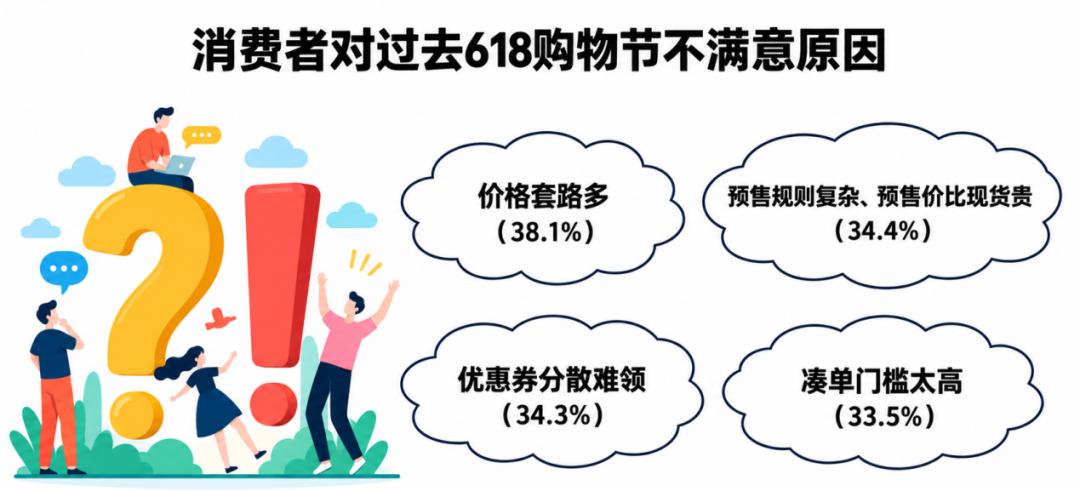
(Source: iResearch)
Not only on the consumer side, merchants participating in Double 11 still face multiple challenges such as high traffic delivery costs, price pressure from top anchors, fluctuating return rates, and great performance pressure. Referring to the situation of the 2025 Double 11 — in Q4 2025, Marubi Biotechnology recorded the highest revenue among the four quarters, but its profit fell to the lowest point of the whole year, falling into the dilemma of "increasing revenue but not increasing profit".
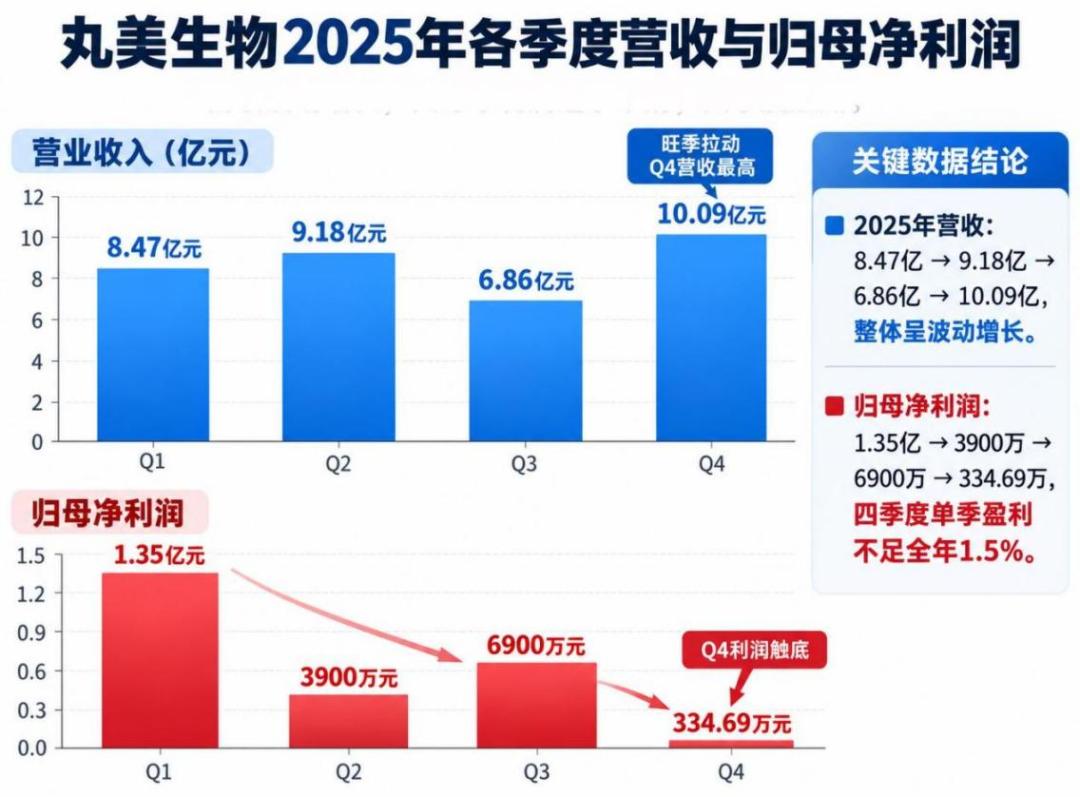
(Source: Marubi Biotechnology Financial Report)
In the same period, Shanghai Jahwa recorded a loss of 138 million yuan, which was the only loss-making quarter of the year. The sales expense ratio of this quarter reached 52.3%, higher than the annual average of 48.0%. Luo Yongtao, the company's chief financial officer, mentioned that the performance has obvious seasonality, and the additional marketing investment for key products during Double 11 failed to be converted into revenue, resulting in pressure on quarterly profits.
Given all these pressures, is it still necessary for merchants to participate in Double 11?
Stéphane de La Faverie, President and CEO of The Estée Lauder Companies, revealed at the 2026 fiscal year (July 1, 2025 - June 30, 2026) earnings call: "The Chinese mainland market achieved 9% organic growth, with skin care products growing at a high single-digit rate, color cosmetics at a mid-single-digit rate, and fragrances at a double-digit rate." The financial report attributes the growth of the mainland market to the outstanding performance of innovative and mature products at key nodes, with the core keywords being promotion nodes and online channels, and 618 and Double 11 are the two most important shopping nodes in China.
Behind this differentiation means that the big promotion is shifting from the past traffic-driven, brand scale expansion to refined operation and pursuit of profit efficiency. Sun Huaiqing, Chairman of Marubi Biotechnology, said that the brand has fully shifted from scale expansion to benefit orientation, and profit has become the core assessment indicator; the team no longer only looks at revenue, expense efficiency and profit quality are equally important, even if the scale can be expanded, unprofitable business channels will be actively reduced.
Then for brands, how to do a good job in refined operation during the promotion period?
Equal Emphasis on Price System, Channels and Brand Barriers
Cheng Yingqi, founder of Icefresh Oral Care, proposed the "333 product structure": 3 key hit products to stabilize the basic sales base, 3 trend products to drive incremental growth, and 3 nurtured products to reserve long-term potential. During the Double 11 promotion, brands can combine potential new products, core hit products, and stock-up essential products that have been verified in the live streaming room to meet the consumption demands of different groups in layers.
After planning the product portfolio, the core is to maintain the price system. Data from the "Insight Report on Beauty Consumption Trends during Big Promotions" shows that price discount intensity (71.1%) is the most concerned factor for consumers during the promotion period.
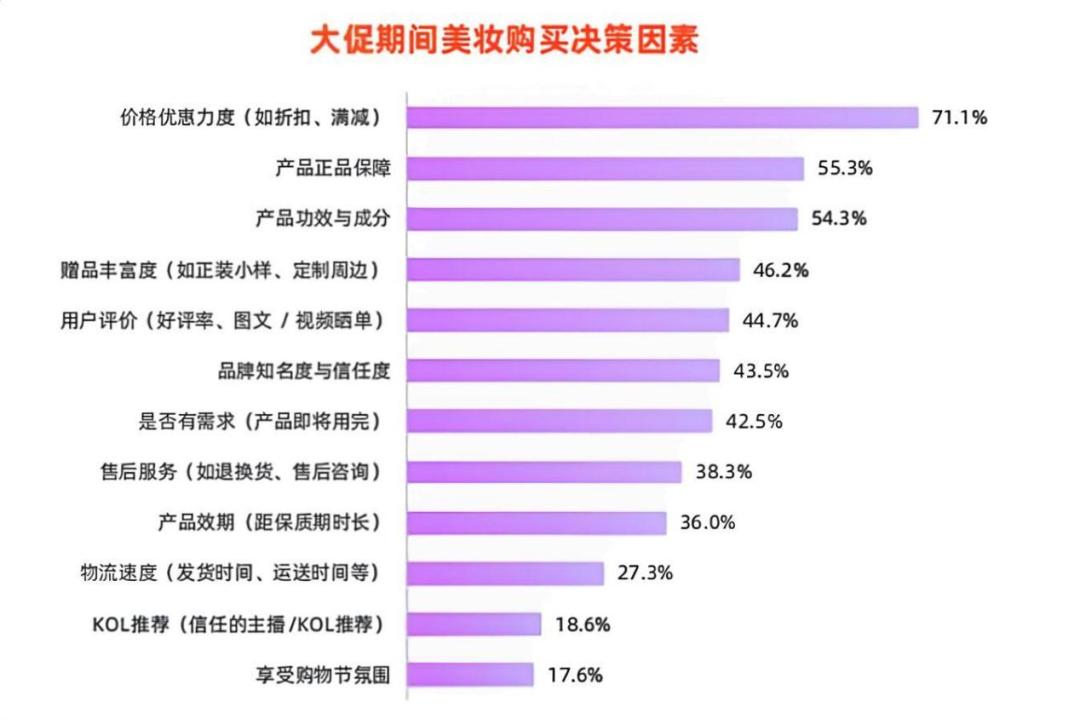
(Source: Insight Report on Beauty Consumption Trends during Big Promotions)
However, for brands, deploying multiple channels and multiple influencer live streaming rooms at the same time makes price system management a major core challenge. Once the price system is chaotic, it will not only impact the brand's existing channel system, but also shake consumers' expectation of the brand value. In particular, compared with mature international brands, domestic beauty brands need to bring the selling prices, gifts and membership rights of different channels into a unified management framework, and implement full-channel price control.
The price system is the bottom line of operation. Combined with the reality of limited marketing budget for big promotions, the value of balanced multi-channel operation is further highlighted. Zhang Yue, founder of Tilovi, said: "Douyin is the field for volume explosion, Tmall is the field for user precipitation, and offline is the field for trust building. No matter how strong the explosion of a single channel is, it cannot compare with the balanced accumulation of multiple channels. Douyin makes the brand run fast, while offline and Tmall make the brand stand firm."
This trend has emerged during the 618 promotion this year, with international big brands performing strongly in Li Jiaqi's live stream and Douyin's rankings. Coming to the 2026 Double 11, the hundreds of millions of daily active users of ByteDance's Red Fruit Short Drama bring the one-click jump to place an order after "searching for the same item via image", and Doubao's "pre-purchase consultation" shortens the user decision-making link. The collaboration of content, AI and shelf will improve conversion efficiency, which may push more international big brands to increase their investment on Douyin.
Taobao and Tmall are seizing the trend of Chinese beauty brands going global. According to Ye Tian, head of Taobao's cross-border e-commerce business, this year's Double 11 will be launched simultaneously in 20 markets around the world, with free shipping services provided in 13 countries and regions, among which Chinese Hong Kong, Chinese Macao, Singapore and Malaysia realize "zero-threshold free shipping". It is foreseeable that the beauty competition between the two major platforms during the Double 11 promotion will continue to escalate.
Beyond the two major platforms, brands also need to tap the value of emerging channels. He Xu, General Manager of Hangzhou Sponge Technology, once said that the core group of instant retail is concentrated in young people in first- and second-tier cities. Such users value timeliness, have emergency needs such as temporary makeup touch-up and skin care during business trips, as well as light consumption needs such as trial use of mini-sized products. Dai Yuzhou, Brand Partner of Rabbit Mom, also mentioned that children's personal care products have the characteristics of temporary and unexpected consumption, and small-sized emergency products perform better in conversion in instant retail channels than traditional e-commerce.
By meeting the instant consumption demands for beauty products, instant retail is becoming an important incremental channel. During this year's 618 promotion, the sales of CHANDO on Meituan Flash Purchase increased by 88% year on year. It is foreseeable that more beauty brands will deploy in the instant retail track in the 2026 Double 11.
Beyond the channel dimension, different categories also present a differentiated competition pattern. Take color cosmetics as an example, among the top 5 color cosmetics list of Douyin 618 this year, YSL is the only international brand. The reason is that color cosmetics iterate fast, popular trends change a lot, consumers are willing to try new products, and their loyalty to a single brand is weak, which gives domestic brands the first round of competitive advantage.
From the observation of Xiaohongshu content marketing, three major changes are taking place among color cosmetics consumers in the 2026 Double 11: demands are more personalized, users are shifting from catering to public aesthetics to self-expression, pursuing makeup that suits themselves and fits real daily scenarios; aesthetics are more diverse, no longer superstitious about standard makeup styles, accepting diverse styles such as freckle makeup, with richer color choices; makeup playing is more fun, in addition to practical functions, IP concepts, special textures and creative packaging have also become highlights to attract users.
Driven by the change of consumption mindset, the competition of domestic color cosmetics brands has upgraded from platform traffic operation to product matrix construction, cross-channel management, user repurchase and brand identity building.
At the level of brand marketing, there are two notable trends for beauty brands in 2026. On the one hand, the popularity of celebrity marketing continues to rise. According to incomplete statistics from FBeauty, from January to July 2026, 163 beauty brands have officially announced a total of 338 celebrity cooperation projects. This year's Double 11, many brands may seize incremental attention through methods such as celebrity same-style products, co-branded limited editions, topic-based content marketing, and surprise appearances in live streams.
On the other hand, the industry trend of "reducing reliance on influencers" is emerging. Shanghai Jahwa proposed in its 2026 semi-annual report to build an internal Douyin content team, and take back the control of traffic and content delivery capabilities for self-operation; Giant Biogene also clearly