Has the "Golden September" fallen short of expectations? The pullback in auto market sales against the high base effect is "far from sluggish"
September has always been the traditional peak season for China's auto market, commonly known in the industry as "Golden September", and it is also the starting point for the full-year sales sprint. However, this year's peak season does not seem to be thriving. Before the monthly data was released, the China Passenger Car Association (CPCA) had given a heads-up: there will be no explosive growth in China's passenger vehicle market in September 2026 as in previous years, with only a slight month-on-month recovery, while the year-on-year performance will face considerable pressure.
The monthly delivery data of major automakers have been released one after another, and this judgment has basically come true. In September, the sales volume of most automakers generally rose month-on-month, and the pull of the peak season still exists; however, due to the high base in the same period of 2025, the total market sales volume declined year-on-year. The gap between different automakers and different tracks is gradually widening.
Total Volume Declines, Market Continues Stock Game
At the overall market level, in September 2026, the retail sales of narrow-sense passenger vehicles in China reached about 1.69 million units, up 9.7% from August, continuing the trend of slight recovery in the peak season. But compared with September 2025, it dropped by 24.6% year-on-year.
The 24.6% year-on-year decline seems relatively high, but there are clear objective factors behind it, not a sudden shrinkage of consumer demand. In September 2025, auto consumption subsidies in many regions were about to expire, a large number of consumers concentrated on purchasing cars within the policy window period, pushing the retail sales of narrow-sense passenger vehicles that month to 2.241 million units, hitting a phased peak. Facing such a high base, the double-digit year-on-year decline in September 2026 is a reasonable data correction brought by the base effect. The weekly data from the China Automobile Dealers Association can also confirm this: from September 1 to 20, the cumulative retail sales of passenger vehicles across the country reached 878,000 units, down 22% year-on-year, but up 8% compared with the same period in August. The market is recovering week by week, and the terminal demand has not weakened.
Compared with the rise and fall of total volume, the structural changes within the market are more worthy of attention. Cui Dongshu, Secretary-General of CPCA, believes that the growth of "Golden September" in previous years was inclusive, with first-car purchase demand and replacement demand released simultaneously, and both fuel vehicles and new energy vehicles could get a share of the increment. The 2026 auto market has gradually entered a new stage, with the overall incremental space significantly shrinking. Only the new energy vehicle track still maintains stable new demand, while fuel vehicles have basically stopped growing and can only compete for users in the stock market.
The terminal retail data of CPCA shows that in the first three weeks of September, the retail sales of new energy passenger vehicles in China reached 596,000 units, down 9% year-on-year, far lower than the overall 22% decline of the general market, and up 14% compared with the same period of last month, with the retail penetration rate reaching 67.9%.
Faced with sales pressure, all parties in the industry are taking the initiative to act. In September, more than ten automakers including FAW, SAIC, Changan, Geely, BYD, and Li Auto accelerated the launch of new cars. More than 50 all-new models, generation-updated models and facelifted models were launched in that month, hitting the highest launch density of the year; according to incomplete statistics, 9 new cars were unveiled intensively on September 23 alone. Local governments are also stepping up efforts to boost consumption. Gansu and Qinghai provinces, as well as cities including Yangzhou, Lanzhou, Qingdao and Nanjing, have successively launched a new round of car purchase subsidies. The maximum subsidy per vehicle in some areas can reach 5,000 yuan, directly reducing consumers' car purchase costs.
Automakers are iterating products, and local governments are rolling out subsidies, both of which have boosted the month-on-month recovery trend in September. However, these short-term positive factors still cannot offset the year-on-year gap brought by the high base. Industry insiders believe that the development trend of the auto market in the fourth quarter mainly depends on two things: whether local subsidies can be continuously implemented, and whether the delivery efficiency of automakers can keep up when they sprint for year-end sales.
▍ Head Rankings Reshuffled, Differentiation and Overseas Expansion Become Key Words
Under the pressure of total volume, the differentiation of automakers has further intensified, and the head rankings have ushered in a new round of adjustment. Overseas market expansion and breakthroughs in new energy businesses are determining the gap between different automakers.
BYD still ranks first in domestic automaker sales. According to the September 2026 production and sales express released by BYD, the company's new energy vehicle sales in that month reached 463,561 units, up 17% year-on-year, making it the only domestic automaker with monthly sales exceeding 400,000 units.
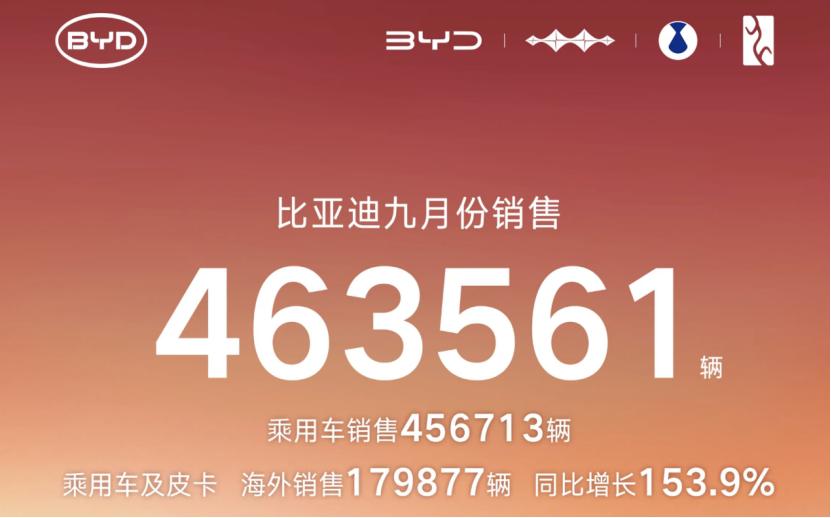
However, by breaking down the sales structure, we can see that BYD's growth momentum has shifted. The company exported 179,877 new energy vehicles overseas that month, accounting for nearly 40% of total sales. The overseas market has become a new growth pole. In the first nine months, BYD's cumulative sales reached 3,131,576 units, with a slight year-on-year decline of 3.94%, still in a slight drop. Analysis shows that BYD has entered the stage of "defending the domestic stock market and seeking overseas increments", and the subsequent expansion speed and market performance of its overseas business will directly affect its full-year performance in 2026.
The competition in the second echelon is more fierce. Chery, Geely and Great Wall have different development paths, but their overall growth is highly dependent on the overseas market.
Chery Group's total sales in September reached 292,308 units, up 4.2% year-on-year, maintaining a steady overall performance. Among them, the company's overseas exports reached 207,814 units, refreshing the record of monthly export sales, with exports accounting for nearly 70% of total sales. The overseas market has become the biggest growth support for Chery. In the same month, Chery's new energy vehicle sales reached 133,310 units, and the transformation effect has been revealed.
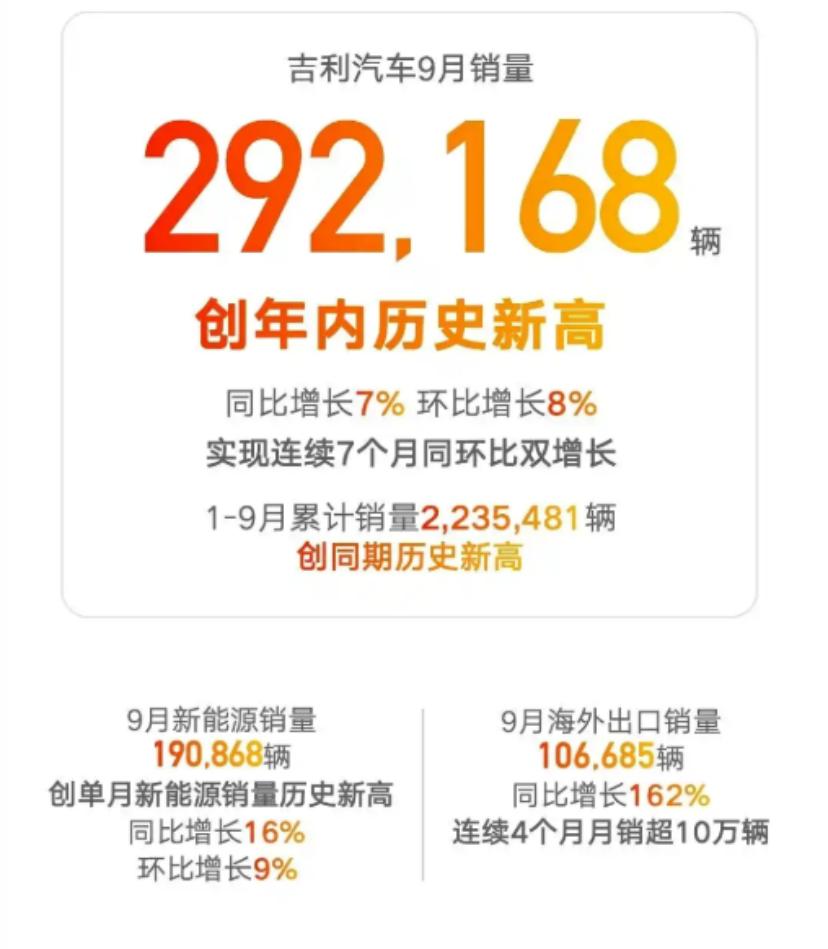
Geely Auto's momentum is more prominent. Its sales in September reached 292,168 units, up 7% year-on-year and 8% month-on-month, achieving double year-on-year and month-on-month growth for seven consecutive months. In terms of new energy, it sold 190,868 units that month, up 15.54% year-on-year, and the penetration rate of new energy models rose to 65%. The overseas market saw explosive growth: overseas sales in September reached 106,685 units, with a year-on-year increase of up to 162%, and overseas monthly sales exceeded 100,000 units for four consecutive months. Geely has clearly proposed to sprint for the annual target of 1 million overseas sales.
Great Wall Motors' performance is relatively sluggish. The company sold 114,944 new cars in September, down 13.99% year-on-year; cumulative sales in the first nine months reached 920,302 units, a slight year-on-year decline of 0.33%. Great Wall's overseas sales that month reached 60,019 units, accounting for 52% of total sales, which is one of the few incremental sources for the company.
The rankings of the new energy new forces camp have also changed significantly. Leapmotor has the strongest momentum. The company delivered 105,656 units in September, up 59% year-on-year, exceeding 100,000 units in monthly delivery for the third consecutive month, firmly ranking first in new forces' sales. In terms of overseas markets, Leapmotor's total exports from January to September exceeded 150,000 units, completing the annual export target ahead of schedule. Xpeng Motors and Xiaomi Auto are also growing simultaneously, both of which delivered more than 40,000 units in September. Xiaomi Auto even exceeded the monthly delivery threshold of 40,000 units for the first time this year, and its all-new model Pengcheng delivered more than 10,000 units in the first month of launch, providing strong support for the company's growth.
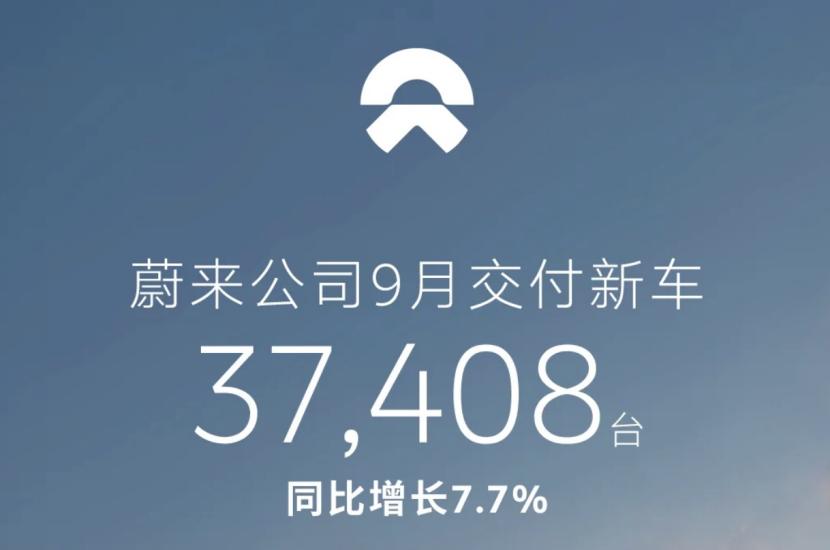
NIO and Zeekr maintained steady growth. NIO delivered 37,408 units in September, up 7.7% year-on-year, with stable performance; Zeekr delivered 37,216 units that month, with a year-on-year increase of up to 103.85%, making it one of the fastest-growing new energy brands that month. Li Auto and Harmony Intelligent Mobility Alliance (HIMA) saw declining performance. Li Auto delivered 31,817 units in September, down 6.29% year-on-year; HIMA delivered 37,490 units that month, down about 29% year-on-year and about 11% month-on-month.
On October 1, Huawei and Seres officially announced the signing of a new five-year cooperation agreement. The two sides will set up a dedicated operation team for the AITO business to further integrate resources from all parties. The competition logic of new forces has changed. The subsequent model iteration speed and product layout cycle will directly determine the market ranking of each brand.
The year-on-year decline in September sales is rooted in the extremely high base in the same period of 2025, rather than the recession of consumer demand. The fundamental of month-on-month recovery in the peak season has not changed. In the stock game environment, market increments are concentrated in the new energy vehicle track, and the market space for fuel vehicles is continuously squeezed. The competition in the domestic stock market is becoming increasingly fierce, and the overseas market has changed from an optional choice to a must-win battlefield, becoming an important source of new increments for automakers. The industry pattern of new forces has not yet been finalized. The product update rhythm, new car launch cycle, and the reputation performance of existing products are still the core variables that rewrite the industry rankings.
Entering the last three months of the year, major automakers have started the final sprint for annual sales and performance, and local car purchase subsidy policies are still continuing. The final sales report card and profitability level of each automaker will be settled at the end of the year.
This article is from the WeChat Official Account "Auto Market Insight", written by Yang Shuo, authorized for release by 36Kr.