Embodied Intelligence Battle Royale: 300 Players Get a Head Start, Only 20 Final Entry Tickets Available
At the beginning of 2025, an investor finished a conversation with the founder of an embodied intelligence project and wrote down a sentence in his memo: "This thing cannot make money within five years, but if you don't invest in it now, you will definitely regret it five years later."
In less than two years up to September 2026, this statement has been repeatedly verified.
Especially after entering 2026, the embodied intelligence track has experienced a rare capital carnival and cognitive tear. According to IT Juzi data, the number of financing events in the embodied track jumped from 105 in 2024 to 333 in 2025, and the amount expanded from 95 billion yuan to 406 billion yuan, surging by 217% and 326% respectively. In the first half of 2026, the number of financing events further rose to 322, almost catching up with the whole year of 2025. The 202 projects with disclosed financing amounts raised a total of more than 934 billion yuan, a year-on-year increase of 350%.
With hot money pouring in, this industry has been rapidly "forced to mature", and investors' judgment criteria have been forced to keep changing.
An investor who has long tracked the track said, "The biggest change in this industry is not whether there is more or less money, but that the first question everyone asks when looking at projects is constantly changing."
In the past, the question was "How good is your technology?", later it was "How much share is available in this round of financing?", and now it is "Who are you delivering your products to?".
From "Unclear Prospects" to "Cannot Miss the Opportunity"
In the first half of 2025, humanoid robots completed the transition from a "niche track" to "mainstream consensus".
The turning point cannot be pinpointed to an exact day, but a frequently mentioned node is the Spring Festival Gala. At the Year of the Snake Spring Festival Gala, 16 Unitree H1 humanoid robots developed by Unitree Robotics participated in the creative dance performance "YangBOT", where the robots performed actions such as rolling handkerchiefs between hands and tossing and catching handkerchiefs for the first time in front of the public.
After the program was broadcast, the effect exceeded expectations and even became popular abroad. The US website Tech Times said that one of the most fascinating moments of the program was when the robots demonstrated their ability to manipulate handkerchiefs. Through precise movements of their mechanical arms, the robots made the handkerchiefs rotate and soar in the air, creating a dazzling visual spectacle that symbolizes the perfect integration of tradition and modernity. Singapore's Lianhe Zaobao stated that it was the first time that 16 robots manufactured by Chinese enterprises performed Yangge dance on the stage of China's Spring Festival Gala through AI reinforcement learning.
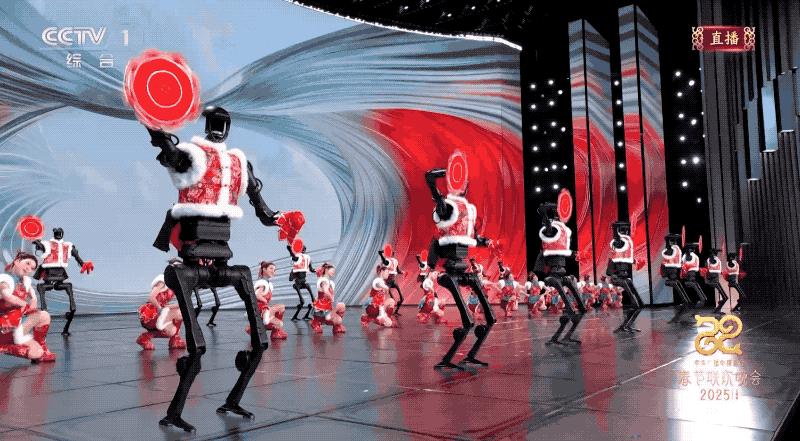
In the prospectus subsequently released by Unitree Robotics, the empowering effect brought by the Spring Festival Gala was also emphasized. The original text reads: "In 2025, the proportion of the company's domestic revenue increased significantly to 56.35%, mainly due to the Spring Festival Gala performance in early 2025, which continuously enhanced the company's brand popularity and attention across the country".
Before the end of February, Zero Power Robot, Zhongke Huiling, Songyan Power, and Zhongqing Robot respectively obtained financing; in March, more than ten robot-related enterprises including Zibianliang Robot, Qianjue Robot, Mech-Mind, Zhipingfang, ExDynamics, and Amio Robot successively announced financing news. In the following months, this financing list grew longer and longer, and the financing amount also became larger and larger. By the middle of the year, a number of enterprises with a valuation of 100 billion yuan had been born in batches.
Apart from the Spring Festival Gala, some people paid attention to robots from another dimension. In April 2025, investor YuBo went to the Beijing Yizhuang Half Marathon site, where 20 robot teams competed against human runners. According to his recollection, the on-site results were not satisfactory: some robots "lay flat" as soon as they started running, some "hit the wall" halfway, and some "fell apart completely". The champion Tiangong finished the race in 2 hours and 40 minutes, while the human champion only took a little over 1 hour.
"But it is precisely those 'fiasco' moments that make me think this is promising." YuBo said, "If a robot runs faster than a human, I would suspect that it is remotely controlled. But those clumsy, stumbling performances instead prove that this is real, early-stage technology. What does the early stage mean? It means there is still huge room for improvement, and it is not too late to enter the market now."
A month later, Brett Adcock, CEO of Figure AI on the other side of the ocean, announced through social media that the new generation of humanoid robot Figure 03 was launched. In the subsequent released demo video, Figure 03 completed long-sequence housework tasks such as making tea, tidying up the room, and washing dishes, and its movement performance was evaluated as "smooth". Its hand dexterity can already complete actions such as picking up tomatoes, eggs, and playing cards separately.
With the two developments at home and abroad superimposed, the carnival belonging to humanoid robots began to enter its climax.
Since the beginning of 2026, the action logic of capital has switched from "judgment" to "allocation". Chen Yu, Managing Partner of Yunqi Capital, believes that "because the track is highly unified now, which is very different from 10 years ago. Ten years ago, there were O2O, online education and other directions; now it is basically AI-related targets, nothing else, and there is definitely more money than 10 years ago. The primary market is essentially asset management. Having raised so much money, we have to invest it out within the specified time; there are no other tracks to choose from. Now everyone is highly concentrated in directions such as AI, robots, and commercial aerospace, and it is nothing more than how to allocate funds in these tracks. If no new industry emerges to attract capital, this state will continue, especially in the primary market. The trend of the secondary market depends on macro liquidity, and whether the primary market can pick up depends on whether there are new tracks to invest in."
Some people also pointed out that the essence of this round of financing carnival is capital's FOMO (Fear Of Missing Out) emotion at play.
With the breakthrough of large model technology, embodied intelligence is regarded by the market as "the ultimate form of AI". Investors are afraid of missing the next "Tesla" or "OpenAI", so they flock into this track. But the problem is that this kind of panic investment is creating a huge valuation bubble.
Huang Jinping, Founding Partner of Rongyi Investment, has a very obvious feeling. He said, "Some popular directions in the track have shown obvious bubbles, which is not a good thing from the perspective of investment. Capital is essentially asset allocation. If a large amount of funds swarm into the track, enterprises will use investors' money to engage in disorderly involution, and excessive competition will eventually hurt the development of the entire industry. At the same time, once an enterprise obtains excess financing, the return expectation of capital will quickly turn into pressure on business growth, forcing enterprises to pursue paths that produce short-term results instead of steadily polishing technologies and products".
After entering the boom period, some investors even knew that some projects might not be delivered successfully, but they still chose to continue to follow the investment.
Chen Yu said, "In popular tracks, capital is prone to herd behavior and group investment, which has happened in many past cycles, such as the sharing economy and energy storage. Funds themselves have established investment cycles and allocation requirements. When investable tracks are highly concentrated, funds will naturally further gather in a few popular directions. Some people will actively push up valuations: the valuation is set very high, and when people see that well-known institutions are participating later and have invested so much money, they will more easily regard it as a top star project, thus further forming a follow-on investment and group investment effect. If an industry is clearly understood, valuations will be rational; if valuations are rational, none of these current valuations can hold up".
Invest in the "Brain", Invest in the "Body", Invest in the Industry, Each Has Its Own Claim
Some subtle changes also began in early 2026. Investors are no longer satisfied with the general label of "embodied intelligence", and start to ask where the value is actually deposited.
The divergence first appeared between the "brain" and the "body".
One group of investors firmly believes that the end game of embodied intelligence is "operating system-level companies", and the core barriers lie in the closed loop of models, data and algorithms. Gao Jiyang, founder of Starsea AI, pointed out that "embodied intelligence lies in the brain, not the form" — a form not driven by a brain is just a pile of scrap metal. The value of the brain is reflected in the part of value that the robot truly generates after completing the work. Therefore, the landing point of the business model should shift from "selling a machine" to "selling the work done by this machine".
Another group of investors insists that the hardware body and engineering capabilities are the "last centimeter" of terminal delivery, and only by doing this step well can we enter real scenarios.
In the same track, two sets of ideas operate in parallel.
The financing distribution in the first 9 months of 2026 confirms this stratification from the side. The total financing amount is rising, but the capital flow is changing. The proportion of capital absorbed by complete machine enterprises has declined, while the investment and financing activity of core components and data infrastructure has risen. "Sellers of water" such as joint modules, force sensors, and tactile perception have become new favorites of capital. The dexterous hand industry has even formed an independent pricing system.
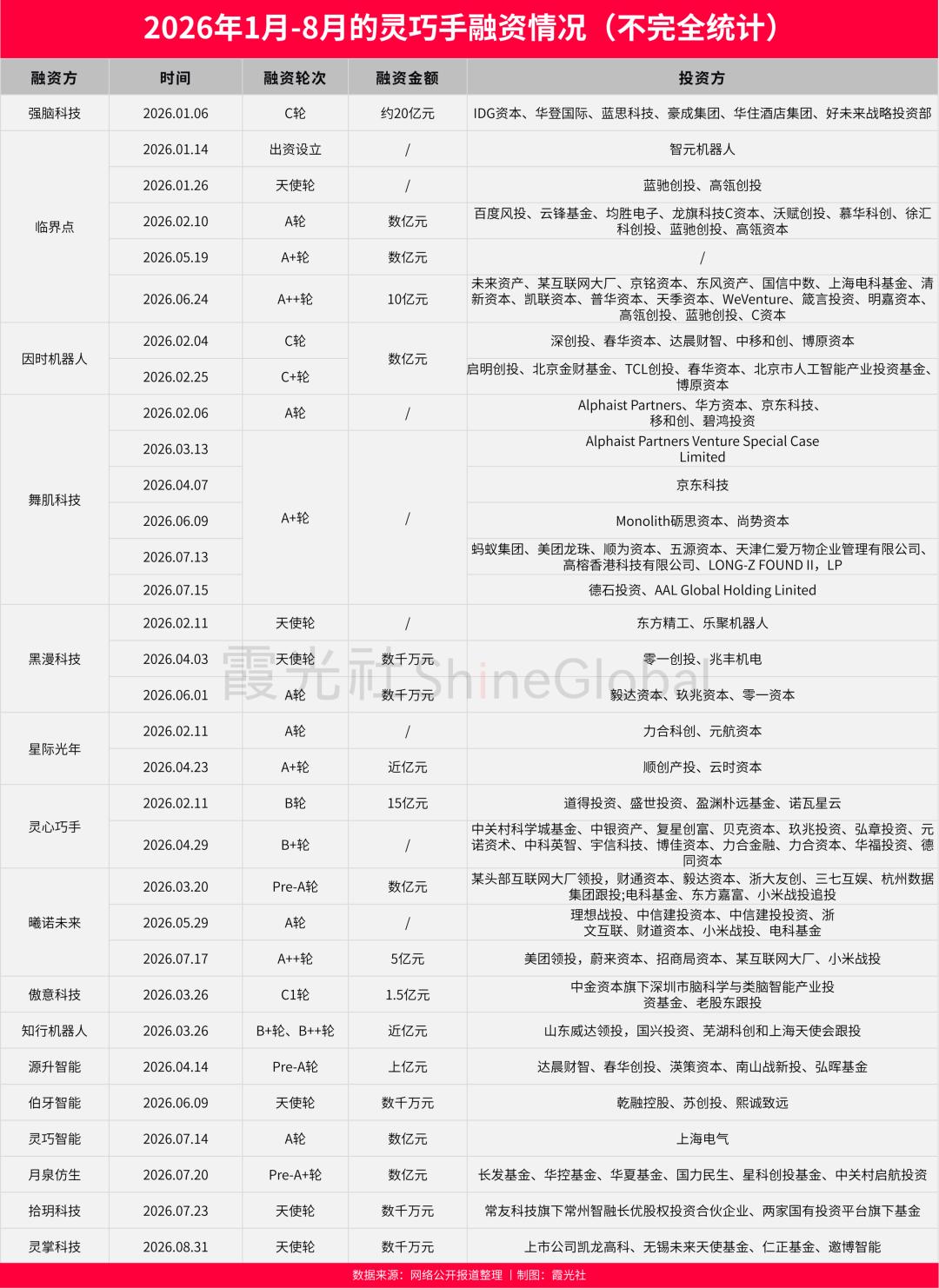
"The difficulty of grabbing shares is comparable to grabbing tickets for Jay Chou's concert." This is the original words of Stephen, Investment Manager of a leading domestic sensor company.
The company he works for has taken a fancy to a leading domestic dexterous hand enterprise and plans to participate in its Series C financing in the first half of the year. The special feature of this enterprise is that it occupies a special position in the field of robot tactile perception and has relevant tactile data foundation.
Other investment institutions and industrial investors have also seen the advantages of this enterprise. According to Stephen's observation, in order to get shares, some investment institutions directly participated in the investment without doing due diligence. Moreover, the interval between the Series C round and the next round of financing of this company is only two weeks. The valuation seen by the two groups of investors differs by more than double. The valuation discussed last month was 3 billion yuan, and those who come again after two weeks have to invest at a valuation of 8 billion yuan.
"It is said that the reason why their two rounds are so close is that there are not enough shares, many people can't get in, so they are forced to open two consecutive rounds of financing". Stephen said. "When everyone is optimistic about the same track, the so-called investment becomes 'grabbing chips'. Whoever can get on the bus can get a share of the pie. As for whether there is a valuation bubble or whether the price is worth it, it has become a secondary issue."
Another divergence is brought about by "listing". After Unitree Robotics and Mech-Mind went public, the media exposed that more than 20 enterprises are queuing up to submit listing applications to the Hong Kong Stock Exchange. This list includes Zhongqing Robot, Zibianliang Robot, ExDynamics, Zhipingfang and many other enterprises. In addition, Qianxun Intelligence, PasiNi Perception, Galaxy General, Songyan Power and other enterprises are actively promoting shareholding system reform to prepare for listing.
The industry's collective rush for high valuations and clustered preparation for listing is obviously somewhat irrational.
Huang Jinping believes that the reason for the irrationality is that the intervention of a large amount of capital has distorted the behavior of enterprises. Capital expectations are also different. Some are industrial thinking, focusing on long-term companionship; some are more financial thinking, just like investing in stocks in the secondary market, rushing in when prices rise, aiming to sell off quickly to make money. However, sometimes things backfire, the bubble pushes the valuation very high, but the enterprise fails to create corresponding value. The industry is overheated in some parts, enterprises cannot deliver expected performance, valuations cannot hold up, fierce competition leads to a decline in gross profit margin, there is no profit, and the growth prospect is also worrying.
At the same time, he pointed out that the industry believes that the robot track has huge future imagination space. We can make a deduction: assuming that 20 robot companies will emerge in the future to carve up a market of 500 billion yuan, the ideal state is to expect everyone to live well, but the reality is probably not. Maybe only three companies are particularly excellent, the 4th to 10th companies can get by, and the rest may not survive. The problem is that at the current point in time, many capitals cannot see clearly who are the top three and who are the top ten; or they see clearly but cannot invest in them. What to do? Then they bet, and also invest in the 11th to 20th ranked companies, otherwise the market voice will question why this institution has not even laid out the embodied track.
The essence of divergence is not who is right and who is wrong, but that capital of different attributes has found different rules of the game in the same track.
"Orders" Become the Only Pass
Listing is always a mixed blessing, which becomes more obvious especially after Unitree Robotics went public.
On August 19, Unitree Robotics was listed on the Sci-Tech Innovation Board at a price of 150.80 yuan per share, and its opening price immediately rose to 1100 yuan per share, with an increase of 629.44%, and its market value once reached 444.9 billion yuan. But it reached its peak right after its debut, and then Unitree ushered in a continuous decline in the following more than a month. As of the close of October 8, the share price of Unitree Robotics was only 427.80 yuan, with a drop of more than 61% calculated from the highest point.
The market's discussion on this round of decline focused on the valuation bubble, but the more fundamental problem lies in the revenue structure of Unitree Robotics — 70% of its revenue comes from scientific research procurement, the industrial scenario accounts for less than 10%, and the repurchase rate is not high.
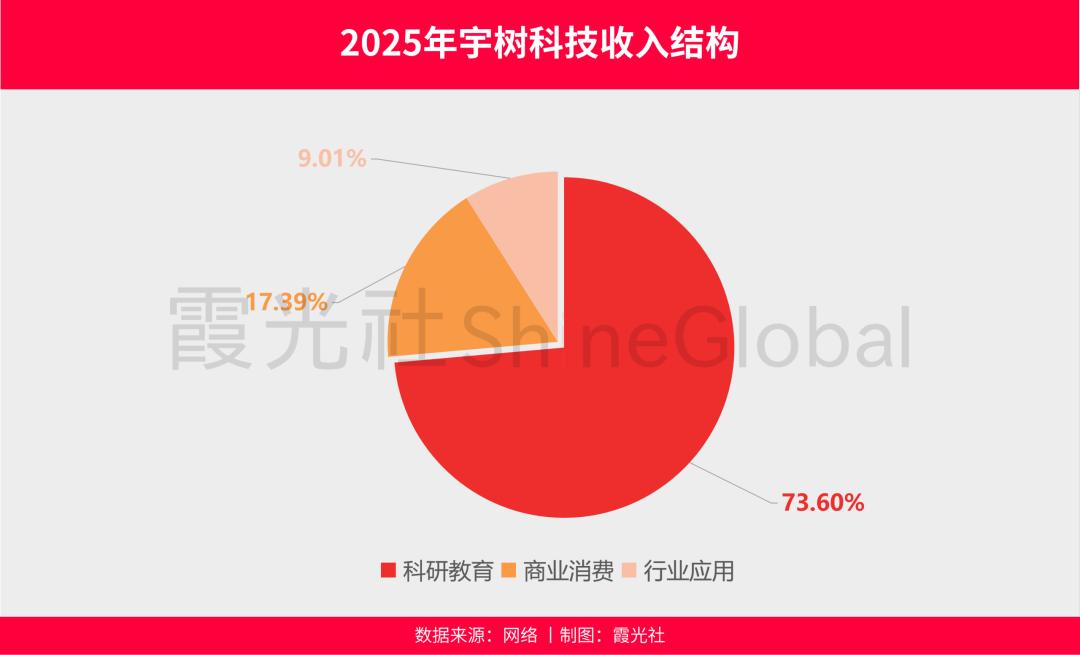
So a question began to be raised repeatedly: "What on earth are your robots doing? Who is paying for them? What is the repurchase rate?"
This question was rarely seriously questioned in 2025, and even in the first half of 2026. At that time, demo videos and parameter comparisons were the protagonists in the BP. In the second half of 2026, many investors clearly stated that demos no longer add points, and "whether there are real customers, whether there are repeat purchases, and whether the unit cost can be justified" have become the prerequisites for making investments.
"Hard data" began to replace