Why is Stephen Chow, who never has to worry about the box office performance of his films, suddenly selling his cinemas for just 1 yuan?
01 Stephen Chow, Why Did He Suddenly Decide to Sell His Cinema Business?
Stephen Chow, whose films never struggle for box office success, is also going to sell his cinemas?
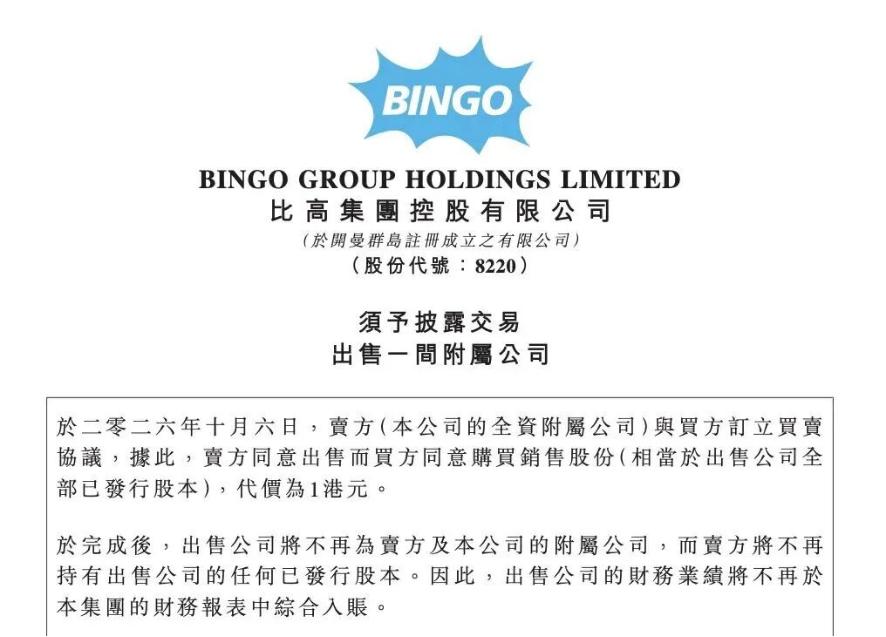
On October 6, 2026, Boke Group (08220.HK), where Stephen Chow serves as executive director and major shareholder, issued an announcement stating that it will sell 100% equity interest in its wholly-owned subsidiary "Boke Cinema Investment Co., Ltd." to an independent third party for HK$1.
This company is mainly responsible for the mainland cinema business. After the transaction is completed, it will no longer be consolidated into Boke Group's financial statements, and Boke will no longer operate any cinema business. In other words, the "cinema operation" business that Stephen Chow launched through the listed company has officially come to an end.
Source: Internet
Why is it priced at HK$1? Is this a marketing gimmick? The answer is that the target itself is not a profitable business. The company mainly engages in cinema operations in mainland China, and recorded an unaudited net liability (excluding inter-company loans) of approximately HK$8.6 million as of August 31, 2026.
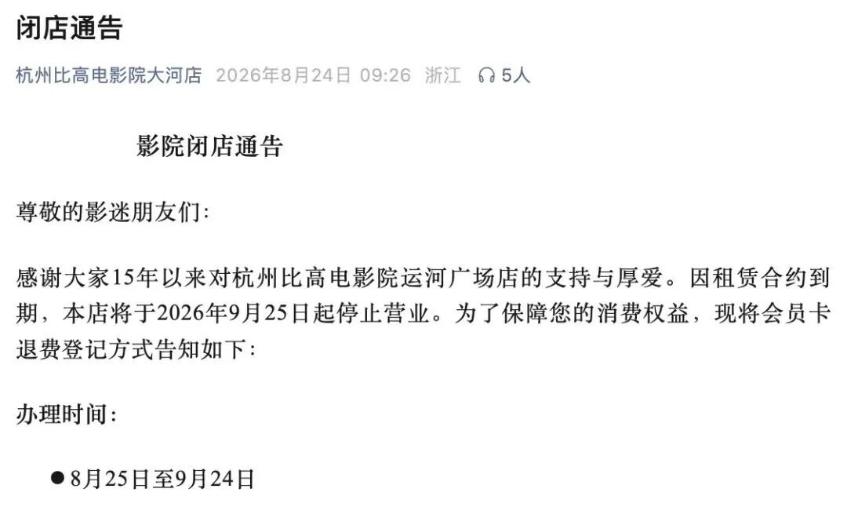
Prior to this, Boke had almost no cinemas left to operate in the mainland. The Boke Cinema Dahe Branch in Hangzhou (also known as Canal Square Branch) had been in operation for 15 years. It issued an announcement on August 24, 2026, stating that its lease had expired, it would cease operations on September 25, and process refunds for membership cards. The Shanghai store closed even earlier, back in May 2023. By the time of the sale, the number of physical cinemas in the mainland had dropped to nearly zero, and selling the company was just a legal way to clear up the remaining mess.
Source: Internet
Then the question arises, why did Boke get into the cinema business in the first place?
Stephen Chow joined the group in June 2010 and currently serves as its executive director and major shareholder. Among the board members, Chow Man Kei, Stephen Chow's elder sister, also serves as executive director. In other words, this company is a listed platform actually controlled by Stephen Chow and his family.
At that time, the mainland film market was in an expansion phase. The box office grew year by year, cinemas were a standard supporting facility in urban shopping malls, and cinema complexes were also being built in second- and third-tier cities. Boke once planned to open 36 cinema complexes within three years, and acquire or take equity stakes in cinema projects in places such as Yongchuan and Beibei in Chongqing, Pixian in Chengdu, and Nanxiang in Shanghai.
The logic was simple: Stephen Chow owned intellectual properties and produced films. By opening its own cinemas, the company could theoretically connect "film scheduling" and "film screening". Once a film was released, its own cinemas could arrange screenings, sell tickets, and sell popcorn, and could also use the "Stephen Chow's Cinema" concept as a brand.
The timing in 2010 was also favorable, as the number of mainland film screens, box office revenue, and cinema complexes in shopping malls were all growing rapidly. Many film and television companies, real estate developers, and capital players all believed that "opening cinemas equals stable cash flow". It was not surprising that Boke entered this track.
But reality soon dealt a blow: a cinema cannot be run well just by borrowing a celebrity's name. Celebrity popularity can bring a boom in popularity when the cinema first opens, but it cannot bring long-term attendance.

Source: Internet
Looking at Boke's financial statements, in the 2026 fiscal year (April 1, 2025 to March 31, 2026), Boke's total turnover was about HK$47.4 million, among which the new media businesses StarBee and Xingyu grew rapidly. However, the cinema business only generated revenue of about HK$2.3 million and gross profit of about HK$1.3 million, a decline from the previous year's revenue of HK$2.7 million and gross profit of HK$1.6 million.
More importantly, compared with Boke's other businesses, the cinema business was becoming increasingly irrelevant. According to the financial report, the company's total turnover in fiscal 2026 was about HK$47.4 million, an increase of about HK$35.3 million from the previous year's HK$12.1 million. The overall revenue increase was mainly driven by the rapid development of the new media business. The StarBee and Xingyu new media businesses launched during this fiscal year contributed about HK$37.8 million in revenue. In contrast, the cinema business accounted for a very small proportion of the group's total revenue.
Moreover, Boke as a whole was not in an easy position. The group still recorded a loss of about HK$26 million in fiscal 2026, compared with a loss of about HK$23.3 million in the previous year. The company's total assets were about HK$68.9 million, cash was about HK$29.4 million, and the liability ratio was about 1.77. In this situation, it is better to cut off a loss-making, non-growing cinema business than to keep it.
After the sale, the group's financial statements will look better, losses are expected to narrow, and the share price may have a chance to rebound.
02 Behind Boke's Case, the Entire Cinema Track Has Undergone Fundamental Changes
In previous years, cinemas were in short supply, and every newly opened cinema was profitable. Around 2015, the national cinema attendance rate was still relatively high, with data from Tuopu showing that the rate was about 17.37% in 2015.
But afterwards, more and more screens were built, while the growth of the audience failed to keep up. Data from Beacon shows that the attendance rate was 10.9% in 2019, remained below 10% for a long time after 2020, reached 7.1% in 2025, and was about 6.6% since 2026. Citing other data, China Economic Net stated that the attendance rate in the first four months of 2026 was only 5.76%.
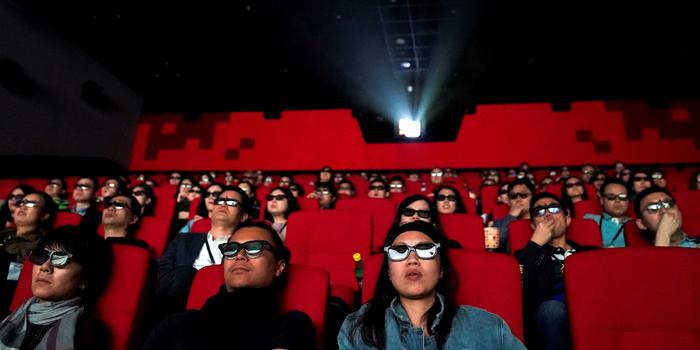
The drop in attendance rate does not mean there is no box office at all, but it is enough to show that most cinema halls are not full most of the time.
China Economic Net once did the math: a cinema with 14 halls has fixed costs of about 300,000 yuan per month including rent, labor, and electricity bills; the daily box office during the May Day holiday can reach more than 50,000 yuan, but after the holiday, it can drop to more than 4,000 yuan on ordinary working days. Fixed costs do not decrease proportionally with the box office, and cinemas can only lose money during the off-season of box office.
Source: Internet
At the same time, the number of cinemas has also become excessive. In 2014, there were only four to five thousand cinemas nationwide, and by the 2026 Spring Festival holiday, the number had exceeded 13,000. The number of screens increased simultaneously. Industry documents in 2025 showed that there were 93,187 screens nationwide, with an average annual output of about 556,000 yuan per screen; other documents showed that the total box office in 2025 was 51.832 billion yuan. With more seats but no proportional increase in the number of audiences, the output per screen has been diluted.
Cinemas are finding it hard to make profits, and there is also the long-standing revenue sharing issue in the industry.
For a 40-yuan movie ticket, taxes and the special fund for film industry development are deducted first, then the remaining revenue is shared among the production, distribution, cinema chain, and cinema parties.
Industry insiders usually estimate that cinemas can finally get about 40% of the total revenue, and the specific proportion varies for different films and different agreements. If the ticket price is low, the attendance rate is low, and the revenue sharing ratio remains unchanged, the gross profit of cinemas will be even thinner.
After counting rent, labor, equipment depreciation, and decoration amortization, it is very difficult for small cinema complexes to operate profitably.
03 Why Can't Stephen Chow's IP Save the Cinema Business?
Many people ask, Stephen Chow's films never have trouble getting box office, why are his own cinemas still losing money?
First of all, IP helps sell movie tickets, not helps a specific cinema sell tickets every day. Audiences go to cinemas for films like *The Mermaid*, *Journey to the West*, and *Kung Fu Soccer Girl*, but they will not come every day just because "this is Boke Cinema". Many people do not even know the connection between Stephen Chow and Boke Cinema.

Source: Internet
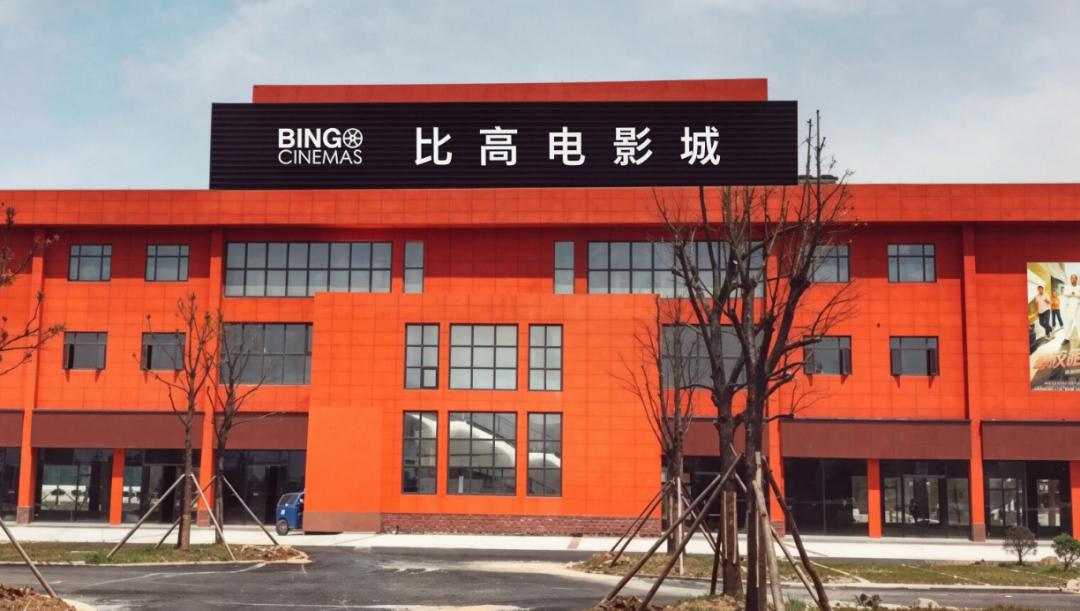
Secondly, Boke had too few cinemas. It does not have the scale and procurement capabilities of Wanda, Hengdian, and Jinyi, which operate hundreds of cinemas. Boke at most deployed a few projects in Shanghai, Hangzhou, and in the early days in Chongqing and Chengdu, and then kept shrinking its business. With only a small number of stores, it had no network effect, nor strong bargaining power with film distributors.
Source: Internet
So the result is very realistic. Although Stephen Chow's films are highly profitable, with *The Mermaid* grossing 3.392 billion yuan and *Kung Fu Soccer Girl* grossing over 2 billion yuan, the total mainland box office of his works as director and core creator has exceeded 8 billion yuan, but Boke's cinema business only generated 2 million yuan in revenue and had a net liability of more than 8 million yuan, forming a sharp contrast.
If Stephen Chow continues to work as a director, producer, and IP developer, he may become more focused by giving up cinema management.
After all, the cinema business is cyclical. If it is only short-term losses, you can wait for the market to recover. But Boke's situation is not suitable for continuing to hold on. On the one hand, with an annual revenue of 2 million yuan, even if it improves to break even, the help to the group as a whole is limited, and it is not worth continuing to invest money in renovation.
On the other hand, the industry downturn will not only last for one or two quarters. With excess screens and short dramas diverting audience attention, the probability of small cinemas turning around is very low. For small loss-making assets, cutting losses early is more worry-free than dragging on.
In any case, for ordinary audiences, it does not matter which cinema they go to watch Stephen Chow's new films. In the future, cinemas will not disappear, but only leading cinemas and cinemas with unique characteristics can survive.
Leading players such as Wanda, Hengdian, and Happiness Blue Ocean reduce costs through scale, membership systems, non-ticket revenue, advertising, and renegotiating leases.
Some other cinemas have launched new businesses such as talk shows, children's plays, e-sports event broadcasts, pet-friendly halls, and integrated catering, transforming into "space operation" providers.
In short, the future competition of cinemas does not lie in "having more screens", but in whether these things are done well: sufficient foot traffic at the location, non-ticket revenue that can make up for box office losses, and stable film supply.
Otherwise, it will be very difficult to recoup costs only by screening films and relying on audiences to check in for celebrity-related gimmicks when the cinema opens.
The cinema business is still viable, but the era when you can make money just by hanging a celebrity's name is gone.
This article is from the WeChat official account "Chief Business Review" (ID: CHReview), written by Qi Yue, published with authorization from 36Kr.