Is Li Auto's L series likely to switch to pure electric, is the range-extender technology really nearing obsolescence?
In September, affected by the L6 model update, Li Auto's deliveries declined both year-on-year and month-on-month, reaching only 31,800 units.
Since 2025, Li Auto has been stuck below the monthly sales threshold of 40,000 units. Even after launching a pure electric product line and creating a hit model like the i6, it has struggled to break into the first echelon of new car-making forces by sales volume.
Against this backdrop, rumors that Li Auto will also launch pure electric products under its L series have emerged from time to time. Recently, another internet blogger revealed that Li Auto's Changzhou plant will renovate its production lines at the end of October to prepare for the pure electric L series.
Although the news has not been confirmed, the rumor itself reveals some clues. As an automaker that started with extended-range technology, Li Auto's move to add pure electric models to the L series beyond the i series is not only a strategic adjustment to its own product line, but also reflects the energy route shift of the entire new energy vehicle market.
Monthly sales stuck at 30,000 units, pure electric L series is launched to seek incremental growth
At the end of 2024, Li Auto's deliveries approached 60,000 units, hitting a historical peak. However, after 2025, the market environment took a sharp downturn. Li Auto not only failed to reach the 50,000-unit monthly sales mark, but also struggled to stay stable above the 40,000-unit threshold. In the whole year of 2025, only two months (May and December) saw sales exceeding 40,000 units, while sales in multiple months were even less than 30,000 units.
Facing the difficult situation, Li Auto is also actively seeking changes, and the launch of the i series is a very significant move.
Li Auto i8 was launched at the end of July 2025, followed by the i6 at the end of September. The driving effect of the i6 was immediate. Shortly after its launch, it became a new sales pillar, with an average monthly delivery of nearly 20,000 units, far exceeding the previous target of 9,000 to 10,000 units. After the production capacity ramp-up was completed in March this year, its monthly sales once hit 24,000 units.
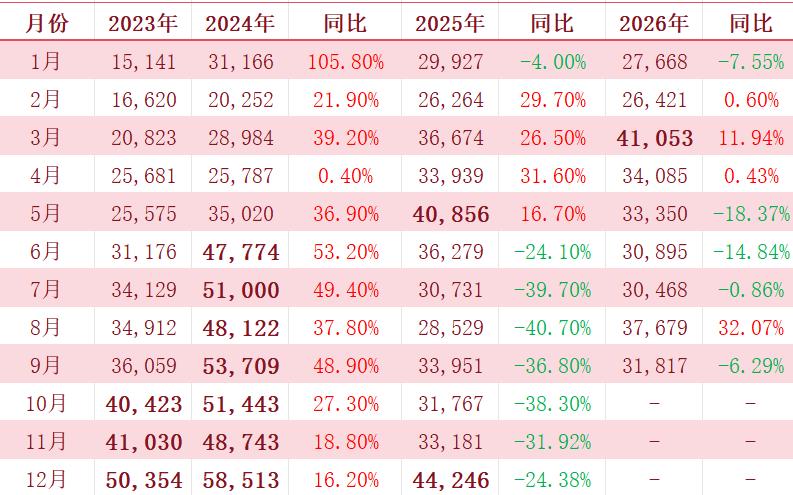
Figure | (Monthly sales of Li Auto in the past 4 years and year-on-year growth)
However, the emergence of hit models has not brought an overall improvement in the brand's total sales.
Since Li Auto has laid out two product lines of extended-range and pure electric at similar positioning and price ranges, internal competition is inevitable. An obvious signal is that while the sales of the i6 are soaring, the L6, which used to be the sales pillar, has started to decline. While this is partly due to the overall cooling of the extended-range market, the main reason is that the two series are targeting the same group of users.
Compared with the avant-garde design of the i series, the square and grand appearance of the L series is more in line with the mainstream aesthetic for family vehicles. If the pure electric version is launched, it is expected to drive incremental growth with its appearance advantage, helping Li Auto return to the monthly sales range of 40,000 units, which is the core business logic behind the rumor of the pure electric L series.
In this assessment, the biggest significance of launching the pure electric L series lies in how much it can drive Li Auto's sales and business performance.
This can actually be broken down into two core points: first, whether it will cause internal friction with the i series and squeeze the existing pure electric sales; second, whether it can open up real incremental growth to push the overall brand to a new level.
From the perspective of competition, the premise of laying out two pure electric product lines is the market differentiation between the two major product lines. At present, the i series attracts users who focus on a sense of technology with its avant-garde design, low wind resistance and long range, while the L series is known for its square shape and spacious interior space. The two do have certain differentiation.
However, if the pure electric version of the L series is launched, it will most likely enter the price range of 250,000 to 300,000 yuan, which is close to that of the i6. Users will face the choice of "choosing between the i series and the L series for pure electric vehicles at the same price", and internal friction is almost inevitable. The diversion of users from L6 to i6 has already staged a preview in advance.
Then look at the incremental growth. If the pure electric L series can complement the i series, taking family practicality and avant-garde technology as respective entry points to cover users with different aesthetics and demands, differentiated competition can still be achieved. For Li Auto, switching the energy form based on the existing L series platform allows the three-electric system to be shared with the i series, which can effectively control R&D costs and further dilute the investment in the platform and supply chain.
But the premise of all this is that the new incremental growth is large enough to cover the mutual diversion between product lines. If after the launch of the pure electric L series, the total sales of the brand still hover around 30,000 units, the two-line layout will only further fragment the existing market and cannot bring substantial growth.
A more realistic market judgment is that with the development of power batteries to date, pure electric vehicles in the 250,000-yuan price range basically have little range anxiety in daily use, and consumers' sensitivity to cruising range is gradually decreasing. In contrast, the impact of vehicle styling on car purchase is increasing, and it has even become a key factor.
This means that the pure electric L series is likely to divert a considerable part of the sales of the i series in a short period of time. Users who like the appearance of the L series have no reason not to choose a pure electric L series with comparable product strength and sufficient cruising range. The key is whether this diversion can be covered by larger incremental growth, and whether it can still bring sufficient net incremental growth after the possible decline of the i series.
The i series has proved that Li Auto can create pure electric hit models, but it has failed to achieve an overall brand leap. The mission of the pure electric L series may be to open up new boundaries in the pure electric vehicle market.
The decline of the extended-range market has become a foregone conclusion
Behind the speculation about the pure electric Li Auto L series, there is another hidden problem that has not been noticed: as an automaker that started with extended-range technology, why is Li Auto widely predicted by the outside world to fully expand its pure electric product line?
As an automaker that is highly sensitive to market trends and has the ability to make predictions, Li Auto's moves are highly representative. When the outside world's speculation focuses on the fact that the classic L series will also launch pure electric models, it also reflects the reversal of the market positions of extended-range and pure electric vehicles.
Recently, data released by Mobility Global shows that the global automotive market has witnessed a historic turning point in the first half of 2026. The share of new pure gasoline vehicle sales dropped to 49%, falling below 50% for the first time since the popularization of automobiles, a sharp 24% decline from the 73% share in 2021.
Correspondingly, the share of pure electric vehicles is rising steadily. According to statistics recently released by the Clean Technica website, in June this year, the global penetration rate of electric vehicles reached 30%, of which the penetration rate of pure electric vehicles was 22%, becoming the core driving force for the growth of the new energy market.
Focusing on Li Auto itself, the change in its sales structure is more intuitive. From January to August 2026, Li Auto's cumulative sales reached 261,600 units, of which the sales of the single i6 model reached 152,800 units, contributing more than half of the total sales, while the sales of extended-range models continued to shrink.
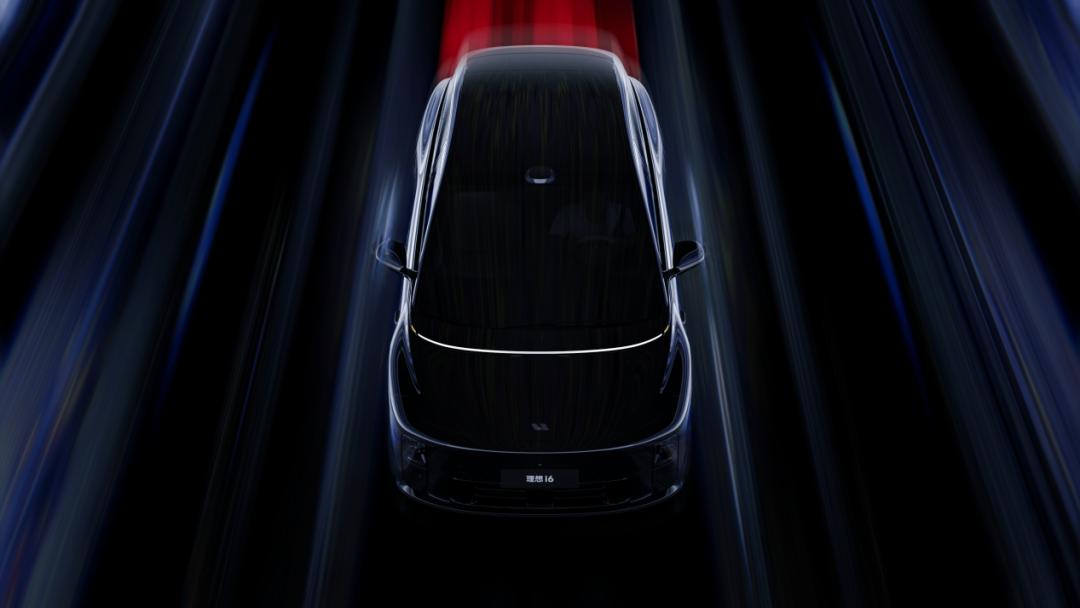
In the 200,000-yuan-level pure electric market that Li Auto focuses on, the i6 has long been firmly among the top three in market sales for a long time, competing on equal footing with the Xiaomi YU7 and Tesla Model Y.
This is actually a very interesting phenomenon. The positioning and styling of the three cars are not conservative, but avant-garde. The Model Y is the pioneer that first opened up the SUV market above the 200,000-yuan price range. Its coupe-like styling that looks like a mouse is quite different from mainstream SUVs. The Xiaomi YU7 adopts a rare FUV supercar styling, while the teardrop design of Li Auto i6 is extremely disruptive.
This is somewhat similar to Geoffrey Moore's theory of crowd segmentation. In *Crossing the Chasm*, he divides users by their insight ability and adoption sequence into: 2% innovators, 14% early adopters, 34% early majority, 34% late majority, and 16% laggards.
In the early stage of innovation, the 2% innovators and 14% early adopters have higher acceptance of avant-garde designs, which explains why models with niche styling can occupy the top of the segment market in the early market stage.
However, as the pure electric market matures, the early majority and late majority have become the main consumer groups, and models that meet mainstream aesthetics begin to gain advantages. In recent years, square box SUVs with a square and grand appearance have continued to gain popularity, and the design of high-end flagship models has also returned to regular and neat styling one after another. These can all be regarded as signals that the market is returning from avant-garde to mainstream.
For the pure electric SUV market, radical-designed pioneer models will gradually give way to mainstream models that meet the public's aesthetic preferences. The square styling of Li Auto L series exactly fits this trend, which is the more core advantage of the pure electric L series over the i series.
As for the original extended-range market of the L series, at a time when new energy vehicle sales continue to rise, extended-range vehicles are the only category among the three new energy routes that have seen declines in both wholesale and retail sales, and their market share is also decreasing. For Li Auto, it is no longer realistic to rely on extended-range models to maintain growth. It is almost an inevitable choice to fully shift to pure electric vehicles and cover more mainstream users.
Behind the rumors of Li Auto L series, in addition to the speculation about the product line adjustment of an automaker, we can also see subtle changes in factors affecting users' car purchase decisions, industry energy forms and even segmented markets.
It is still unknown whether Li Auto will launch the pure electric L series, but no matter whether it does so or not, the industry's trend of decelerating extended-range development and accelerating pure electric development is already clear. The pure electric era of the mainstream family vehicle market is truly coming.
This article is from the WeChat official account "Auto Community" (ID: iAUTO2010), written by Sai Jiatong, published with authorization from 36Kr.