China National Petroleum Corporation's 48 million-yuan large charging project in Hainan has been officially settled. Competitors that have deployed 900,000 charging piles are still operating at a loss. Where lies the key to the success or failure of China's three major state-owned oil giants in their green transformation?
The three major state-owned oil giants are transforming gas stations into charging networks via public bidding to advance green transition.
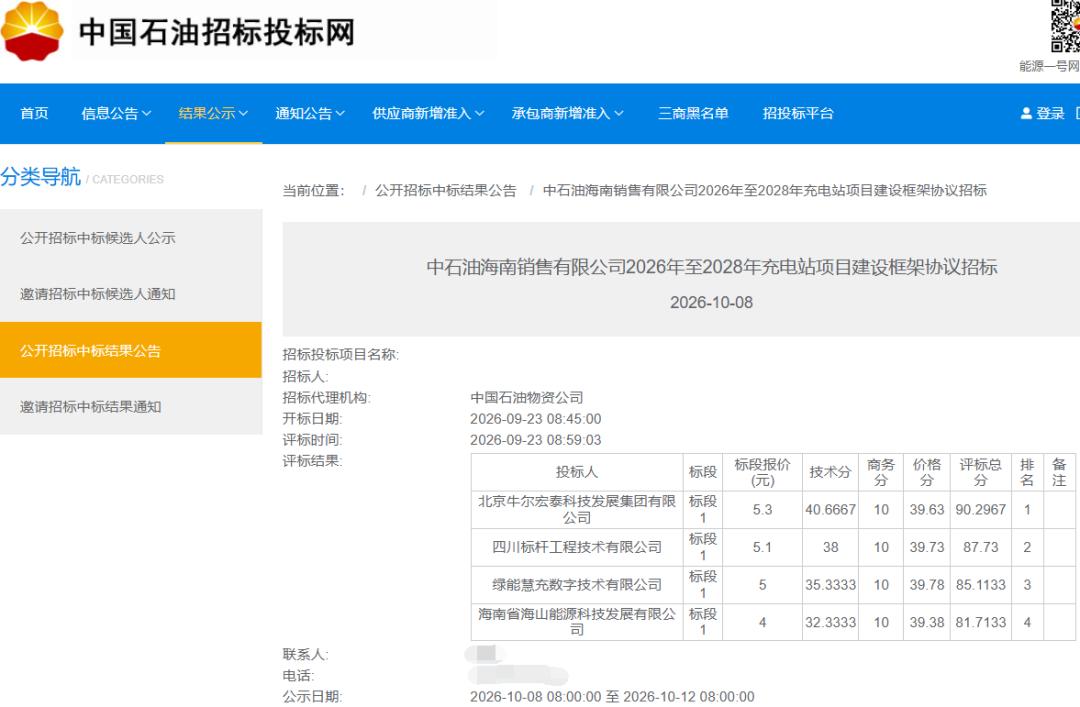
Energy Insights learned that on October 8, PetroChina Hainan Sales Co., Ltd. publicized the bid winning results of the 2026-2028 charging station project construction framework agreement. Four contractors, namely Beijing Niuer Hongtai Technology Development Group Co., Ltd., Sichuan Benchmark Engineering Technology Co., Ltd., Green Energy Huichong Digital Technology Co., Ltd., and Hainan Haishan Energy Technology Development Co., Ltd., will share this three-year contract with a total budget of 48 million yuan. The order covers the construction of all charging stations of PetroChina in Hainan and its holding and participating companies.
Viewed in isolation, this order is not large, but when placed in the overall coordinate system of the three major oil giants' charging networks, it is a segment worth dissecting. The three oil giants are using their most familiar method of public bidding and outsourcing to transform the gas station network into a charging network, and the green transition ledger behind this network may be far more complex than the charging piles themselves.
01
How many charging piles have the three major oil giants deployed respectively
Kunlun Grid Power, PetroChina's charging operation platform, covers 31 sales enterprises across the country, with more than 7,000 charging stations. Its monthly charging volume exceeds 300 million kWh, a figure that stood at only 100 million kWh a year ago. According to reports from Chezhuangwang, in the first 5 months of 2026, the charging volume of PetroChina's sales enterprises increased by 158.3% year on year.
Sinopec is moving faster than PetroChina. At present, it has nearly 13,000 operating charging and battery swapping stations covering more than 400 cities, with annual charging volume exceeding 5 billion kWh. Its strategy is "station inside a station", which makes use of the prime locations of more than 30,000 energy stations across the country to access charging services without adding new construction land.
CNOOC has a significantly different path from the former two, and its overall pace is the slowest. Energy Insights has not retrieved the latest data. According to previous reports, as of December 2024, CNOOC Refining & Chemical has built more than 150 comprehensive energy stations integrating multiple energy supplies such as charging, battery swapping and photovoltaic power, with over 1,000 operating charging guns. In the first half of 2026, CNOOC added 18,500 new charging guns. Instead of deploying on a large scale, it integrates photovoltaic, energy storage and charging into one energy system, and has built the largest photovoltaic-storage-charging integrated project in China's offshore oil and gas equipment manufacturing sector in Zhuhai.
PetroChina's moves in Hainan are very clear in this context. Hainan is one of the provinces with the highest penetration rate of new energy vehicles in China, and the whole province is devoting efforts to promoting new energy. PetroChina has ranked first among more than 200 charging and battery swapping operators in Hainan in terms of market share. The 48 million-yuan framework contract is essentially PetroChina's continuous investment to increase station density and consolidate its leading position in the dominant market.
02
The three major oil giants and third-party service providers
What is the fundamental difference between them
Putting the three major oil giants together with Teld and Star Charge for comparison, it is easy to draw a rough conclusion: central SOEs have sufficient capital, land and brand advantages, while private enterprises have technology and operation experience. The actual situation is far more complex than this judgment.
Teld and Star Charge are essentially charging operators, making profits from service fees, equipment sales and platform SaaS. Their site selection logic follows the traffic flow, deploying piles where charging demand is dense. The logic of the three major oil giants is completely different.
Their core assets in hand are gas stations, most of which are located on urban main roads, expressway entrances and exits and transportation hubs. Transforming a gas station to install charging piles does not require additional land acquisition, re-approval procedures, or building power supply supporting facilities from scratch.
Sinopec Shaoyang Dongfang Energy Station is a typical case. It uses the idle space on the gas station slope to lay photovoltaic modules, supporting fast charging parking spaces and energy storage systems. No new construction land is added throughout the process, and triple revenues from photovoltaic power generation, charging service fees and convenience store sales are realized at the same time.
On the other hand, the shortcomings of the three major oil giants are equally obvious. The charging service fee has dropped from 20-30 cents per kWh to around 17 cents, and the net profit after deducting power loss and operation and maintenance costs is only 4 cents. The daily utilization rate of a single charging gun of PetroChina Anhui Sales remains stable above 12%, while the industry-recognized break-even line is between 8% and 10%, which means 12% is just above the passing line.
03
The ledger of green transition
It is far more than charging piles
Apart from charging piles, the three major oil giants have completely different ideas for green energy transition, rooted in their respective asset structures.
But first, we need to answer a more fundamental question: why do the three major oil giants have to carry out transition? This is not following the trend, nor is it entirely an active choice. The pressure from the policy side is rigid. The State-owned Assets Supervision and Administration Commission has included energy consumption and greenhouse gas emission indicators into the business performance assessment of enterprise leaders, with indicators decomposed level by level and strictly assessed and implemented.
In the first half of 2026, the General Office of the Communist Party of China Central Committee and the General Office of the State Council intensively issued three documents on energy conservation and carbon reduction, putting forward the "reducing coal and controlling oil" initiative for the first time, and the total petroleum consumption has become a "one-vote veto" indicator for local Party and government authorities. Carbon emission has changed from a "soft indicator" to a "hard constraint", so the transition of the three major oil giants is no longer a matter of whether to do it, but a matter of how fast to push it forward.
However, policies alone cannot explain the investment intensity of the three major oil giants in green power and green hydrogen. The more direct driving force comes from their main business itself. In 2025, the revenue and net profit of the three major oil giants declined collectively, and oil and gas sales business accounted for 81%, 61% and 84% of the revenue of PetroChina, Sinopec and CNOOC respectively. Over-reliance on oil and gas means that once the oil price falls, the performance will slump.
PetroChina proposed the "second growth curve", and Sinopec called for the transformation into a comprehensive energy service provider covering "oil, gas, hydrogen, electricity and services". In essence, both of them are looking for backup for their future revenue structure. Policy is the bottom line, and finding new growth poles is the real driving force.
Back to the respective strategies of the three major oil giants. PetroChina adopts the "self-production for self-use" model. A large number of onshore oil and gas fields consume large amounts of power. Using self-built clean power to replace purchased grid power can save electricity costs as profits, and carbon reduction is a by-product. It does not need external customers, and internal consumption can make the business operate smoothly. Its idea is the most stable, but also the most dependent on the power consumption scale of oil and gas fields.
Sinopec follows the "demand first" logic. The refining process requires a large amount of hydrogen. It first uses clean hydrogen to replace the original hydrogen production, and then expands production capacity to the upstream. It locks in consumption scenarios first, and then builds supply, so its commercial closed loop does not rely on the maturity of the external market. The risk is low, but the pace is constrained by refining demand.
CNOOC takes the "scenario-driven" path. Offshore platforms are far away from the grid, with high energy consumption costs and great emission reduction pressure, so it can only develop off-grid new energy and carbon sequestration. The threshold is high and replication is difficult, but once the model is verified, it will directly change the energy consumption structure of offshore operations. It does not pursue scale, but focuses on the rigid replacement of its own high-carbon scenarios.
None of the three companies chose to compete with power generation enterprises in the same track, but use new energy to replace the highest-cost purchased energy in their own production links. The effect has been reflected in cost reduction and carbon reduction, but the proportion of new energy in revenue and profit is still very small.
In 2025, the revenue and net profit of the three major oil giants declined collectively, among which oil and gas sales still occupied an absolute dominant position. The direction is clear, and the speed is restricted by the profitability of their oil and gas main business. None of the three companies rely on new energy for survival, which is an advantage, but also the reason why the transition cannot move fast, as there is no sense of urgency.
Back to the 48 million-yuan charging station framework contract of PetroChina Hainan. It is not an isolated bidding event, but a tiny footnote of the three major oil giants shifting from "selling oil" to "selling electricity". The station construction speed can be guaranteed by framework bidding, but answers to questions including whether charging piles can make profits, whether green hydrogen can achieve real parity, and whether the operation and maintenance cost of offshore wind power can be controlled cannot be found in the bidding documents.
The advantage of the three major oil giants in promoting green transition is that they do not need to rely on new energy to make a living. The disadvantage is exactly the same: when a business can survive without making profits, the speed of verifying its commercial model is often slower than market expectations.
Energy Insights will continue to pay attention to the practices and effects of the three major oil giants in green energy transition.
This article is from the WeChat Official Account "Energy Insights", written by Wang Mengjiao, and published with authorization from 36Kr.