The First Airport has changed hands.
China's top airport has rotated among Beijing Capital International Airport, Guangzhou Baiyun International Airport and Shanghai Pudong International Airport over the past few years, with each taking the leading position in turn.
Before 2019, Beijing Capital International Airport ranked first in passenger throughput, with no other airport able to surpass it. In that year, the passenger volume of Capital Airport reached 100.01 million, making it the only airport in the country with annual passenger flow exceeding 100 million. In September 2019, Daxing International Airport was officially opened, gradually diverting passenger flow from Capital Airport. Affected by the black swan event in 2020, the passenger throughput of Beijing Capital International Airport dropped to the 5th place nationwide, and Guangzhou Baiyun took the first spot.
From 2021 to 2023, Guangzhou Baiyun Airport firmly held the top position. In 2024 after the end of the black swan event, the passenger flow of Shanghai Pudong International Airport recovered rapidly, surpassing Guangzhou Baiyun and taking the first place.
In 2025, the total passenger throughput of Shanghai's airport cluster has exceeded 130 million, among which Pudong Airport recorded over 80 million passenger trips and Hongqiao Airport over 50 million, both hitting all-time highs. Shanghai Pudong has been listed into the world's top 10 airports, becoming the most popular airport in terms of passenger flow in China.
The title of China's top airport this year will undoubtedly belong to Guangzhou. Because from the first quarter to the third quarter of this year, Guangzhou Baiyun Airport has been leading the country in passenger flow.
The latest official data shows: In the first three quarters, Guangzhou Baiyun Airport recorded 67.029 million passenger trips, ranking first nationwide. In addition, its year-on-year growth rate reached 9.7%, also ranking first among the top 20 airports in China. Shanghai Pudong, ranking second, recorded 66.588 million passenger trips, with a year-on-year increase of 4.7%.
It seems that the gap between Shanghai Pudong and Guangzhou Baiyun is not large, and as long as Pudong makes efforts in the fourth quarter, it still seems possible to hold the first place.
However, according to historical data, the fourth quarter of each year is the peak passenger flow period for Guangzhou Baiyun Airport, and its quarterly passenger volume is generally one million more than that of Shanghai Pudong.
In addition, this year is the APEC year, and the APEC Summit will be held in Shenzhen in November. Leaders and delegations from many countries around the world will come to Shenzhen for the meeting, and this international passenger flow will inevitably spill over to Hong Kong Chek Lap Kok Airport and Guangzhou Baiyun Airport, which have more international routes.
Therefore, it is almost certain that Guangzhou Baiyun Airport will return to the top by the end of the year.
Why is Guangzhou Baiyun Airport growing so fast?
It is not difficult to understand why Guangzhou Baiyun Airport has returned to the top in passenger flow.
After all, since Beijing Capital Airport had its passenger flow diverted by Daxing Airport, the top airport in the past five years has basically alternated between Guangzhou Baiyun and Shanghai Pudong, with the two chasing each other. Besides, Beijing, Shanghai and Guangzhou are the three major gateway cities in China, responsible for North China, East China and South China respectively.
However, with such a large scale, Guangzhou Baiyun Airport still achieved a 9.7% growth rate, ranking first among the top 20 airports in China in the first three quarters of this year, which makes people wonder the reason behind it.
This official account believes there are three main reasons:
First, it benefits from the runway expansion of Baiyun Airport.
In October 2025, the T3 terminal and the fifth runway of Baiyun Airport were put into use simultaneously. Baiyun Airport has officially entered the era of "five runways + three terminals", with its short-term passenger support capacity increased to 120 million passenger trips per year, and the long-term capacity reaching 140 million passenger trips per year.
Previously, capacity was one of the biggest bottlenecks for Baiyun Airport, and now this bottleneck has been greatly removed. In the first half of the year, Baiyun Airport recorded 281,400 aircraft takeoffs and landings, up 5.88% year on year. During the summer travel peak, its passenger throughput in July and August reached 16.2152 million, up 12.1% year on year. The single-month passenger volume in August even hit 8.394 million, exceeding 8 million for the first time. The annual passenger flow this year is expected to exceed 90 million, hitting a new record high.
Second, international passenger flow is becoming the strongest growth driver for Baiyun Airport.
In the first half of the year, the passenger throughput of international routes at Baiyun Airport increased by 19.6%, far higher than the overall growth rate of 8.2%. From January to August, the airport has opened or increased the frequency of more than 30 international passenger routes, adding and restoring multiple destinations in Central Asia, Southeast Asia, Australia, New Zealand and other regions, with international passenger volume increasing by about 18% year on year.
In the first 9 months of this year, the number of entry-exit passengers inspected at the port of Baiyun Airport exceeded 15 million, up more than 18.3% year on year, hitting a new all-time high for the same period.
The airport authority also clearly stated that the visa-free policy, the integration of aviation, culture, tourism and convention and exhibition industries in Guangzhou, and the Canton Fair's attraction to overseas business travelers have jointly promoted the growth of international passenger flow.
Guangzhou itself is an export-oriented economic city, and the Canton Fair, cross-border trade, international business activities and tourism together form a stable source of international passenger flow.
During the Canton Fair this year, the number of entry-exit passengers at the port of Baiyun Airport exceeded 1.14 million, up 14.5% year on year, among which the number of foreign passengers exceeded 540,000, up 20.8% year on year.
Third, the economic vitality of Guangzhou itself is being converted into passenger flow.
In the first quarter, Guangzhou achieved a real GDP growth rate of 6%, 1 percentage point higher than the national average, leading the top 10 cities in GDP. Chongqing's growth rate was only 4.5%, ranking last among the top 10 cities, 0.5 percentage point lower than the national average.
In the first half of the year, Guangzhou's GDP growth rate reached 5.8%, 1.1 percentage points higher than the national average, tying for first place with Shenzhen among the top 10 cities.
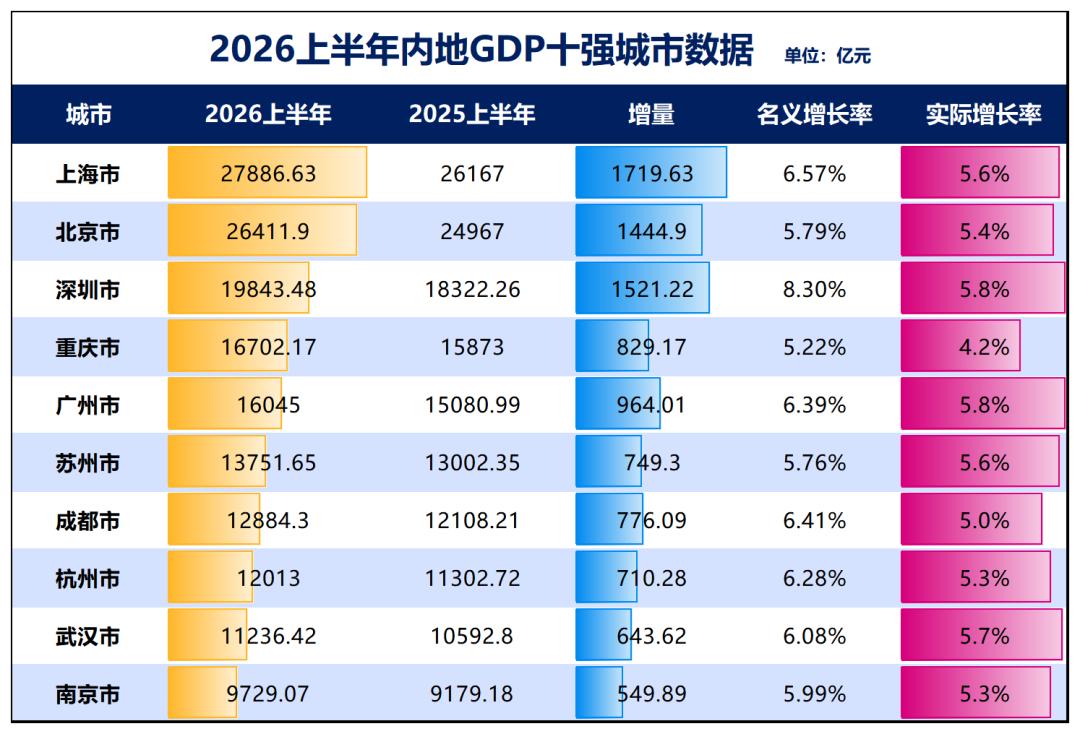
Cartography: City Finance; Data: Statistics bureaus of various cities
The return of growth is backed by the recovery of industrial growth. In the first half of the year, the added value of industrial enterprises above designated size in Guangzhou increased by 6.6%. Behind the recovery of industrial growth, the three leading industries in Guangzhou have achieved rapid growth again. The automobile manufacturing industry grew by 9.1%, the electronic product manufacturing industry grew by 11.2%, and the petrochemical manufacturing industry grew by 5.2%. At the same time, the number of entry-exit passengers in Guangzhou in the first half of the year exceeded 10.44 million, up 18.5% year on year.
Therefore, overall, the underlying reason for Baiyun Airport returning to the top is that Guangzhou's industry, trade, convention and exhibition, tourism and international exchanges have jointly formed a combined force.
This time, Baiyun Airport returning to the top does not rely on a one-time passenger flow peak, but on the simultaneous release of infrastructure expansion, international passenger flow growth and urban economic vitality.
The superposition of these three forces has allowed Guangzhou to regain the top spot as the busiest airport in China.
Guangzhou will become the fourth city with two airports
In addition to a single airport returning to the top in passenger flow, the construction of Guangzhou's second airport is also in full swing. Interestingly, Guangzhou's second airport is not located within the territory of Guangzhou, but in Foshan, with the tentative name of Pearl River Delta Hub Airport at present.
Such cases are not rare.
For example, Xi'an Xianyang International Airport is not under the jurisdiction of Xi'an, but located in Xianyang. Xining Caojiabao Airport is not located in Xining, but in Haidong City. Lhasa Gonggar Airport is not located in Lhasa, but in Shannan Prefecture. In addition, Shanghai's third airport is not located in Shanghai, but in Nantong, Jiangsu Province.
Foshan has carried out regional expansion to build this airport. In October 2025, Foshan released the Announcement on Partial Changes to the Administrative Boundary Between Foshan City and Zhaoqing City: With the approval of the People's Government of Guangdong Province, the partial changes to the administrative boundary between Foshan City and Zhaoqing City are announced as follows: 9 administrative villages including Chiao, Gaobu, Linan, Liangcun, Yiqing, Dongkou, Jingdong, Pingling and Yunlu in Jiaotang Town, Gaoyao District, Zhaoqing City are put under the jurisdiction of Guihe Town, Gaoming District, Foshan City. After the change, Guihe Town in Gaoming District, Foshan City governs 28 administrative villages and 3 communities, and the seat of the town people's government remains unchanged, at No. 355, Guihe Avenue.
In short, 9 villages in Jiaotang Town, Gaoyao District, Zhaoqing City have been transferred to Guihe Town, Gaoming District, Foshan City.
Article 8 of the Regulations on the Administration of Administrative Divisions issued in 2019 clearly stipulates: For the change of partial administrative boundaries of counties, cities and municipal districts, and the relocation of the seat of the people's governments of counties, cities not divided into districts and municipal districts, the State Council authorizes the people's governments of provinces, autonomous regions and municipalities directly under the Central Government to make examination and approval decisions; when the change is approved, it shall be reported to the State Council for the record at the same time. That is to say, the State Council has delegated the right to approve partial administrative boundary changes of counties, county-level cities and municipal districts to provincial-level administrative units.
The adjustment between Zhaoqing and Foshan falls into this category.
The villages remain the original villages, with no changes to their names and territories. Only the boundary between Gaoming District of Foshan and Gaoyao District of Zhaoqing has been moved towards the Zhaoqing side, and the 9 villages that originally belonged to Gaoyao District of Zhaoqing have been transferred to the territory of Gaoming District of Foshan.
Therefore, it only needs the approval of the People's Government of Guangdong Province, and then be reported to the State Council for the record. This administrative division adjustment in Foshan is prepared for the construction of the airport, to clarify the administrative boundary.
The reason why this airport is called Guangzhou's second airport is that no matter from the perspective of official publicity caliber or equity distribution, it is undoubtedly Guangzhou's second airport.
In the official publicity caliber, in the "15th Five-Year Plan" released by the state earlier this year, the new Guangzhou airport is still mentioned as follows: Improve the capacity of world-class airport clusters in the Beijing-Tianjin-Hebei region, Yangtze River Delta, Guangdong-Hong Kong-Macao Greater Bay Area and Chengdu-Chongqing region, complete the construction of new airports in Dalian and Xiamen, build new airports in Guangzhou and Nantong, promote the preliminary work of new airports in Chongqing and Sanya, and carry out expansion and renovation projects of hub airports including Shenyang, Changchun, Nanjing, Hangzhou, Wenzhou, Zhengzhou and Chengdu Tianfu. Promote regional airport projects such as the relocation of Yanji Airport and Yining Airport.
In terms of equity distribution, Guangdong Airport Management Group holds 64% of the shares, and Foshan Airport Construction and Development Co., Ltd. holds 36%. The new Guangzhou airport was approved by the National Development and Reform Commission at the end of 2025, and construction started in March this year, which is expected to be put into operation by the end of the 15th Five-Year Plan period. By then, Guangzhou will become the fourth city in Chinese mainland to have two airports, following Shanghai, Beijing and Chengdu.
In addition to Guangzhou, Nanjing and Chongqing will also join the rank. In February 2025, Nanjing stated that it would open the civil aviation function of Nanjing Ma'an International Airport at an appropriate time, but no relevant news has been released up to now.
Ma'an International Airport is an existing airport. If Ma'an International Airport opens its civil aviation function before the completion of the new Guangzhou airport, Nanjing will become the fourth city with two large civil aviation transport airports, and Guangzhou the fifth.
As for Chongqing's second airport, I emphasized in the article about Chengdu airport expansion I wrote last month that since the fourth runway of Chongqing Jiangbei Airport was put into use at the end of 2024, the T3B terminal was officially put into use in April 2025.
Jiangbei Airport has formed an operation pattern of 3 terminals + 1 satellite hall + 4 runways. The terminal support capacity of the airport has been directly increased to 80 million annual passenger throughput, 1.2 million tons of cargo and mail, and 580,000 aircraft takeoffs and landings.
Therefore, the construction of Chongqing's second airport is no longer urgent. Although the site selection has been approved, the official statement has changed from "starting construction during the 14th Five-Year Plan period" to "promoting the preliminary work of the new Chongqing airport during the 15th Five-Year Plan period".
In addition, Shanghai will become the first city in China to have three large civil aviation transport airports.
In June this year, the Nantong municipal government introduced the latest progress of the new Nantong Airport: The new Nantong Airport has been included in the list of 109 major projects in the national "15th Five-Year Plan" Outline, and construction will officially start next year. It is designed to handle 40 million annual passenger trips, operate in an integrated manner with Pudong and Hongqiao Airports, and will become an important part of the Shanghai International Aviation Hub after completion.
An important signal released by this statement is that construction will start next year.
Just as Guangzhou's second airport is located in Foshan, Shanghai's third airport is located in Nantong. The reason why the new Nantong Airport is called Shanghai's third airport is that no matter in terms of strategic positioning, equity control or integrated operation, it is the third main airport of Shanghai International Aviation Hub, so it is commonly known as "Shanghai's third airport".
From the perspective of equity structure, Shanghai-Su Nantong New Airport Construction and Investment Co., Ltd. has been officially registered, which is a joint venture between Shanghai Airport Group and Nantong Urban Construction Group. Among them, Shanghai Airport Group holds 51% of the shares, and Nantong Urban Construction Group holds 49% of the shares.
Judging from the current situation, a new round of aviation competition has started again.
The essence behind the competition is the competition for passenger flow. In today's world, there are three major carriers for passenger flow: seaports and inland ports, aviation ports, and land transport hubs. People, capital, goods, information and technology around the world circulate through these three major carriers. In the era of passenger flow, whoever can become a flow engine can gain the first-mover advantage in development, or get further boosted in growth.
This article is from the WeChat official account "City Finance", author: Yu Fei, authorized for release by 36Kr.