Shipments have plunged by 20%, and PC vendors are facing an unprecedentedly complex situation.
The global PC market is undergoing a new round of cyclical adjustments.
Preliminary data recently released by IDC shows that global PC shipments in the third quarter of 2026 reached 62.7 million units, a year-on-year decrease of 20.1%. Meanwhile, shipments in the third quarter were 9.1% lower than that in the second quarter.
From the perspective of specific brands, no leading manufacturer was spared. Among the top 5 PC brands by market share, Lenovo's shipments fell 22.6% year-on-year, but still ranked first with 14.9 million units shipped, with a market share of 23.8%. HP, which ranked second in shipments, saw the largest decline, down 30.9% year-on-year, and the gap in market share with Lenovo widened to 7.3 percentage points. ASUS recorded the smallest shipment decline, down 8.6% year-on-year.
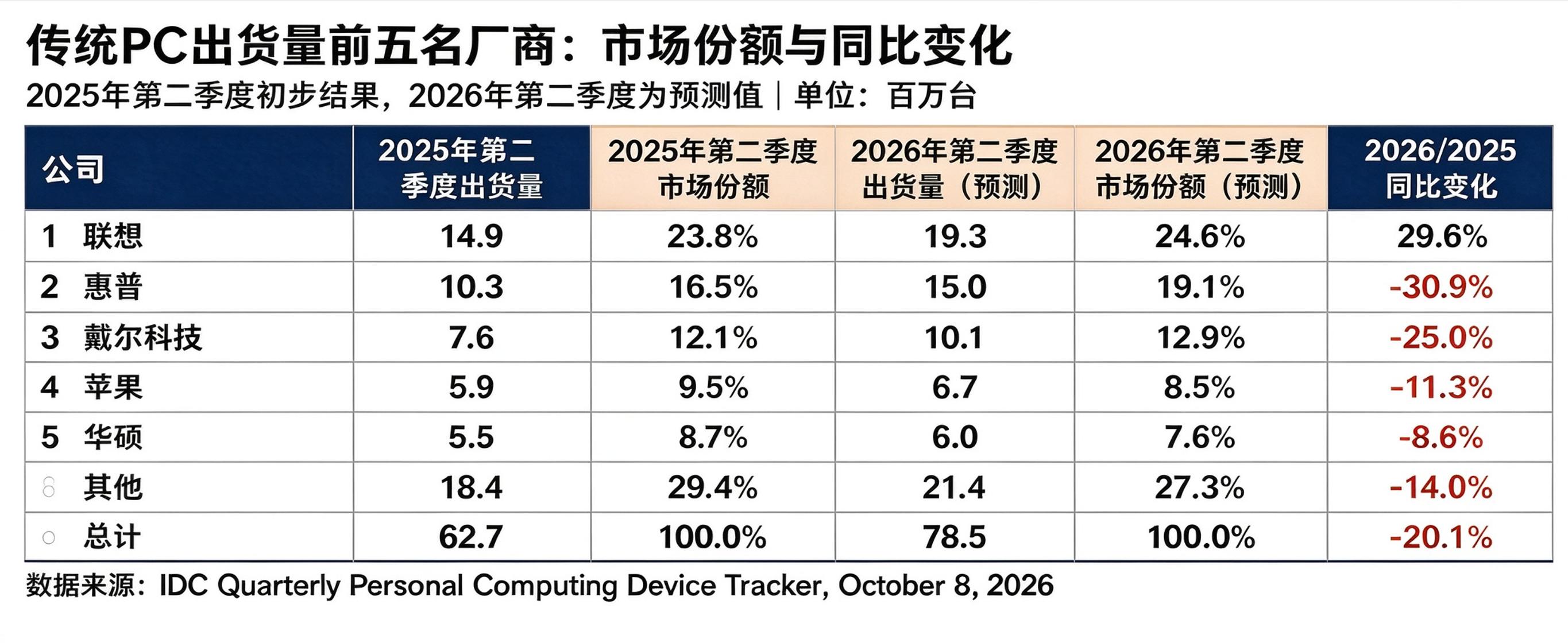
Jiemian News produced the chart based on IDC data
According to the sales rhythm of the PC industry, the third quarter is usually the peak season for annual shipments, and shipments are usually higher than that in the second quarter. This year, not only the original sales rhythm of the PC industry has been broken, but it has also recorded the largest year-on-year decline in the third quarter on record.
IDC attributes the core reason for the decline to industry-wide advance stockpiling: to cope with memory-driven price increases, manufacturers and channel partners concentrated on procurement and hoarded inventory at the beginning of this year, advancing the demand that should have appeared in the second half of the year. By the third quarter, the main task of channels was to digest the PCs that had been shipped in the previous quarter, and the seasonal growth did not appear. Limited supply, high prices and logistics disruptions further suppressed end-user demand.
An insider at a leading PC manufacturer told Jiemian News that many enterprises have released their PC replacement demands in advance in 2025 to cope with PC price increases. On the one hand, this pushed the shipment base of this year to a very high level, and on the other hand, it led to the exhaustion of subsequent market demand.
IDC data shows that in the second and third quarters of 2025, the year-on-year growth rate of global PC shipments both reached more than 9%, and the year-on-year growth rate of full-year shipments also reached 8.1%. The shipment growth brought by this advance stockpiling continued into the first quarter of this year, but starting from the second quarter of this year, the year-on-year growth of PC shipments turned negative, which was also the first negative growth in nearly nine quarters.
The change on the demand side is only a superficial phenomenon. What really affects global PC shipments is the continuous tight supply of memory chips and the rise in product prices.
AI data centers are redistributing global memory production capacity. Global memory chip giants such as Samsung, SK Hynix and Micron prioritize their advanced process production capacity for HBM and server DRAM, squeezing the production of memory chips for PCs and mobile phones. TrendForce data shows that DRAM contract prices in the second quarter rose sharply by 58% to 63% quarter-on-quarter, hitting the highest single-quarter increase in nearly 15 years. According to its forecast, in the fourth quarter of this year, conventional DRAM contract prices will rise by another 10% to 15% quarter-on-quarter, and the growth rate of enterprise-level SSD will be as high as 23% to 28%.
YANG Yuanqing, Chairman and CEO of Lenovo Group, previously predicted that the shortage of memory chip supply and price rise are not short-term phenomena, and the tight memory supply may last until 2027.
The shortage of memory chip supply and price rise not only squeeze the production capacity of PCs, but also drive up PC prices, which has a negative impact on consumer demand.
Gartner calculated in its report in February this year: a total 130% increase in DRAM and SSD prices will push the global average PC price up by 17%. Since the beginning of this year, PC manufacturers including Lenovo, HP, Dell, ASUS and Acer have adjusted prices many times, with some models increasing by 15% to 30%.
Jason CHEN, Chairman of Acer, publicly stated in September this year that the price increase of complete PC machines in the fourth quarter is expected to be between 5% and 20%, the price of parts may not peak until mid-2027, and the end selling price will not have a chance to stop rising and fall until the second half of 2027.
This means that global PC shipments in 2027 may continue to decline at a double-digit rate.
The above insider of the leading PC manufacturer told Jiemian News that PC manufacturers are currently facing an unprecedented complex situation. The rising cost of key components and changes in demand have brought many uncertainties to all manufacturers. At the same time, changes in product form and technical routes brought by AI will also bring new changes to the original competition pattern.
Previously, the PC industry has also experienced many crises, such as the impact of smartphones, the advance release of demand and inventory backlog caused by the epidemic. But this time, while facing the pressure on traditional businesses, PC manufacturers also need to invest a lot of resources to cope with the changes of next-generation products and ecological directions.
Facing the current complex situation, various PC manufacturers are carrying out different explorations based on their own situations.
On the one hand, PC manufacturers need to ensure the stability of the supply chain, which is the premise of stable shipments. According to Jiemian News, Lenovo's approach is to stock up in advance, especially the inventory of key components such as memory is about 50% higher than usual. At the same time, it has signed optimal contracts with core component suppliers to ensure supply in 2026. Manufacturers such as ASUS and Acer have introduced new suppliers such as ChangXin Memory Technologies to expand supply sources, and some small and medium-sized manufacturers respond to the shortage of memory chips and price increases through flexible procurement methods.
In contrast, Apple has adopted the method of adjusting product structure to cope with the situation. Among them, MacBook Neo launched by Apple in March has a starting price of $599, equipped with A18 Pro chip and 8GB memory, directly entering the notebook market below $700. It shipped 1.1 million units in the first quarter of its launch, becoming the best-selling product in the Mac product line in that period. The annual shipments of products in this price range account for nearly 40% of the total global notebook shipments, which was long monopolized by Windows products before.
On the other hand, various PC manufacturers are also vigorously deploying AI products and ecosystems under the condition of uncertain demand, but there are still large differences in routes.
Lenovo is one of the more active manufacturers in the layout of AI PCs. Its idea is to superimpose its own AI capabilities on the basis of platform standards, and launch personal agent capabilities such as Tianxi AI, Lenovo and Motorola Qira. An insider of Lenovo told Jiemian News that Lenovo wants to promote the PC business to develop towards higher value fields through AI PCs and high-end products, and promote personal AI to evolve from information Q&A and content generation to complex task execution.
Dell pays more attention to enterprise deployment and Microsoft ecosystem. Its AI PCs take advantage of Microsoft Copilot and enterprise IT system to undertake AI application demands, while its own resources are more focused on enterprise equipment, security, management and services. ASUS's idea is to launch AI PC products with multiple configurations, providing products with different configurations and prices for users with different demands such as games and professional creation.
Although different manufacturers have adopted different coping strategies, they are essentially trying their best to reduce the impact of memory chip shortage and rising costs on their business. These measures can help manufacturers maintain supply and profits, but it is difficult to fundamentally solve the problem of weak demand.
Compared with the pressure on the supply chain, what PC manufacturers need to think more about is where the next round of growth will come from. AI PC is undoubtedly an important direction, but there is still a gap to cross from hardware upgrading to user willingness to pay.
From the perspective of industry competition, this round of adjustment may also become the starting point of a new round of reshuffling in the PC market. Whether scale advantages can be transformed into operational resilience and whether AI layout can form real differentiation will affect the position of manufacturers in the new round of competition.
ZHANG Yi, CEO of iiMedia Research, told Jiemian News that there will be no subversive reshuffling in the PC industry in the short term, but structural differentiation will occur. Factors such as the product capability of AI PCs and cost control capability will widen the gap between PC manufacturers.
In ZHANG Yi's view, Apple's anti-decline advantage is relatively obvious, while traditional leading manufacturers will face certain pressure, and small and medium-sized manufacturers are most obviously squeezed.
For the future competition pattern, ZHANG Yi believes that the improvement rhythm of upstream components, the product capability and implementation intensity of AI PCs will be two very key variables.
This article is from Jiemian News, written by XIAO Fang, edited by WEN Shuqi, and published with authorization by 36Kr.