vivo steps into the "shadows"
Duan Yongping, the iconic figure of the BBK system, once made a very famous remark: People often pay attention to us because of the things we have done, but in fact, what makes us who we are is largely due to the things we choose not to do.
vivo is the one that has practiced this remark most resolutely.
Due to fierce market competition, most mobile phone manufacturers often waver back and forth in product definition and market strategies. Its sibling manufacturer once incubated a domestic top 5 chip enterprise, but finally chose to give it up; a rival brand recently launched its new flagship models all equipped with privacy-protective screens, which triggered a public outcry.
On the one hand, vivo adheres to the principle of "daring to lag behind others in the market", does not make decisions lightly, lets other companies test the waters first before entering the industry itself, as seen in its foldable phone business; on the other hand, once it has decided on a direction, it implements the plan more firmly, which is reflected in the imaging capabilities of its high-end series, as well as iQOO's persistent focus on gaming experience.
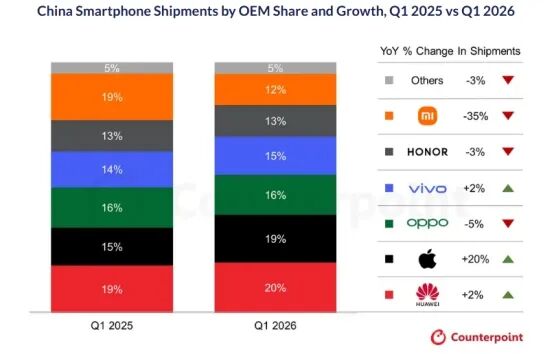
This makes vivo's market performance more stable compared with its peers. Relying on the high-end X series, mid-range S series, mass market Y series, and gaming-focused iQOO, vivo has ranked first in domestic market share for the past few years. Even in the first quarter of this year, when domestic Android peers all saw declining performance, vivo still recorded a 2% year-on-year growth in the Chinese market.
Now, the situation has started to change.
At the launch of its flagship models this year, vivo took the rare step of firing the first shot in marketing and promotion, but the effect was mediocre. According to data observed by Weibo blogger RD, the sales of vivo X500 series (X500/X500 Pro Max) on the first launch day ranked in the middle among the full flagship lineups of three major brands, accounting for 30% to 40% of the total; the 16GB configuration accounts for about 20% of the entire series.
In contrast, the sales volume of iPhone 18 Pro series was nearly 1300K 7 days after its launch, which was about 115% of that of iPhone 17 Pro series and 90% of that of iPhone 17 series in the same period.
Under this unprecedented storage cycle, the market for low and mid-range mobile phones is shrinking, and the "imaging first, cost performance as foundation" strategy that Android manufacturers have long been familiar with is gradually losing its effectiveness, leaving them with less and less room for maneuver. At the same time, the AI mobile phone industry is entering a period of drastic transformation, Doubao has launched its second-generation mobile phone, and OpenAI has already started developing its own mobile phone hardware.
This also means that for vivo at the moment, finding a new development path is as important as avoiding mistakes.
01 The Victory of Persistence
Although we often mention the four domestic brands Honor, Xiaomi, OPPO and Vivo together, in terms of brand power alone, the other three are indeed inferior to Xiaomi.
On the one hand, in terms of the inherent traffic of the brands, Xiaomi is on a par with Huawei, frequently trending on social media hot lists, which the other three brands cannot match; on the other hand, relying on greater influence and a larger user base, Xiaomi's flagship models also achieve better sales.
According to data shared by RD Observation, as of 2026 W37 (September 7 to September 13), the sales volume of Xiaomi 17 series, vivo X300 series and OPPO Find X9 series reached about 6.2231 million, 3.8067 million and 3.0485 million respectively. Xiaomi has opened a clear gap with the other two brands.
Surprisingly, in the ultra-high-end price segment of top-tier flagship models, Xiaomi failed to maintain its leading position — as of 2026 W37 (September 7 to September 13), Xiaomi 17 Ultra sold about 250,700 units, while the sales volume of vivo X300 Ultra in the same period was about 308,200 units.
With its traffic and brand power obviously lagging behind its peers, why did vivo's top-tier flagship models outperform others in the highest price segment?
A large part of the reason lies in its persistent investment in imaging. vivo did not enter the imaging field very early. Around 2016, technologies such as multi-lens setup, large image sensor and optical image stabilization gradually matured, and imaging had become a key competitive battlefield for high-end mobile phones. It was not until 2017 that vivo decided to systematically increase investment in imaging.
But vivo's advantage lies in its consistent and persistent investment. In 2021, Yu Meng, the then head of the imaging business, said in an interview with the media, "On the long track of imaging, our internal requirement is to aim for the first place. Without the goal of being the top player, we will hesitate in making investments and sticking to the path."
According to reports from Leiphone, when a vivo mobile phone starts its structural stacking process, the position of the camera module is usually prioritized and decided by the imaging department first, before other modules are arranged.
In 2020, vivo started its cooperation with Zeiss to deepen its understanding of optics, color science and imaging. At the same time, vivo set up a team for self-developed imaging chips. In 2021, vivo released its first generation ISP chip V1, which helped Android phones narrow the gap with iPhone in video shooting performance.
Moreover, as imaging functions involve more and more technical links, vivo has extended its collaboration to a wider range of fields, such as in-depth customization of products with Samsung and MediaTek. Its cooperation with Zeiss is no longer limited to the software level such as filters and lens packages, but has gone deep into the hardware level, launching T* coating and the upcoming zoom telephoto lens.
This has given vivo unique competitiveness.
After the full-screen design became popular, the product form of mobile phones has hit a bottleneck. Apple can rely on its advantage of integrated software and hardware to retain users, while Android manufacturers have to rely on parameter stacking to create cost performance. But beyond cost performance, vivo has the imaging card to play.
For example, in 2022, vivo became the brand with the largest market share above the 3500-yuan price segment in China, second only to Apple; for another example, the telephoto converter launched on its previous generation flagship was brought out by rival brands earlier, but vivo was the first to achieve mass production, which finally established vivo X300 Ultra's reputation as a "concert shooting artifact".
We randomly interviewed users around us who switched to vivo phones, and more than 80% of them chose vivo for its excellent camera performance.
Identifying your own goals and direction in the determined industry trend, and sticking to it without deviation, is the path to success for vivo.
02 Trade-offs on Costs
The huge demand for AI computing power has prompted storage manufacturers to shift their production capacity to HBM, and the production capacity of traditional DRAM and NAND has been squeezed by the siphon effect, leading to a sharp price surge: in the second quarter, the price of the 16GB+512GB storage configuration commonly used in mobile phones has increased by 212 US dollars compared with the beginning of last year, directly pushing the proportion of storage in the BOM cost of flagship phones to 42%.
The latest memory industry research report from Bank of America Securities analyst Simon Woo shows that the average contract price of DRAM in the third quarter rose 20% to 30% month-on-month, and NAND flash prices rose more than 15% month-on-month, with the price increase lasting far longer than the market expected at the beginning of the year.
Not only memory prices are rising, display panels are also gearing up for price hikes. On September 11, Corning, the global giant in glass substrates, announced that it would implement a price increase of more than 15% for its display glass substrate products denominated in Japanese yen worldwide starting from the fourth quarter. Subsequently, domestic panel giants including BOE and HKC followed suit, and issued official price adjustment notices to downstream customers in mid-September.
Therefore, raising prices is almost a common practice for all mobile phone manufacturers.
Among the new phones released in September, the starting price of OPPO's new Find X 10 series is 1100 to 2000 yuan higher than that of last year's model; the starting price of Xiaomi 18 Pro series has also been raised by 1000 yuan compared with the previous generation; vivo's new flagship X500 series has a price increase of at least 1100 yuan across the lineup; Apple 18 Pro series has a price increase of at least 1000 yuan for all configurations; the price increase of Huawei Mate90 series is also at the thousand-yuan level.
When prices rise sharply, the price itself will become the biggest selling point, which puts extremely high requirements on product managers' precise control of product configuration.
Some brands chose to use back screen and privacy protection as new selling points, but the actual results were unsatisfactory; vivo chose 2K screen and telephoto imaging for its top-tier flagship models, but the effect was also limited. Due to cost considerations, vivo even removed the 16GB RAM configuration from the standard and Pro versions of the X500 series. Consumer complaints were so widespread that just the next day, vivo quietly put the 16+512GB and 16+1TB regular versions of X500 Pro and Pro Max back on e-commerce platforms.
The brand that performed the best turned out to be Honor, which took a straightforward approach to pricing.
The price of Honor Magic9 16GB+512GB version after national subsidy is 5499 yuan, and the starting price of Magic9 series is set at 4499 yuan. The price increase of the entire lineup is strictly controlled between 500 yuan and 800 yuan, significantly lower than the flagship models of other brands.
After the National Day holiday, Honor's management could not wait to show off its achievements on social media: in week 40, Honor's weekly market share ranked top 3 among all brands, and No.1 in the Android camp. To put it simply, its performance is second only to Apple and Huawei.
Some distributors said that consumers with a budget of 6000 yuan are now wondering whether it is more cost-effective and longer-lasting to buy the iPhone 17 series.
This shows that in this unprecedented price hike cycle, as long as the iPhone 17 that is eligible for national subsidy is still on the market, the best opportunity for Android manufacturers to make sales is still in the 6000-yuan price segment covered by national subsidy. In the face of rising prices, the leading imaging performance alone cannot persuade consumers to place orders.
This means that vivo needs to come up with other breakthrough solutions.
03 The Next Stop for Mobile Phones
For all mobile phone manufacturers, high-end transformation is an eternal proposition: using unique technologies that others do not have to develop products that outperform peers, so that users are willing to pay a premium, which requires persistent investment in three generations of product R&D and the leadership of one hit product.
But in the dividend period of market growth, it is already difficult to make up one's mind on this, and in the current difficult period when the phone replacement cycle is extended and the industry continues to decline, making such a choice is even more challenging.
However, a new opportunity is coming.
Industry insiders define 2026 as "the first year of popularization of AI agent mobile phones". On the one hand, most institutions are optimistic about the shipment volume of AI mobile phones. IDC predicts that the shipment of new-generation AI mobile phones in China will reach 147 million units in 2026, a year-on-year increase of 31.6%, accounting for 53% of the total market, surpassing non-AI mobile phones for the first time.
More importantly, starting from this year, AI mobile phones are moving from "concept" to "mainstream".
In June this year, at the OpenAI Voice Hack Night event, a team demonstrated an "Agentic Operating System" built for mobile phones, which breaks the traditional APP ecosystem, does not need to call any traditional APP, and all interfaces are generated in real time.
In September this year, the second-generation Doubao phone was launched. In terms of appearance, the overall body is more lightweight, and an AI button is set on the side of the body. Users can click or double-click to directly activate different AI functions, making the whole operation process smoother, and the security and privacy issues can be unlocked through the fingerprint lock. ByteDance has started to let Doubao perform a large number of tasks, such as hailing a taxi, booking air tickets and hotels across apps; searching for music, books and other content according to user instructions, and even integrating with Feishu to summarize meeting recordings, generate PPTs and documents, so that the phone can help users with office work.
From the perspective of technology itself, the end-side model is also developing and growing, and mobile phones as AI hardware can do more and more things. Huawei has taken the lead in realizing the end-side deployment of MoE large model with total parameters of 30 billion and activation parameters of 2 billion on the Mate 90 series; Qualcomm has cooperated with Stepfun, InfinityFire and Longsys to complete the end-side deployment of 30-billion-parameter MoE model on the 6th generation Snapdragon 8 Elite platform. Qualcomm predicts that the next generation of agentic AI devices can process up to 1 million Tokens per day on the terminal side.
AI mobile phones will become a new key competitive battlefield for all manufacturers. But the achievements vivo has made so far are not enough.
vivo's investment in large models started very early, and it established the AI Global Research Institute in 2017; in 2023, it launched the Blue Brain large model matrix for the first time on the X100 series, making vivo one of the first batch of domestic mobile phone manufacturers to mass-produce and access self-developed large models, and also the first mobile phone brand to open the weights of end-side models. But later, the proportion of AI in vivo's external promotion narrative gradually declined. At the X500 new product launch, vivo focused its main narrative on imaging, and there was almost no systematic demonstration of Agent-related functions.
Even at this year's Developer Conference, vivo's performance was relatively restrained.
At the system level, vivo has two cards in hand: one is OriginOS 7, which enables AI to perform as many tasks as possible on the Android platform, relying on 6000 atomic capabilities mostly from vivo's own system applications to realize cross-application and cross-device task execution.
The other is BlueOS 4, which bets on vivo's future development space and is first applied to vivo WATCH 6 and other smartwatches and IoT devices.
But the problem is that none of these can give vivo the initiative at present. The capability of the end-side model depends on the parameter scale, and its operation depends on the cooperation of chip manufacturers, while vivo's own Blue Brain 30B MoE end-side large model is not expected to be deployed on terminals until the end of 2028. BlueOS needs a sufficient number of developers and industry customers to build an ecosystem, which is very difficult to achieve with the current scale of vivo's wearable and IoT products.
The memory price hike is, to some extent, just the first impact brought by AI. To get the ticket to the next era, vivo can no longer rely solely on "stability".
Reference sources:
1. 36Kr Finance: Memory Prices Not Falling, Screen Prices Rising, The "Phone Waiting Party" Lost in 2026
2. LatePost: Ten Years of vivo Imaging, Finding Its Own Methodology
3. Huxiu: vivo Bets on AI on Two Fronts, But Can Both Deliver Strong Results?